WHEN THE MARGIN FELL
Mass-Transport Loading, Overpressure, Delayed Maturation and Pulsed Charge from the Suriname Kitchen to Tambaredjo
Drs. M.P.T. Chin-A-Lien, MBA, M.Sc., Ing. Geologist
AAPG CPG #5201-1996 | EFG EurGeol #92-1996 | AIEN Energy Negotiator
Principal Founding Partner & Chief Architect, GLIAG
16 October 2026
Correspondence: info@gliag.com
Document ID: GLIAG-GGR-2026-1016-MTC-001
WORKING-HYPOTHESIS PAPER – EXPLORATION SCREENING, NOT A CALIBRATED BASIN MODEL
Author and publication responsibility
The geological interpretations, working hypotheses, screening calculations and exploration conclusions in this paper are the independent analysis of Drs. M.P.T. Chin-A-Lien, MBA, M.Sc., Ing. Geologist, AAPG Certified Petroleum Geologist #5201-1996, EFG European Geologist #92-1996, AIEN Energy Negotiator, Principal Founding Partner & Chief Architect of GLIAG.
Executive abstract
This paper proposes that giant Tertiary mass-transport emplacement along the Suriname slope did more than redistribute sediment.
It may have imposed a coupled pressure-and-charge perturbation on the deep ACT and Aptian source-rock system: an immediate mechanical loading pulse, followed by a delayed thermal-maturation pulse, while faults and carrier sands transmitted expelled fluids landward toward the Tambaredjo high.
The idea extends Tambaredjo-II – The Next Big Discovery in Oil?, Hydrocarbon Generation, Migration and Trapping in Suriname’s Tambaredjo, and The South-East Golden Lane, Read From Its Kitchen.
GLIAG Mass-Transport Loading and Charge Pulse (MTLCP):
a coupled but asynchronous perturbation in which rapid MTC emplacement generates an immediate poro-mechanical pressure pulse and a delayed thermal-kinetic generation pulse, potentially focused through transiently conductive faults and stratigraphic carriers.
1. Evidence and literature correction
The Staatsolie GeoAtlas supplies the public stratigraphic, thermal, fluid and migration framework.
The local mechanism is strengthened by Pattier et al. (2013), Nifuku et al. (2021), and Saul et al. (2026).
1A. GeoAtlas seismic evidence dossier
GeoAtlas figure attribution and interpretive use
The seismic figures originate from the Staatsolie GeoAtlas.
Copyright and underlying data rights remain with Staatsolie and/or the original data owners.
The supplied screenshots were cropped and resized for legibility but their geological content was not intentionally altered.
They are included for source-attributed technical commentary, research and petroleum-system comparison. Inclusion does not imply Staatsolie review, endorsement or agreement with the independent GLIAG interpretations.
Readers should consult the official current GeoAtlas for authoritative context, legends, resolution and terms of use.
The regional lines are treated as evidence, not decoration.
They demonstrate the northward burial gradient, the thick young deep-water load, basement-controlled compartmentalisation, landward onlap, lateral facies variability and the position of carbonate-prone basin-margin intervals.
They do not alone prove pressure, maturity or a unique migration path.
Regional Dip Line 1 – chronostratigraphy
Source: Staatsolie GeoAtlas p. 39.
The ACT and older source intervals descend strongly northward beneath a thick Pliocene-Pleistocene wedge.
This establishes the burial contrast required by a northern kitchen and late pressure loading.
Regional Dip Line 1 – facies

Source: Staatsolie GeoAtlas p. 40.
Basement relief, faults, slope architecture and non-uniform packages demonstrate that charge cannot be represented by one uninterrupted arrow.
Regional Dip Line 2 – facies and well control

Source: Staatsolie GeoAtlas p. 42.
TAM20, WT-1, POP-1 and RAS-1 constrain southward thinning, landward onlap, carbonate positions and the shelf-to-basin burial gradient.
Regional Strike Line 2 – chronostratigraphy and facies


Source: Staatsolie GeoAtlas pp. 47-48.
The CO-1 to SNY-1 transect tests lateral continuity and forces the model to explain both shows and dry controls, not merely the dip geometry.
Regional Strike Line 1 – Demerara Plateau carbonate context

Source: Staatsolie GeoAtlas p. 46.
Faulted carbonate-prone plateau intervals sit beside deeper basinal equivalents, permitting direct, fault-assisted or remigration charge scenarios while exposing segmentation and diagenetic risk.
Evidence convergence
| Evidence stream | What it substantiates | Residual uncertainty |
|---|---|---|
| Dip geometry | Deep northern kitchen and updip gradient toward the south | Carrier continuity |
| Thick Cenozoic/MTC load | Necessary condition for disequilibrium pressure | Event thickness and timing |
| Published pressure models | Rapid sedimentation as primary overpressure mechanism | Local pulse magnitude |
| Venting and faults | Hydraulic coupling is plausible | Whether a specific fault conducted |
| Thermal physics | Delayed maturation after rapid burial | Exact lag and kinetic response |
| Wells and fluids | Calibration and falsification of pathways | Raw-data QC and charge ages |
A one-kilometre slide remains a sensitivity case, not a measured thickness.
Approximately 450 ms TWT of reported basal erosion cannot be converted directly to metres.
Several thinner events could create a more important pressure-pulse train than one monolithic slide.
2. The two-clock mechanism
Fast clock – pressure
A 1 km body with bulk density 1,800-2,100 kg/m3 adds about 17.7-20.6 MPa total vertical stress.
Under rapid poorly drained loading, an illustrative B of 0.6-1.0 gives roughly 10.6-20.6 MPa added pore pressure.
These are screening values only.
Slow clock – maturation
Burial is immediate; heating is not.
For a 1 km length scale and sediment thermal diffusivity of 0.7-1.0 x 10⁻⁶ m2/s, the response is of order 104-105 years. Palumbo et al. (1999) supports transient thermal treatment. “Instant maturity” is therefore rejected; accelerated maturity after a lag is testable.
3. Basin feedback
Rapid deposition builds overpressure and weakens the slope; failure then emplaces an MTC whose toe load can further raise pressure, reactivate faults and reorganise migration.
This feedback predicts stronger pressure/venting beneath toe regions than evacuated headwalls, followed later by greater maturity beneath sustained load.
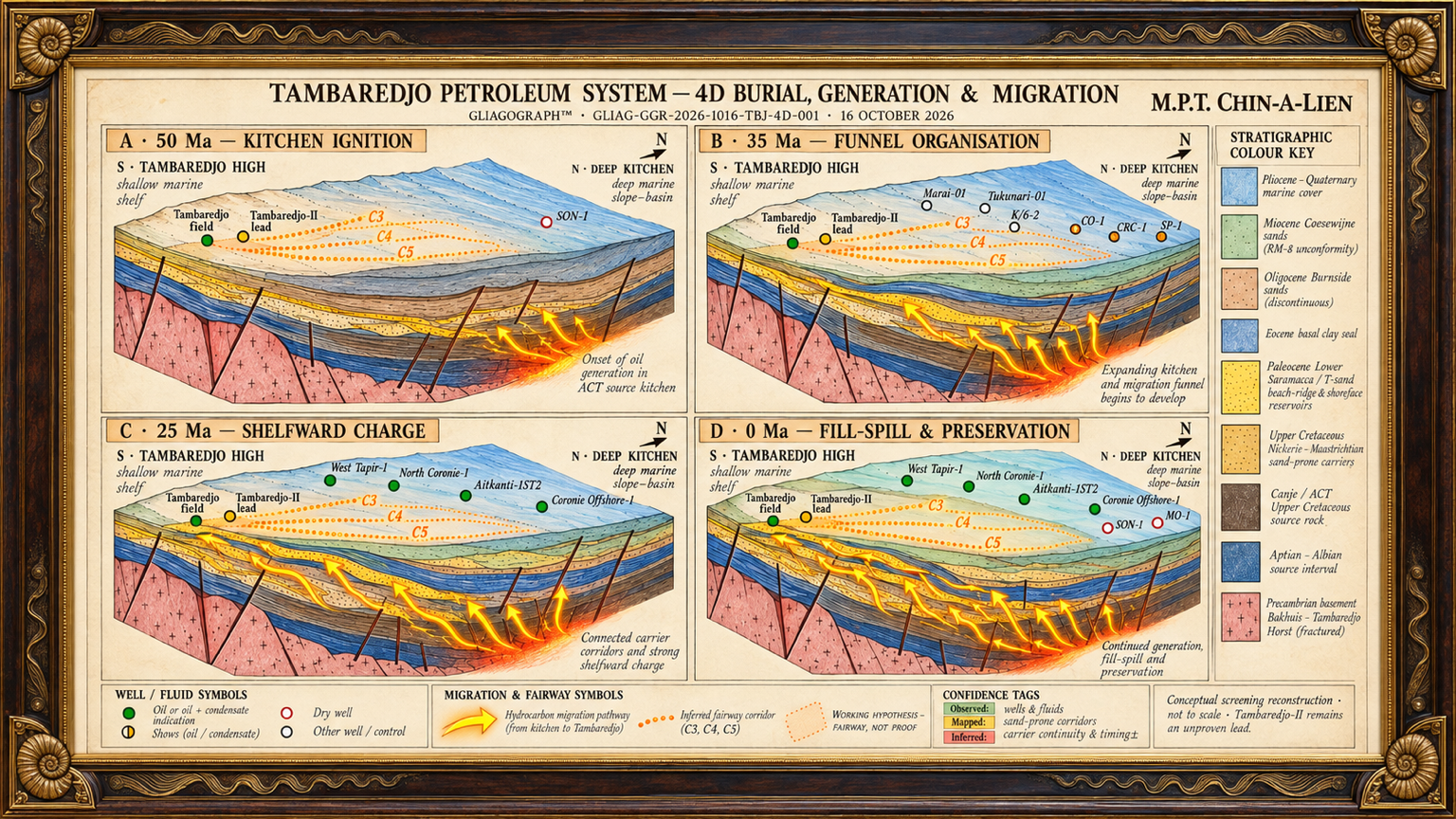
4. Tambaredjo funnel
The four-stage reconstruction links kitchen ignition, funnel organisation, shelfward charge and present fill-spill.
C3-C5 fairways remain inferred. Tambaredjo-II is strengthened only if carrier continuity, trap-before-charge, pressure history and fluid correlation all survive testing.
5. MBF
The Main Basin Fault is retained only as a possible fault-valve.
It is not located or drawn here. It must be mapped on seismic, kinematically validated and tested for time-dependent transmissibility.
The funnel can operate without it.
6. Carbonates
Jurassic-Early Cretaceous platforms, Aptian isolated buildups and Paleocene-Eocene shelf-edge platforms represent distinct plays.
Charge may arrive by faults and Upper Cretaceous/Paleocene carriers during late pulses.
Regional Ranger-1 precedent supports concept, not Suriname commerciality. High-permeability carbonate facies and depth must be demonstrated, not assumed.
See Lower Cretaceous Carbonates and Ranger-1.
7. Required model
Restore MTC top/base surfaces and event ages; couple pressure, transient heat and source kinetics; model pressure-dependent fault/seal states; route charge through C3-C5; calibrate to pressure, temperature, maturity, fluids, shows and dry wells.
Compare continuous-sedimentation, discrete-MTC, fault-valve, MBF-sensitivity and carbonate scenarios probabilistically.
8. Socratic falsification
- If MTCs cannot be mapped and dated, remove the discrete pulse.
- If toe pressure anomalies are absent, treat the MTC as passive overburden.
- If transient thermal modelling shows negligible maturity acceleration, keep only the mechanical effect.
- If faults do not become transmissive, prefer stratigraphic carrier migration.
- If fluid families do not connect kitchen, intermediate wells and Tambaredjo, reject a single continuous funnel.
- If the MBF cannot be mapped, exclude it.
9. Conclusion
The strongest defensible formulation is not that a slide instantly cooked the source rock.
It is that rapid MTC emplacement could have generated an immediate pressure and effective-stress perturbation, followed by a delayed thermal-generation response.
Faults and carriers may then have converted these asynchronous effects into repeated expulsion and migration pulses.
That formulation is new, exploration-relevant and falsifiable.
Annex A – GLIAG essay network
- Tambaredjo-II – The Next Big Discovery in Oil? – Lead framing, trap context and onshore analogue.
- Hydrocarbon Generation, Migration and Trapping in Suriname’s Tambaredjo – Generation-to-trap narrative and long-distance migration.
- The South-East Golden Lane, Read From Its Kitchen – Kitchen-first exploration logic.
- Petroleum Arithmetic: Unpacking Guyana-Suriname’s Oil Equation – Source, migration-loss and recoverability logic.
- Golden Lane Basin Fluid Evolution Insights – Oil families, fluid evolution and calibration.
- New Frontiers: Lower Cretaceous Carbonates and Ranger-1 – Carbonate play analogue and risk.
- The Golden Lane – Guyana-Suriname Basin – Regional play framework.
- Offshore Suriname: A 20-Year Journey in Oil Exploration – Exploration chronology and learning.
- The Evolution of Petroleum Systems in Suriname Offshore Exploration – Petroleum-system evolution.
- Exploring the Legendary Petroleum Province of El Dorado – Regional exploration narrative.
- Petroleum Systems of the Guyana-Suriname Basin – Source-reservoir-seal synthesis.
- Exploring the Complex Petroleum Dynamics of the Guyana-Suriname Basin – Charge complexity and basin architecture.
- Guyana-Suriname Basin: From Discovery to Production Success – Discovery-to-development context.
- Aptian-Albian Insights: Exploring Guyana-Suriname Basin Potential – Deeper source and reservoir potential.
- SHO West Proposal: Key Insights on Suriname’s Petroleum Potential – Deepwater charge, overpressure, faults and fill-spill.
- Understanding Dual-Phase Petroleum Systems in Guyana-Suriname – Oil-gas phase, PVT, charge and seal interaction.
- Golden Lane: Kitchen and Receiver of ACT Charge – Tests whether Golden Lane is both principal kitchen and charge receiver.
- From Exploration to National Value: Guyana-Suriname Super-Basin Insights – Connects subsurface evidence to GIP and sovereign decision-making.
- Understanding the Canje Formation: Key to Suriname and Guyana Oils – ACT/Canje source-rock characteristics and regional oil family.
- Evaluating Petroleum Generation and Migration in Suriname – Time-dependent charge architecture, generation and migration.
Annex B – Trusted external sources
- Staatsolie, Suriname GeoAtlas / geology portal. Primary public framework for stratigraphy, wells, fluids, maturity, migration, MTCs and plays.
- Yang, W. & Escalona, A. (2011). Tectonostratigraphic evolution of the Guyana Basin. AAPG Bulletin 95, 1339-1368. Regional tectonostratigraphy, burial and petroleum-system architecture.
- Goss, S.J., Mosher, D.C. & Wach, G.D. (2010). Cenozoic Seismic Sequence Stratigraphic Analysis of the Suriname Margin. Suriname Cenozoic sequences, lowstand systems and MTDs.
- Pattier, F. et al. (2013). Mass-transport deposits and fluid venting in a transform margin setting, eastern Demerara Plateau. Marine and Petroleum Geology 46, 287-303. Local MTD, structure and fluid-venting relationship.
- Nifuku, K. et al. (2021). Overpressure evolution controlled by spatial and temporal changes in sedimentation rate: offshore Suriname. Basin Research. Direct quantitative support for disequilibrium compaction and sedimentation-rate control.
- Saul, D. et al. (2026). Tectonostratigraphic Evolution of the Guyana Basin: Implications for Sediment Routing and Slope Stability. Basin Research. Modern basin-wide MTD and sediment-flux synthesis.
- Palumbo, F. et al. (1999). The thermal evolution of sedimentary basins and its effect on hydrocarbon maturation. Geophysical Journal International 139, 248-260. Transient heat and maturity response to sudden/continuous deposition.
- Delhaye-Prat, V. et al. (2024). Tectono-sedimentary evolution of the Suriname margin in the Cretaceous. Earth-Science Reviews 253, 104770. Modern Cretaceous sequence-stratigraphic framework.
- Saul, D. et al. (2026). Open PDF: Tectonostratigraphic Evolution of the Guyana Basin. Open full-text source for megasequences, sediment flux, MTD dominance and slope stability.
- Goss, S.J. (2010). Cenozoic Seismic Stratigraphic Analysis of the Suriname Margin, MSc thesis. Open Library and Archives Canada thesis with the complete seismic-stratigraphic analysis.
- Goss, S.J., Mosher, D.C. & Wach, G.D. (2009). Cenozoic Shelf to Slope Transition along a Passive Margin. Open AAPG Search and Discovery seismic-stratigraphic precursor.
- Pattier, F. et al. (2013). Open repository record and manuscript: Mass-transport deposits and fluid venting, eastern Demerara Plateau. Open institutional source linking MTDs, overpressure, faults and fluid venting.
- Mosher, D.C. & Goss, S. Shallow geohazard assessment, Repsol YPF Block 30, Demerara Rise. Open Government of Canada record resolving the remembered Repsol connection.
- Rouby, D. et al. (2023). Sediment routing systems to the Atlantic rifted margin of the Guiana craton. Open IRD publication on source-to-sink routing and margin sediment supply.
- Alves, T.M. et al. (2022). Mass transport processes, injectites and styles of sediment remobilization. Open Cardiff preprint on MTC reservoir, seal and fluid-pathway roles.
- GeoExpro (2023). The Suriname-Guyana Basin cover story. Open industry synthesis covering MTCs, present-day generation and Ranger-1 carbonates.
- AAPG Explorer. Suriname Basin Gets a Good Look. Open professional overview noting long-distance migration toward Tambaredjo.
- Panahi, H. et al. (2014). 4D synchrotron X-ray tomography of hydrocarbon migration pathways in heated organic-rich shale. Open research on generation-linked microfracturing and primary migration.
- Pang, B. et al. (2023). Dynamic mechanisms of hydrocarbon expulsion from deep source rocks. Open Petroleum Science paper on expulsion-driving mechanisms.
- IODP publication catalogue: Stratigraphy of the Demerara Rise, Suriname. Open authoritative catalogue entry for Demerara Rise source-rock and margin stratigraphy.
- Karlsen, D.A. et al. (2006). Petroleum migration, faults and overpressure, Part I. Peer-reviewed framework for calibrating migration with petroleum in traps; DOI landing page.
- Sibson, R.H. (1990). Conditions for fault-valve behaviour. Foundational fault-valve paper and mechanism used only as an analogue in this essay.
Disclaimer and intellectual property
Technical disclaimer.
This independent working-hypothesis paper is provided in good faith for professional discussion and exploration screening. It is not a reserves report, competent-person report, investment recommendation, drilling prognosis or calibrated commercial basin model. No representation or warranty is made as to completeness, accuracy, currency or fitness for a particular purpose. Interpretations may change materially when proprietary seismic, wells, laboratory data, velocity models or calibrated basin models become available. Decisions require independent due diligence and qualified professional advice. The MBF position is intentionally excluded pending direct seismic validation.
GeoAtlas and third-party material.
Reproduced GeoAtlas figures remain the property of Staatsolie and/or their respective data owners. Cropping, scaling and placement do not transfer ownership or imply endorsement. No GLIAG interpretation should be represented as an official Staatsolie conclusion. Any further republication should comply with the applicable rights holder’s permission requirements and terms of use.
Copyright and AI-use restriction.
Copyright 2026 M.P.T. Chin-A-Lien / GLIAG. All rights reserved. GLIAGOGRAPH(TM), MTLCP, the evidence architecture, original synthesis, tables and interpretive text may not be copied, republished, commercially exploited, incorporated into a competing database, used to train or fine-tune artificial-intelligence systems, or used for automated model evaluation without prior written permission, except where permitted by applicable law with full attribution. Contact: info@gliag.com.