GLIAG | PETROLEUM INTELLIGENCE SERIES | GUYANA-SURINAME BASIN
The Hidden Architecture
of the Guyana-Suriname Basin
Why Petroleum Systems Matter More Than Licence Blocks
Drs. M.P.T. Chin-A-Lien, MBA, M.Sc., Ing. Geologist – 30 June 2026
Principal Founding Partner & Chief Architect — Golden Lane Investments Advisory Group (GLIAG)
Certified Professional Geologist Nr. 5201-1996 (AAPG)
Chartered European Geologist Nr. 92-1996 (EFG)
Energy Negotiator June 2021 (AIEN)
petroleumenergyinsights.com
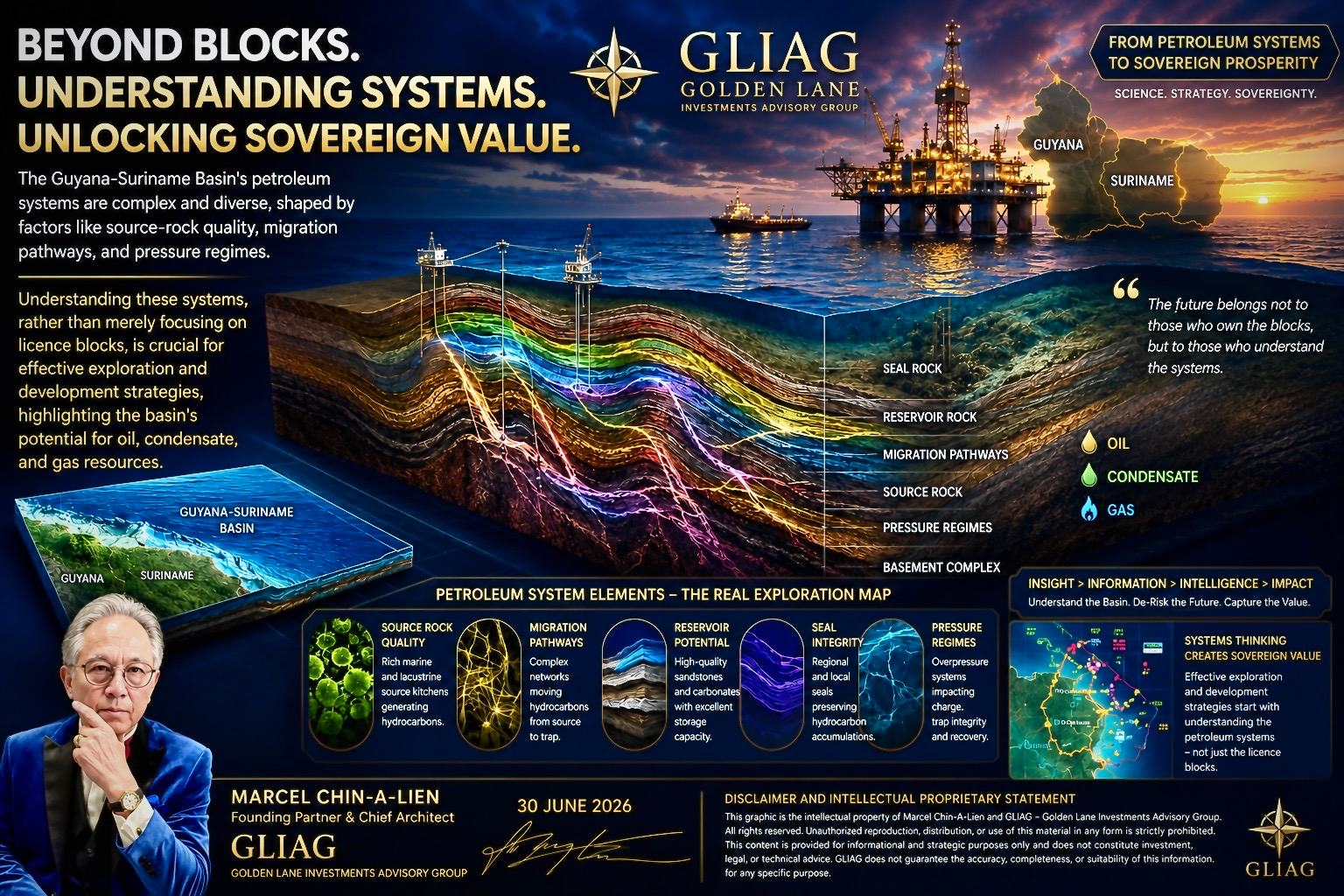
[Insert GLIAG Approved Hero Image Here]
Executive Overview
The most important geological question in the basin is no longer only where the next discovery will occur, but why discoveries occur where they do. A petroleum-systems framework answers that question by integrating source-rock quality, burial history, heat-flow evolution, migration pathways, fault and top-seal behavior, carrier beds, pressure compartments, fluid phase and timing into a single basin interpretation.
This perspective matters because licence blocks are commercial and legal boundaries, whereas petroleum systems are physical and geological realities. Discoveries, development concepts and fiscal terms may change over time, but basin architecture evolves slowly and therefore provides a more durable interpretive framework for exploration, appraisal and national strategy.
Licence blocks are how governments divide acreage. Petroleum systems are how nature stores hydrocarbons. The gap between the two is where exploration risk lives.
Geological Foundation
The Guyana-Suriname Basin is best understood not as a single, uniform petroleum province but as a mosaic of overlapping petroleum systems expressed through different source kitchens, migration domains, pressure regimes, seal behaviors, reservoir fairways and fluid provinces. The dominant subsurface engine is widely interpreted to be the Albian-Cenomanian-Turonian (ACT) marine source system, yet the observed diversity of oils, condensates and gas shows that one source system can produce multiple petroleum-system outcomes across space and time.
Publicly available studies and syntheses consistently identify the ACT interval as the main hydrocarbon source engine of the Guyana-Suriname Basin. On the Demerara Rise, Cenomanian-Turonian black shales have documented total organic carbon values commonly around 4 to 15 wt% with local maxima above 25 wt%, and the preserved organic matter is dominantly marine Type II kerogen deposited under suboxic to euxinic conditions.
This does not mean the basin should be treated as geologically homogeneous. Rather, a single world-class source system is expressed differently because burial, maturity, migration plumbing and trapping conditions vary laterally and vertically across the basin.
Reconciling One ACT Source with Many Fluids
The ACT model reconciles fluid diversity by recognizing that the same marine source system can generate different fluid outcomes depending on thermal maturity, pressure regime, leakage history and trap conditions. In shallower or cooler sectors, ACT source rocks may remain in the oil window and charge oil-dominant turbidite systems, whereas in deeper and hotter sectors the same source package evolves toward volatile oil, condensate and gas-prone charge.
Recent basin-scale interpretation increasingly frames the Guyana-Suriname Basin as evolving from an oil-centric province into a dual oil and gas-condensate super-basin. This interpretation is supported by the contrast between the central oil-dominant core of Stabroek, the retrograde gas-condensate signal at Haimara and Longtail in southeastern Stabroek, and the mixed-fluid to gas-commercialization signals emerging in offshore Suriname Block 52.
Fluid diversity is not evidence against the ACT source model. It is evidence that the basin contains several overlapping petroleum systems derived from one dominant source engine and modified by distinct geological pathways.
Source Kitchens and Maturity Domains
The basin contains multiple effective kitchens rather than one simple continuous kitchen. Differences in burial depth, structural position, heat-flow evolution and sediment loading create separate maturity domains that may be oil-prone, condensate-prone or gas-prone at different times.
Under this framework, the ACT source system is basin-wide, but the effective petroleum system is local to each maturity domain and depends on when that domain enters peak oil or gas generation relative to trap formation and seal preservation.
Migration Fairways and Charge Focusing
Migration is not random in the Guyana-Suriname Basin. Deepwater fan systems, carrier beds, structural lineaments and fault corridors act together to focus hydrocarbon movement along preferred fairways that repeatedly concentrate charge into certain reservoir trends and bypass others.
This helps explain why some corridors become highly prolific while adjacent areas remain underfilled or untested. The most useful interpretive framework is not a block map or a discovery map, but a conceptual petroleum-system architecture map that shows kitchens, fairways, charge domains and fluid provinces as an integrated system.
Pressure Regimes, Seals and Fluid Preservation
Pressure regime is central to understanding why similar source input can still yield different trap-scale fluids. Overpressured domains with strong seal integrity can preserve volatile oils and condensates, while more normally pressured or leakage-prone settings may lose gas and light ends or retain heavier oil signatures.
The emerging gas-condensate interpretation in the eastern and southeastern basin is closely linked to deep overpressure systems, pressure retention and high gas-processing intensity. Public discussion around Haimara references retrograde gas, condensate separation, gas cycling and reinjection — hallmarks of a gas-condensate development system rather than a simple oil FPSO case.
Reservoir Distribution and Facies Control
Reservoir presence and reservoir quality remain fundamental controls on petroleum-system success. Facies architecture in the basin — especially the distribution of deepwater fan, channel and slope systems — determines where ACT-derived hydrocarbons can accumulate in sufficient volumes and connectivity to become commercial.
The basin’s petroleum systems are not only source-driven but also reservoir-filtered. High-quality charge without adequate carrier and reservoir architecture produces a very different exploration outcome from the same source system charging laterally continuous deepwater turbidites.
Timing and Multi-Pulse Charge
Timing is one of the strongest reasons to abandon the simplistic idea of a single static petroleum province. Repeated hydrocarbon charging, remigration, phase evolution and pressure changes through geologic time can produce different fluid outcomes in different parts of the same basin, or even overprint earlier charge in the same structural trend.
A multi-pulse model helps explain why some sectors remain oil-dominant, others become mixed-fluid systems, and still others display gas-condensate behavior. It also supports the interpretation that later gas pulses may have overprinted earlier oil accumulations in deeper and hotter sectors of the basin.
Oil Province, Condensate Province, Gas Province
From a petroleum-systems perspective, the basin can be interpreted qualitatively as containing at least four interacting domains. This zonation is conceptual rather than cartographic in a strict GIS sense. Its value lies in showing how basin architecture produces fluid diversity and discovery clustering without pretending to define exact coordinates in the public domain.
| Domain | Geological Meaning | Typical Expression |
| Oil Province | ACT oil-window charge intersects effective migration fairways, robust seals and high-quality turbidite reservoirs. | Oil-dominant deepwater discoveries and FPSO-friendly development concepts. |
| Condensate Province | Deeper, hotter and commonly higher-pressure sectors where ACT has evolved toward volatile oil and condensate charge. | Condensate-rich or retrograde gas-condensate discoveries with higher gas-processing intensity. |
| Gas Province | Gas-window ACT charge focused into preserved traps and pressure compartments. | Gas-dominant systems, late gas charge and potential future LNG or Gas-to-Shore anchors. |
| Mixed-Fluid Transition Corridor | Zones where migration fairways cross maturity belts or later gas pulses overprint earlier oil charge. | Oil, condensate and gas coexist regionally or within stacked systems. |
These domains are conceptual zones, not precise GIS polygons. They illustrate how basin architecture gives rise to different petroleum-system expressions without claiming detailed cartographic accuracy.
Why Petroleum Systems Matter for Strategy
Exploration and Portfolio Logic
A petroleum-system architecture framework changes exploration logic from searching for the next isolated trap to understanding the basin’s deeper charge and migration organization. Geoscientists and decision-makers should ask not only whether a prospect has structure and reservoir, but whether it lies in the correct charge domain, maturity belt, migration corridor and pressure regime.
For explorers and portfolio managers, this lens alters risk and opportunity assessment fundamentally:
• Prospects are evaluated not only for trap and reservoir, but for their position within charge, migration and pressure domains.
• Underexplored corridors in the condensate and gas provinces are recognized as distinct strategic frontiers, rather than residual gas risks in an oil-only narrative.
• Play-opening wells are explicitly framed as tests of petroleum-system architecture, reducing conceptual uncertainty for subsequent campaigns.
This supports a more systematic, basin-wide exploration strategy aligned with source and migration physics rather than with administrative boundaries.
Development Concepts and National Value
For governments and national companies, the same architecture perspective clarifies where oil-centric development — FPSO chains — is the natural first phase; where condensate-rich systems require gas-intensive facilities, cycling and more complex value chains; and where gas-dominant provinces justify long-term FLNG, pipeline export and Gas-to-Shore infrastructure, and how these can be sequenced to maximize national value.
Oil provinces, condensate provinces and gas provinces imply different facility concepts, plateau behavior, monetization routes, infrastructure sequencing and sovereign value creation pathways. GLIAG’s broader work on Gas-to-Shore and fiscal architecture demonstrates that fluid provinces and petroleum-system maturity directly influence the optimal monetisation pathways and revenue profiles for Guyana and Suriname.
GLIAG Doctrine
The basin’s most durable geological doctrine can be stated simply: petroleum systems, not licence blocks, are the true architecture of an offshore basin. The Guyana-Suriname Basin should no longer be interpreted as a single petroleum province, but as several overlapping petroleum systems expressed through distinct kitchens, migration fairways, pressure compartments and fluid provinces.
| # | Doctrine |
| 1 | A world-class ACT marine source system powers the basin. The Canje-ACT interval is the dominant hydrocarbon engine, capable of generating hundreds of billions of barrels of oil equivalent. |
| 2 | One source system, multiple petroleum systems. Lateral and vertical variations in maturity, migration plumbing, pressure, seal and reservoir produce distinct oil, condensate, gas and mixed-fluid domains. |
| 3 | Petroleum systems — not licence blocks — are the true architecture. Blocks, PSCs and FPSOs are surface expressions of deeper petroleum-system realities. Long-term strategy should be calibrated to system architecture, not only to current licences. |
| 4 | Discoveries are data points, not doctrine. Each discovery refines the map of the underlying petroleum-system architecture, but the architecture itself will outlive any one field or development. |
| 5 | The Guyana-Suriname Basin is a still-maturing super-basin. Oil, condensate and gas provinces are emerging sequentially and overlapping; gas-condensate and gas systems likely hold major remaining potential. |
GLIAG DOCTRINE
Petroleum systems, not licence blocks, are the true architecture of an offshore basin.
The Guyana-Suriname Basin should be interpreted as several overlapping petroleum systems —
distinct kitchens, migration fairways, pressure compartments and fluid provinces — not as a single petroleum province.
ANNEX
Selected PetroleumEnergyInsights Articles Underpinning This Paper
The following GLIAG articles published on petroleumenergyinsights.com form the analytical backbone of this working paper. Each is referenced in the text and available via the links below.
| Article | Short Content | Link |
| Petroleum Without a Public Fingerprint | State-of-knowledge review of the ACT source system, public geochemical evidence and limits of public-domain oil-source correlation in the basin. | https://petroleumenergyinsights.com/petroleum-without-a-public-fingerprint-petroleumenergyinsights/ |
| A World-Class ACT Marine Source Rock System | Basin-scale interpretation of ACT source richness, maturity and exploration implications for the Guyana-Suriname Basin. | https://petroleumenergyinsights.com/a-world-class-act-marine-source-rock-system-petroleum-systems-and-exploration-implications/ |
| Estimating Petroleum Generation in the Guyana-Suriname Basin | Analysis of how much petroleum the ACT source rocks may have generated relative to discovered and prospective volumes. | https://petroleumenergyinsights.com/estimating-petroleum-generation-in-the-guyana-suriname-basin/ |
| Why Facies Matter in the Guyana-Suriname Basin’s Petroleum Systems | Discussion of how depositional architecture controls reservoir quality, connectivity and play distribution. | https://petroleumenergyinsights.com/why-facies-matter-in-the-guyana-suriname-basins-petroleum-systems/ |
| Longtail Gas & Fluids | Fluid and phase-behavior interpretation using Longtail and related discoveries as evidence of basin fluid diversity. | https://petroleumenergyinsights.com/longtail-gas-fluids-insights-from-the-guyana-suriname-basin/ |
| The Emerging Gas-Condensate System of the Guyana-Suriname Basin | Strategic and geological interpretation of the basin’s transition toward gas-condensate significance in the east and southeast. | https://petroleumenergyinsights.com/the-emerging-gas-condensate-system-of-the-guyana-suriname-basin/ |
| Evaluating Offshore Hybrid Potential in the GSB: Frack or Not? | Exploration of unconventional or hybrid development concepts within the broader ACT petroleum-system setting. | https://petroleumenergyinsights.com/evaluating-offshore-hybrid-potential-in-the-gsb-frack-or-not/ |
| Impact of Basement Structures on Suriname’s Hydrocarbon Potential | Interpretation of how basement structure influences accommodation, migration and petroleum-system organization offshore Suriname. | https://petroleumenergyinsights.com/impact-of-basement-structures-on-surinames-hydrocarbon-potential/ |
| GranMorgu: Pioneering Integrated Value Generation in Suriname | Connects reservoir behavior and fluid systems to development and national value generation in Suriname’s first major deepwater project. | https://petroleumenergyinsights.com/granmorgu-pioneering-integrated-value-generation-in-suriname/ |
| Guyana Gas-to-Shore (GtS) — Domestic-First Monetisation | Examines how associated and gas-prone systems connect subsurface fluid reality to national monetization strategy. | https://petroleumenergyinsights.com/guyana-gas-to-shore-gts-domestic-first-monetisation-in-an-oil-dominant-system/ |
Closing Observation
The most useful public-domain petroleum geology contribution at this stage is no longer another discovery note or another block review. It is an integrated, conceptual petroleum-system architecture paper that explains why the basin contains clustered oil success in some domains, condensate-rich systems in others, and an emerging gas province in the deeper and more mature east and southeast.
The basin’s architecture will outlive any one field, any one licence and any one development concept. Understanding that architecture is the most durable investment a government, company or investor can make in the Guyana-Suriname Basin.
Disclaimer
This publication reflects the independent professional opinion of the author and GLIAG. It is intended to stimulate strategic discussion and does not constitute legal, fiscal or investment advice. All geological interpretations are based on publicly available information and do not imply access to proprietary subsurface data.
© 2026 Golden Lane Investments Advisory Group (GLIAG). All Rights Reserved.
Drs. M.P.T. Chin-A-Lien, MBA, M.Sc., Ing. Geologist
Principal Founding Partner & Chief Architect — Golden Lane Investments Advisory Group (GLIAG)
Independent Strategic Opinion | petroleumenergyinsights.com
The Hidden Architecture of the Guyana-Suriname Basin | GLIAG | 2026Page