GLIAG | STRATEGIC PETROLEUM INTELLIGENCE
GLIAG
GOLDEN LANE INVESTMENTS ADVISORY GROUP B.V.
info@gliag.com
marcelchinalien@gliagcom
Zoetermeer · Paramaribo · petroleumenergyinsights.com
At 19:20 Netherlands time on 22 September 2026, Staatsolie announced that it had received a proposal for an area in
Preface — One Hour, the Whole Energy Chain
Open Door Sector 1, SHO West. About one hour later, GLIAG had a first investor edition of this essay in hand. It was not a news note but a petroleum-systems and investment assessment reaching from source rock to state revenue.
This reviewed edition followed the same evening.
That pace did not come from haste.
It came from preparation.
That preparation is the Golden Lane Intelligence Platform™ (GIP).
For the Guyana–Suriname Basin, GIP holds in one auditable record what the industry usually keeps in separate places: wells with their fluids and results, licences and open acreage, 2D and 3D seismic coverage, discovery volumes, offshore infrastructure, depletion and fiscal models, and 286 linked GLIAG essays.
When the announcement landed, nothing had to be searched for from scratch.
The question was already sitting on a map, surrounded by its evidence.
Speed alone is not the achievement; speed is common, and usually cheap.
What sets GIP apart is that speed arrives together with integration and provenance — across the whole energy chain, not one link of it.
ONE ANNOUNCEMENT, THE WHOLE CHAIN — WHAT GIP CONNECTED WITHIN THE HOUR
Link in the chain Decision question
What GIP brought to this essay
Source and charge Can charge reach the inner shelf? ACT–Canje source model, Maka-1 three-pulse charge hypotheses, oil-family geochemistry
Reservoir and trap Which plays can work in Sector 1? GeoAtlas stratigraphy and twelve play concepts, ranked into a SHO West play screen
Wells and fluids What has the drill bit actually proved? Evidence register from Korikori-1 and Caiman-1 to Tambaredjo, Orinduik and instructive dry holes
Production behaviour Can the oil flow at a profit? Saramacca Crude properties and the ADEKUS thesis corpus on sand, water and steam
Development and gas How would it be developed and sold? Shallow-water concepts, cluster logic and the Sloanea gas route Market and refining
What is the barrel worth? Assay implications for pricing, desalting and refinery yield
Contract and State: What does the proposal legally mean? Open Door rules, the 90-day window, PSC and JSA/TEA routes, sovereign value
Capital and monitoring When should money move — and what would change the view?
Eight-stage work programme, six investment gates, thesis-change triggers, GBW surveillance
GLIAG–GSB–2026–SHOW–001 | Public Investor Technical Essay | 22 September 2026 | 2GLIAG | STRATEGIC PETROLEUM INTELLIGENCE
Most intelligence products cover one of these links in depth, or all of them thinly.
GLIAG’s standard — the standard against which GIP should be judged at its commercial launch at AAPG Paramaribo on 18–19 November 2026 — is to hold all of them at once, at decision speed, while keeping every statement traceable as operator fact, official evidence, GLIAG interpretation, assumption or open gap. That separation runs through every page that follows. Where evidence is missing — the Korikori-1 result, the proposal polygon, the identity of the bidder — the essay says so, rather than filling the silence.
The machine accelerated retrieval, comparison and drafting. Judgment did not move to the machine.
Nearly five decades of work in this basin and its neighbours — from the Ceuta Giant discovery in Lake Maracaibo to the international promotion
of Suriname’s offshore — decide what matters, what is noise, and where the burden of proof still lies.
GIP does never presents bold and hollow headlines.
GlP, GLIAG and its two (2) daily Basin Watch Newsletters, one on Guyana Suriname Super Basin and one on whole South America?
Stand for both trusted data, socratic, deep interpretation of these with, resulting in uncontested, added value commercial, strategic and political insights.
GIP makes that judgment faster, auditable and repeatable.
It does not replace it.
The reader is invited to test that claim against the pages that follow.
Chief Architect and sole Designer of GIP.
Drs. M.P.T. Chin-A-Lien
Principal Founding Partner, GLIAG · 22 September 2026
SHO West After the First Proposal
Charge Access, Preservation and Conversion on Suriname’s Western Shelf — A Petroleum Systems and Investment Decision Essay on Open Door Sector 1
The proposal changes competitive timing. It does not change the burden of geological proof.
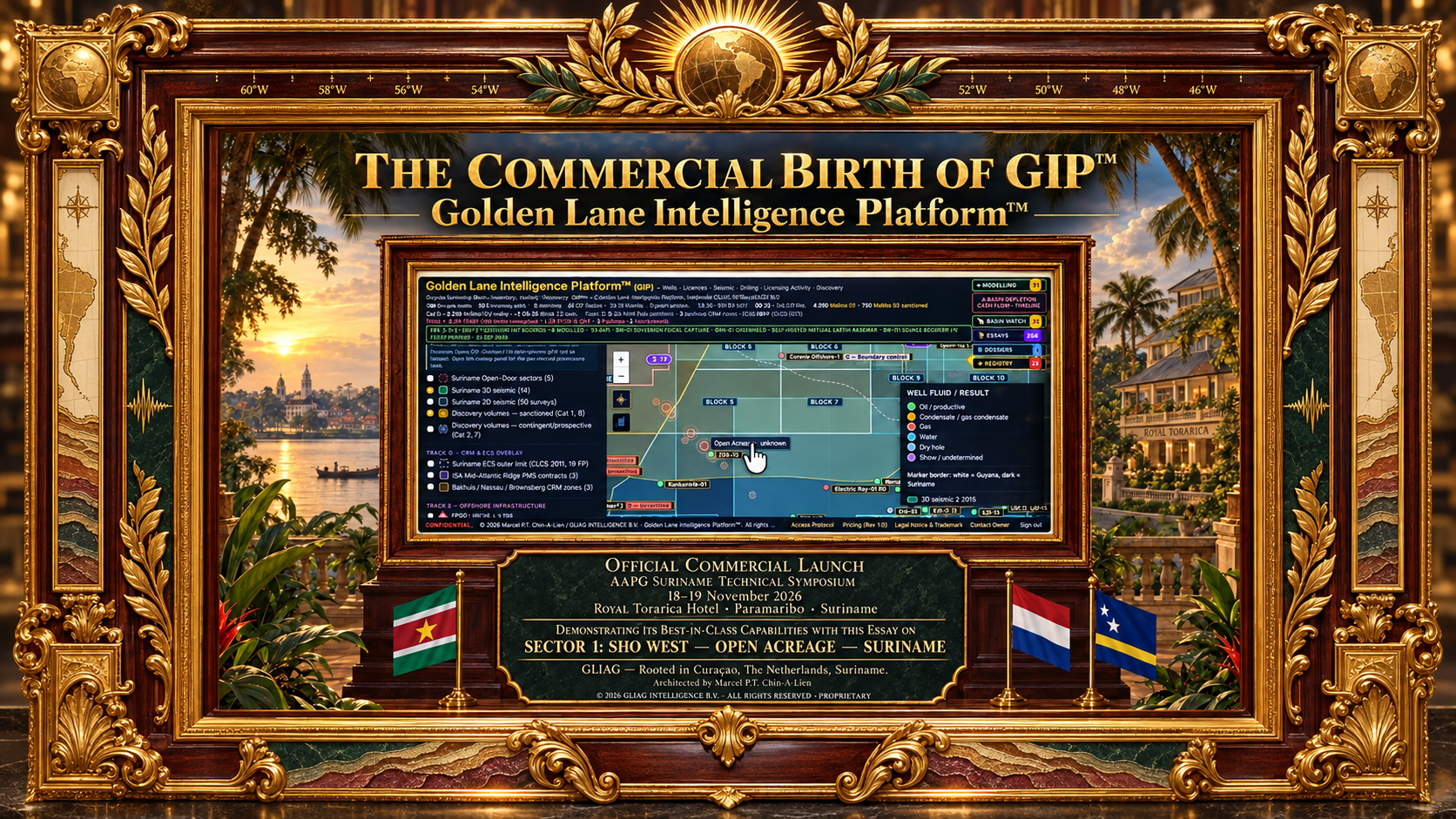
Figure 1 Golden Lane Intelligence Platform™ (GIP) — the live basin view behind this essay: 159 wells, 72 blocks, 64 seismic surveys, licensing activity and well fluid/result classes on one auditable map. This analysis moved from Staatsolie’s announcement to a first investor edition in about one hour. GIP launches commercially at AAPG Paramaribo, 18–19 November 2026; GBW Guyana–Suriname Basin and GBW South America carry its intelligence to subscribers. GLIAG, 22 September 2026.
Figure 2 Staatsolie Open Door map, status September 2026: Sector 1 SHO West (red outline, proposal received) lies inboard of contracted Blocks 5 and 7, between the Guyana border and Sector 5 SHO Central. User-supplied screen capture of the official Staatsolie map.
| Document record | |
| Author | Drs. M.P.T. Chin-A-Lien, MBA, M.Sc., Ing. Geologist — AAPG Certified Professional Geologist Nr. 5201-1996 · EFG Chartered European Geologist Nr. 92-1996 · AIEN Energy Negotiator (June 2021) |
| Publisher | Golden Lane Investments Advisory Group B.V. (GLIAG) · Zoetermeer / Delft, Netherlands and Paramaribo, Suriname |
| Document ID | GLIAG–GSB–2026–SHOW–001 · Edition 2.1 (reviewed investor edition) |
| Evidence cut-off | 22 September 2026, 21:00 CEST |
| Classification | Public investor technical essay · independent public-domain assessment · no data-room or operator-confidential material used |
| Integration | GLIAG Intelligence Platform (GIP) · GBW Guyana–Suriname Basin · GBW South America |
Executive Investment Judgment
| GLIAG BOTTOM LINE. SHO West is investable as a staged, shallow-water option on a proven regional petroleum system — not yet as a de-risked extension of the Golden Lane.The proposal starts a 90-day clock that closes on 21 December 2026 at 10:00 GMT-3. It creates no contract, commitment, discovery, resource or reserve.Everything that matters now reduces to three tests — Access (can charge reach the trap?), Preservation (does it survive shallow residence?) and Conversion (can the fluid be produced at a profit?). Capital should be released one test at a time. |
Staatsolie’s receipt of a proposal for an area within Sector 1 SHO West on 22 September 2026 is a meaningful competitive signal. A qualified party has moved beyond generic basin interest and has selected acreage and a work concept worth submitting to the Open Door process. With it, four of the five Open Door sectors have now attracted proposals within roughly three months; only Sector 5 SHO Central has not.
The value proposition of SHO West is structurally different from GranMorgu. Deepwater success proves a prolific, basin-scale generative system with short vertical migration into Upper Cretaceous fans. SHO West asks a harder, narrower question: can charge travel onto the inner shelf, remain in shelf and nearshore traps, and reside there as a movable fluid in reservoirs of sufficient quality, column and scale to be developed simply? The upside is lower drilling and facilities intensity, short cycle time, proximity to shore and the possibility of cluster development. The penalties are long-distance migration, leakage, biodegradation and water washing, subtle traps, small compartments — and the ever-present risk that good sands are wet.
The correct investor stance is therefore neither promotional extrapolation nor reflexive dismissal. It is staged exposure: data-room access, seismic reprocessing and depth conversion, legacy-well re-evaluation, charge and alteration modelling, a multi-play prospect inventory, amplitude and rock-physics calibration, environmental and social screening — and only then a drill-or-drop decision. The proposal starts a clock; it does not end the technical debate.
The Event in Context
The Open Door programme was launched on 24 November 2025 and runs for two years. It covers five sectors totalling more than 70,000 km² in water depths of approximately 5 to 3,000 metres. Companies select their own acreage and may seek a Production Sharing Contract or — where uncertainty is too high for an immediate licence commitment — a Joint Study or Technical Evaluation Agreement. Each proposal is published, and qualified companies then have 90 days to compete for the same area. Proposals are evaluated only after the window closes; an area is “under contract” only once a PSC is signed.
OPEN DOOR PROPOSAL SEQUENCE, 2026 (OFFICIAL ANNOUNCEMENTS)
| Date | Sector | Water-depth domain | Competition window |
| 17 June | Sector 4 DW West | Deepwater | Closed 15 September 2026 |
| 6 July | Sector 3 Demerara (two proposals) | Deepwater / plateau | Open per Staatsolie notice |
| 7 July | Sector 2 SHO East | Shallow offshore | Closes 5 October 2026 |
| 22 September | Sector 1 SHO West | Shallow offshore / nearshore | Closes 21 December 2026 |
| — | Sector 5 SHO Central | Shallow offshore | No proposal announced at cut-off |
The pattern matters more than any single event. Industry appetite now spans deepwater, plateau and both shallow flanks of the Suriname shelf. That is evidence of basin-wide attention across different play domains; it is not evidence of uniform geological quality across the sectors.
| Observed event | What it supports | What it does not support |
| Proposal received | Real company interest; selected acreage; an initial work and commercial concept | Discovery, reserve, permit, rig award, PSC or guaranteed investment |
| 90-day competition | Potential price and work-programme tension; accelerated diligence | Proof that further bidders will emerge |
| Four of five sectors with proposals | Basin-wide attention across distinct play domains | Uniform geological quality across sectors |
| Legacy well and seismic data | Faster screening and low-cost re-evaluation | Modern, decision-grade 3D imaging everywhere |
| GranMorgu and Block 52 success | Regional source effectiveness and multiple fluid phases | Direct charge, reservoir or commerciality in SHO West |
What Has Changed on the Shelf
A year ago, the shallow-water case in Suriname rested largely on onshore production, legacy shows and extrapolation. Three developments since then change the quality of the debate, though not its burden of proof.
1. Caiman-1: oil in Cretaceous sands under shelf-edge water depths
PETRONAS’ Caiman-1 in Block 52 encountered multiple oil-bearing Cretaceous sandstone intervals, drilled in about 90 metres of water to a total depth of 5,065 metres (reported July 2026, following the operator’s 30 June update). This is the most consequential shallow-water datum in Suriname to date: it demonstrates that Upper Cretaceous oil charge reaches reservoirs beneath the shelf margin, not only beneath the deepwater fairway. It does not transfer to SHO West automatically. Caiman-1 lies far to the east and outboard; SHO West sits on the inner shelf, where the migration path is longer and the residence temperature lower.
2. Block 52 is moving towards commercial projects
PETRONAS now reports eight successful wells in Suriname. The Sloanea gas discovery was declared commercially viable in November 2025, with a final investment decision targeted by end-2026 around a floating LNG concept. For SHO West, the significance is indirect but real: a first gas monetisation route in Suriname would change the commercial meaning of a shelf gas or condensate outcome from “stranded” to “potentially aggregable”.
3. Korikori-1: the missing western control
Chevron’s Korikori-1 in Block 5 — about 78 km offshore, north of Nickerie, in roughly 40 metres of water, drilled with the Noble Regina Allen jack-up from October 2025 on a programme of about 90 days — is the closest modern well to SHO West. Staatsolie described it as a play-opener outside the Golden Lane. No reliable public result had been located by the evidence cut-off. Silence is not a negative result; it is a gating item. Whoever holds the Korikori-1 logs, pressures and fluid data holds the single most valuable calibration point for Sector 1.
Where SHO West Sits in the Basin
Sector 1 is the westernmost nearshore strip of the Suriname offshore, running from the Guyana border eastward to Sector 5, directly inboard of contracted Blocks 5 and 7. Block 5 is published as lying 45 to 82 km offshore in 30 to 60 metres of water; SHO West therefore occupies, broadly, the inner shelf between the coastline and that block (GLIAG inference from the official map and Block 5 parameters; the exact proposal polygon has not been published). It is not a Golden Lane block. It lies in the shelf-to-coastal migration domain, where petroleum generated in deeper, mature kitchens must reach reservoirs through carrier beds, faults, unconformities and fill-spill chains — and then survive leakage and near-surface alteration.
That position gives SHO West a distinctive portfolio role: it tests the western continuation of Suriname’s shallow-water play systems while integrating lessons from the Guyana shelf, the onshore Tambaredjo complex directly to the south, and the Block 5 campaign directly to the north. The basin is continuous; play effectiveness is segmented. Sediment routing, reservoir thickness, trap style, heat flow, maturity, phase and preservation change over short distances. Political adjacency is not geological equivalence.
The Three Tests: Access, Preservation, Conversion
GLIAG frames the SHO West investment case as three sequential tests. Each has its own evidence, its own failure mode and its own cheapest route to an answer. A proposal that cannot show how it will pass all three in order is a volume story, not an investment case.
| Test | Core question | Decisive evidence | Typical failure |
| Access | Does effective charge reach the specific trap, in time? | Kitchen mapping, 3D migration modelling, carrier continuity, fault connectivity, shows and oil-family geochemistry | Trap outside the drainage cell, or formed after the main charge pulse |
| Preservation | Does the accumulation survive seal, leakage and alteration? | Top- and fault-seal analysis, residence temperature, biomarker alteration, gas-oil ratio, pressure history | Breached seal; biodegraded or water-washed heavy oil or bitumen |
| Conversion | Can the fluid be produced and sold at a profit? | PVT, viscosity–temperature curves, core strength, sand production, water drive, export or gas market | Viscous, compartmentalised or sand-prone accumulation below economic threshold |
Petroleum Systems Architecture
Source and charge — the Access test
The basin’s best-established source family is the marine Upper Albian to Cenomanian–Turonian (locally Coniacian) organic-rich succession — the Canje-equivalent, OAE-2-linked interval within the broader ACT system — that charged the Upper Cretaceous deepwater discoveries and, through long migration, contributed to nearshore and onshore accumulations. An older Aptian–Lower Albian family may be effective in restricted depocentres; Jurassic or Barremian contributions remain locally plausible but less securely demonstrated. SHO West should therefore be modelled with multiple kitchens and multiple charge episodes, not with a single regional maturity contour.
The decisive issue is not source presence somewhere in the basin. It is prospect-specific charge access. Fault connectivity, carrier continuity, expulsion timing and top-seal history must be reconstructed in three dimensions. A trap may sit above a prolific basin and still be empty because it lies outside the effective drainage cell or formed after the principal charge pulse.
Reservoir, trap and seal
Candidate reservoirs include Paleogene–Neogene shelf sands, Upper Cretaceous shelf-edge and slope clastics, and deeper Albian–Aptian siliciclastics or carbonates. Younger targets are shallower and cheaper but more exposed to biodegradation, unconsolidated-sand behaviour and small closure. Upper Cretaceous clastics carry strong regional analogues but may thin, bypass or reorganise across the inner shelf. Lower Cretaceous carbonates are porous only where dissolution, dolomitisation or fracturing overcome cementation: carbonate presence is not reservoir proof.
Trap styles include faulted closures, drape, stratigraphic pinch-outs, channel and shoreface bodies, unconformity truncations and combinations. Regional marine shales provide potential seals, but the faults that enable charge may also breach the trap. In low-relief shelf settings, depth conversion and velocity uncertainty deserve equal status with amplitude interpretation: a closure that disappears inside the velocity envelope is not a prospect.
Fluid phase and alteration — the Preservation test
The investor case must carry oil, gas, condensate, heavy oil, residual bitumen and wet reservoirs as live outcomes. Onshore heavy oil proves charge and retention in one setting, but warns that shallow residence, microbial alteration and water washing can destroy value even where hydrocarbons are present. Conversely, gas or condensate need not be failure if aggregation and a monetisation route exist — which is why the Sloanea FID matters. Fluid prediction must be tied to burial, maturity, migration distance, leakage history and reservoir temperature, never to map proximity.
Tambaredjo: the Onshore Charge-and-Fluid Calibration
Tambaredjo, Calcutta and Tambaredjo North West are not direct reservoir analogues for every SHO West prospect, but they are indispensable calibrations of the system that feeds the western coast. Staatsolie’s GeoAtlas reports approximately 1 billion barrels STOIIP across the onshore complex, produced mainly from Paleocene, Eocene and Miocene fluvial point-bar and mouth-bar reservoirs. The fields prove that offshore-generated petroleum can migrate landward along a long, low-gradient carrier system and be retained in shallow stratigraphic and combination traps. Their heavy oil records the price of that journey: residence below about 80 °C, water washing and biodegradation have removed lighter components and raised viscosity. SHO West sits on that same journey — between the kitchen and Tambaredjo. That is both its charge argument and its preservation risk.
PUBLISHED FLUID AND OPERATING DATA — SARAMACCA CRUDE / ONSHORE COMPLEX
| Parameter | Published value | Investor meaning and limitation |
| API gravity | 15.8° API | Heavy crude: price differential, heating and artificial-lift assumptions must be explicit |
| Kinematic viscosity | 480 cSt at 50 °C | Relevant to lifting, gathering and export; not interchangeable with in-situ dynamic viscosity |
| Sulphur | 0.65 wt.% | Moderate burden; refinery value depends on full assay and yield slate |
| Asphaltenes | 1 wt.% | Deposition and emulsion relevance; a bulk value is not a flow-assurance model |
| Sodium / vanadium | 23 ppm / 10 ppm | Desalting and refining inputs; confirm sampling basis before valuation |
| Onshore production 2024 | 6.4 MMbbl (≈17,500 bbl/d) | Demonstrates durable production, not SHO West deliverability |
| Remaining reserves, 31 Dec 2024 | 104.5 MMbbl | Official field-complex figure; not a resource proxy for SHO West |
| Lifting cost 2024 | Below US$10/bbl | Mature onshore efficiency; excludes offshore exploration and full-cycle cost |
| Conceptual subsurface range | T-sands ≈275–400 m; ≈14–17° API; low GOR; high permeability | GLIAG public-domain synthesis for analogue screening only; verify against current well files |
Fluid typing strengthens rather than simplifies the charge model. The GeoAtlas distinguishes two principal oil families: Family 1 is strongly marine (sub-family 1.2, Pr/Ph ≈ 1.5, anoxic); Family 2 carries more terrigenous input (sub-family 2.2, Pr/Ph ≈ 2.4, sub-oxic, more C23+ wax). Offshore oils are generally saturate-rich; nearshore and onshore samples carry more polar, asphaltene and NSO components, consistent with biodegradation and water washing. These families imply multiple organofacies and possible mixing. They do not justify assigning a single Canje fingerprint to every western prospect without prospect-specific biomarkers and isotopes.
Generation, Migration and Alteration: GLIAG Integrated Model
GLIAG’s working model links a world-class stacked ACT–Canje source system to two contrasting migration regimes. In the deepwater Golden Lane, mature source rocks sit close beneath Campanian–Santonian fan reservoirs; overpressure, faults and fill-and-spill allow short vertical migration and repeated charging. On the shelf and onshore, petroleum must travel farther laterally, across structural steps and under a more hydrostatic regime. Tambaredjo proves basin-scale connectivity; its altered heavy oil proves that charge efficiency, residence time and preservation determine value after generation.
GLIAG’s Maka-1 model proposes three conceptual charge pulses — 55–45 Ma (primary oil), 35–25 Ma (recharge and remigration) and 15–5 Ma (late gas-condensate overprint). These are transparent modelling hypotheses anchored to public constraints, not operator-calibrated results. For SHO West they should be run as scenarios: an early long-distance oil pulse is likely to be more altered; a later pulse may refresh a trap; the deepest kitchen connection may raise GOR and condensate risk.
| Process | Deepwater Golden Lane expression | SHO West / onshore implication |
| Generation | Stacked ACT, OAE-2/Canje-equivalent and Upper Cretaceous intervals mature beneath or near reservoirs | Kitchen location and maturity must be mapped west of proven fairways; regional presence is insufficient |
| Primary migration | Short vertical escape from overpressured source intervals | Expulsion efficiency must be coupled to access into shelf carrier beds |
| Secondary migration | Fault-assisted vertical movement; fill-and-spill between fans | Long lateral migration, unconformities, faults and carrier continuity dominate risk |
| Alteration | Deeper, warmer accumulations retain lighter oil or condensate | Shallow, cool residence raises biodegradation and water-washing risk |
| Phase outcome | Oil to gas-condensate variability with kitchen depth and late cracking | Heavy oil, normal oil, gas, condensate, bitumen and water all remain live |
| Commercial test | Column, net pay, pressure, movable fluid, connectivity | Add viscosity, sand production, water cut, emulsion, lift and heating to every case |
SHO West Play Screen
The GeoAtlas supports a broad reservoir inventory and twelve basin play concepts. GLIAG has converted that inventory into a ranked screen for Sector 1. The ranking is GLIAG interpretation; regional atlas presence establishes geological possibility, not reservoir, charge, seal or closure inside the polygon.
| GLIAG tier | Interval and play | Why it ranks here | Principal test |
| Primary | Campanian–Santonian shelf-edge, slope and channel sands (turbidite, onlap, pinch-out) | The regional play that works; Caiman-1 shows oil under shelf-margin water depths; the published rationale for Block 5 | Does the sediment route reach the inner shelf, and is it in the drainage path? |
| Primary | Paleocene–Miocene fluvial, mouth-bar, strandplain and deltaic sands | Direct Tambaredjo analogue immediately onshore; cheapest targets | Preservation: viscosity, biodegradation, compartment size, sand control |
| Secondary | Upper Albian–Turonian shelf clastics | North Coronie-1 reported hydrocarbon-bearing Turonian sands; source–reservoir juxtaposition | Reservoir quality, pressure and phase prediction |
| Secondary | Aptian–Lower Albian clastics; fault-controlled and roll-over closures | Proven sands and shows elsewhere (Galibi-1); older kitchen access | Maturity, correlation, charge timing, fault seal |
| Upside only | Lower Cretaceous–Jurassic carbonate platform, reef and ramp | Presence plausible; reservoir repeatedly inadequate (Demerara A2-1) | Effective pore system; never a base case |
| Upside only | Nickerie syn-rift graben fill; truncation traps; fractured basement | Distinct concept on the western margin; high information value | Graben geometry, truncation seal, fracture connectivity |
Well and Fluid Evidence Register
No public evidence reviewed identifies a legacy well inside the Sector 1 outline that proves a commercial offshore accumulation. The case must therefore be built from adjacent, regional and onshore calibration — not from an invented discovery analogue. “Relevant” does not mean “direct analogue.”
| Well or field | Public outcome or fluids | Decision relevance to SHO West |
| Korikori-1, Block 5 | Jack-up well in ≈40 m water, 78 km offshore; spud window October 2025; no reliable public result at cut-off | Closest modern control; the critical gating item |
| Caiman-1, Block 52 | Multiple oil-bearing Cretaceous sandstones; ≈90 m water; TD 5,065 m | Best shelf-margin oil proof in Suriname; distant and outboard |
| North Coronie-1 (NCO-1) | Reached Aptian; oil and gas shows; hydrocarbon-bearing Turonian sands reported | Petroleum access and Upper Cretaceous reservoir on the shelf; not commercial |
| Tambaredjo / Calcutta | Producing onshore heavy oil | Proves long-distance migration and retention; warns on viscosity |
| Nickerie traces and auger holes | Historic oil traces and reported flowed hydrocarbons in the western coastal area | Supports western petroleum access; unquantified |
| Block 52 success set | Eight successful wells incl. Sloanea, Roystonea, Caiman, Swartzia Aspasia; PETRONAS reports >1 Bboe recoverable in aggregate | Multiple working systems and phases; first gas route via Sloanea |
| Block 58 set | Maka Central, Sapakara, Kwaskwasi, Keskesi, Krabdagu (oil–condensate–gas); Dikkop-1 dry with aquifers | Proves the basin and local failure inside a prolific trend |
| Galibi-1 / Maroni-1, eastern shelf | Good Aptian–Albian sands, shows, Aptian bitumen; non-commercial | “Dry” can carry high petroleum-system information value |
| Caracara-1 / Aracari-1, former Block 37 | Good reservoir at Caracara-1; no effective petroleum system at the wells | Modern 3D and good sand do not guarantee charge |
| Demerara A2-1 / Araku Deep-1 / GVN-1 | Shows and poor carbonate reservoir; wet gas–condensate in Upper Albian; dry | Plateau and eastern controls on phase, carbonates and charge |
| Orinduik (Jethro-1, Joe-1), Guyana | Heavy oil discoveries | Hydrocarbons present, economics weak: the Conversion warning |
The ADEKUS Tambaredjo Knowledge Register
The Anton de Kom University of Suriname thesis catalogue is a strategic and under-used local evidence base. The records below are the Tambaredjo-focused works GLIAG could retrieve by the cut-off; catalogue indexing is not guaranteed complete. Each should enter GIP with its catalogue record, full-text status, methods, wells used, data vintage and a reproducibility grade.
| Author / year | Thesis subject | Decision contribution |
| S. Toelsie, 1996 | Behaviour of producing wells, Tambaredjo field | Early well-performance record; decline and data-lineage reconstruction |
| R. Bihariesingh, 2005 | Break-even analysis, drilling area 9C12 | Links productivity to economic limit; rebase costs and prices before reuse |
| S. Sie Tjam Soi, 2016 | Reassessment of steam injection for Tambaredjo heavy oil | Thermal-EOR screening: viscosity reduction, heat loss, emissions |
| R. Girjasing, 2018 | Precambrian basement of the Bakhuis Horst below Tambaredjo | Fault inheritance and structural control on migration and segmentation |
| N. Imansoeradi (per catalogue) | Causes of sand production, Tambaredjo North-West | Sand-failure mechanisms; uptime and workover economics |
| G.W. Wijngaarde (per catalogue) | Gravel-packing practice, Tambaredjo North-West | Sand control; converting unconsolidated rock into sustainable rate |
| Per catalogue | FIELD factor analysis, Tambaredjo and Calcutta wells | Operational factor ranking; re-run on quality-controlled data |
| S. Bergwijn (per catalogue) | Polymer-gel water shut-off in high-water-cut wells | Water-control candidate selection and incremental-oil logic |
| D. Gopal, 2026 | Gel treatment feasibility, northern Tambaredjo | Current water-shutoff screening; late-life value |
Investor conclusion from the corpus: Tambaredjo value is governed not only by oil in place but by well behaviour — sand production, gravel-pack quality, water influx, thermal response, viscosity, lift and economic limit. SHO West diligence should acquire laboratory PVT, dead-oil viscosity–temperature curves, live-oil density and GOR, formation-water chemistry, pressure gradients, formation-tester mobility, core strength, particle-size distribution, relative permeability and emulsion behaviour before adopting any development analogue.
What the Proposal Reprices
The proposal reprices information and timing before it reprices barrels. A bidder has presumably identified a tract where its reading of charge, reservoir, trap and commercial route justifies expenditure. Competitors now face a shorter decision window and the possibility that the best-defined acreage will be captured. Staatsolie gains negotiating leverage through potential competition. Service providers gain an option on reprocessing, environmental work, site surveys and drilling. None of these effects requires a discovery to be economically real.
For investors the most important optionality is shallow-water capital efficiency: jack-up drilling, short flowlines, simpler export or nearshore processing, and a potentially lower breakeven than a stand-alone deepwater development. But development simplicity multiplies geological success; it cannot substitute for it. Shallow water does not rescue poor rock or a small, viscous, compartmentalised accumulation.
| Value driver | Upside case | Failure mode or discount |
| Water depth and access | Lower-cost drilling and intervention; shorter schedule | Shallow hazards, unconsolidated formations, environmental sensitivity |
| Proximity to shore | Short infrastructure routes; domestic supply or modular options | Coastal permitting, fisheries, communities, wetlands, export limits |
| Regional charge proof | Multiple proven systems in the basin; Caiman-1 on the shelf margin | Long migration path or isolated drainage cell |
| Legacy wells and seismic | Low-cost reinterpretation and calibration | Sparse vintage data; uncertain coordinates; incomplete logs or samples |
| Cluster potential | Several modest fields sharing facilities | Fragmented ownership; insufficient aggregate volume; mismatched fluids |
| Oil and gas optionality | Oil, gas-to-power, industry or regional aggregation | No bankable gas market; contaminants; weak deliverability |
A Bankable Work Programme
The strongest proposal is not the one with the largest speculative volume. It is the one that retires the highest-value uncertainties in the right order and protects capital if the play fails. GLIAG recommends eight stages.
1 Data integrity and coordinate audit. Reconcile navigation, well headers, checkshots, formation tops, sample inventories, seismic datums and coordinate reference systems; recover original mud logs, wireline, cores, cuttings, pressures and geochemistry.
2 Seismic reprocessing and depth uncertainty. Amplitude-preserving reprocessing with multiple attenuation, anisotropy and shallow-velocity modelling; map closure survival across velocity cases before ranking amplitude.
3 Petroleum-system reconstruction (Access). Calibrated 1D and 3D burial, maturity, expulsion and migration models with separate Aptian–Lower Albian and Upper Albian–Coniacian source cases.
4 Alteration and phase modelling (Preservation). Residence-temperature mapping, biodegradation risk, GOR and phase scenarios tied to the three-pulse charge hypotheses.
5 Multi-play portfolio. Rank independent play families by reservoir, seal, trap, charge, phase and data confidence. Avoid a single-prospect programme.
6 Rock physics and DHI discipline. Tie anomalies to conditioned gathers, fluid substitution, tuning and wet-sand analogues. A DHI is a causal hypothesis, never a hydrocarbon measurement.
7 Commercial screening (Conversion). Oil, heavy-oil, gas-condensate and dry-hole cases including viscosity, sand control, water handling, export route, gas market, carbon intensity and abandonment.
8 Learning-well design with stop rules. Test the principal objective while acquiring pressures, samples, image logs, sidewall cores, biostratigraphy and source kinetics; pre-agree thresholds to deepen, sidetrack, test, appraise or exit, so that a dry well is still a basin-calibration experiment.
Investment Gate Matrix
| Gate | Evidence required | Investor action |
| A · Competitive entry | Defined polygon, data entitlement, fiscal route, work programme, liability map | Enter only if data access and optionality justify bid exposure |
| B · Prospect maturation | Depth-robust closure, reservoir probability, kitchen and migration connection, seal and phase cases | Fund reprocessing and studies; book no prospect value |
| C · Drill commitment | Approved environmental pathway, executable well design, rig and logistics, pre-drill risk register | Approve exploration capital with explicit dry-hole tolerance |
| D · Discovery | Logs, pressures, samples, contacts, net pay and movable fluid | Recognise a technical discovery; do not call it a reserve |
| E · Appraisal | Connectivity, deliverability, fluid properties, volume range, development concept | Move from geological to contingent commercial valuation |
| F · Sanction | Certified resources or reserves, contracts, financing, market, facilities, abandonment security | Value as development only after decision-quality integration |
What Would Change the GLIAG View
A thesis that cannot say what would change it is not a thesis. GLIAG will monitor the following signals through GBW Guyana–Suriname Basin and record every revision in GIP.
| Signal | Would upgrade SHO West if… | Would downgrade SHO West if… |
| Korikori-1 result | Movable, light-to-medium oil in Upper Cretaceous or Paleogene sands | Wet reservoirs with no shows, or only residual or biodegraded oil |
| Competition by 21 December | Further qualified proposals for the same area | No competition and a minimal work programme |
| Proposal polygon and bidder | Operator with shelf, heavy-oil or cluster expertise and a committed well | Study-only agreement with no seismic or drilling commitment |
| Caiman-1 appraisal | Evidence the shelf-margin oil system extends westward | Results confined to a local, outboard structure |
| Sloanea FID | A sanctioned gas route that makes shelf gas aggregable | Delay that keeps Suriname gas stranded |
| Legacy-data release | Recoverable logs, samples and pressures from western wells | Data gaps that make pre-drill calibration impossible |
GLIAG Conclusions
1. The Sector 1 proposal is material because it converts a western shallow-water sector from passive inventory into an active competitive process. It is not a geological result.
2. SHO West is best understood as an Access, Preservation and Conversion test on the inner shelf — not as a westward or shoreward continuation of GranMorgu.
3. The regional petroleum system is proven; the prospect system is not. Caiman-1 strengthens the shelf-margin case, but long-distance migration must still be demonstrated for the selected trap.
4. Public well evidence spans shows, bitumen, heavy oil, wet gas, condensate, dry holes, good reservoirs without charge and world-class oil discoveries. That diversity is the central technical message: the basin works, but it does not work the same way everywhere.
5. Shallow-water economics can make modest volumes valuable through clusters and shared infrastructure. The same setting can yield small, biodegraded or poorly sealed accumulations. Fluids and deliverability matter as much as gross rock volume.
6. The proposal should trigger disciplined competition for knowledge, not competitive overstatement. The bidder that best integrates legacy evidence, modern imaging, petroleum-system modelling, environmental execution and commercial stop rules will create the most value.
7. An independent, auditable decision record — facts separated from interpretation, provenance preserved, uncertainty explicit, scenarios linked to economics — is how a frontier option becomes credible to technical partners, investors and the State.
About This Analysis: GIP Decision Assurance
This essay was produced with the Golden Lane Intelligence Platform (Figure 1). Following Staatsolie’s announcement at 19:20 Netherlands time on 22 September 2026, GLIAG assembled a first edition in approximately one hour; this reviewed edition followed the same evening. Speed did not relax the burden of proof: operator statements, official evidence, GLIAG interpretation, assumptions and data gaps were kept separate throughout.
GIP does not replace operator data rooms, seismic workstations, reservoir simulators or competent-person reports. It is the decision layer above and between them — linking provenance (HERKOMST), wells, plays, fluid evidence, regulatory status, MODELLING and DEPLETION, CASH FLOW and fiscal outcomes, and explicit human sign-off. For SHO West, a GIP decision card preserves the proposal status and polygon, links every claim to a well, map, report or assumption, carries low, base and high cases without presenting them as discovered resources, exposes missing data and records why each gate was passed or rejected. The planned ASK Marcel Intelligence Agent will make that record queryable in natural language, with provenance and uncertainty displayed and professional accountability retained by people, not the machine.
GIP’s official commercial launch is scheduled for the AAPG Suriname Technical Symposium in Paramaribo, 18–19 November 2026. Advisory enquiries: Marcel Chin-A-Lien, info@gliag.com.
Linked GLIAG Reading
▪ SE Golden Lane: A Dual Oil and Gas Condensate Basin
▪ Bakhuys Horst: The Key to Suriname Onshore Oil Success
▪ Understanding Maka-1’s Role in the Golden Lane Petroleum System
▪ Understanding Golden Lane Petroleum Charge Dynamics
▪ A World-Class ACT Marine Source Rock System
▪ Araku Deep-1: A Calibration Well for Suriname’s Oil Future
▪ Before the Bit Turns: PetroChina Block 15 and Suriname’s Eastern Shallow-Water Margin
▪ Aptian–Albian Insights: Exploring Guyana–Suriname Basin Potential
▪ Sapakara South Flow Test: Key Insights on Oil Deliverability
▪ Reading the Molecule: Liza and Suriname Oil Properties
▪ The Sovereign Gas Conversion: Gas to Shore for Suriname and Guyana
▪ The Billion Barrel Conversion Gap: Refinery Investment Opportunity
▪ All essays: petroleumenergyinsights.com
Principal public sources
▪ Staatsolie: Open Door Offering launch (24 Nov 2025), process documents and sector announcements (17 Jun, 6–7 Jul, 22 Sep 2026)
▪ Staatsolie GeoAtlas of Suriname (2025) and Geological History pages
▪ Staatsolie: Korikori-1 drilling announcement (Oct 2025); Macaw-1 and 2025 exploration programme releases; Dikkop-1 update
▪ Ocean Energy Resources: Caiman-1 oil discovery (14 Jul 2026); Open Door proposal coverage (14 Jul 2026)
▪ Industrial Info Resources: Suriname offshore overview incl. Block 52 results and Sloanea (Jul 2026)
▪ Reuters: PETRONAS Block 52 update (23 Jun 2026); PetroChina shallow-water plan (24 Jun 2026)
▪ GeoExpro: Back on the Shelf (16 Jun 2025)
▪ Anton de Kom University of Suriname (ADEKUS) library catalogue
▪ TotalEnergies: GranMorgu project information
Disclaimer and Legal Notice
1. No advice
This publication is provided for sophisticated professional discussion and general information only. It is not investment, securities, legal, tax, accounting, engineering or environmental advice; not a reserves or resources certification, competent-person report, valuation or title opinion; and not a substitute for independent due diligence. Prospective resources are not reserves; a proposal is not a licence; a discovery is not a development; geographic proximity is not charge proof.
2. No offer or solicitation
Nothing herein is an offer, solicitation or recommendation to buy or sell any security, asset, licence, interest or service. No reader should commit capital or take regulatory, contractual or operational action on this publication alone. No fiduciary, advisory or contractual relationship arises from it; an advisory relationship exists only under a separate written engagement accepted by GLIAG.
3. Independence of analysis
This is an independent GLIAG synthesis of public-domain information available at the stated cut-off. No non-public data-room information, operator reservoir model or certified resource report was used. GLIAG has no mandate from, and receives no compensation from, any party to the SHO West proposal. Operator and official statements are reported as attributed evidence; GLIAG interpretations are explicitly analytical. Absence of a public result is not evidence of a negative result.
4. Forward-looking statements
Estimates, scenarios, models, charge hypotheses and opinions are forward-looking and inherently uncertain; they may change without notice as evidence emerges. Public information may be incomplete, delayed, superseded or non-comparable. GLIAG gives no warranty as to accuracy, completeness or the achievement of any outcome and, to the fullest extent permitted by law, accepts no liability for any loss arising from reliance on this publication.
Copyright, intellectual property and AI/ML opt-out
Copyright © 2026 Marcel P.T. Chin-A-Lien and Golden Lane Investments Advisory Group B.V. All rights reserved. The selection, arrangement, synthesis, taxonomy, scoring logic, decision gates, written expression, graphics and interpretations are protected by applicable copyright, database and intellectual-property law. Golden Lane™, GLIAG, GIP, Golden Lane Intelligence Platform, GBW, HERKOMST, MODELLING, DEPLETION and ASK Marcel are proprietary identifiers of GLIAG. Permitted use is limited to reading and internal evaluation by the lawful recipient; limited quotation must be proportionate and fully attributed with title, author, document ID and link.
Text and data mining reservation. Pursuant to Article 4(3) of Directive (EU) 2019/790 and its national implementations, GLIAG expressly reserves all rights of text and data mining. Automated scraping, bulk extraction, database ingestion, retrieval-augmented indexing, and the use of this publication for training, fine-tuning or benchmarking artificial-intelligence or machine-learning models are prohibited without a separate written licence. Third-party facts, official maps and cited publications remain the property of their owners. Permissions: info@gliag.com.
Recommended citation: Chin-A-Lien, M.P.T. 2026. SHO West After the First Proposal: Charge Access, Preservation and Conversion on Suriname’s Western Shelf. GLIAG, GLIAG–GSB–2026–SHOW–001, Edition 2.1, 22 September 2026.
Converting bare headlines into deep strategic, added value
GLIAG · Where Information Becomes Intelligence
Soso Lobi
Con todo mi alma y corazón.
Ku tur mi kurasón. Sjonnan.
Marcel P. T. Chin-A-Lien
GLIAG–GSB–2026–SHOW–001 | Public Investor Technical Essay | 22 September 2026 |