GLIAG · GOLDEN LANE INVESTMENTS ADVISORY GROUP N.V. · PETROLEUM & ENERGY INSIGHTS
GLIAG
GOLDEN LANE INVESTMENTS ADVISORY GROUP N.V.
FROM 300 BILLION BARRELS GENERATED
TO THE BARRELS WE CAN ACTUALLY PRODUCE
The Hidden Petroleum Arithmetic of the Guyana–Suriname Basin
Marcel P. T. Chin-A-Lien
Principal Founding Partner · Managing Partner · Chief Architect, GLIAG N.V.
Drs., MBA, M.Sc., Ing. Geologist · AAPG Certified Professional Geologist Nr. 5201-1996
EFG ChEGeol Nr. 92-1996 · AIEN Energy Negotiator, June 2021
Zoetermeer / Delft · Paramaribo | 19 August 2026 | GLIAG-GSB-2026-0819-001 · Essay Edition
www.petroleumenergyinsights.com
I. A number that explains nothing by itself
There is a number circulating in the Guyana–Suriname Basin that is larger than every reserve figure ever published for the province, and it is almost always quoted for the wrong reason.
On the Suriname side alone, Staatsolie states that its mapped and modelled ACTC, Aptian and older Type II marine source-rock intervals are estimated to have generated more than 300 billion barrels of liquids. Staatsolie also indicates that much of this generation occurred during the last approximately five million years.
That figure is a measure of source-system scale. It is not a reserves figure. It is not a discovered-resource figure. It is not a promise of recoverability.
Set it beside what the basin has actually surrendered. ExxonMobil currently places the gross recoverable resource of the Stabroek Block at nearly 11 billion oil-equivalent barrels. TotalEnergies places the recoverable resource of the Sapakara and Krabdagu fields developed through GranMorgu at nearly 760 million barrels. Together these public disclosures establish a recoverable-resource floor of roughly 11.8 billion boe — before adding other Suriname discoveries for which directly comparable public recoverable-resource estimates are not available.
Three hundred billion generated. Something under twelve billion publicly quantified as recoverable. The gap is not an error in either number. The gap is the subject.
Editorial note on nomenclature. Staatsolie’s ACTC (Albian–Cenomanian–Turonian–Coniacian) is the primary-source label for the Suriname petroleum-system model. GLIAG uses ACT/Canje throughout the remainder of this essay to denote the Albian–Cenomanian–Turonian marine acmes that dominate effective charge, while treating the Late Aptian as a separately proven charge system consistent with the Staatsolie GeoAtlas classification.
II. The conversion chain
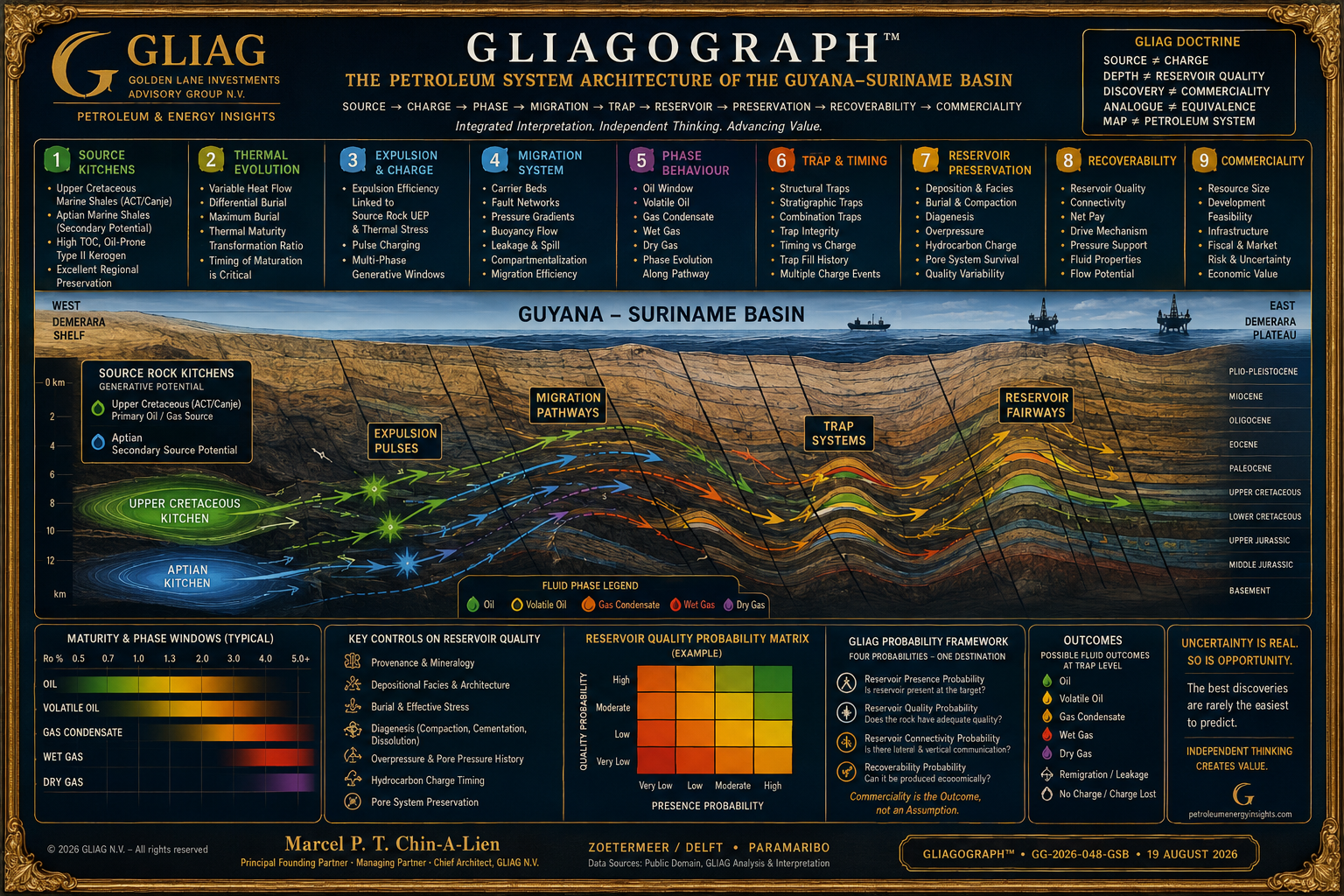
Petroleum systems do not convert generated molecules into reserves in a single step. They lose volume at every stage: through source retention, expulsion inefficiency, migration loss, spill, leakage, biodegradation, reservoir absence, poor connectivity, non-commercial field size and imperfect recovery.
The full chain is: generated → retained → expelled → migrated → trapped → preserved → discovered → appraised → recoverable → commercial → produced.
Each arrow is an efficiency term — geological, technical or economic. The undiscovered-resource problem is, in essence, the problem of estimating the still-unresolved remainder of that chain.
GLIAG codifies the discipline as doctrine:
GENERATED ≠ EXPELLED · EXPELLED ≠ MIGRATED · MIGRATED ≠ TRAPPED
TRAPPED ≠ RECOVERABLE · RECOVERABLE ≠ COMMERCIAL
The underlying distinction runs throughout prior GLIAG research. The compact banner form is introduced here as the doctrinal reference.
Once the chain is stated plainly, the central exploration question changes. It is no longer how much was generated. It is: where was the conversion chain unusually efficient — and where has the remaining petroleum not yet been accounted for?
Petroleum generated, petroleum accumulated and petroleum recoverable are fundamentally different quantities. A source rock may generate billions of barrels while only a small percentage ultimately reaches reservoirs in structures large enough to develop. The basin must therefore be treated as a sequence of filters, not as an inventory.
III. What we know, and what we do not
| Quantity | Current working figure | Correct interpretation |
| Liquids generated — Suriname petroleum-system model | >300 Bn bbl | Generated liquids; not reserves or recoverable resources |
| Stabroek gross recoverable resource | ~11 Bn boe | Operator estimate for Stabroek |
| GranMorgu recoverable resource | ~0.76 Bn bbl | Sapakara + Krabdagu development resource |
| Publicly quantified floor | ~11.8 Bn boe | Stabroek + GranMorgu only; excludes non-standardised additional discoveries |
| Suriname open-acreage undrilled estimate | 6.8 Bn boe | Prospective / undrilled resource estimate; not discovered reserves |
| GLIAG central remaining scenario | 10–15 Bn boe | Scenario, not PRMS certification |
| GLIAG geological upside | 20+ Bn boe additional | Requires one or more major new play families |
| GLIAG possible ultimate recoverable basin range | ~17–30+ Bn boe | Strategic scenario range, not a reserves statement |
Units note. The Stabroek estimate is expressed by ExxonMobil as oil-equivalent barrels, with approximately 20% gas; the GranMorgu figure is expressed by TotalEnergies primarily as recoverable oil, although the field carries associated gas and the FPSO topside includes approximately 500 MMcf/d of gas-handling capacity. The ~11.8 Bn boe floor is therefore an approximate sum of a boe estimate and a recoverable-oil estimate rather than a strictly homogeneous boe total.
That floor should also not be read as the complete discovered-resource inventory of the basin. Block 52 contains commercial gas at Sloanea and oil and gas discoveries at Roystonea and Fusaea, but directly comparable public recoverable-resource figures are not available for all of them. PETRONAS and Staatsolie declared Sloanea commercial in November 2025 and selected a development concept involving subsea wells and floating LNG, with FID targeted for 2026.
IV. Two calibration points
GranMorgu is more than a 760-million-barrel development. Its Final Investment Decision — announced by TotalEnergies on 1 October 2024, referencing recoverable reserves of over 750 million barrels, a total project investment of approximately US$ 10.5 billion and first oil expected in 2028 — together with its 220,000-bopd FPSO, establishes that Suriname’s offshore petroleum system can combine charge, reservoir quality, connected volume, fluid properties, pressure behaviour and development economics at world-scale commercial thresholds.
That makes GranMorgu a calibration point for adjacent exploration. The value lies not in transferring its properties wholesale to neighbouring acreage, but in asking which elements can legitimately be transferred and which must be re-risked.
Analogue is evidence. Analogue is not equivalence.
Stabroek proves something different. It demonstrates repeated success across multiple Upper Cretaceous sandstone reservoirs, and it also proves that the block contains materially different play expressions — including the Ranger carbonate discovery and gas-condensate-bearing reservoirs such as Haimara and Longtail. The correct basin model is therefore multi-play and multi-phase, not a single turbidite-oil template.
My Golden Lane work has consistently interpreted discovery clustering as the consequence of aligned ACT/Canje charge, sediment routing, reservoir distribution, migration and trap access. A discovery trend is the outcome of a petroleum system. It is not the petroleum system itself.
V. Source is not charge
A world-class source rock is only the first element of the chain. Effective charge requires sufficient maturity, transformation, expulsion efficiency and access to reservoir.
My ACT/Canje source-rock work argues that source presence and quality are now less uncertain than the distribution of maturity, charge timing, migration efficiency and trap access. This is the practical consequence of a very large generation figure: once generation is demonstrated at scale, the discriminating risks migrate downstream. If generation were marginal, the question would be whether charge exists at all. It is not marginal. So the question becomes access, timing, seal, phase, reservoir preservation and commercial threshold.
The Suriname GeoAtlas and Staatsolie’s geological framework should therefore be read as the foundation for dynamic source–charge interpretation. GLIAG’s Source–Charge–Phase Atlas builds on that foundation by separating source presence from source effectiveness, and by preserving alternative charge hypotheses where the well record does not yet uniquely resolve the model.
VI. Phase, and the discipline of not assuming oil
The basin is not uniformly oil-prone. My Longtail and SE Golden Lane studies interpret oil, volatile oil, condensate and gas as expressions of a maturity and burial gradient operating within an integrated petroleum system. The interpretation matters most in the southeastern basin, where deeper kitchens and later charge may shift the dominant phase toward gas-condensate.
The practical consequence is that phase prediction belongs inside prospect ranking, not beside it. An exploration success containing gas rather than oil may still be strategically superior if it calibrates a deep kitchen, proves seal competence and anchors regional gas infrastructure.
VII. Depth is a coordinate, not a reservoir model
The second half of the petroleum arithmetic is reservoir effectiveness.
My Block 58 reservoir-modelling work and facies research emphasise that reservoir quality is inherited from provenance, sediment routing, facies, sorting and grain composition before burial modifies it through compaction, cementation, dissolution and pressure history.
The rule is simple and frequently ignored. Two sandstones at the same present burial depth can possess radically different porosity, permeability and connectivity, because their depositional and diagenetic histories differ. Overpressure further complicates any attempt to use depth as a universal proxy for compaction.
Depth is a coordinate. It is not a model.
VIII. The open-acreage signal
Staatsolie states that Suriname’s open acreage contains an estimated 6.8 billion boe of undrilled resources. This is not a reserve and not a discovery. It is nevertheless strategically important, because it indicates that material exploration potential remains outside currently licensed acreage.
The implication for national strategy is straightforward. Suriname should manage open acreage as an evolving portfolio of petroleum-system hypotheses. Licensing should be coordinated with improvements in seismic imaging, basin modelling, well calibration and market timing — not treated as the administrative disposal of blocks.
IX. How much could still be found
No single honest number answers this. Remaining resources are controlled by field-size distribution, exploration maturity, play opening, reservoir effectiveness, phase, recovery technology and infrastructure. GLIAG therefore uses scenarios rather than a pseudo-precise basin total.
A conservative case of another 5–8 billion boe assumes that most major Stabroek-style fairways are already recognised and that remaining discoveries are smaller or more technically difficult.
A central GLIAG case of another 10–15 billion boe allows for material conversion of Suriname open acreage, further Block 52 and Block 58 volumes, Stabroek infrastructure-led exploration, deeper Upper Cretaceous objectives and additional gas-condensate.
A 20+ billion-boe upside case requires at least one genuinely material new play family — deeper Lower Cretaceous, carbonate, Aptian-sourced, Jurassic/syn-rift, major Demerara Plateau or equivalent.
Together these imply a possible long-term recoverable basin range of roughly 17–30+ billion boe. This is an analytical scenario range. It is not a PRMS reserves or contingent-resource certification.
The high-side case is not an act of optimism. It rests on the combination of very large modelled generation, a proven world-class recovery system, large open acreage, stacked source and reservoir possibilities, and an exploration record that has already demonstrated more than one play expression. The largest upward revision would probably come not from finding more exact Liza analogues, but from opening another play family. Frontier exploration creates step changes when new reservoir or charge concepts are proven. It does not merely add fields along a straight extrapolation of the old fairway.
Bridging note. The 10–15 Bn boe central case and 17–30+ Bn boe ultimate range presented here are deliberately anchored to the conservative province-scale trapping efficiencies used in GLIAG’s earlier YTF assessment for Blocks 58 and 52 — retained-in-traps of roughly 0.2–0.8% for oil and 0.1–0.5% for gas. GLIAG’s SE Golden Lane charge-fairway mass balance, which resolves the expelled mass into oil, condensate and gas legs and applies zone-specific trap efficiencies of 5–22%, yields a materially higher SE-sector recoverable envelope of approximately 73 Bn boe with approximately 65 Bn boe still to find — consistent with the Staatsolie GeoAtlas basin-wide recoverable endowment of 50–70 Bn boe. The two frames are complementary. The conservative case bounds the low end of the trapping-efficiency space; the SE Golden Lane and Aptian mass balances describe the geologically defensible upper envelope. This essay uses the conservative frame to preserve investor discipline.
X. Seven disciplines that follow from the arithmetic
If the chain is the model, then practice must be organised around the chain. Seven disciplines follow.
First, rank prospects against the whole chain. Every material prospect should be screened through nine independent questions: Source; Thermal Evolution; Expulsion; Migration; Phase; Trap and Timing; Reservoir; Recoverability; Commerciality. The purpose is to prevent a compelling seismic attribute from masking a weak petroleum-system element. The accompanying discipline is to preserve an evidence class for every conclusion — direct well evidence, seismic/DHI evidence, regional analogue, petroleum-system model or expert hypothesis. A high-confidence interpretation based on direct evidence should never be silently blended with a lower-confidence analogue assumption.
Second, track a Charge Conversion Index. GLIAG defines it conceptually as recoverable petroleum divided by petroleum generated within the effective drainage system. It is not a falsely precise universal coefficient. It is a comparative diagnostic. Low apparent conversion may indicate poor migration, weak trapping, leakage, reservoir absence — or simply exploration immaturity. In an underdrilled area, a low discovered-to-generated ratio can therefore be a positive signal, provided the petroleum balance is not otherwise explained.
Third, map petroleum loss, not only petroleum presence. Exploration maps usually show where petroleum may occur. A mature intelligence platform should also map where petroleum likely failed to accumulate: source retention zones, expulsion inefficiency, migration shadows, spill corridors, leaky faults, seal-risk domains, biodegradation zones and over-mature gas kitchens. The negative space is predictive. If the system generated more petroleum than existing accumulations account for, explaining where petroleum was lost helps constrain where it could still be preserved.
Fourth, treat dry wells as information events. A dry well should never be reduced to a red dot. It must update source, maturity, expulsion, migration, reservoir, seal, trap, phase, pressure and commerciality separately. A well can fail commercially and still materially increase the probability of a different prospect by proving one or more petroleum-system elements. This is the logic of GLIAG’s Dry-Well Learning Atlas and Bayesian play-risk doctrine. The correct question after every well is not “was it dry?” but “which probabilities changed, by how much, and why?”
Fifth, accept that infrastructure changes geology’s commercial meaning. Once an FPSO and subsea network exist, smaller nearby accumulations may become commercial as tie-backs. GranMorgu is explicitly designed to accommodate future satellite connections. Stabroek’s expanding installed capacity similarly lowers the standalone size threshold for some future discoveries. Yet-to-find analysis should therefore include distance-to-host, subsea complexity and minimum economic accumulation size. GLIAG’s Infrastructure Optionality Atlas exists to translate a geological discovery into development optionality rather than leaving infrastructure outside the exploration model.
Sixth, build a national petroleum balance. For Suriname, the ultimate petroleum balance should evolve into a national intelligence account: generated, retained, expelled, migrated, trapped, preserved, discovered, recoverable, produced and depleted. The difference between each stage carries a distinct geological or economic meaning. The Suriname GeoAtlas is the natural national foundation. GLIAG’s proposition is to extend it into an evidence-graded living system integrating dry wells, pressure, phase, resource maturity, infrastructure and economics — not to replace the GeoAtlas, but to convert its authoritative geological framework into a continuously updated decision architecture.
Seventh, impose classification discipline on capital. Investors should insist that every petroleum number be labelled by classification stage. Generated petroleum, hydrocarbons in place, prospective resources, contingent resources, reserves and annual production are not interchangeable. Valuation errors usually begin when a presentation moves casually from one category to another. The simplest due-diligence question is therefore: at which stage of the conversion chain does this number belong? That single question forces discipline into both geological and financial interpretation.
XI. From molecules to sovereign value
There is one final conversion chain, and it lies beyond geology:
organic matter → petroleum generation → discovery → reserves → production → revenue → sovereign capture → productive investment → national capability → intergenerational prosperity.
My production, depletion and fiscal-revenue work argues that resource abundance does not automatically produce national wealth. Geological conversion efficiency and institutional conversion efficiency are parallel problems. In both cases the starting endowment can be enormous while only a fraction becomes durable value.
Hence the sixth line of the doctrine:
PETROLEUM REVENUE ≠ NATIONAL WEALTH
XII. Prognosis — 2026 to 2055
The next phase of the basin will not be a simple continuation of the 2015–2025 discovery pattern. Exploration will move deeper, farther from proven fairways, and toward subtler traps, non-DHI opportunities, gas-condensate and infrastructure-led satellites. The commercial basin will move simultaneously from exploration dominance toward depletion management, gas monetisation and capital-efficiency optimisation.
The basin is therefore neither mature nor frontier in any single sense. It is mature in some Upper Cretaceous fairways, early-stage in several deeper or laterally displaced play families, and only beginning its gas-commercialisation cycle. That mixed maturity is precisely why a single basin resource number misleads.
XIII. Conclusion — follow the unexplained petroleum balance
The most extraordinary number in the Guyana–Suriname Basin may not be the nearly 11 billion boe of Stabroek, nor GranMorgu’s nearly 760 million barrels. It may be the more than 300 billion barrels of liquids that Staatsolie says were generated by the Suriname petroleum-system model.
That number guarantees no further giant field. What it does is eliminate one of the most fundamental frontier uncertainties: whether the basin possessed a sufficiently powerful petroleum engine. It did. The question that remains is where that endowment was converted efficiently into preserved and recoverable accumulations — and where it was not.
The next great discovery may lie not where the discovery map is densest, but where the petroleum balance remains least explained.
Soso Lobi.
GLIAG Doctrine
| GENERATED ≠ EXPELLED |
| EXPELLED ≠ MIGRATED |
| MIGRATED ≠ TRAPPED |
| TRAPPED ≠ RECOVERABLE |
| RECOVERABLE ≠ COMMERCIAL |
| PETROLEUM REVENUE ≠ NATIONAL WEALTH |
The value of a petroleum system is determined not only by what it generates, but by how efficiently geology, technology and institutions convert that endowment into enduring value.
GLIAG Research Library — Companion Reading
The Golden Lane – Guyana–Suriname Basin — Predictive Golden Lane framework: stratigraphy, sediment routing and charge alignment.
The Golden Lane Corridor: Suriname’s Oil Future Unfolds — Suriname-side expression of the Golden Lane petroleum system.
A World-Class ACT/Canje Marine Source Rock System — Source-system quality, maturity and exploration implications.
ACT/Canje Petroleum Systems: Insights from the Guyana–Suriname Basin — Pan-Atlantic ACT/Canje source-rock context and geochemical interpretation.
Understanding Dual-Phase Petroleum Systems in Guyana–Suriname — Stacked sources, phase architecture, migration regimes and charge-column logic.
SE Golden Lane: A Dual Oil and Gas Condensate Basin — Quantified charge, phase, mass-balance and Block 52/58 interpretation.
Longtail Gas & Fluids: Insights from the Guyana–Suriname Basin — Maturity gradient, gas-condensate calibration and deeper-kitchen implications.
The Emerging Gas-Condensate System of the Guyana–Suriname Basin — Strategic implications of a dual oil/gas-condensate basin.
Estimating Yet-to-Find Oil and Gas in Suriname, Blocks 58 and 52 — Charge-constrained YTF methodology and trapping-efficiency scenarios.
Deep-Water Reservoir Modeling in Block 58 — Core-calibrated stratigraphy, connectivity and development-oriented reservoir modelling.
Why Facies Matter in the Guyana–Suriname Basin’s Petroleum Systems — Depositional architecture, reservoir quality and play distribution.
Repricing the Guyana–Suriname Basin — How discoveries recalibrate reservoir, charge, pressure and commercial assumptions.
Guyana–Suriname Super Basin – Production-Depletion & Fiscal Revenue Outlook — Transition from discovery to depletion, fiscal recovery and sovereign-value management.
The Golden Lane, Guyana: From Deep-Water Turbidite Petroleum Systems to FPSO-Driven National Revenue — Reservoir architecture, production system and conversion of geology into cash flow.
Sapakara South Flow Test: Pioneering Suriname’s Oil Production — Flow-test calibration, reservoir deliverability and GranMorgu development logic.
The Evolution of Petroleum Systems in Suriname Offshore Exploration — From oil discovery narrative toward multi-system petroleum architecture.
The Overlooked Aptian Source-Rock System — Aptian charge hypothesis, facies-weighted expulsion and future play implications.
Editorial note on earlier GLIAG estimates. Selected earlier GLIAG essays — notably the May 2025 note quoting approximately 886 Bn boe generated and approximately 130 Bn boe yet-to-find for Suriname offshore — used different model inputs and preceded Staatsolie’s 2026 public disclosure of the ACTC/Aptian >300 Bn bbl liquid-generation figure. For consistency, the Staatsolie 2026 disclosure is treated in this essay as the primary anchor and supersedes the earlier GLIAG generated-volume numbers. The GLIAG mass-balance treatments in the SE Golden Lane and Overlooked Aptian essays remain current.
Trusted Primary & Technical References
Staatsolie Hydrocarbon Institute — Geology — Primary Suriname geological framework; source systems, >300 Bn bbl modelled liquid generation, reservoir characteristics and open-acreage resource estimates.
Staatsolie — Petroleum Geological Atlas / GeoAtlas — Official integrated Suriname petroleum geology, stratigraphy, petroleum-system and play framework.
ExxonMobil — Guyana Project Overview — Current operator estimate of nearly 11 Bn boe gross recoverable resource in Stabroek and discovery history.
TotalEnergies — GranMorgu Project — GranMorgu resource, 220,000-bopd FPSO, 2028 first oil and satellite tie-back design.
TotalEnergies — GranMorgu Final Investment Decision — FID, >750 MMbbl recoverable, US$ 10.5 Bn investment and development parameters.
PETRONAS — Sloanea Commerciality — Commerciality of Sloanea and Suriname’s first offshore gas-development milestone.
Staatsolie — Sloanea-1 Commercial Field Approval — Official Suriname approval, development concept, FID and first-gas pathway.
PETRONAS — Fusaea-1 Block 52 Discovery — Campanian oil- and gas-bearing sandstone packages and integrated Block 52 development potential.
USGS — Assessment of Undiscovered Oil and Gas Resources in Central and South America — Regional resource-assessment methodology and Atlantic-margin giant-field potential.
Publication Note & Disclaimer
This publication is an independent GLIAG geological and strategic interpretation integrating the author’s published research with public-domain information from national oil companies, operators and scientific institutions. Scenario ranges are analytical exploration scenarios and do not constitute PRMS reserves or contingent-resource certification, securities analysis, investment advice, or a substitute for proprietary subsurface evaluation. Third-party data and publications remain attributable to their original sources.
Copyright & intellectual property. © 2026 Golden Lane Investments Advisory Group N.V. (GLIAG). All rights reserved. No part of this publication may be reproduced, distributed or transmitted in any form without prior written permission of GLIAG N.V. In accordance with Article 4(3) of Directive (EU) 2019/790, GLIAG N.V. expressly reserves all rights in this work for the purposes of text and data mining, and does not permit its use for the training or development of artificial-intelligence or machine-learning systems.
GLIAG N.V. · Golden Lane Investments Advisory Group
Zoetermeer / Delft, Netherlands · Paramaribo, Suriname · petroleumenergyinsights.com
Converting bare headlines into deep strategic, added value
GLIAG · WHERE INFORMATION BECOMES INTELLIGENCE
GLIAG-GSB-2026-0819-001 · Essay Edition · 19 August 2026 · © 2026 GLIAG N.V. · petroleumenergyinsights.com ·