Beyond Discoveries
Reading the Architecture of a Petroleum Province
Written by Marcel Chin-A-Lien – Petroleum & Energy Advisor – Principal Founder & Chief Architect of GLIAG N.V. – Golden Lane Investments Advisory Group – A boutique of senior high level professionals with more than a century of involvement in E&P, with deep roots and also established in Suriname, Switi Sranankondre. Above all with Soso Lobi.
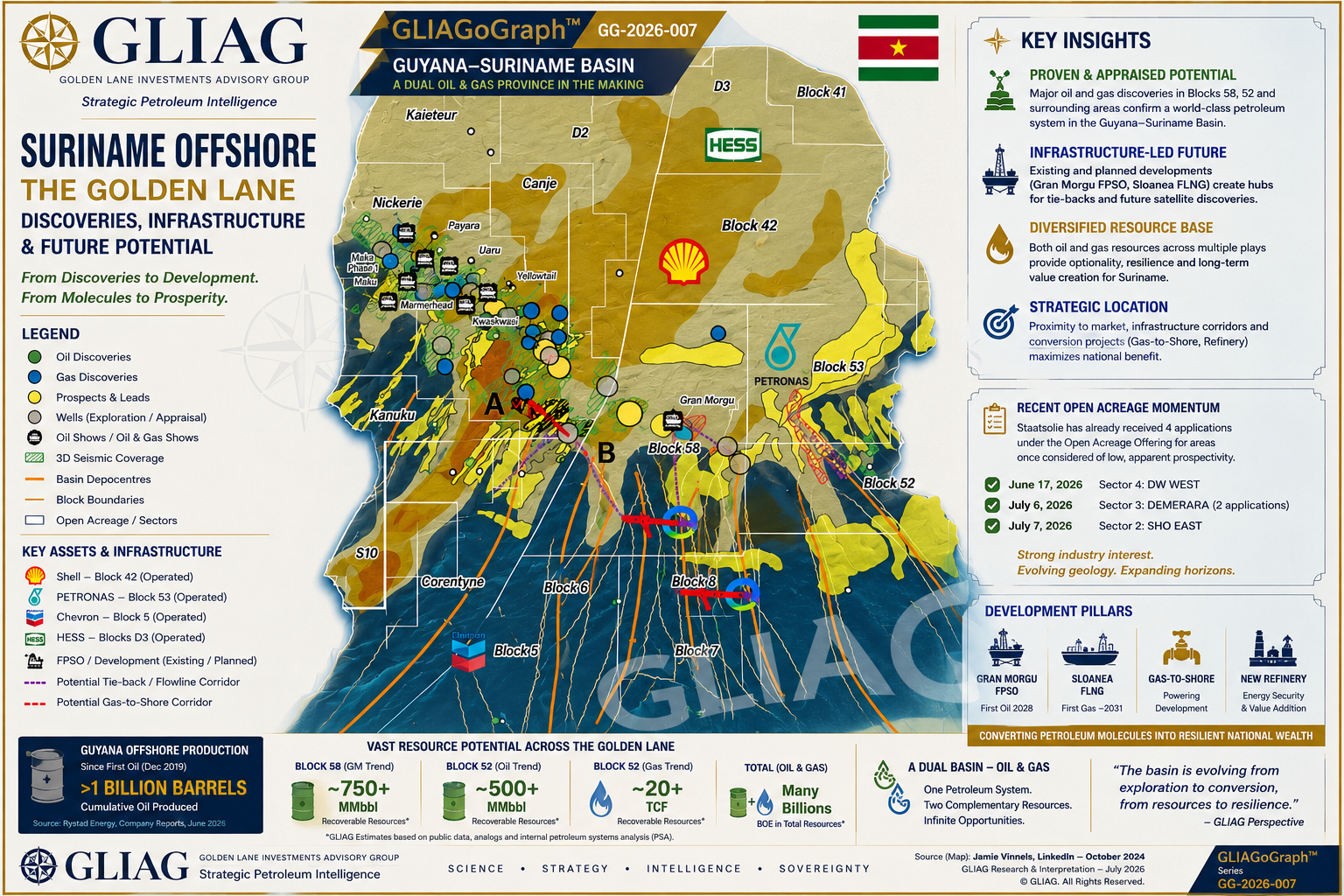
At first glance, a map of offshore blocks, discoveries and operator positions shows little more than geography claimed. To the petroleum geologist, it reveals something far more profound: the gradual unveiling of an integrated petroleum province whose architecture has been more than one hundred million years in the making.
Cartographic note. The map underlying this GLIAGoGraphic draws on the regional compilation prepared by Jamie Vinnels (LinkedIn, October 2024) — among the clearest visual syntheses of the evolving Guyana–Suriname Basin published in recent years. GLIAG gratefully acknowledges this work as the cartographic foundation. The geological interpretation, petroleum systems analysis, strategic conclusions and resource perspective that follow are entirely GLIAG’s own, drawn from independent research and decades of professional experience within the basin.
An Integrated System, Not a Scatter of Wells
The Guyana–Suriname Basin has entered a new geological chapter. Exploration is no longer simply about finding isolated accumulations of hydrocarbons; it is increasingly about understanding an interconnected petroleum system in which world-class Cenomanian–Turonian marine source rocks, exceptional Cretaceous turbidite reservoirs, regional sealing intervals, long-distance migration pathways, structural evolution and subtle stratigraphic trapping mechanisms collectively define one of the world’s most prolific emerging offshore provinces.
From Guyana’s Stabroek Block through Suriname’s Block 58, Block 52 and beyond, each successful well refines our understanding of source kitchens, migration fairways, reservoir distribution and charge history. Every new discovery reduces geological uncertainty while simultaneously opening new exploration opportunities. The basin is steadily evolving from frontier exploration toward petroleum-system optimization.
A dual-hydrocarbon province is not a coincidence of drilling. It is a geological signature.
Oil, Gas, and the Same Petroleum System
The basin is demonstrating that it is not merely an oil province, but a dual-hydrocarbon province. Commercial oil accumulations, associated gas, condensates and standalone gas fields increasingly coexist within the same petroleum system. Recent drilling success in Suriname’s Block 52 reinforces this interpretation, confirming that both liquids and gas are natural expressions of the basin’s geological evolution rather than isolated occurrences. This duality fundamentally strengthens the long-term resilience of the province.
The scale of development is equally remarkable. Since first oil in December 2019, Guyana has already produced well in excess of one billion barrels of crude oil, while discovered recoverable resources across the basin continue to grow into the many billions of barrels of oil equivalent. Yet production statistics tell only part of the story. The geological evidence increasingly suggests that substantial additional resources remain to be discovered, particularly where deeper source kitchens, overlooked migration fairways, subtle stratigraphic traps and infrastructure-led exploration economics converge.
What Acreage Applications Reveal
Perhaps the strongest indication that the basin continues to surprise even experienced explorers is not found in a seismic line or a well log, but in industry behaviour itself. During the past few weeks, Staatsolie has received four separate applications under its Open Acreage Offering — covering Sector 4: DW WEST, two independent applications for Sector 3: DEMERARA, and Sector 2: SHO EAST. These are areas that, until recently, many regarded as possessing relatively modest or uncertain prospectivity.
Capital allocation is rarely accidental. When experienced exploration companies voluntarily compete for acreage, they signal that regional geological understanding is evolving and that previously underestimated petroleum systems deserve renewed attention. The basin is not becoming less prospective; it is becoming better understood.
Readers interested in this remarkable shift are invited to consult GLIAG’s recent analyses of Sector 4: DW WEST, Sector 3: DEMERARA, and Sector 2: SHO EAST, available through the Petroleum & Energy Insights research library, where these developments are examined within the broader context of petroleum systems, exploration strategy and basin evolution.
From Exploration Province to Conversion Economy
This changing geological understanding naturally leads to a broader strategic conclusion. Hydrocarbons create lasting prosperity only when they are transformed into national capability. A dual oil-and-gas province therefore strengthens — not weakens — the strategic rationale for Gas-to-Shore (GtS), domestic gas utilization and a modern refinery in Suriname. Together they represent far more than industrial projects. They are the logical next step in converting petroleum molecules into electricity, refined products, petrochemicals, industrial capability, employment, energy security and resilient sovereign wealth.
In GLIAG’s view, the Guyana–Suriname Basin is gradually evolving from an exploration province into a conversion economy.
A Landscape Painted Before It Was Drilled
There is, however, another story quietly hidden beneath the geology. Geologists sometimes live with landscapes that have not yet entered the maps.
During my years serving as a consultant to Staatsolie between 2008 and 2010, an oil painting overlooked the room where countless seismic sections, well logs and petroleum-system models were studied. It imagined ancient turbidity currents descending through the Berbice Canyon, carrying immense volumes of sand into the deep Atlantic, where they settled layer upon layer to form the reservoirs that would remain concealed beneath kilometres of rock and water for more than one hundred million years.
The painting was created by my dear wife, an artist who studied at the Nola Hatterman Art Academy, where she developed her craft under the guidance of the distinguished Surinamese painters Rinaldo Klas and Wilgo Vijfhoven. It was never intended as prophecy. It was simply an artist’s interpretation of a geologist’s fascination with invisible landscapes. Yet, as discoveries gradually illuminated what is now recognised as the Golden Lane, the painting acquired a quiet resonance of its own. It seemed to remind us that science and art often begin in the same place: the disciplined imagination to see what time has not yet revealed. Some maps, perhaps, are first painted before they are ever drilled.
Science and art often begin in the same place — the disciplined imagination to see what time has not yet revealed.
Molecules Into National Wealth
That quiet dialogue between imagination and evidence continues to shape GLIAG’s work today. Our research integrates petroleum geology, basin modelling, geophysics, reservoir engineering, economics, commercial strategy, fiscal architecture, industrial policy, energy security and sovereign development into a single analytical framework. We seek not merely to understand where hydrocarbons occur, but what they make possible.
The map before us is therefore much more than a catalogue of discoveries. It is a portrait of a petroleum province steadily revealing its full architecture — from source rock to reservoir, from migration to accumulation, from exploration to production, from production to industrialization, and ultimately from molecules to resilient national wealth.
The Guyana–Suriname Basin is still writing its geological story. Every well, every appraisal campaign, every new licence application and every infrastructure investment adds another chapter. Increasingly, the evidence suggests that its greatest legacy may ultimately lie not only in the hydrocarbons it contains, but in the institutions, industries and opportunities those hydrocarbons can sustain for generations.
That is precisely where GLIAG — Golden Lane Investments Advisory Group — seeks to contribute: at the intersection of geology, strategy and statecraft, transforming information into intelligence, discoveries into strategy, and natural resources into enduring national prosperity.
FURTHER READING — GLIAG PETROLEUM & ENERGY INSIGHTS
- The Golden Lane Corridor: Suriname’s Oil Future Unfolds
- Suriname’s Block 52: A Dual-Hydrocarbon Revolution
- Block 52: Unveiling More Than One Billion BOE
- Exploring the Petroleum Systems of the Guyana–Suriname Basin
- Sector 4: DW WEST — Reading the Open Acreage Signal
- Sector 3: DEMERARA — A New Exploration Phase
- Sector 2: SHO EAST — Why Industry Is Looking Again
- Gas-to-Shore: From Molecules to National Development
- The Strategic Case for a New Refinery in Suriname
- Petroleum & Energy Insights Research Library — petroleumenergyinsights.com
Soso Lobi
GLIAG — Strategic Petroleum Intelligence
Where Information Becomes Intelligence. Where Discoveries Become Strategy.
From Geology to Sovereignty. From Molecules to Resilient National Wealth.
petroleumenergyinsights.com