From Subsurface to Sovereignty
The Guyana–Suriname Basin Evidence-to-Execution Architecture: Linking Petroleum Systems, GIP, and Suriname Horizon 2050+
Marcel P.T. Chin-A-Lien
Principal Founding Partner & Chief Architect | Golden Lane Investments Advisory Group (GLIAG)
6 October 2026 | GLIAG-FE-2026-1006-001 | Revision 3.0
Independent GLIAG Flagship Essay | Pre-publication edition
Executive abstract
The Guyana–Suriname Basin (GSB) is entering a new phase: discoveries and sanctioned projects now make execution, evidence quality, and national conversion as consequential as exploration.
Decision makers need a way to connect stratigraphy, source systems, maturity, migration, reservoir architecture, appraisal, facilities, fiscal timing, and industrial choices without treating uncertainty as certainty.
This independent GLIAG flagship essay presents an evidence-to-execution architecture for integrating these domains in the GLIAG Intelligence Platform (GIP), informed by continuous Basin Watch monitoring and the author’s technical and strategic research.
Operators and service companies can draw on extensive proprietary seismic, well, log, test, and operating data. GLIAG does not claim equivalent access or attempt to replace specialist studies.
Its distinctive value lies in making disparate evidence legible, comparable, traceable, and decision-relevant—and connecting subsurface opportunity to Suriname Horizon 2050 and Beyond.
GIP integrates the crucial E&P functions with project, commercial, fiscal, infrastructure, and national-conversion intelligence in one auditable environment.
Offshore production creates a finite fiscal window; Gas-to-Shore (GtS), a New Refinery (NR), and related infrastructure are potential conversion pathways whose timing, interfaces, commercial viability, and public value must be tested in distinct but coordinated cases.
The governing principle is that integration should increase the usefulness of evidence while leaving its uncertainty visible.
1 | An independent integrative contribution
Operators, national oil companies, service companies, and specialist researchers can build studies on proprietary seismic, well, log, pressure, fluid, test, and operational datasets unavailable to an independent public-domain synthesis.
Their data advantage is real and should be respected.
GLIAG’s strongest contribution is complementary: connect evidence that normally sits in separate technical, commercial, and policy conversations; disclose what kind of evidence each claim rests on; and show how a change in geological understanding affects the next decision.
This essay does not claim to out-data operating companies or replace their detailed work.
It offers an integrative lens above, alongside, and between specialist results—preserving provenance and uncertainty as interpretation moves from basin to asset, project, and national development.
A small independent advisory can be best in its niche by joining accumulated basin experience, rapid source monitoring, connected analytical work, and a platform that links maps, documents, models, and decisions.
The goal is not to make sparse data look complete; it is to make the consequences of sparsity useful.
2 | The precise relationship to yesterday’s charge paper
This is the strategic and execution companion to the author’s 5 October paper, Charge Architecture of the Guyana–Suriname Basin.
That paper asks how source systems, maturity, phase, expulsion, migration, trapping, and preservation may combine through time, presenting two distinct GLIAG quantitative screening models.
This essay asks a different question: how should geological evidence—whether generated by a company, public source, or GLIAG model—be carried into appraisal, development, commercial structuring, and durable national value?
For clarity, the charge paper reports a GLIAG Rev 0.22.33 zoned screening model of 1,307 billion boe generated across Suriname offshore and a separate SE Golden Lane mass-balance scenario of 73.3 billion boe recoverable.
The domains and methods differ; the figures are not additive, and neither is a reserves estimate. This essay does not repeat, recalculate, or independently validate those outputs.
It treats them as screening hypotheses and a source-to-accumulation ledger to test against higher-tier evidence—especially measured source-rock data, fluids, pressure, PVT, DSTs, and well-tied seismic. [1]
The two papers form a deliberate pair:
the charge paper develops a basin-scale petroleum-system hypothesis;
this essay connects hypotheses and observations to decision gates, delivery risk, cash-flow sequencing, GIP design, and SH-2050+ execution.
GLIAG’s 6 October Basin Watch classifies the charge paper as a Tier 3 screening model plus Tier 4 interpretation, explicitly not reserves; its next decisive evidence is Tier 1 measured source-rock, fluid, pressure, PVT, DST, and well-tied seismic data.
The same Basin Watch reports no new verified project gate for GranMorgu, Block 52, Stabroek, GtS, or NR on that date. This essay does not offer another estimate of generated hydrocarbons.
3 | One basin, multiple petroleum systems, uneven proof
Staatsolie’s GeoAtlas describes multiple petroleum systems in the Guiana Basin, including the proven Albian–Cenomanian–Turonian (ACT) and Late Aptian intervals, alongside older Early Cretaceous and Jurassic possibilities that remain unproven. [2]
These intervals should not be blended into one generic kitchen: each needs its own evidence record, burial history, kinetics, maturity assessment, expulsion timing, migration access, and calibration status.
The Cretaceous record, Demerara Rise, and Ocean Drilling Program Leg 207 provide regional constraints on stratigraphy, organic-rich intervals, and paleoceanography. [3]
They do not automatically calibrate a specific western-basin kitchen, prospect, or licence. A source correlation can support an interpretation without proving maturity or migration access throughout the margin.
GLIAG’s 5 October maturity audit found that public material supports a first-pass western-basin framework but does not establish dense maturity control or open access to every modern seismic trace used in published interpretations.
A 2026 Basin Research synthesis improves regional tectonostratigraphic and sediment-routing context, but its underlying seismic data were supplied by GGMC, TGS, and Viridien. Published sections are valuable; they are not automatically open digital seismic fit for independent calibrated time-depth conversion. [4–5]
This limitation changes what can responsibly be claimed.
A maturity map should expose its calibration points, assumptions, model version, residuals, and uncertainty.
It should distinguish present-day depth from maximum burial and measured maturity from maturity inferred through models or correlations.
If source presence, richness, maturity, generation, expulsion, and migration are collapsed into one bright map layer, integration has hidden the uncertainty that decision makers need.
4 | The evidence-to-execution architecture
Seven linked gates carry evidence forward.
At each gate, GIP preserves the source, displays the interpretation, records uncertainty, and names the decision the evidence can support. Scenarios may inform planning before certainty is complete, but must not silently upgrade upstream evidence.
1. Stratigraphic identity and geometry: interval, age, well tie, seismic horizon, structural setting, alternate picks, original two-way time, depth conversion, datum, navigation, velocity model, licence, and uncertainty.
2. Source presence and quality: sample depth, laboratory method, TOC, Rock-Eval, kerogen/facies, biomarkers, and representativeness. Label measurement, reported interpretation, and correlation separately.
3. Burial, maturity, generation, expulsion: time-dependent burial and thermal history; sensitivity to age, erosion, heat flow, kinetics, and conductivity; calibration residuals and ranges. Generation is not expulsion, and expulsion is not successful migration.
4. Migration, reservoir, seal, timing: source access, migration routes, trap formation, reservoir deposition, and seal effectiveness through time. Integrate sediment routing, facies, channel–levee and lobe architecture, mass transport, pressure, and connectivity. A mapped body does not prove deliverability.
5. Appraisal and development readiness: distinguish discovery, appraisal, concept select, approval, FID, construction, commissioning, and production. Tie recovery and schedule to well tests, pressure, PVT, connectivity, facilities, export, and cost.
6. Commercial and fiscal conversion: connect production profiles to price, contracts, costs, state participation, fiscal receipts, debt claims, and timing. Project returns, Treasury cash, foreign-exchange effects, avoided imports, and broader benefits are different measures.
7. Resilient national capability: synchronize production and revenue with power, transport, industrial demand, skills, institutions, maintenance, local supply capacity, and public-finance controls. Identify reversible choices, long-lived obligations, and the evidence required before capital commitment.
5 | From basin interpretation to better asset decisions
Prospect ranking should show the evidence behind its score: source-system confidence, charge timing, migration access, reservoir architecture, seal, pressure, and data quality.
Rankings should be stress-tested against alternative source and thermal histories, revealing whether a target remains attractive when uncertain assumptions move against it.
Seismic spending should resolve a named uncertainty.
For a western depocentre, decision value depends on line position, orientation, bandwidth, navigation, imaging beneath the relevant unconformity, velocity control, and well tie.
For reservoir connectivity, acquisition and processing should resolve geometry at the scale that can change appraisal or development. “More data” is an investment case only if the data discriminate between alternatives.
Probabilistic reservoir modelling, OBN, formation testing, and well-test analysis become more useful when connected to the petroleum-system and commercial models.
A connectivity range should flow into recovery and schedule sensitivities; gas composition uncertainty should flow into processing, pipeline, export, and domestic-market choices.
AI can accelerate fault interpretation, seismic conditioning, log classification, literature extraction, anomaly detection, and scenario comparison. It cannot turn sparse or licensed data into observations.
Record the input domain, validation, model version, human review, and failure modes; label extrapolation plainly.
6 | SH-2050+: synchronization, not a shortcut
Suriname Horizon 2050 and Beyond provides the national-development connection.
In Marcel Chin-A-Lien’s SH-2050 doctrine, the central question is how temporary offshore resources and income become durable productive capacity. Production timing, sovereign receipts, gas development, infrastructure, industrialization, institutions, and human capital must be synchronized. Offshore production creates fiscal space; conversion determines how much becomes lasting national value. [6]
Synchronization does not mean merging every project into one megaproject.
It means planning independent projects against shared national constraints: energy demand, fuel security, feedstock, corridors, financing, procurement, workforce, regulation, maintenance, and the public balance sheet.
Refinery, GtS, export/FLNG, and power need distinct technical and commercial economics; their interfaces and national effects must then be coordinated.
GranMorgu is a sanctioned Block 58 development with an announced 220,000 b/d FPSO, approximately US$10.5 billion investment estimate, and first oil expected in 2028. [7]
Sloanea-1 received commercial-field approval in Block 52, a meaningful milestone distinct from FID, contracted gas delivery, domestic allocation, or production. [8]
These baselines make preparation timely; they do not establish the feedstock, schedule, price, financing, or offtake needed to call NR or GtS bankable.
SH-2050+ is a GLIAG strategic sequencing framework, not a substitute for project diligence.
Prepare options, secure evidence and legal frameworks, preserve flexibility, and stage commitments against verified gates.
7 | Integrating GtS and New Refinery—smoothly, with separate business cases
GtS and NR can support a resilient development system, but they involve different molecules, markets, and risks.
GtS requires deliverable gas volumes and composition, processing, transport, allocation, tariff, demand, offtake, and a credible payment structure.
A refinery requires qualified crude or other feedstock, product demand, configuration, yields, operating capability, logistics, financing, and product offtake.
Gas may support utilities or power if justified; that interface must be engineered and contracted.
A disciplined sequence is: establish separate project baselines; update demand and energy balances, including power demand displaced by GtS; qualify crude assays and refinery product slate; test pipeline, storage, power, port, water, and logistics interfaces; run independent bankability cases; identify shared infrastructure that lowers combined cost without transferring unpriced risk; then stage investment through explicit gates. Do not credit the same avoided imports, electricity savings, or receipts twice.
Advance refinery feasibility competitively; make construction conditional on a robust normal-market case, secured feedstock, realistic demand, a capable operator, financeable contracts, and resilience testing.
Keep strategic fuel-security benefits separate from commercial refining margin.
Test GtS against export and hybrid alternatives, domestic demand, infrastructure costs, and long-term volume risk.
The national benefit is reliable, affordable energy that supports productive activity without compromising bankability or alternative market value.
Your connected work develops these pathways:
From Gas-to-Shore to Growth-to-State,
Suriname’s Gas Architecture: A Pre-FID Strategy, and
Transforming Suriname: From Value Leakage to Capture.
They are a research record, not proof that a project has reached FID or bankability.
8 | Resilience tests the whole chain
Test each asset and national project under: lower connected volumes, later production, weaker deliverability, longer appraisal, or a source interpretation that loses support; lower oil/gas prices, narrower refining margins, changing demand, export limits, freight and insurance disruption; higher CAPEX, schedule delay, equipment constraints, interface failure, commissioning underperformance; slower receipts, debt-service pressure, currency changes, cost escalation, or competing claims on petroleum income; and GtS demand below forecast, delayed power integration, refinery feedstock mismatch, low utilization, skills gaps, or infrastructure arriving after the production window.
These are not reasons to reject development.
They are conditions to price, contract, phase, hedge, insure, or monitor.
Resilience comes from staged investment, credible alternatives, operational readiness, capable institutions, and updating choices when evidence changes.
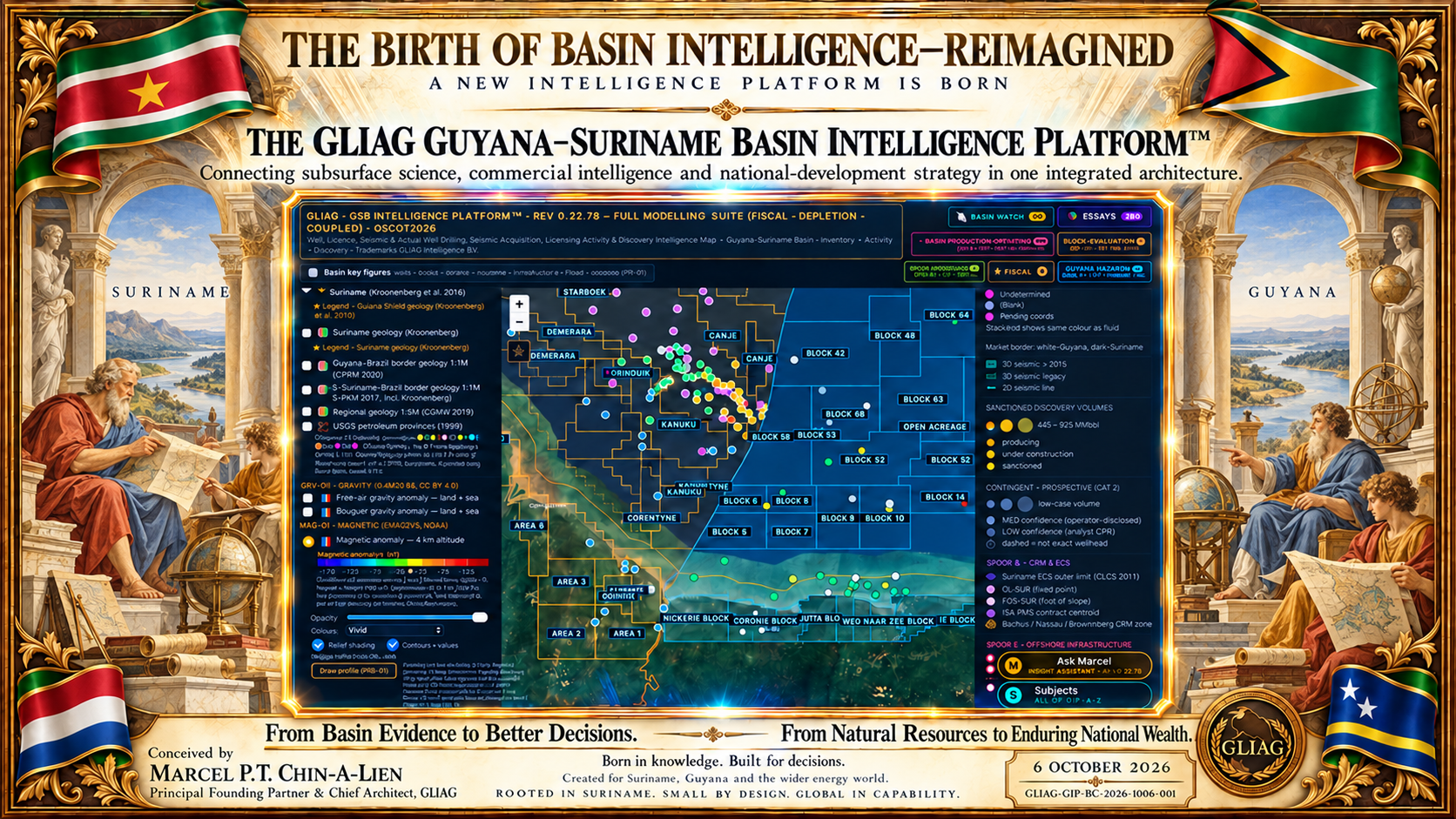
9 | GIP: seamlessly integrated E&P and national-conversion intelligence
GIP operationalizes the architecture as a connected decision environment rather than a traditional document library or static database.
A well, sample, seismic line, horizon, source interval, reservoir body, licence, field, project milestone, model parameter, cash-flow assumption, infrastructure dependency, and policy choice can carry a provenance-bearing evidence card: source, date, geographic and stratigraphic scope, access rights, evidence class, method, uncertainty, dependencies, and review status. Interpretations remain connected to their inputs, alternatives, and permitted decision use.
The E&P layer integrates basin evolution, tectonostratigraphy, wells, seismic sections, stratigraphy, sedimentology, source-to-sink systems, reservoir architecture, source-rock presence and quality, burial and maturity, generation through time, expulsion, migration, charge, pressure, fluids, analogues, discoveries, licences, and play or prospect evidence.
Map and section views can therefore lead directly to the documents, data controls, assumptions, and competing interpretations behind them.
The modelling layer connects source kitchens and generated hydrocarbons through time with reservoir and fluid scenarios, production and depletion profiles, development schedules, project cash flow, fiscal take, sovereign receipts, and sensitivity cases.
It preserves the critical boundaries between generated petroleum, expelled petroleum, in-place volumes, recoverable resources, reserves, production, and state cash.
A geological change can be traced to its potential effect on appraisal, facilities, timing, economics, and public revenue without pretending that one stage proves the next.
The project and conversion layer connects GranMorgu, Block 52/Sloanea, Stabroek and future developments to GtS, NR, power, storage, ports, pipelines, marine logistics, product demand, import substitution, industrial hubs, skills, institutions, and fiscal resilience.
GIP can expose shared dependencies while keeping each project’s business case separate.
This supports the SH-2050+ synchronization question: whether infrastructure, institutions, finance, and human capability will be ready during the finite production and revenue window.
The intelligence layer joins the evidence registry, literature and essay library, Basin Watch monitoring, licence and asset profiles, economic and strategic modules, confidence labels, alerts, and the agentic “ Ask Marcel “ interface.
Basin Watch identifies what changed; GIP locates the change in the evidence graph; modelling tests its consequences; essays explain the interpretation; and advisory work converts it into an auditable decision package.
That seamless loop—from new signal to evidence, model, decision, and monitoring—is the platform’s central commercial functionality.
Basin Watch supplies the monitoring loop: identify material changes, separate new evidence from recycled or unverified claims, and trace implications for the basin and national conversion.
GIP relates and stores evidence; essays synthesize it; newsletters show what changed and why it matters. Together they form a recurring intelligence service.
This creates a credible GLIAG commercial pathway.
The flagship essay demonstrates judgment.
Daily Basin Watch serves executives who need recurring signal interpretation.
GIP serves teams needing linked evidence and scenario workspaces.
Confidential advisory can address specific decisions: basin or licence screening; source-to-reservoir risk audits; appraisal and acquisition priorities; development-interface review; or SH-2050+ conversion, GtS, NR, and fiscal readiness.
Each engagement needs a clear scope, evidence boundary, deliverable, and price—not a promise of certainty.
The proposition is not that GLIAG holds every dataset.
It is that GLIAG can help clients ask better questions of the data they hold, combine them with public and regional evidence, and see the consequences across geology, project economics, and national development.
GIP can be demonstrated independently, and also be adapted and customised to the needs and including the specific data of different firms, companies, exploration teams, investors, operators, lenders, public institutions, and strategic partners through a confidential Basin Decision Audit or SH-2050+ Conversion Readiness discussion.
For a private demonstration or scoping conversation: info@gliag.com.
Conclusion | More decision value from each piece of evidence
The GSB does not need one more claim that all uncertainty has been solved.
It needs better ways to connect the work specialist teams, governments, universities, and independent analysts are doing.
Proprietary datasets are a real advantage for presentations built on them.
GLIAG’s niche is to integrate evidence across domains, show where links are strong or weak, and carry implications into decisions beyond the subsurface.
That is how a source-rock hypothesis becomes an appraisal question; appraisal becomes a development gate; a production profile becomes a fiscal timeline; and that timeline becomes an SH-2050+ choice about GtS, refining, infrastructure, skills, and resilience.
GIP and Basin Watch make the chain repeatable.
The proposition is precise: **not more certainty than data allow, but more decision value from every piece of evidence—and a clearer path from geological opportunity to enduring national capability.**
Annex A | GLIAG companion essays and research record
This curated index connects the technical and strategic workstreams discussed here. Some essays reflect earlier project baselines; historical numbers and schedules retain their original dates. Use the latest dated Basin Watch and primary operator or government records for current status.
Petroleum systems, charge, reservoir and basin history
- A World-Class ACT Marine Source Rock System
- The Overlooked Aptian Source Rock System
- Understanding Dual-Phase Petroleum Systems in Guyana–Suriname
- SE Golden Lane: A Dual Oil and Gas-Condensate Basin
- Golden Lane Basin Fluid Evolution Insights
- The Emerging Gas-Condensate System of the Guyana–Suriname Basin
- ACT Petroleum Systems: Insights from the Guyana–Suriname Basin
- Charge Architecture of the Guyana–Suriname Basin
New Refinery, fuel security, and investment
- Investment Insights: Guyana & Suriname Billion-Barrel Refinery Opportunity
- Why Suriname Needs a Modern Oil Refinery
- Invest in Suriname: A Self-Funding Modular Refinery
- How a Suriname’s New Refinery Can Ensure Energy Security
- Guyana–Suriname Basin: Time to Build a Refinery Before 2028
- Transforming Suriname: From Value Leakage to Capture
- Impact of Suriname’s New Modular Refinery
- Suriname’s Economic Transformation: The GLIAG Model Explained
Gas-to-Shore, Sloanea, and commercial governance
- Powering Future: Gas-to-Shore for Suriname and Guyana
- Suriname’s Gas Architecture: A Pre-FID Strategy
- Suriname’s Multi-Hub Future: Turning Gas-to-Shore into Sovereignty
- Why Gas-to-Shore Infrastructure and New Refinery are Key to Guyana–Suriname Development
- From Gas-to-Shore to Growth-to-State
- How to Monetise Sloanea?
- Evaluating Suriname’s Gas Commercialization Pathways
- Gas Governance in Suriname: The 2050 Framework Explained
- The Legal Framework for Sloanea Gas Development
- Sloanea Gas Discovery: Evolution in Petroleum Law
- Sloanea Gas Development: Fiscal Strategies that Drive Investment
Suriname Horizon 2050+, conversion, fiscal resilience, and execution
- Gas-to-Shore and Refinery: Projecting Suriname’s Cash Waterfall
- Suriname’s Petroleum Future: Debt vs. Net Sovereign Cash
- GranMorgu’s Revenue Waterfall: A Look at Suriname’s Future
- Inventory vs. Accessible Supply: Key Insights for Suriname’s Oil Sector
- Stranded Energy: Lessons for Suriname’s Petroleum Future
- Commercial Energy Integration: Key Insights for 2026
- From Oil to Prosperity: Suriname’s Strategic Energy Execution Framework
- Suriname: Van Olie-inkomsten naar een Weerbare Productiestaat
- Transforming Suriname’s Petroleum Wealth into National Capability
- Staatsolie’s Financial Future: Beyond Traditional Metrics
- Suriname Horizon 2050 and Beyond: The Conversion Execution Navigator
- Suriname and The Conversion
- Transforming Suriname’s Petroleum into Productive Power
- Suriname’s Horizon 2050: A Roadmap for Sustainable Petroleum Management
- Suriname Horizon 2050: A Strategic National Transition Framework
- Navigating Suriname’s Oil Era: A Fiscal Management Guide
- Transforming Offshore Energy: Governance in the Guyana–Suriname Basin
Feedstock, production window, and energy context
- Golden Lane Crude: A Game Changer for Caribbean Refineries
- Analyzing Liza and Suriname’s Oil Properties for Better Insights
- Liza Birth Certificate and Crude’s Geological Journey: From Source to Refinery
- Liza Crude: Guyana’s High-Value Light Oil Explained
- Guyana–Suriname Super Basin: Production-Depletion & Fiscal Revenue Outlook
- GranMorgu Development: A Comprehensive Reservoir Analysis
- Suriname’s Block 52: A Dual-Hydrocarbon Revolution
- The Hormuz Factor: Analyzing Global Energy Vulnerabilities
- Gas Is Becoming the Geopolitical Fuel
- Gas as Geopolitical Fuel: Implications for Suriname
- Junín 5: Transforming 35 Billion Barrels into Bankable Assets
Annex B | Selected trusted technical and project references
- Staatsolie Hydrocarbon Institute, GeoAtlas.
- Ocean Drilling Program, Leg 207: Demerara Rise.
- Yang & Escalona (2011), Basin modelling and source rock evaluation in the Guyana Basin, First Break 29, 59–69.
- Saul et al. (2026), Tectonostratigraphic Evolution of the Guyana Basin, Basin Research 38, e70097.
- TotalEnergies, GranMorgu final investment decision.
- Staatsolie, Sloanea-1 commercial-field approval, Block 52.
- GLIAG, New Refinery for Suriname in a Fragmenting Fuel Market, Revision 002, 4 October 2026. Earlier scenario assumptions are not updated forecasts.
- GLIAG, Suriname Horizon 2050 and Beyond: The Conversion Execution Navigator.
Author’s note, disclaimer and rights
This is an independent GLIAG technical and strategic interpretation based on cited public records, the author’s research and professional experience, and clearly identified model outputs and scenarios. It is not affiliated with, commissioned by, or prepared for any operator, regulator, government, or professional association. It is not a reserves report, investment offer, engineering design, legal opinion, or government policy. A model output or strategic scenario is not an observation, resource certification, or guarantee. Project status and external facts are stated as of the cited source and publication date.
© 2026 Marcel P.T. Chin-A-Lien / GLIAG. All rights reserved. Proprietary analytical work. No reproduction, redistribution, commercial extraction, or use for AI training without prior written permission, except brief quotation with attribution and link. Third-party marks and materials remain the property of their respective owners.
Suggested citation: Chin-A-Lien, M.P.T. 2026. “From Subsurface to Sovereignty: The Guyana–Suriname Basin Evidence-to-Execution Architecture: Linking Petroleum Systems, GIP, and Suriname Horizon 2050+.” GLIAG Flagship Essay, GLIAG-FE-2026-1006-001 | Revision 3.0, 6 October 2026.