GLIAG · BASIN INTELLIGENCE · GLIAG-SIS-2026-AALB-002
GLIAG BASIN INTELLIGENCE ESSAY
The Aptian–Albian Record of the Guyana–Suriname Basin
What the drilled wells prove, what they merely suggest, and why the next play cannot be built from nomenclature alone
Author: Marcel P.T. Chin-A-Lien, Drs., MBA, M.Sc., Ing. Geologist
Professional standing: AAPG Certified Petroleum Geologist #5201-1996 · European Geologist #92-1996 · AIEN Energy Negotiator
Organisation: GLIAG · Petroleum & Energy Insights
Date: 27 August 2026
Document ID: GLIAG-SIS-2026-AALB-002
Technical status: Independent public-domain basin synthesis; GIP reference edition, Revision 4
Intelligence platform: Developed with the GLIAG Intelligence Platform (GIP)—GLIAG’s integrated, provenance-led subsurface and strategic decision environment; commercial access forthcoming.
Principal conclusion
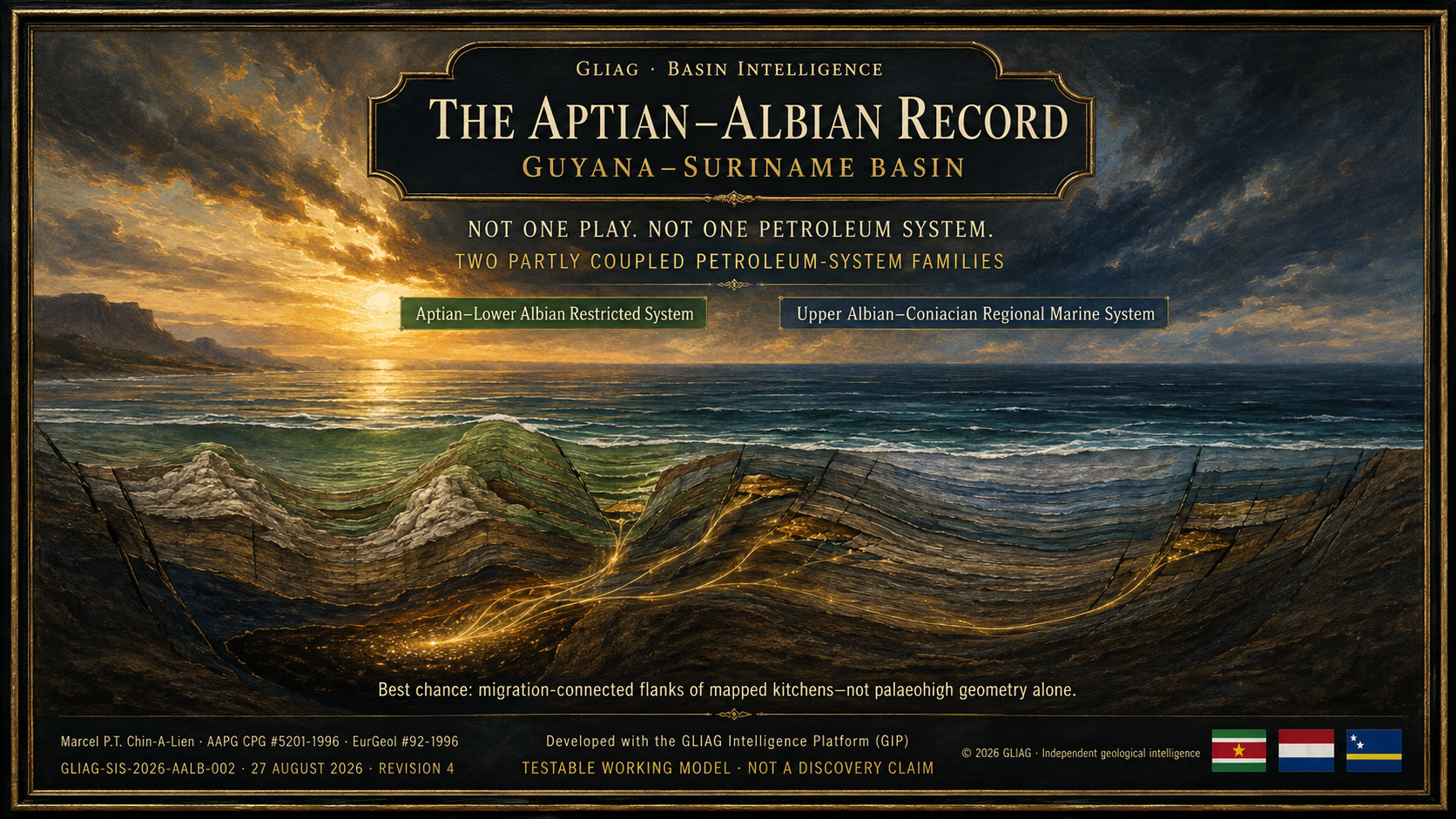
The Aptian–Albian of the Guyana–Suriname Basin is not one play and should not be forced into one petroleum system. It is a diachronous, tectonically segmented transition from syn-rift and transform-margin relief to post-rift drowning. The interval can act as source, reservoir, seal, carrier and overburden in different places. The public evidence is most consistent with two partly coupled petroleum-system families—an Aptian to Lower Albian, locally restricted system and a younger Upper Albian–Coniacian regional marine system—sharing some migration corridors and reservoirs. This is a testable working model, not a discovery claim.
1. Executive thesis · 2. Scope and definitions · 3. Regional tectonostratigraphic framework · 4. Evidence hierarchy · 5. Drilled-well inventory · 6. Suriname calibration · 7. Guyana calibration · 8. Demerara Rise scientific drilling · 9. Carbonates, clastics and source rocks · 10. Petroleum-system synthesis · 11. IMAGE 2026 evidence audit · 12. GeoAtlas extraction · 13. TotalEnergies evidence boundary · 14. Coupled-system hypothesis · 15. Golden Lane interpretation · 16. Falsification tests · 17. GIP implementation · 18. Exploration implications · 19. Commercial-discovery thesis · 20. Conclusions · References · Author note · Disclaimer
The basin’s commercial history has conditioned geoscientists to read the Cretaceous primarily through the successful Cenomanian–Turonian/Upper Cretaceous source-to-turbidite system. That success is real, but it can obscure an older and more heterogeneous exploration object: the Albian.
The public record supports five defensible conclusions.
Albian strata are regionally proven. Industry wells on the Guyana and Suriname shelves, deep wells on or adjacent to the Demerara Plateau, and all five Ocean Drilling Program Leg 207 sites collectively establish an Albian basin record.
The Albian is genetically heterogeneous. It includes syn-rift or breakup-related deposits, shallow-marine and marginal-marine strata, carbonates on structural highs, siliciclastic reservoirs, organic-rich source rocks and condensed or eroded intervals.
The Albian petroleum contribution is not restricted to reservoir. At NCO-1 and in regional source-rock studies, Albian organic-rich intervals may be more important as charge than as reservoir. Elsewhere, Albian sandstones or carbonates provide possible reservoir intervals.
Carbonate presence is not reservoir proof. A2-1 demonstrates the danger directly: Lower Cretaceous shallow-water carbonates were penetrated, but the prospect reportedly failed for lack of effective reservoir.
No public dataset presently validates a regional commercial Albian reef play. Ranger-1 is an important Lower Cretaceous carbonate discovery, but published work dates the principal carbonate reservoir as Aptian. It is a bounding analogue, not permission to relabel every seismic mound Albian reef.
Revision 2 adds a sixth conclusion. The Aptian and Albian must be evaluated both separately and as a coupled charge architecture. The 2026 Staatsolie-led work identifies an Aptian petroleum system using source penetration, gas and regional oil correlation, while the GeoAtlas and scientific drilling document several younger Albian–Coniacian organic-rich acmes. A single undifferentiated “ACT source” is therefore convenient for mapping but too coarse for prospect risking, oil-family correlation and charge timing.
Accordingly, the correct GLIAG/GIP classification is:
Aptian petroleum system: supported by direct source penetration and regional fluid correlation. Albian petroleum-system participation: proven regionally. Aptian–Albian reservoir presence: locally proven or indicated. Commercial Albian carbonate/reef province: unproven.
This study uses “Guyana–Suriname Basin” for the linked passive-margin system offshore Guyana and Suriname, including the Demerara Plateau/Rise scientific-drilling transect because it is indispensable to Albian age, facies and oceanographic calibration. French Guiana exploration wells are not included in the core commercial inventory where public formation tops are unavailable. The Demerara High is not treated as a regional mature kitchen.
Three naming distinctions prevent avoidable errors:
Albian is the youngest stage of the Early Cretaceous, approximately 113–100.5 Ma in the current international timescale.
Albion-1 is a named 2005 Guyanese Berbice Block well. Its name does not establish an Albian penetration.
ACT is used here as a practical Albian–Cenomanian–Turonian source-rock family, but it must not erase event-scale differences among OAE1b, OAE1d, OAE2 and intervening intervals.
“Drilled Albian” is assigned only where a publication, official atlas, well correlation, biostratigraphic study or geological synthesis places the borehole in Albian strata. Wells reported only as “Cretaceous,”“Lower Cretaceous,” or “Early Cretaceous” are retained as boundary controls until their tops are verified.
3. Regional tectonostratigraphic framework
The Albian interval records the final mechanical and oceanographic transformation of the margin. Regional syntheses describe Jurassic–Early Cretaceous rifting, subsequent Equatorial Atlantic opening, breakup-related uplift and erosion, and eventual post-rift thermal subsidence. The Suriname GeoAtlas maps Early Albian dextral pull-apart/transpressional deformation and fracture zones, followed by Late Albian tectonic relaxation and passive-margin sedimentation.
This evolution creates four distinct geological domains:
On the Guyana and Suriname shelves, Albian sections may contain mixed carbonates, mudstones and siliciclastics. Thickness and preservation are controlled by inherited relief, erosional truncation and later subsidence. NCO-1, AKT-1ST2 and historical Guyana shelf wells are the principal controls.
3.2 Break-up unconformity and palaeohighs
The Aptian–Albian break-up unconformity (BUC) is not merely a seismic horizon. It can juxtapose older carbonate or rift strata against younger onlap, focus fluid movement and preserve or destroy porosity. Exposure and erosion make local dissolution possible, but karst cannot be inferred without rock evidence.
The plateau preserves shallow-water Lower Cretaceous carbonate and mudstone successions, but the record is segmented by uplift, erosion, magmatism, transform tectonics and drowning. A2-1 and ODP Leg 207 demonstrate that the plateau is a stratigraphic archive; neither makes the whole plateau a mature source kitchen or effective carbonate reservoir.
3.4 Slope and deep-water fairway
Downdip Albian strata can serve as source, seal and locally reservoir. Their present maturity depends strongly on burial history, especially rapid Neogene sediment loading. This distinction supports Marcel Chin-A-Lien’s west-of-Demerara-High mini-basin concept: charge should be modelled in mapped pods and migration corridors, not spread uniformly across the high.
| Class | Meaning | Examples |
| A — Direct | Cored or logged interval with published age/facies control | ODP 1257A/1258C ammonites; published NCO-1 source data |
| B — Strong regional | Atlas or peer-reviewed well correlation assigns Albian | NCO-1, AKT-1ST2, selected historical Guyana wells |
| C — Boundary control | Lower/Early Cretaceous reached, exact Albian component unresolved publicly | A2-1, Ranger-1, Walker-1, Berbice Block wells |
| D — Unverified | Well name, target concept or corporate claim without public tops | Albion-1 as an “Albian well” solely because of its name |
This hierarchy is essential. “Found carbonate,” “found reservoir,”“found hydrocarbons” and “flowed commercially” are four different statements.
5. Basin-wide drilled-well inventory
5.1 Confirmed or strongly supported Albian controls
| Well/site | Sector | Public Albian status | Principal scientific value | Commercial implication |
| NCO-1 | Suriname shelf/shelf edge | Reached Aptian; sampled Albian source rocks and overlying ACT system | Source quality, maturity, shows, sequence calibration | Proves petroleum-system ingredients, not an Albian carbonate discovery |
| AKT-1ST2 | Suriname outer shelf | TD/termination in Albian above BUC in GeoAtlas correlation | Carbonate–clastic facies, BUC, gas-condensate indication | Important but carrier lithology and dynamic productivity remain unresolved publicly |
| ARA-1 | Eastern Suriname | TD in Albian above BUC; Early Cretaceous limestone facies reported | Eastern facies and structural-high control | No public commercial flow proof |
| CRC-1 | Suriname shelf | Albian interval reported; minor gas in sandstones | Source/reservoir and shallow-shelf calibration | Clastic, not carbonate proof |
| FG2-1 | Suriname | Aptian–Albian clastic reservoirs reported | Reservoir quality and wetness/charge calibration | Strong warning that Albian opportunity is not synonymous with reef |
| Guyana Offshore-1 | Guyana shelf | Early Cretaceous/Albian included in published regional well models | Western shelf subsidence and facies control | Dry; not a play validation |
| Guyana Offshore-2 | Guyana shelf | Early Cretaceous/Albian included in published regional well models | Central shelf correlation | Dry; value is stratigraphic |
| Arapaima-1 | Guyana shelf | Early Cretaceous deposition included in peer-reviewed burial/sedimentation analysis | Thickness, subsidence and western–central margin comparison | Dry with shows context; no commercial Albian proof |
| Essequibo-1 | Guyana shelf | Early Cretaceous/Albian represented in regional model | Shelf evolution and sedimentation rate | Outcome does not establish Albian reservoir |
| Essequibo-2 | Guyana shelf | Early Cretaceous/Albian represented in regional model | Shelf-break correlation and subsidence | Dry; stratigraphic control |
| Abary-1 | Guyana shelf/slope | Deep Cretaceous control; used in Albian–Cenozoic regional correlations | Working petroleum system, overpressure and maturity | Flowed 37° API oil from a younger turbidite; not evidence of Albian production |
| ODP 1257A-C | Demerara Rise | Albian recovered; 1257A has early Late Albian ammonites | Direct age, shallow-marine syn-rift facies, unconformity below black shale | Scientific calibration, not petroleum test |
| ODP 1258A-C | Western Demerara Rise | Albian recovered; 1258C has early Late Albian ammonites | Palaeodepth, age, redox and facies | Scientific calibration |
| ODP 1259A-C | Eastern transect | Basal marginal-marine/tidal-flat interval assigned Albian? | Tests lateral facies variability and age uncertainty | Highlights danger of overconfident tops |
| ODP 1260A-B | Western transect | Albian included beneath CT black shales | Palaeoceanographic and geochemical transect | Scientific calibration |
| ODP 1261A-B | Western transect | Albian included in Leg 207 transect | Shallow-endmember palaeodepth and stratigraphy | Scientific calibration |
5.2 Essential boundary and verification wells
| Well | Why it matters | Correct status |
| Demerara A2-1 | Penetrated Lower Cretaceous–Tithonian carbonates and mudstones; oil shows; only historical well reaching Jurassic in Suriname GeoAtlas | Lower Cretaceous carbonate calibration and negative reservoir case; exact productive Albian interval not demonstrated |
| Galibi Offshore-1 / GO-1 | Appears in regional well correlations and Suriname shallow-water sequence framework | Tops and exact Albian penetration require data-room verification |
| CO-1 / Coronie-1 | Upper Cretaceous shallow-shelf shows and regional correlation | Not automatically an Albian well |
| Albion-1 | 2005 Berbice Block well; reservoir-quality sands and possible shows reported by CGX | Dry hole in official Guyana history; exact Albian age not publicly demonstrated |
| Yakusari-1, Hermitage-1 | Berbice Block wells with reported reservoir-quality sands and possible/trace shows | Early Cretaceous prospectivity claimed; exact age and raw logs needed |
| Mahaica-1, Mahaica-2, Berbice-1/2 | Important legacy shelf wells in regional seismic/well correlations | Include only after formation-top audit; public summaries are insufficient for well-level Albian claims |
| Ranger-1/2 | Hydrocarbons in Lower Cretaceous carbonate over volcanic relief | Published principal reservoir is Aptian; critical analogue but not evidence of an Albian discovery |
| Walker-1 | Suriname Cretaceous carbonate play analogue cited by EAGE | Exact age, reservoir character and commercial significance require operator data |
| DSDP 144 | Demerara Rise legacy scientific hole with Albian source-rock relevance | Scientific source/stratigraphic calibration; details should be integrated with Leg 207 |
Modern deep-water discovery wells are not listed as Albian penetrations merely because their Upper Cretaceous reservoirs overlie an Albian source system. Operators generally do not publish complete TD ages and formation tops. Silence is not evidence.
6.1 NCO-1: the source-rock cornerstone
Elf drilled NCO-1 in 1975 on an Aptian–Albian four-way dip closure. The GeoAtlas reports that it reached Aptian strata, encountered oil and gas shows, and for the first time established mature ACT source rock in this part of the basin. Staatsolie’s published synthesis reports Albian source rocks with TOC up to approximately 5%, excellent oil potential and early-to-peak oil maturity.
NCO-1 therefore supports three propositions: Albian source presence, a working migration system and a strong regional age tie. It does not publicly demonstrate reef facies, open-fracture porosity or commercial Albian deliverability. Older literature also documents hydrocarbon-bearing Turonian sandstones above the Cenomanian source interval. Mixing those younger reservoir shows into an “Albian discovery”would be stratigraphically wrong.
6.2 AKT-1ST2 and ARA-1: BUC and outer-shelf calibration
AKT-1ST2 is arguably the most decision-useful public Suriname control for the Albian play because it terminates in Albian strata above the BUC and intersects carbonate-bearing successions. Reported Albian gas-condensate elevates charge interest, but only raw logs, samples and test data can distinguish carbonate, sandstone, fracture or mixed porosity.
ARA-1 provides an eastern limestone-facies control and an Albian-above-BUC termination. Together the wells show that carbonate deposition/preservation was spatially variable. They do not support extrapolating a continuous porous shelf-edge reef belt.
6.3 A2-1: the necessary negative case
A2-1 penetrated shallow-water Lower Cretaceous carbonates and mudstones and reached Tithonian strata. The target failed through absence of effective reservoir. For play analysis this is not an embarrassment but a vital calibration: depositional carbonate can survive while primary porosity is lost through mud-rich facies, compaction, cementation, pressure solution or unfavourable diagenesis.
6.4 CRC-1 and FG2-1: the clastic correction
CRC-1 reports minor gas in Albian sandstone; FG2-1 reports good-quality Aptian–Albian clastic reservoirs but wetness or inadequate charge. These wells prove that the Albian must be mapped as a mixed depositional system. A carbonate-only play map would erase real reservoir evidence.
The official Guyana Petroleum Management Programme provides dates, operators, positions, water depths and fluid classifications, but generally not full formation tops. The most rigorous regional stratigraphic framework remains the peer-reviewed integration of 16 offshore wells and seismic data by Yang and Escalona, updated by Saul and co-authors.
Historical shelf wells—Guyana Offshore-1/2, Essequibo-1/2, Arapaima-1 and Abary-1—constrain Early Cretaceous subsidence and later margin evolution. Abary-1 is especially important because it established movable hydrocarbons and severe pressure risk, but its reported 37° API flow came from a younger turbidite at about 3,990 m. It should calibrate charge and pressure, not be cited as Albian production.
The Berbice Block record requires unusually careful language. Albion-1, Yakusari-1 and Hermitage-1 reportedly encountered reservoir-quality sands and possible or trace hydrocarbons, yet official history classifies them as dry. Corporate diagrams suggest Early Cretaceous sands, but public biostratigraphic tops and raw logs are not sufficient for an A-class Albian assignment. Albion-1 is therefore a verification target, not linguistic evidence.
Ranger-1 changed the basin’s carbonate conversation by proving hydrocarbons in Lower Cretaceous carbonate over volcanic relief. The strongest published age assignment is Aptian. Its proper scientific role is to prove that non-clastic Lower Cretaceous reservoirs can work locally and to stimulate disciplined Albian comparison—not to prove an Albian reef belt.
7.1 A. Ewan Campbell and the Abary–Mahaica calibration
Dr A. Ewan Campbell—trained at Vrije Universiteit Amsterdam and subsequently associated with TNO and Wintershall in the Netherlands and Wintershall A.G. in Kassel—provides an important independent legacy calibration. His peer-reviewed 2005 study used 29 unmigrated 24-fold 2D seismic profiles together with wireline and lithological logs from Abary-1, Mahaica-1 and Mahaica-2. The work is principally a Cenozoic mixed carbonate–siliciclastic shelf-geometry analysis, but its well framework records Albian carbonates beneath Cenomanian–Turonian siliciclastics at Abary-1.
Campbell’s central result also matters methodologically for the Lower Cretaceous play. Carbonate margins can remain stationary or slightly prograde during relative sea-level rise and tend to stack vertically or reoccupy earlier relief, whereas siliciclastic shelf margins migrate more readily with changing accommodation and sediment supply. Consequently, apparent onlap, downlap or unconformity geometries near a carbonate margin need not record a discrete tectonic or eustatic event; they can arise from the fundamentally different dispersal and growth behaviour of carbonate and siliciclastic systems.
For GIP this produces two safeguards. First, the Abary succession is genuine support for Albian carbonate presence in western Guyana, but not proof of effective carbonate reservoir or commercial productivity. Second, seismic stacking above inherited relief is a predictive facies clue, not a reef diagnosis. Campbell’s well-calibrated geometrical approach should therefore be used alongside petrography, velocity discrimination, diagenesis and charge analysis.
The bibliographic audit identifies Campbell’s relevant Abary work securely as the 2005 Sedimentary Geology article. His VU doctoral qualification and later Wintershall career are corroborated, but an independently catalogued PhD dissertation specifically devoted to Abary-1 has not yet been located; the report therefore does not invent such a thesis title.
8. Demerara Rise scientific drilling
ODP Leg 207 provides the best openly accessible Albian rock and age control in the wider basin. Thirteen holes were drilled at Sites 1257–1261. The eastern transect recovered mid-Albian to Maastrichtian strata; the western transect recovered early Albian to Maastrichtian strata. Ammonites from Holes 1257A and 1258C establish an early Late Albian age and a Tethyan palaeobiogeographic affinity.
The sites record shallow-marine to marginal-marine basal Albian units, unconformable transition into Cenomanian–Santonian black shales, and major lateral variations in sediment thickness and palaeodepth. The scientific result is profound: the Albian was already a spatially differentiated gateway system, not a simple uniform platform.
These cores also impose a maturity caution. Excellent source facies at shallow scientific-drilling burial do not imply present expulsion there. Source presence, richness, maturity and migration access must be mapped separately.
9. Carbonates, clastics and source rocks
Lower Cretaceous carbonate production was favoured on structural or volcanic highs and in areas with restricted siliciclastic dilution. Reservoir quality depends on original texture, exposure, dolomitisation, dissolution, fracture history and burial cement. Seismic relief alone cannot distinguish a reef, carbonate drape, volcanic edifice or erosional remnant.
FG2-1, CRC-1 and the Berbice Block claims demonstrate Albian–Aptian sand potential. Such sands may represent shoreface, deltaic, channel or deeper-water systems depending on position and sequence. Their existence requires GIP to carry parallel Albian clastic and carbonate play families.
Albian organic-rich intervals belong to the broader evolution of restricted circulation and episodic oceanic anoxia preceding OAE2. NCO-1 and DSDP/ODP evidence prove source potential; burial models indicate strong spatial maturity gradients. The label ACT is useful regionally but must not turn every interval into one homogeneous source rock.
10. Petroleum-system synthesis
| Element | Basin evidence | Present interpretation |
| Source | NCO-1 Albian organic-rich strata; Demerara scientific cores; regional geochemistry | Proven regionally, maturity highly variable |
| Reservoir—carbonate | A2-1 carbonate presence but poor reservoir; Ranger Aptian success; AKT/ARA carbonate indications | Locally possible; no public commercial Albian validation |
| Reservoir—clastic | FG2-1, CRC-1 and Berbice claims | Locally proven or indicated; facies and charge vary |
| Seal | Drowning/onlap mudstones and ACT/CT shale packages | Regionally plausible; fault and local top-seal integrity require testing |
| Trap | BUC palaeohighs, four-way closures, stratigraphic pinch-outs, volcanic/structural relief | Multiple styles proven conceptually; preservation varies |
| Charge | Shows in NCO-1 and many shelf wells; Abary flow; regional discoveries | Working system proven; source pod and migration timing are prospect-specific |
| Commerciality | No publicly proven commercial Albian carbonate/reef development | Unproven upside, exclude from base-case resources |
11. IMAGE Houston 2026: what the new evidence actually adds
The official IMAGE 2026 programme is now audited directly rather than inferred from social-media summaries. Five Staatsolie-led contributions concern the basin, but only three bear directly on Aptian–Albian petroleum-system architecture: the Aptian petroleum system, Aptian–Albian carbonate reservoir potential, and Demerara Plateau heat flow. The other Staatsolie contributions—Open-Door access and proven Tertiary shallow-offshore plays—supply licensing and play-context information, not Lower Cretaceous proof.
| IMAGE 2026 contribution | Authors/institutions in official programme | What it can support | What it cannot support publicly |
| Aptian Petroleum System Offshore Suriname, Guiana Basin | D. Biharie, Staatsolie | Recognition of an Aptian system as a separate analytical object | Full well-by-well geochemistry, volumes or commercial discovery |
| Aptian–Albian Carbonate Reservoir Potential in the Guiana Basin, Suriname: Insights from Thin-section Petrography and Seismic Facies Integration | A. Lieveld; B. Vincent, Cambridge Carbonates; M. Kisoensingh; G.A. Hirschfeld; N.M. Sardjoe, Staatsolie | Rock-calibrated carbonate facies and diagenetic/reservoir screening; a materially stronger basis than seismic morphology alone | Regional reservoir continuity, charge, seal, producibility or reserves |
| Hydrothermal cooling and heat-flux anomalies near the Demerara Plateau | G.A. Hirschfeld, M. Sabiran, S. Wood, Staatsolie | Non-uniform heat flow and an improved basis for maturity uncertainty | A uniformly mature Demerara High or a single regional kitchen |
| Suriname Open-Door Offering | S. Kisoensingh, M. Kisoensingh, D. Biharie, Staatsolie | Current acreage and access context | Subsurface validation of any play |
| Proven Tertiary plays in shallow offshore Suriname | M. Kisoensingh, N. Poeketie, C. de Seil, V. Chedi, Staatsolie | Younger-system context and potential vertical charge relationships | Direct Aptian–Albian reservoir proof |
The official programme also contains one TotalEnergies-led Suriname–Guyana paper: an ocean-bottom-node case study on field-development imaging. It demonstrates acquisition and imaging capability in a developed Block 58 context. It is not a public Aptian–Albian petroleum-system synthesis. This distinction matters because corporate participation must not be converted into evidence for an unrelated stratigraphic claim.
The companion 2026 EAGE/SBGf study by M. Sabiran, S. Wood, A. Pepper, L. Heister and D. Biharie is more consequential for charge. Its title explicitly integrates source penetration, gas and regional oil correlation. That combination is the correct evidential pathway for recognising a petroleum system: rock, fluid and correlation together, rather than source richness alone. Until the full analytical tables are released, the public conclusion should remain at system recognition and correlation level.
12. Systematic extraction from the Suriname GeoAtlas
The GeoAtlas does not describe an exclusively carbonate Aptian–Albian margin. Its palaeogeographic, seismic-stratigraphic and well-correlation panels require a mixed, segmented model.
| GeoAtlas observation | Geological consequence | Risk implication |
| Late Aptian–Middle Albian shallow-marine carbonate shelf across much of the Demerara Plateau | Carbonate production was regionally possible on suitable palaeohighs | Distribution is not equivalent to effective porosity |
| Coeval fluvial–deltaic and shallow-marine clastic shelves southward and eastward | Carbonate and siliciclastic reservoir families coexist | GIP must map both; a reef-only screen is incomplete |
| Broad western and northeastern slope, with mini-basins | Local sediment bypass, confinement and organic-rich accumulation are plausible | Source and reservoir fairways may be strongly compartmentalised |
| Break-up uplift, erosion and subaerial exposure | Local karstification and secondary porosity are possible | Exposure surface, palaeorelief and diagenetic preservation must coincide |
| Early Albian dextral pull-apart/transpression, then Late Albian relaxation | Faults can create accommodation, fracture corridors and later seals/onlap | A fault can enhance reservoir and charge, but also destroy seal |
| A2-1 Lower Cretaceous limestone without effective reservoir | Carbonate deposition survived but reservoir quality failed | Mandatory negative analogue for porosity risking |
| FG2-1 good Aptian–Albian clastics; CRC-1 Albian sandstone gas; AKT/ARA carbonate-bearing sections | Multiple reservoir families have well control | Prospect classification must be lithology-specific |
| OAE1b and OAE1d source intervals plus younger OAE2/ACT acmes | Several source pulses exist through Early–Late Albian and CT time | Oil-source correlation and maturity modelling must remain event-resolved |
The Atlas is an authoritative national synthesis, not a substitute for the underlying well logs, core descriptions, thin sections, geochemical tables, velocity models or seismic volumes. “Extracted from GeoAtlas”therefore means that mapped observations and published correlations were captured; it does not mean that every study offered in the Staatsolie data room was acquired or independently reprocessed.
13. TotalEnergies: useful confirmation and a strict public-data boundary
TotalEnergies’ public Suriname releases establish a world-class, commercially progressing Upper Cretaceous deepwater system in Block 58 and continued basin commitment. Published discovery descriptions, however, generally place the named reservoirs in Campanian–Maastrichtian or broader Upper Cretaceous turbidites. Those discoveries validate regional charge, seal and deepwater reservoir competence, but they do not by themselves prove Aptian–Albian reservoirs.
The company’s IMAGE 2026 paper concerns ocean-bottom-node imaging for field development. It can improve structural definition, illumination and reservoir imaging; it does not disclose a Lower Cretaceous source-to-reservoir synthesis. No accessible TotalEnergies public source located in this audit provides the complete Aptian–Albian well-top, petrographic, pressure, test and oil-source-correlation dataset required to declare an Albian carbonate play proven.
The defensible use of TotalEnergies evidence is therefore indirect but valuable:
it confirms that younger deepwater reservoirs receive effective charge in the same basin;
it demonstrates that high-end imaging can resolve development-scale heterogeneity;
it constrains later burial, overpressure and migration history; and
it provides a commercial end-member against which older, less-proven play families must be risked.
Anything stronger would convert corporate presence into stratigraphic evidence and should be rejected.
14. A defensible out-of-the-box model: two coupled petroleum-system families
The preferred working model is a twin-source, dual-reservoir, two-phase charge architecture. It is explicitly a hypothesis for testing.
| Component | PS-A: Aptian–Lower Albian restricted system | PS-B: Upper Albian–Coniacian regional marine system |
| Tectonic setting | Syn-rift/transform, pull-apart and relief-controlled mini-basins | Late-breakup to post-rift drowning and passive-margin subsidence |
| Source style | Local marine/restricted and locally terrestrial organic-rich facies; demonstrated by source penetration and fluid correlation | Regionally extensive marine anoxic acmes, including OAE1d and CT intervals |
| Reservoir candidates | Pre-/syn-BUC carbonates, locally karstified or fractured; coeval clastics | Albian clastics, younger deepwater turbidites and locally reworked/onlap reservoirs |
| Kitchen geometry | Discrete downdip pods; strongly sensitive to heat-flow anomalies | Broader depocentres loaded especially during the Cenozoic/Neogene |
| Charge phase | Potentially earlier and more local; later cracking/gas possible at depth | Important late charge, plausibly including the last several million years in deeply buried kitchens |
| Principal uncertainty | Source continuity, preserved porosity and early trap timing | Event-scale source attribution, migration partitioning and reservoir access |
These systems can be coupled in four ways: stacked source intervals can expel into a shared carrier; the BUC can juxtapose older reservoir against younger seal/source; faults can connect separate kitchens to the same trap; and mixed oils can record more than one source acme. Conversely, they may be decoupled by fault seal, erosional removal, maturity mismatch or diagenetic destruction.
The model yields falsifiable predictions:
oils charged dominantly from PS-A should show a distinct biomarker/isotope family relative to ACTC-dominated fluids;
the best carbonate reservoirs should cluster where exposure/dissolution, brittle structure and later sealing overlap—not wherever a carbonate seismic facies is mapped;
charge risk should increase away from immature structural highs toward calibrated downdip pods, but decline again where overmaturity or seal breach dominates;
some “Albian” shows may prove vertically migrated from younger or older sources, so age of reservoir must never be used as age of source;
mud losses, image-log fractures and seismic damage zones should correlate only where fault-related dissolution is real; any one indicator alone is insufficient.
The minimum discrimination suite is Rock-Eval and kinetics by source acme; biomarker and stable-carbon-isotope oil–source correlation; diamondoids and maturity-sensitive aromatic ratios; gas composition and carbon isotopes; pressure and mud-gas ratios; petrography, cathodoluminescence and fluid inclusions; formation micro-imager logs; and 1D/2D/3D burial, expulsion and migration modelling with alternative heat-flow histories.
15. Marcel Chin-A-Lien and the Golden Lane interpretation
Marcel Chin-A-Lien’s 2008–2010 work should be positioned as an independent, later basin contribution: development, visualisation and application of the Golden Lane as a linked source–migration–reservoir fairway, including a mini-basin or generative pod west of the Demerara High and updip migration toward its flank.
That interpretation adds a crucial constraint to the Albian discussion. The Demerara High itself should not be painted as a broad mature kitchen. The stronger hypothesis is spatially selective:
downdip mini-basin generation → fault or carrier-bed migration → bypass of deep high flanks → updip charge of preserved Albian or younger traps.
This hypothesis is consistent with the need to separate source presence from maturity and reservoir presence from charge. It remains testable through calibrated burial histories, pressure data, oil–source correlation, migration modelling and the distribution of dry wells and shows.
Historical priority must be treated carefully. Earlier basin-scale concepts, including Joshua Rosenfeld’s 1995/1997 presentations, anticipated mature source, Upper Cretaceous fans and possible Albian reef highs. Those ideas and Chin-A-Lien’s later Golden Lane framework are complementary, not identical. GIP should preserve dated provenance levels rather than collapse them into one origin claim.
An Albian prospect should fail the GLIAG screen unless it can answer:
Is the age based on biostratigraphy, sequence correlation or assumption?
Did the well encounter carbonate, reservoir-quality carbonate or producible hydrocarbon in carbonate?
Could the seismic mound instead be volcanic relief, erosional remnant, clastic body or velocity artefact?
Is porosity matrix, intercrystalline, mouldic, vuggy, fractured or a washout artefact?
Did the proposed source reach expulsion before trap formation and before porosity destruction?
Does the charging fault also breach the top seal?
What negative wells constrain the same depositional fairway?
Can the prospect survive a model in which the Demerara High is immature?
Create a basin-wide Albian Well Evidence Layer linked to the Dry-Well Atlas, Source–Charge–Phase layer and Albian Carbonate Play Watch. Each penetration should carry:
official well name, aliases, coordinates, water depth, operator and year;
MD, TVDSS, TD age and age-confidence method;
formation tops and uncertainty;
lithology and depositional interpretation;
source richness, kerogen, maturity and shows;
reservoir type, porosity/permeability and test result;
pressure, losses and drilling hazards;
evidence class A–D and provenance link;
result labels: Observed / Interpreted / Prospective / Proven.
No Albian carbonate volumes should enter the base-case Yet-to-Find estimate until a well demonstrates effective porosity, charge, seal and dynamic productivity. Use it as upside with explicit risking.
17.1 How the GLIAG Intelligence Platform adds value
This study was not assembled as a conventional literature review. Its observations, contradictions, hypotheses and commercial implications were interwoven through the GLIAG Intelligence Platform (GIP). GIP is designed to convert fragmented public geology, national atlases, conference papers, operator disclosures, legacy wells, dry-hole learning and GLIAG’s independent basin concepts into a continuously auditable decision architecture.
The platform’s cutting-edge character lies in integration rather than information accumulation:
provenance before promotion: every material claim is tied to its source and evidence class;
one basin, multiple sovereign datasets: geology continues across national and licence boundaries while legal ownership remains explicit;
petroleum-system coupling: source, maturity, expulsion, migration, reservoir, seal, trap and preservation are evaluated together;
negative evidence as an asset: dry wells and failed reservoir intervals constrain the play rather than disappearing from the narrative;
hypothesis–falsification workflow: attractive concepts are subjected to alternative explanations and kill criteria;
commercial translation: geological uncertainty is converted into decision gates, risked option value and observable de-risking milestones;
living intelligence: new wells, publications and official releases can update the evidence graph without erasing historical provenance.
This architecture gives GIP a defensible advantage over static newsletters, undifferentiated document repositories and headline-driven intelligence products. It does not claim access to data that GLIAG does not possess. Its added value is the disciplined conversion of available evidence into a clearer, faster and more challengeable view of where knowledge is strong, where it is weak, and what decision should follow.
GIP proposition: From scattered information to integrated geological intelligence; from attractive stories to auditable decisions.
The GLIAG Intelligence Platform—including its Guyana–Suriname Basin intelligence layers, analytical essays and premium newsletters—is being prepared for commercial availability to qualified corporate, institutional and professional users. Licensing terms, scope and access conditions will be announced separately through Petroleum & Energy Insights. Academic and capacity-building access can be structured independently in support of GLIAG’s knowledge-sovereignty objectives.
The most defensible future search spaces are:
BUC palaeohighs and onlap pinch-outs along the western and southern Demerara Plateau margin;
fault intersections or relay zones where charge access can be demonstrated without sacrificing seal;
preserved platform-margin or isolated-high carbonates with seismic facies tied to rock data;
Albian clastic fairways mapped independently of the carbonate concept;
transition zones between downdip mature source pods and updip preserved reservoir.
The highest-value next data are not another regional amplitude map, but audited composite logs and biostratigraphy for NCO-1, AKT-1ST2, ARA-1, A2-1, Albion-1 and the legacy Guyana shelf wells; paired with reprocessed 3D seismic, image logs, petrography, pressure and tests.
19. Commercial-discovery thesis: where, why, how and when
This section translates the science into a capital-allocation and exploration sequence. It is play-level prognosis, not an acreage valuation, prospect endorsement, resource estimate or investment recommendation. A commercial discovery requires the simultaneous success of charge, reservoir, seal, trap, timing, retention, scale, deliverability and development economics. The public domain resolves none of these at prospect level.
| Ranked search space | Why it can work | Dominant geological failure | Pre-drill evidence required |
| 1. Western and southwestern flanks of the Demerara Plateau, above mapped downdip mini-basin kitchens | Shorter, structurally plausible migration from buried pods into BUC/onlap traps; relief may preserve carbonate and clastic reservoirs | High may be undercharged; faults may leak; carbonate may be cemented | Calibrated maturity/expulsion model, fault-seal analysis, depth imaging, rock-physics tie and negative-well calibration |
| 2. BUC palaeohighs with demonstrable exposure followed by marine sealing | Exposure can create karst/vuggy porosity; drowning/onlap can provide top seal; several reservoir ages may stack | Seismic mound may be volcanic or tight limestone; karst may be later cemented | Thin-section/diagenetic analogue, inversion tied to wells, velocity discrimination, seal-capacity and charge-access proof |
| 3. Relay zones at intersections of transform-related and margin-parallel faults | Fracture corridors can connect kitchens and enhance carbonate permeability | Same corridor can breach seal or create water-dominated thief zones | FMI, mud-loss and pressure evidence; present-day stress; fault juxtaposition; dynamic connectivity test |
| 4. Aptian–Albian siliciclastic fairways south and east of carbonate-dominated highs | FG2-1/CRC-1-type evidence shows that effective reservoir need not be carbonate; clastics may be easier to image and develop | Wet reservoir, poor trap definition or source bypass | Depositional-element map, sand prediction, DHI calibration where valid, migration-cell modelling |
| 5. Isolated volcanic/structural highs with Lower Cretaceous carbonate drape | Ranger proves that this play family can contain hydrocarbons regionally | Aptian analogue may not transfer; volcanic relief may mimic reservoir and degrade seismic | Age control, facies model, diagenesis, elastic discrimination and prospect-specific fluid prediction |
The most attractive conceptual position is not the crest of the Demerara High itself. It is the charge-accessible transition from a sufficiently buried pod to a preserved updip trap, especially where a mapped carrier terminates beneath a competent younger seal. The Golden Lane hypothesis therefore ranks migration geometry above visual mound appeal.
19.2 Why a commercial discovery is possible—but not yet demonstrated
Four independent observations justify exploration courage: multiple Lower Cretaceous source acmes exist; working petroleum systems are proven across the basin; Lower Cretaceous carbonate and clastic reservoirs occur in wells; and younger commercial accumulations prove long-distance charge and retention in the regional margin system. The missing conjunction is prospect-specific: no public Albian carbonate case yet demonstrates effective pore system, hydrocarbon charge, sealed column and commercial flow together.
The commercial upside is asymmetric. A new Lower Cretaceous play family could open stacked targets beneath established Upper Cretaceous fairways and extend exploration onto structural domains previously discounted. The downside is equally material: deeper targets cost more to image and drill, carbonate quality is discontinuous, and false positives from volcanic relief, velocity effects and tight limestone are credible.
19.3 How to explore without paying for avoidable uncertainty
Use a gated programme rather than a basin-wide drilling wager.
Reconstruct the rocks. Audit biostratigraphy, conventional logs, mud logs, pressure, tests, core, cuttings and thin sections for A2-1, NCO-1, AKT-1ST2, ARA-1, CRC-1, FG2-1 and relevant Guyana/French Guiana controls. Resolve “carbonate” into depositional texture and pore system.
Separate the fluids. Build Aptian, Lower Albian, Upper Albian and CT source organofacies/kinetic models; perform oil–source and gas–source correlations. Do not use reservoir age as a proxy for source age.
Rebuild time. Model alternative heat-flow histories, hydrothermal cooling, burial, expulsion, trap formation and fault reactivation. Require charge after trap creation and before destructive leakage.
Re-image the geometry. Use broadband 3D, FWI/depth imaging and, where justified, OBN to distinguish carbonate build-up, volcanic edifice, erosional remnant and clastic body. Inversion must be blind-tested against wells.
Drill for information and commerciality simultaneously. Select a prospect with stacked objectives and a well design capable of coring, pressure sampling, image logging and dynamic testing. A non-commercial result should still resolve a basin-scale uncertainty.
“When” is controlled by evidence readiness, not calendar optimism. A first dedicated Aptian–Albian test becomes defensible when five gates are passed:
a source pod reaches modeled expulsion under more than one credible heat-flow case;
migration pathways connect that pod to the trap without requiring an unsealed fault;
reservoir prediction is calibrated to rock and at least one relevant well analogue;
trap closure survives depth conversion and velocity uncertainty;
seal capacity and pressure prognosis support both retention and safe drilling.
If these data already exist proprietarily, a prospect could be drill-ready within a normal reprocessing, integration and well-planning cycle. If raw legacy wells must be digitised and new seismic acquired, the rational sequence is multi-year. Publishing a calendar without the gate status would be theatre, not prognosis.
19.5 Investor-facing interpretation
For technically sophisticated investors, the Aptian–Albian should presently be treated as risked option value, not booked value and not base-case resources. Value should rise only at observable de-risking events: release of auditable well control; reproducible source–fluid correlation; calibrated reservoir facies; depth-converted closure; farm-in by a technically capable operator after data-room review; and, ultimately, wireline pressure, fluid sampling and flow testing.
The strongest positive signal is not a promotional seismic image. It is convergence among independent evidence families. The strongest negative signal is repeated failure of reservoir quality or charge in the same fairway. Capital discipline and exploration courage are not opposites: the boldest defensible move is to drill the hypothesis that has survived the most serious attempts to kill it.
Dare-to-explore conclusion: Target the migration-connected flank, not the attractive high in isolation; pursue parallel carbonate and clastic plays; and design the first dedicated well to discriminate petroleum systems as rigorously as it tests a trap.
The drilled record and the 2026 evidence transform the Aptian–Albian from a loosely grouped interval into a legitimate set of petroleum-system hypotheses. They do not transform every Lower Cretaceous seismic feature into a discovery.
The scientific synthesis is therefore deliberately asymmetrical:
The presence of Aptian and Albian strata is proven regionally, with unequal well control.
A distinct Aptian petroleum system is strongly supported by source penetration and regional fluid correlation, although the full public analytical dataset remains incomplete.
The presence and quality of Albian source rock are proven locally and regionally supported.
Albian clastic reservoir is locally indicated or proven by well data, although commerciality varies.
Albian carbonate deposition is geologically credible and locally constrained.
Commercial Albian carbonate/reef productivity is not demonstrated publicly.
That is not a negative conclusion. It defines a frontier play correctly. The next breakthrough will come not from repeating “reef,” but from integrating age, facies, diagenesis, pressure, charge, seal and dynamic performance at the well scale.
Final GLIAG judgment: The Aptian–Albian contains at least two partly coupled petroleum-system families, locally proven source and reservoir intervals, and an unproven but technically credible commercial carbonate-and-clastic frontier. Its best chance lies on migration-connected flanks of mapped kitchens, not on palaeohigh geometry alone.
This conclusion illustrates the purpose of GIP. The platform does not promise certainty where the rocks and the public record do not provide it. It creates competitive added value by identifying the precise observation, missing dataset or technical test capable of changing a geological interpretation—and therefore a capital decision. That is the standard by which GLIAG intends to remain ahead: not by publishing more noise, but by converting evidence into earlier, sharper and more defensible insight.
References and trusted source base
Staatsolie, Suriname GeoAtlas, 2025 edition, tectonostratigraphy, palaeogeography, facies, well history and correlation chapters.
Staatsolie Hydrocarbon Institute, Geology.
Staatsolie GeoPortal, Sequence Stratigraphy 2022—shallow and deep-water well framework.
Yang, W. & Escalona, A. (2011), Tectonostratigraphic evolution of the Guyana Basin, AAPG Bulletin, 95, 1339–1368.
Saul, D. et al. (2026), Tectonostratigraphic evolution of the Guyana Basin, Basin Research.
Trude, K. et al. (2023), The structure and tectonics of the Guyana Basin, Geological Society Special Publication 524.
Ocean Drilling Program Leg 207, Initial Reports—Demerara Rise.
ODP Leg 207, Preliminary Report.
Owen, H.G. & Mutterlose, J. (2006), Late Albian ammonites from offshore Suriname, Cretaceous Research.
Graindorge, D. et al., Demerara Plateau tectono-stratigraphic synthesis.
Reuber, K. et al. (2016), Demerara Rise, offshore Suriname: magma-rich transform margin, Interpretation.
Staatsolie (2016), Vision 2030: contributions of petroleum geology,Netherlands Journal of Geosciences.
Raghubir, S. et al. (2014), Overview of the Cretaceous petroleum systems of the Suriname–Guyana Basin, AAPG Search and Discovery.
Griffith, C. (2019), Albian–Cenomanian–Turonian source rock in Suriname, AAPG Search and Discovery.
Nguyen, B.T.T. et al. (2021), Overpressure evolution offshore Suriname, Basin Research.
Guyana Petroleum Management Programme, Official well activities database.
Guyana Petroleum Management Programme, Summary history of petroleum exploration.
CGX Energy (2020), Berbice Block exploration history and well-log claims.
CGX Energy (2020), Corporate technical presentation.
EAGE (2021), Guyana–Suriname Basin Seminar—carbonate play overview.
Erlich, R.N. et al., NCO-1 and regional wireline/lithology figures, AAPG Memoir 79.
GLIAG, Chin-A-Lien, M.P.T., The Golden Lane—Guyana–Suriname Basin.
GLIAG, Chin-A-Lien, M.P.T., A World-Class ACT Marine Source Rock System.
GLIAG–GIP (2026), Fault–Dissolution in Albian Carbonates Offshore Suriname, internal reference assessment dated 27 August 2026.
IMAGE (2026), Official Technical Program, including the Staatsolie-led Aptian petroleum-system, Aptian–Albian carbonate and Demerara heat-flow presentations and the TotalEnergies OBN case study.
Sabiran, M., Wood, S., Pepper, A., Heister, L. & Biharie, D. (2026),Aptian Petroleum Systems in the Suriname–Guyana Basin: Insights from Source Penetration, Gas, and Regional Oil Correlation, EAGE/SBGf.
Lieveld, A., Vincent, B., Kisoensingh, M., Hirschfeld, G.A. & Sardjoe, N.M. (2026), Aptian–Albian Carbonate Reservoir Potential in the Guiana Basin, Suriname: Insights from Thin-section Petrography and Seismic Facies Integration, IMAGE 2026 official programme.
Casson, M. et al. (2021), Evaluating the segmented post-rift stratigraphic architecture of the Guyanas continental margin,Petroleum Geoscience, 27.
Meyers, P.A., Bernasconi, S.M. & Forster, A. (2006), Origins and accumulation of organic matter in expanded Albian to Santonian black-shale sequences on the Demerara Rise, Organic Geochemistry, 37, 1816–1830.
Krauspenhar, P.M. et al. (2014), Albian palynostratigraphy of ODP Leg 207, Revue de Micropaléontologie, 57, 1–16.
Kulhanek, D.K. & Wise, S.W. (2006), Albian calcareous nannofossils from ODP Site 1258, Revue de Micropaléontologie, 49, 181–195.
Watkins, D.K., Cooper, M.J. & Wilson, P.A. (2005), Calcareous nannoplankton response to late Albian OAE1d, Paleoceanography, 20.
Nemčok, M. et al. (2015), Transform-margin model of hydrocarbon migration: the Guyana–Suriname case study, Geological Society Special Publication 431.
TotalEnergies (2022), Sapakara South-1 discovery description, Block 58, official company release.
TotalEnergies (2025), Expansion into two shallow-water exploration blocks offshore Suriname, official company release.
AAPG Explorer (2026), Offshore Opportunities in Suriname, discussion of Staatsolie basin analysis and Lower Cretaceous play potential.
Shipper, K., Mann, P. & Pepper, A. (2026), Spatial variation in charge risk along the Guyana–Suriname margin, GEO ExPro; public Rock-Eval, maturity and ultimate-expellable-potential synthesis.
Campbell, A.E. (2005), Shelf-geometry response to changes in relative sea level on a mixed carbonate–siliciclastic shelf in the Guyana Basin,Sedimentary Geology, 175, 259–275; seismic and well-log calibration from Abary-1, Mahaica-1 and Mahaica-2.
Marcel P.T. Chin-A-Lien is a consulting petroleum and energy geologist and GLIAG Founding Partner & Chief Architect. His professional record includes approximately five decades in petroleum geology, extensive Venezuelan experience, consultancy to Staatsolie during 2008–2010 and participation in Suriname’s UNCLOS/EEZ work. He developed and applied the Golden Lane framework in the Guyana–Suriname setting during 2008–2010. This essay expresses his independent professional interpretation.
Legal, scientific and reliance disclaimer
© 2026 GLIAG Intelligence B.V. / Marcel P.T. Chin-A-Lien. All rights reserved. This document is an independent geological intelligence assessment based on publicly accessible sources and the Staatsolie GeoAtlas supplied for research. GLIAG is not presently acting as adviser to any named operator, government or licence participant referenced herein. The review includes publicly identifiable IMAGE, EAGE, AAPG, Staatsolie and TotalEnergies materials located by the cut-off date; it does not represent acquisition of every proprietary Staatsolie study-on-offer, operator data-room report or unreleased conference paper. Formation tops, ages, shows and outcomes may be revised when proprietary well, core, seismic, biostratigraphic, geochemical, petrophysical, pressure or test data become available. UEP, generated-hydrocarbon and in-place model outputs are not reserves, recoverable resources or value. This document does not certify reserves or resources and is not investment, legal, fiscal or drilling advice. No party may rely on it for a transaction, licence bid, well decision or public discovery claim without independent technical and legal verification. No reproduction, redistribution or commercial use is permitted without prior written authorisation.
© 2026 GLIAG · Independent geological intelligence · No external reliance without verification