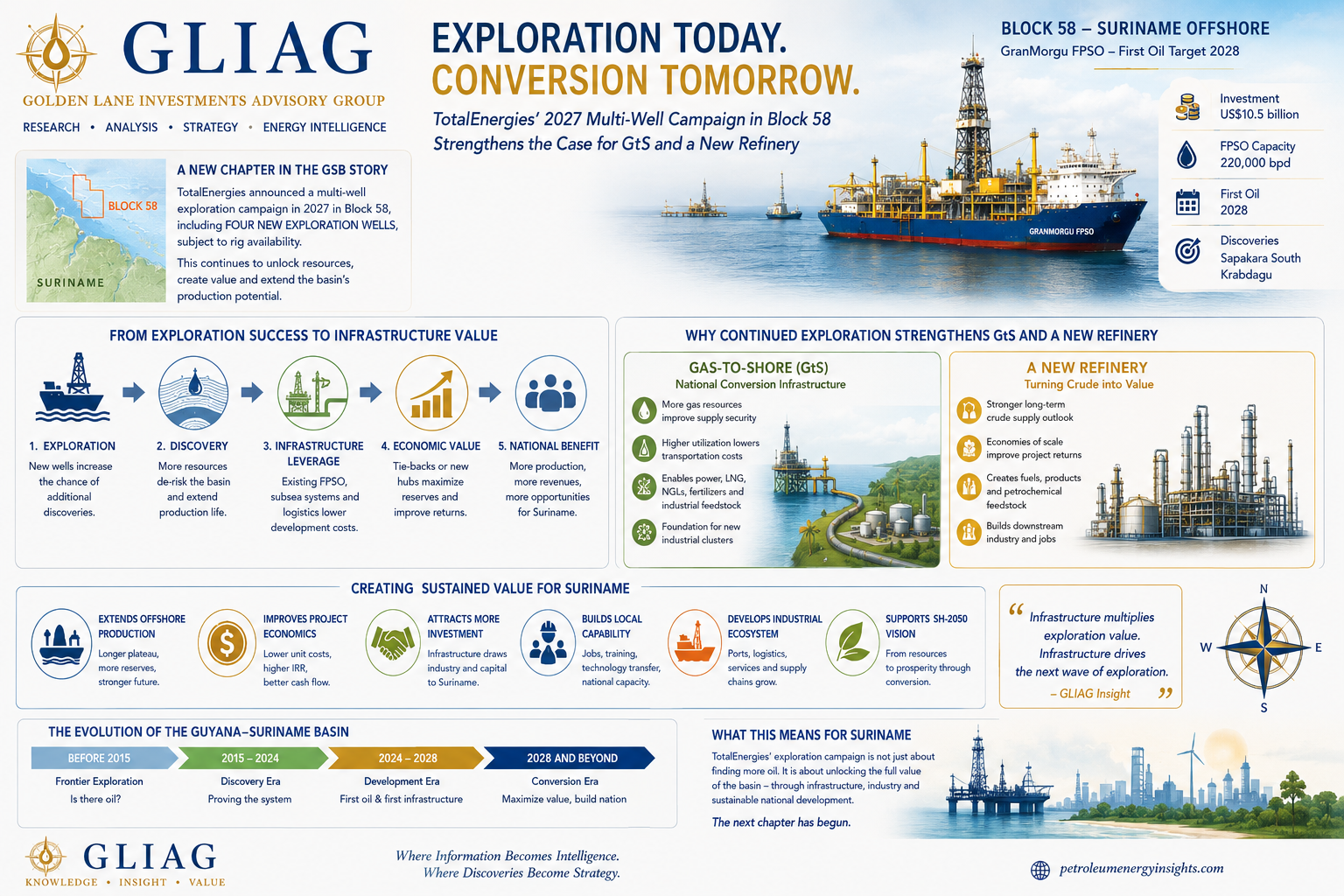
Why Continued Exploration Strengthens the Case for Gas-to-Shore and a New Refinery
TotalEnergies’ planned multi-well campaign is not just an upstream decision. It is a signal that the basin is becoming a production province — and that changes the infrastructure conversation entirely.
Written by Marcel P.T.Chin-A-Lien – Petroleum & Energy Advisor – Founding Partner & Chief Architect of GLIAG – GOLDEN LANE INVESTMENTS ADVISORY GROUP – Est. 2025 ; 6 July 2025
TotalEnergies’ planned multi-well exploration campaign is more than an upstream investment decision.
It is a strong market signal that the Guyana–Suriname Basin is evolving from a frontier exploration province into a long-term production province.
That evolution fundamentally strengthens the strategic rationale for both Gas-to-Shore infrastructure and a new refinery. The logic runs through five distinct mechanisms, each reinforcing the next.
01 – Exploration Reduces Infrastructure Risk
Every new discovery increases confidence that offshore production will continue well beyond the initial GranMorgu development. Longer production lives justify long-lived national infrastructure, including Gas-to-Shore pipelines, gas processing facilities, power generation, LNG and NGL recovery, crude gathering, storage and export infrastructure, and ultimately a modern refinery.
Infrastructure becomes more bankable when multiple fields can utilize it rather than relying on a single development.
02 – Infrastructure Creates a Virtuous Investment Cycle
The relationship is reciprocal. Initially, exploration justifies infrastructure. Later, infrastructure attracts more exploration. Once pipelines, processing plants, ports and industrial facilities exist, smaller discoveries become commercially attractive through lower development costs.
EXPLORATION
→
INFRASTRUCTURE JUSTIFIED
→
INFRASTRUCTURE BUILT
SMALLER FIELDS BECOME COMMERCIAL
←
LOWER UNIT DEVELOPMENT COST
←
INFRASTRUCTURE IN PLACE
Observed in the North Sea, the Gulf of Mexico, offshore Brazil and offshore Angola. The Guyana–Suriname Basin is entering the same phase.
03 – Gas-to-Shore Is No Longer a Single-Field Project
One of GLIAG’s central propositions has been that Gas-to-Shore should be viewed as national conversion infrastructure, not merely as a transportation pipeline. Continued exploration supports this vision because additional discoveries can:
- Increase future gas supply
- Improve pipeline utilization
- Reduce unit transportation costs
- Support domestic electricity generation
- Provide feedstock for petrochemicals and fertilizers
- Underpin new industrial clusters
The value of Gas-to-Shore grows as the basin grows.
04 – The Business Case for a New Refinery Becomes Stronger
The same logic applies to refining. If exploration continues to expand recoverable resources, Suriname’s long-term crude production outlook becomes more robust. A refinery should therefore not be evaluated solely on GranMorgu production. Its business case improves when considering:
- Future Block 58 tie-backs
- Additional discoveries in Block 58
- Block 52 oil developments
- Future discoveries elsewhere offshore
- Possible regional crude supply from the Guyana–Suriname Basin
A refinery becomes an integral component of a broader conversion economy, transforming hydrocarbons into higher-value products, industrial capability and economic diversification.
05 – Exploration Creates Demand for Industrial Capability
Every additional offshore project increases demand for engineering services, fabrication yards, logistics bases, calibration laboratories, inspection and certification, maintenance providers, ports, marine services, digital operations, and technical education.
This is precisely the industrial ecosystem envisioned in SH-2050. The objective is not simply to produce more oil, but to convert offshore resources into sustained national capability.
GLIAG CONCLUSION
TotalEnergies’ exploration campaign is not merely about finding additional barrels. It reinforces a much broader strategic reality. Every new offshore discovery strengthens the economic foundation for Suriname’s next generation of infrastructure.
- Gas-to-Shore becomes more viable because additional gas resources improve utilization and lower long-term costs.
- A new refinery becomes more compelling because a growing resource base enhances feedstock security, economies of scale and investment confidence.
- Industrial infrastructure becomes increasingly bankable as multiple developments share common facilities and services.
In GLIAG’s strategic framework, this is the transition from an Exploration Economy to a Conversion Economy.
EXPLORATION
Creates Resources
INFRASTRUCTURE
Converts Resources into Value
INDUSTRY
Converts Value into Prosperity
GLIAG INSIGHT
Continued exploration in Block 58 should not be viewed as an isolated upstream event.
It is another building block in Suriname’s long-term journey toward becoming a fully integrated energy and industrial nation under SH-2050.
The instinct is to read an exploration campaign as an upstream story — wells, seismic, reserves. The more accurate reading is downstream: every barrel and every cubic foot confirmed offshore lowers the risk profile of the infrastructure decisions still to be made onshore. That is the mechanism by which a drilling program in Block 58 becomes, quietly, an argument for a refinery final investment decision years later.
Soso Lobi.
GLIAG
Golden Lane Investments Advisory Group — Independent Strategic Petroleum Advisory, Guyana–Suriname Basin