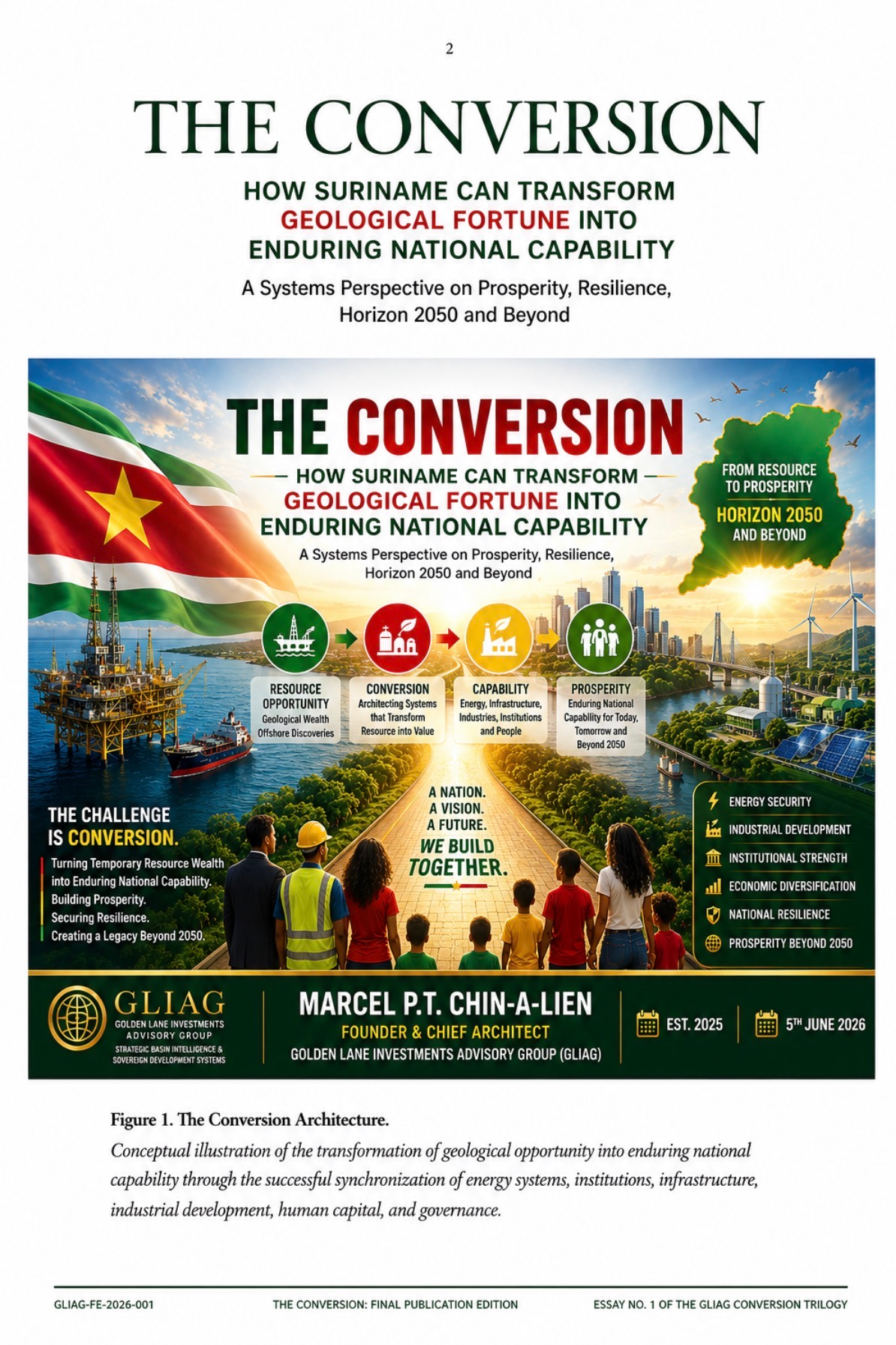
How Suriname Can Transform Geological Fortuneinto Enduring National Capability
A Systems Perspective on Prosperity, Resilience, Horizon 2050 and Beyond
Document ID: GLIAG-FE-2026-001
Classification: GLIAG Mini-Flagship Essay
Edition: Final Publication Edition
Series: Essay No. 2. of The GLIAG Conversion Trilogy (3)
Date: 5 June 2026
Author: Marcel P.T. Chin-A-Lien – Founder & Chief Architect, Golden Lane Investments Advisory Group (GLIAG)
Insights emerge where disciplines intersect.
DISCLAIMER
This publication is intended for educational, analytical, and strategic-discussion purposes. It reflects the authors interpretation of publicly available information, historical experience, petroleum-system concepts, development literature, and long-horizon systems thinking at the time of writing.
The essay does not constitute investment advice, legal advice, engineering advice, fiscal advice, governmental policy, or a recommendation for any specific commercial, regulatory, or political decision.
References to institutions, countries, projects, companies, or development pathways are presented for analytical and educational purposes only. Any errors or omissions remain the responsibility of the author. The views expressed herein are those of the author and do not necessarily represent the official position of any government, company, institution, or organization.
INTELLECTUAL PROPERTY AND USE NOTICE
This publication is an original work prepared by the Golden Lane Investments Advisory Group (GLIAG).
Reasonable quotation, citation, academic reference, educational use, and non-commercial distribution are encouraged provided appropriate attribution is given to the author and GLIAG.
Commercial reproduction, republication, modification, resale, redistribution under another name, or incorporation into commercial products or services should not occur without prior written permission from the author or GLIAG.
GLIAG encourages the responsible exchange of ideas, knowledge, and public discussion while preserving proper attribution of original intellectual contributions.
ABOUT THE AUTHOR
Marcel P. T. Chin-A-Lien is a petroleum explorationist, strategic energy advisor, and Founder & Chief Architect of the Golden Lane Investments Advisory Group (GLIAG). His professional work has evolved from petroleum exploration and basin intelligence toward integrated energy systems, sovereign development strategy, and long-horizon national transformation thinking.
This essay reflects that journey. It does not seek to replace economic, fiscal, institutional, or governmental planning frameworks. Rather, it offers a complementary systems perspective on how geological opportunity, petroleum development, energy infrastructure, industrial pathways, institutional capability, and national resilience may interact over time.
GLIAG POSITIONING STATEMENT
GLIAG is positioned as a strategic basin-intelligence and sovereign-development advisory platform. Its work focuses on translating subsurface opportunity into national capability through systems thinking, sequencing logic, energy-to-industry conversion, fiscal-governance screening, and long-cycle development architecture.
The central concern is not merely whether resources exist, but how resource opportunities can be converted into durable institutions, productive capacity, energy security, industrial competitiveness, and resilience beyond a single petroleum cycle.
CONTENTS
- Positioning Statement
- Executive Summary
- The GLIAG Conversion Trilogy
- Horizon 2050 Is a Waypoint, Not a Termination Horizon
- Chapter 1 – The Long Accumulation of Value
- Chapter 2 – The Conversion Question
- Chapter 3 – The Conversion Question Is Not New
- Chapter 4 – Lessons from the Hemisphere
- Chapter 5 – From Petroleum Systems to National Systems
- Chapter 6 – The Suriname Window
- Chapter 7 – The Conversion Architecture
- Literature References and Source Base
- GLIAG Flagship Essays and Internal Doctrine Base
- Recommended Citation
- Publication Status
POSITIONING STATEMENT
This essay is not intended as an economic model, a government policy document, or a sector-specific study.
Rather, it offers a systems perspective on a question that increasingly sits at the center of Suriname’s future: how can temporary resource opportunities be converted into enduring national capability?
Recent discoveries offshore Suriname have created extraordinary possibilities. Yet history demonstrates that natural-resource wealth alone does not guarantee prosperity. Across the world, some nations have transformed resource endowments into broad-based development, while others have struggled to convert temporary wealth into lasting capability.
The purpose of this essay is to examine the mechanisms of that conversion.
Drawing upon lessons from petroleum systems, energy development, industrialization, institutional evolution, and long-horizon strategic planning, it proposes that prosperity emerges not from resources alone, but from the successful synchronization of multiple interacting systems over time.
The essay therefore contributes a complementary perspective to the national development conversation: one focused not merely on resources, revenues, or projects, but on the architecture through which opportunity becomes capability and capability becomes prosperity.
EXECUTIVE SUMMARY
CENTRAL THESIS
Prosperity emerges not from resources alone, but from the successful synchronization of the systems that convert resources into productive capability.
Suriname stands at a historic threshold. Offshore discoveries, led by Gran Morgu and potentially followed by additional oil and gas developments, have created opportunities capable of influencing the nation’s trajectory for decades to come.
Understandably, public discussion has focused on revenues, institutions, sovereign wealth, diversification, local content, and economic transformation. These discussions are essential.
Yet beneath them lies a deeper question.
How does a nation convert resource wealth into enduring prosperity?
The central challenge is no longer discovery. The challenge is conversion.
This essay argues that the central challenge facing Suriname is no longer the discovery of value beneath the seabed. That challenge has largely been met. The challenge now is conversion: the conversion of petroleum resources into productive capability, temporary revenues into enduring institutions, energy into industrial competitiveness, opportunity into resilience, and geological fortune into national capability.
The petroleum accumulations now being developed offshore Suriname emerged through the successful interaction of multiple geological systems over immense spans of time, consistent with the petroleum-system framework developed in the exploration literature (Magoon and Dow, 1994). Source rocks, reservoirs, migration pathways, seals, structural traps, and timing all had to function together. The absence of any critical component could have prevented the formation of a significant accumulation.
National development follows a similar logic. Prosperity emerges not because a nation possesses resources, but because multiple systems synchronize successfully over time. Institutions, infrastructure, education, energy, governance, industrial capacity, finance, and innovation must work together. Success depends less on individual projects than on the effectiveness of the system as a whole.
This perspective leads to a central implication: resource wealth should be treated not as an outcome, but as an input. The objective of national development should not be extraction alone, but the accumulation of capability. Major initiatives such as gas monetization, industrial development, infrastructure expansion, and downstream value creation should therefore be evaluated according to their contribution to long-term national capability, not short-term activity alone.
Suriname also possesses an important advantage. Unlike many historical resource producers, it can learn from the experiences of others before the bulk of its petroleum revenues arrive. This creates a rare opportunity to design systems deliberately rather than reactively.
THE GLIAG CONVERSION TRILOGY
The Conversion is Essay No. 1 of The GLIAG Conversion Trilogy, a three-part flagship essay series examining how Suriname can transform geological opportunity into enduring national capability, resilience, competitiveness, and prosperity.
Essay No. 1 ” The Conversion
The foundational essay establishing the conversion doctrine, the petroleum-system analogy, and the conversion architecture through which temporary resource opportunity may become enduring national capability.
Essay No. 2 ” Conversion Mechanisms
The second essay examines the practical instruments through which conversion may occur, including transfer pricing, co-investment structures, sovereign participation models, special economic zones (SEZs), value-capture mechanisms, industrial pathways, and domestic-capital formation.
Essay No. 3 ” Conversion Execution
The third essay focuses on sequencing, implementation architecture, institutional dependencies, the Horizon 2050 pathway, and the practical roadmap for pursuing conversion beyond 2050.
Together, the GLIAG Conversion Trilogy moves from doctrine, to mechanisms, to execution. Its purpose is to examine not merely how resources are discovered, but how temporary geological advantage can be converted into enduring national capability across generations.
HORIZON 2050 IS A WAYPOINT, NOT A TERMINATION HORIZON
STRATEGIC FRAMING
Horizon 2050 is a planning waypoint within a potentially longer petroleum and national-development cycle.
Throughout this essay, Horizon 2050 is used as a strategic planning horizon, not as an assumption regarding the end of Suriname’s petroleum era.
The history of major petroleum provinces suggests that resource development often unfolds across multiple generations. Basins that today rank among the world’s important energy provinces frequently required decades of exploration, appraisal, infrastructure development, technological innovation, and successive phases of growth before reaching maturity.
The Guyana-Suriname Basin remains in the early stages of that journey. Suriname occupies approximately half of this basin, a geological inheritance that places the country near the beginning of a potentially multi-decade petroleum-development cycle.
This creates not only a resource opportunity, but also a time opportunity: the chance to build institutions, skills, infrastructure, energy systems, and industrial capability before the petroleum cycle reaches maturity.
Additional discoveries, new development concepts, advances in recovery technologies, evolving gas monetization pathways, and future exploration success may continue to shape the basin well beyond 2050. From this perspective, Horizon 2050 may represent not the end of a petroleum cycle, but an important milestone within a longer development trajectory.
Similarly, while the pace and character of the global energy transition remain uncertain, hydrocarbons are expected to remain part of the global energy mix for decades to come.
For this reason, the objective of this essay is not to prepare Suriname for the end of petroleum. Rather, it is to explore how the nation can use a potentially long-lived petroleum opportunity to build capabilities, institutions, industries, and systems that remain valuable regardless of how global energy markets evolve.
In that sense, Horizon 2050 is best understood not as a finish line, but as a waypoint.
More Than 200 Million Years AgoPetroleum SystemDiscoveryRevenueEnergyIndustryCapabilityResilienceProsperityHorizon 2050 and Beyond
CHAPTER 1 – THE LONG ACCUMULATION OF VALUE
KEY INSIGHT
Great accumulations emerge when multiple systems synchronize successfully across time.
Suriname stands at the threshold of one of the most consequential periods in its modern history.
The discoveries offshore, including Gran Morgu and the growing promise of additional petroleum and gas resources, have understandably focused national attention on revenues, investment, institutions, diversification, and economic transformation.
These discussions are important.
Yet before discussing revenues, sovereign wealth funds, industrial corridors, or economic diversification, it is useful to step back and consider a larger question.
How does value come into existence?
The answer is neither simple nor immediate.
The petroleum accumulations now being discovered offshore Suriname were not created in a single moment. They are the result of a long chain of interconnected processes operating over immense spans of time.
More than 200 million years ago, the geological foundations of the Guyana-Suriname Basin began to evolve. Ancient environments deposited the organic material that would eventually become source rocks. Tectonic forces shaped basin architecture. Sediments accumulated. Reservoirs formed. Source rocks matured. Hydrocarbons migrated. Traps developed. Seals preserved accumulations. Timing aligned.
Only when these elements functioned together did significant accumulations emerge.
A petroleum system succeeds not because one element is present, but because many elements interact successfully.
A world-class source rock alone is insufficient. An excellent reservoir alone is insufficient. A perfect trap alone is insufficient. Success emerges from synchronization.
This offers a useful analogy. Nature converted the basic ingredients of a petroleum system into offshore petroleum wealth through successful synchronization. Suriname must now continue that conversion path on land: converting petroleum wealth into enduring national capability through the synchronization of institutions, education, energy systems, infrastructure, industrial development, and governance.
This observation contains a lesson that extends beyond geology.
Nations also possess potential. Some possess natural resources. Some possess strategic geography. Some possess human talent. Some possess energy. Some possess institutions. Some possess capital.
Yet history repeatedly demonstrates that possession alone does not create prosperity.
Just as petroleum systems require synchronization, national development requires the successful interaction of multiple systems operating together through time.
Resources alone are not enough. Capital alone is not enough. Infrastructure alone is not enough. Institutions alone are not enough.
The challenge is not merely possession.
The challenge is conversion.
Potential is not prosperity. Resources are not capability. Discovery is not development.
Between potential and prosperity lies a process of conversion.
Nature has already demonstrated what becomes possible when multiple systems synchronize successfully over time. The question now is whether the Republic can do the same.
CHAPTER 2 – THE CONVERSION QUESTION
KEY INSIGHT
The decisive challenge facing Suriname is not the extraction of resources, but the conversion of resources into capability.
History offers a sobering lesson.
The discovery of natural resources does not automatically create prosperity (Auty, 1993; Sachs and Warner, 2001; Ross, 2012).
If it did, every resource-rich nation would be wealthy, diversified, innovative, and resilient.
Yet the historical record suggests otherwise.
Across the world, nations endowed with significant petroleum, mineral, agricultural, or strategic resources have experienced remarkably different outcomes. Some transformed resource wealth into strong institutions, productive industries, technological capabilities, and rising living standards. Others struggled with dependency, volatility, weak diversification, and recurring economic vulnerability.
The difference was rarely the resource itself.
More often, the difference lay in what happened after discovery.
The resource represented potential.
The challenge was conversion.
A resource possesses value. But value alone does not create prosperity. A barrel of oil in the ground generates no schools, no infrastructure, no industries, no innovation, and no competitive advantage. Broader value emerges only when the resource enters a larger system of conversion.
Knowledge possesses value. Yet knowledge alone does not create capability.
Energy possesses value. Yet energy alone does not create prosperity.
Capital possesses value. Yet capital alone does not create development.
In every case, value must pass through a conversion process.
The petroleum era therefore presents Suriname with a challenge that is often misunderstood.
The challenge is not simply how to manage revenues. Nor is it solely how to diversify the economy. Nor is it merely how to avoid the resource curse. These are important questions, but they are secondary to a more fundamental one.
How can Suriname convert geological fortune into enduring national capability?
This essay proposes that capability should become the primary measure of success. Not production alone. Not revenue alone. Not GDP alone. Capability.
The ability of a nation to educate. The ability to innovate. The ability to compete. The ability to build. The ability to adapt. The ability to create value long after the original resource has been depleted.
Viewed through this lens, petroleum becomes something different. It ceases to be the objective. It becomes a catalyst: a temporary but potentially powerful mechanism for accelerating the development of enduring national capabilities.
Many nations have extracted resources. Far fewer have converted resource wealth into capability.
The future of Suriname may depend less on the quantity of hydrocarbons discovered than on the quality of the systems built around them.
The challenge of the coming decades is therefore not simply production.
It is conversion.
The conversion of resources into institutions. The conversion of energy into competitiveness. The conversion of revenues into capability. The conversion of opportunity into resilience. The conversion of geological fortune into national prosperity.
This is the question that leads into the historical and regional lessons that follow.
CHAPTER 3 – THE CONVERSION QUESTION IS NOT NEW
KEY INSIGHT
The challenge facing Suriname has been encountered before. The opportunity lies not in repeating history, but in learning from it.
The central question explored in this essay is not new.
Long before the discoveries offshore Suriname, policymakers, economists, historians, energy thinkers, and development practitioners were already grappling with a fundamental challenge: why do some resource-rich societies transform natural wealth into enduring prosperity, while others struggle to do so?
Across Latin America, the Caribbean, Africa, the Middle East, and elsewhere, generations of scholars have examined the relationship between natural resources and national development. Their conclusions differ in many respects, yet they often converge on a common observation.
Resources alone do not determine outcomes.
The existence of natural wealth does not automatically produce economic diversification, technological advancement, institutional strength, industrial capability, or social progress.
What matters is what happens after discovery: the governance, fiscal, institutional, and productive systems through which resources are converted into development outcomes (Humphreys, Sachs, and Stiglitz, 2007; World Bank, 2009; NRGI, 2014).
What matters is the quality of the conversion process.
Public discussions surrounding petroleum often focus on the resource itself. Understandably so. Discoveries attract attention. Production attracts attention. Revenues attract attention.
Yet history repeatedly suggests that the resource is only the beginning of the story.
The more consequential question concerns the system that develops around the resource.
Some nations viewed resource wealth primarily as a source of income. Others viewed it as a mechanism for building broader forms of national capability. The difference between these approaches often proved significant.
The most successful examples did not simply extract hydrocarbons. They used resource opportunities to strengthen institutions, expand technical competence, invest in education, improve infrastructure, develop industries, and build capabilities that extended beyond the resource sector itself.
In other words, they converted resource wealth into other forms of capital: human capital, institutional capital, industrial capital, knowledge capital, and productive capital.
This observation aligns with the central argument of this essay. Prosperity emerges not from resources alone, but from the successful conversion of resources into enduring capability.
Petroleum resources are finite. Even the largest accumulations are eventually depleted. Institutions can endure. Knowledge can endure. Capabilities can endure. Competitiveness can endure.
The strategic challenge is therefore not merely how to extract resources, but how to use temporary resource opportunities to create lasting forms of national strength.
For Suriname, this historical perspective offers an important advantage. The country enters its petroleum era later than many of the examples that shaped the global debate.
This timing creates a rare opportunity. Suriname is not required to navigate the future without reference points. It can learn from decades of accumulated experience, study successes and failures, identify recurring patterns, and adapt those lessons to its own circumstances.
The challenge is therefore not a lack of knowledge. The challenge is application.
The future of Suriname will depend not simply on what is discovered offshore, but on what is built because those discoveries occurred. If resources represent potential, conversion determines outcome.
CHAPTER 4 – LESSONS FROM THE HEMISPHERE
KEY INSIGHT
Suriname’s greatest advantage may not be its petroleum resources. It may be its ability to learn from those who travelled this path before.
Every generation tends to believe its challenges are unique.
In reality, many of the questions now confronting Suriname have been encountered before, albeit under different circumstances, in different countries, and at different moments in history.
Across the Western Hemisphere, resource-rich nations have followed remarkably different development trajectories. Some converted resource opportunities into broader economic capabilities. Some achieved partial success. Others struggled to transform resource wealth into durable prosperity.
Together, these experiences form a valuable laboratory of development.
Their histories demonstrate that petroleum itself is neither destiny nor development.
Petroleum creates opportunity. What follows depends upon the choices, institutions, capabilities, and systems that surround it.
The experience of Venezuela illustrates one side of the challenge, often discussed within the wider resource-dependence and resource-curse literature (Auty, 1993; Ross, 2012). For much of the twentieth century, Venezuela possessed one of the world’s most significant petroleum endowments. Yet the long-term conversion of petroleum wealth into diversified and resilient national capability proved far more complex than resource abundance alone could resolve.
Trinidad and Tobago provides a different perspective. The country leveraged hydrocarbon resources to develop important industrial capabilities, particularly in natural gas, petrochemicals, and energy-intensive industries. Yet its experience also illustrates the continuing challenge of diversification within resource-dependent economies.
Brazil offers another lesson. Its offshore petroleum success was not simply a consequence of favorable geology, but also reflected long-term institutional, technological, and deepwater engineering capability development (Petrobras, 2026). It also reflected decades of investment in institutions, engineering capability, technical expertise, research, and industrial competence.
Guyana provides the most immediate point of comparison for Suriname. The speed of development following the Liza discovery demonstrated how rapidly a petroleum province can emerge when geology, investment, technology, and execution align.
At the same time, Guyana continues to confront many of the questions now facing Suriname: institutional readiness, energy strategy, industrial development, infrastructure expansion, human-capital formation, and the conversion of resource opportunities into broader national benefits.
Taken together, these experiences reveal a recurring pattern.
The decisive variable is rarely the size of the resource. The decisive variable is the quality of the conversion process.
Countries that focus exclusively on extraction often struggle to achieve broader transformation. Countries that use resource opportunities to strengthen institutions, knowledge, infrastructure, industrial capability, and competitiveness tend to achieve more durable outcomes.
This observation should not be interpreted as an argument for copying any particular model. The objective is not imitation. The objective is learning.
Suriname is not entering a mature petroleum province approaching decline. It is participating in the early development of a basin whose full potential is still being evaluated. At the same time, it possesses the benefit of hindsight.
Few nations have enjoyed both advantages simultaneously.
The discoveries have created the opportunity. The conversion has yet to be completed.
CHAPTER 5 – FROM PETROLEUM SYSTEMS TO NATIONAL SYSTEMS
KEY INSIGHT
Just as successful petroleum accumulations emerge through the synchronization of multiple subsurface systems, enduring prosperity emerges through the synchronization of multiple national systems.
One of the most important lessons from the Guyana-Suriname Basin may have little to do with geology itself. It may have to do with systems.
The offshore discoveries that transformed perceptions of the basin were not created by a single factor; they reflect the interaction of petroleum-system elements that must align through time. They emerged because multiple elements of the petroleum system functioned successfully together. Source rocks generated hydrocarbons. Migration pathways transported them. Reservoirs stored them. Seals preserved them. Geological timing aligned.
The absence of any critical element could have weakened or prevented the accumulation. Success emerged not from one component, but from the successful interaction of many components.
This observation offers a useful perspective for national development.
Nations are also systems.
Economic development does not emerge from a single policy. Industrialization does not emerge from a single project. Prosperity does not emerge from a single resource.
Rather, it emerges through the successful interaction of institutions, education, infrastructure, energy systems, finance, governance, entrepreneurship, technology, and productive industry.
Just as a petroleum system requires synchronization beneath the seabed, a development system requires synchronization above it.
The analogy is not exact. Nor should it be interpreted mechanically. Yet the underlying principle is similar: the quality of the outcome depends upon the quality of the interaction between the parts.
This perspective has important implications for Suriname.
The future success of the petroleum era will not be determined solely by the quantity of hydrocarbons discovered offshore. Nor will it be determined solely by fiscal revenues, sovereign wealth funds, local content requirements, or industrial projects viewed in isolation.
Success will depend upon whether these elements reinforce one another as part of a coherent national system.
Energy must support industry. Industry must support capability formation. Education must support productivity. Institutions must support investment. Infrastructure must support competitiveness. Governance must support confidence.
The objective is not merely growth. The objective is synchronization.
A country can possess energy without competitiveness. Infrastructure without productivity. Revenues without capability. Resources without resilience.
The challenge is to ensure that the components of national development interact successfully and reinforce one another through time.
In this sense, the petroleum discoveries offshore Suriname represent more than a resource opportunity. They represent a systems opportunity.
The petroleum system created the offshore opportunity. The national system must now determine what becomes of it.
CHAPTER 6 – THE SURINAME WINDOW
KEY INSIGHT
Every nation receives opportunities. Few receive opportunities of this magnitude. Fewer still receive them with the advantage of hindsight.
The discoveries offshore Suriname have created a rare strategic moment.
Not simply because hydrocarbons have been discovered. Not simply because future revenues may be substantial. But because multiple trends are converging simultaneously.
A world-class petroleum province is emerging. Large-scale offshore developments are advancing. Natural-gas opportunities are beginning to take shape. Regional energy markets are evolving. New industrial possibilities are appearing.
And, perhaps most importantly, Suriname has the opportunity to learn from the experiences of others before the majority of petroleum revenues arrive.
One of Suriname’s least appreciated advantages may be geological rather than economic.
The nation occupies approximately half of the Guyana-Suriname Basin, a petroleum province that has emerged as one of the most successful new offshore exploration regions of the twenty-first century.
From a geological perspective, the basin does not recognize political boundaries. The same broad petroleum system extends across both jurisdictions, creating a shared geological inheritance that has already demonstrated world-class potential.
Equally important, the basin remains in the early stages of its exploration and production history.
This creates not only a resource opportunity. It creates a time opportunity.
Suriname is not entering a mature petroleum province approaching decline. It is participating near the beginning of what may prove to be a multi-decade cycle of exploration, appraisal, production, gas commercialization, industrial development, and capability formation.
This perspective is strategically significant. The opportunity therefore extends beyond first oil, beyond first revenues, and potentially far beyond Horizon 2050.
The modern offshore development phase was unlocked by the Maka Central-1 discovery, followed by the development trajectory now represented most prominently by Gran Morgu (TotalEnergies, 2024; Staatsolie, 2024; APA Corporation, 2024). Yet from a broader perspective, Maka did not begin the story. It revealed the story.
The geological journey began more than 200 million years ago. Nature has already completed the first conversion. The responsibility for the second conversion now passes to the people of Suriname.
The discoveries have created the opportunity. The conversion remains ahead.
The challenge is whether the various components of national development can advance together.
Can energy strategy and industrial strategy reinforce one another? Can infrastructure and competitiveness reinforce one another? Can education and productivity reinforce one another? Can institutions evolve at the same pace as opportunity?
These are not purely economic questions. They are systems questions.
The answers may determine whether the petroleum era becomes a temporary episode of extraction or a long-term platform for national transformation.
CHAPTER 7 – THE CONVERSION ARCHITECTURE
KEY INSIGHT
The central challenge is not the extraction of petroleum resources, but their conversion into enduring forms of national capability.
If conversion is the challenge, then a natural question follows.
What exactly must be converted?
The answer extends far beyond petroleum itself.
The offshore discoveries represent a form of geological capital. They are valuable. Yet their greatest significance may not lie in the hydrocarbons themselves, but in what those hydrocarbons make possible.
A barrel of oil possesses value. But that value is realized only when it enters a broader system of transformation.
The same principle applies at the national level.
Geological capital must be converted into energy capital. Energy capital must be converted into productive capital. Productive capital must be converted into human capital. Human capital must be converted into institutional capability. Institutional capability must ultimately be converted into resilience, competitiveness, and enduring prosperity.
This sequence is important.
Many discussions surrounding petroleum development focus primarily on revenues, though fiscal-management literature emphasizes that resource revenues are large, volatile, uncertain, and finite, requiring disciplined conversion into broader development assets (IMF, 2021). Revenue is undoubtedly important. Yet revenue represents only one stage in a much larger process.
The objective is not revenue itself. The objective is what revenue enables.
When viewed through the lens of conversion, petroleum ceases to be the destination. It becomes an instrument, a means through which broader national objectives may be pursued.
This observation has significant implications for Suriname.
The success of the petroleum era should not ultimately be measured by production volumes, export revenues, or fiscal receipts alone. These are important indicators. But they are intermediate indicators.
The deeper question is what remains after those revenues have been generated.
What capabilities have been created? What institutions have been strengthened? What industries have emerged? What knowledge has been accumulated? What infrastructure has been built? What resilience has been achieved?
In this sense, the true measure of a petroleum era is not how many barrels are produced, but how much national capability remains after the barrels are gone.
The most successful resource-producing societies understood this principle, either explicitly or implicitly: natural wealth must be governed, sequenced, invested, and transformed into other forms of capital (Humphreys, Sachs, and Stiglitz, 2007; World Bank, 2009; NRGI, 2014). They viewed natural resources not merely as commodities to be extracted, but as opportunities to build broader forms of national strength.
The challenge facing Suriname is therefore not simply to manage a petroleum sector.
It is to design a conversion architecture.
An architecture capable of transforming geological opportunity into long-term national capability.
The ultimate measure of a petroleum era is not the volume extracted from beneath the seabed. It is the capability created above it.
Future generations will not inherit the reservoirs. They will inherit the institutions, infrastructure, knowledge, skills, industries, and systems built during the years when those reservoirs were converted into national opportunity.
Nature spent more than two hundred million years creating the conditions that produced the petroleum accumulations of the Guyana-Suriname Basin. The next chapter of the story will be written on land.
The discoveries have revealed the opportunity. The conversion will determine the outcome.
That is the challenge. That is the responsibility. And that is the opportunity before the Republic.
LITERATURE REFERENCES AND SOURCE BASE
The following references provide the literature and source base for the manuscripts petroleum-system analogy, resource-to-development conversion argument, resource-governance framing, fiscal-management logic, and selected Guyana–Suriname Basin contextual references. They are included to support the essay without expanding its scope.
APA Corporation. 2024. APA Announces Final Investment Decision for First Oil Development Offshore Suriname. Press release, October 1, 2024.
Auty, Richard M. 1993. Sustaining Development in Mineral Economies: The Resource Curse Thesis. London: Routledge.
ExxonMobil. 2026. Guyana Project Overview. Corporate project overview, including Stabroek Block discovery chronology.
Humphreys, Macartan, Jeffrey D. Sachs, and Joseph E. Stiglitz, eds. 2007. Escaping the Resource Curse. New York: Columbia University Press.
International Monetary Fund. 2021. How to Design a Fiscal Strategy in a Resource-Rich Country. IMF How-To Note 2021/001.
Magoon, Leslie B., and Wallace G. Dow, eds. 1994. The Petroleum System ”From Source to Trap. AAPG Memoir 60. Tulsa: American Association of Petroleum Geologists.
Natural Resource Governance Institute. 2014. Natural Resource Charter, 2nd edition. London: Natural Resource Governance Institute.
Petrobras. 2026. Pre-Salt: Dive into This Ultra-Deep Journey. Corporate overview of Brazilâs pre-salt development and deepwater production capability.
Ross, Michael L. 2012. The Oil Curse: How Petroleum Wealth Shapes the Development of Nations. Princeton: Princeton University Press.
Sachs, Jeffrey D., and Andrew M. Warner. 2001. “The Curse of Natural Resources.†European Economic Review 45(4–6): 827-838.
Staatsolie Maatschappij Suriname N.V. 2024. TotalEnergies and APA Corporation Announce Final Investment Decision for Block 58. News release, October 1, 2024.
TotalEnergies. 2024. “Suriname: TotalEnergies Announces Final Investment Decision for GranMorgu. Press release, October 1, 2024.
World Bank. 2009. Extractive Industries Value Chain: A Comprehensive Integrated Approach to Developing Extractive Industries. Washington, DC: World Bank.
GLIAG FLAGSHIP ESSAYS AND INTERNAL DOCTRINE BASE
The following GLIAG essays and internal doctrine papers form part of the cumulative intellectual source base for The Conversion. They are included as institutional references rather than as external literature.
Chin-A-Lien, Marcel P.T. 2026. The Conversion: How Suriname Can Transform Geological Fortune into Enduring National Capability. GLIAG Mini-Flagship Essay, TFCCWV V3 Publication Pass.
Chin-A-Lien, Marcel P.T. 2026. Debt Before Oil, Discipline Before Wealth: Navigating Suriname’s First-Oil Fiscal Claims Stack under SH-2050. GLIAG Flagship Essay / Fiscal Readiness Doctrine.
Chin-A-Lien, Marcel P.T. 2026. From Reservoirs to Republics: Converting Petroleum Systems into Sovereign Development Systems. GLIAG Strategic Intelligence Doctrine Paper.
Chin-A-Lien, Marcel P.T. 2026. The Unveiling Gas Basin: How the Guyana-Suriname Basin is Transitioning from an Oil Province into an Integrated Gas-to-Shore and Industrial Energy System. GLIAG Future Flagship Essay Concept.
Chin-A-Lien, Marcel P.T. 2026. The ICJ Climate Opinion and the Guyana-Suriname Basin: From Petroleum Province to Climate-Governed Energy System. GLIAG Future Flagship Essay Concept.
Chin-A-Lien, Marcel P.T. 2026. Beyond Headquarters – The Institutional Heart of the Guyana-Suriname Basin. GLIAG / SH-2050+ Institutional Development Manuscript Concept.
Chin-A-Lien, Marcel P.T. 2026. Suriname Strategic Execution Package V7: Oil Revenue Engine, Gas Monetization Engine, Industrial Engine, Fiscal and Financial Engine, and Integrated Sovereign Development Architecture. GLIAG Strategic Execution Framework.
Chin-A-Lien, Marcel P.T. 2026. Sloanea Gas-to-Shore Viability – 20% Entitlement vs FLNG + Guyana Berbice Supplement. GLIAG Gas Monetization and Policy Framework.
Chin-A-Lien, Marcel P.T. 2026. GLIAG Strategic Basin Intelligence Doctrine and AI-Native Work Protocol. Institutional Doctrine Note.
Chin-A-Lien, Marcel P.T. 2026. GLIAG Work, Research & Publishing Doctrine. Institutional Operating Doctrine.
RECOMMENDED CITATION
Chin-A-Lien, M.P.T. (2026). The Conversion: How Suriname Can Transform Geological Fortune into Enduring National Capability. GLIAG-FE-2026-001. Golden Lane Investments Advisory Group (GLIAG).
PUBLICATION STATUS
Publication Status:Public Release
Version: Final Publication Edition
Document ID: GLIAG-FE-2026-001
Release Date: 5 June 2026
Series:Essay No. 1 of The GLIAG Conversion Trilogy – GLIAG-FE-2026-001THE CONVERSION: FINAL PUBLICATION EDITION ESSAY NO. 2 OF THE GLIAG CONVERSION TRILOGY (3)