tabroek Depletion, GranMorgu and the Suriname Plateau-Extension Window
GLIAG Flagship Essay · 12 August 2026
GLIAGOGRAPH · Guyana–Suriname Basin Production-Depletion & Fiscal Revenue Outlook
GG-2026-028-GSB · Rev004
Drs. Marcel P. T. Chin-A-Lien, MBA, MSc, Eng.Geologist · Certified Petroleum Geologist (AAPG, 1996)
Chartered European Geologist (EFG, Paris) · Certified Energy Negotiator (AIEN, 2022)
Principal Founding Partner & Chief Architect, GLIAG · Zoetermeer, The Netherlands
The Guyana–Suriname Basin has entered a new analytical phase. For the past decade, the dominant questions were geological: How large is Stabroek? How many discoveries can Guyana make? Will Suriname follow? Those questions have largely been answered. The more important question now is what happens when one of the world’s fastest-growing offshore petroleum provinces begins to mature — and whether Suriname can extend the basin’s production and sovereign-value plateau.
That requires looking beyond discoveries and FPSO nameplate capacities. The basin must now be understood through three interacting curves: recoverable resources, production-depletion, and sovereign fiscal capture.
Stabroek: The Basin’s First Great Production Engine
ExxonMobil continues to describe the Stabroek Block as containing nearly 11 billion oil-equivalent barrels of gross discovered recoverable resource (ExxonMobil). This should not be confused with 11 billion barrels of proved reserves. The distinction matters because a resource base is not identical to sanctioned, developed or booked reserves.
~11 bnBOE GROSS DISCOVERED RECOVERABLE · STABROEK
~900 kb/dSTABROEK PRODUCTION, LATE 2025
1.7 MMb/dINSTALLED CAPACITY TARGET BY 2030
220 kb/dGRANMORGU FPSO · FIRST OIL 2028
The scale is nevertheless extraordinary. By late 2025, Stabroek production had reached about 900,000 barrels per day with the startup of the Yellowtail development — the block’s fourth offshore project — while the block’s eight planned developments were expected to provide approximately 1.7 million barrels per day of installed production capacity by 2030 (ExxonMobil Yellowtail startup release). Capacity, however, is not production.
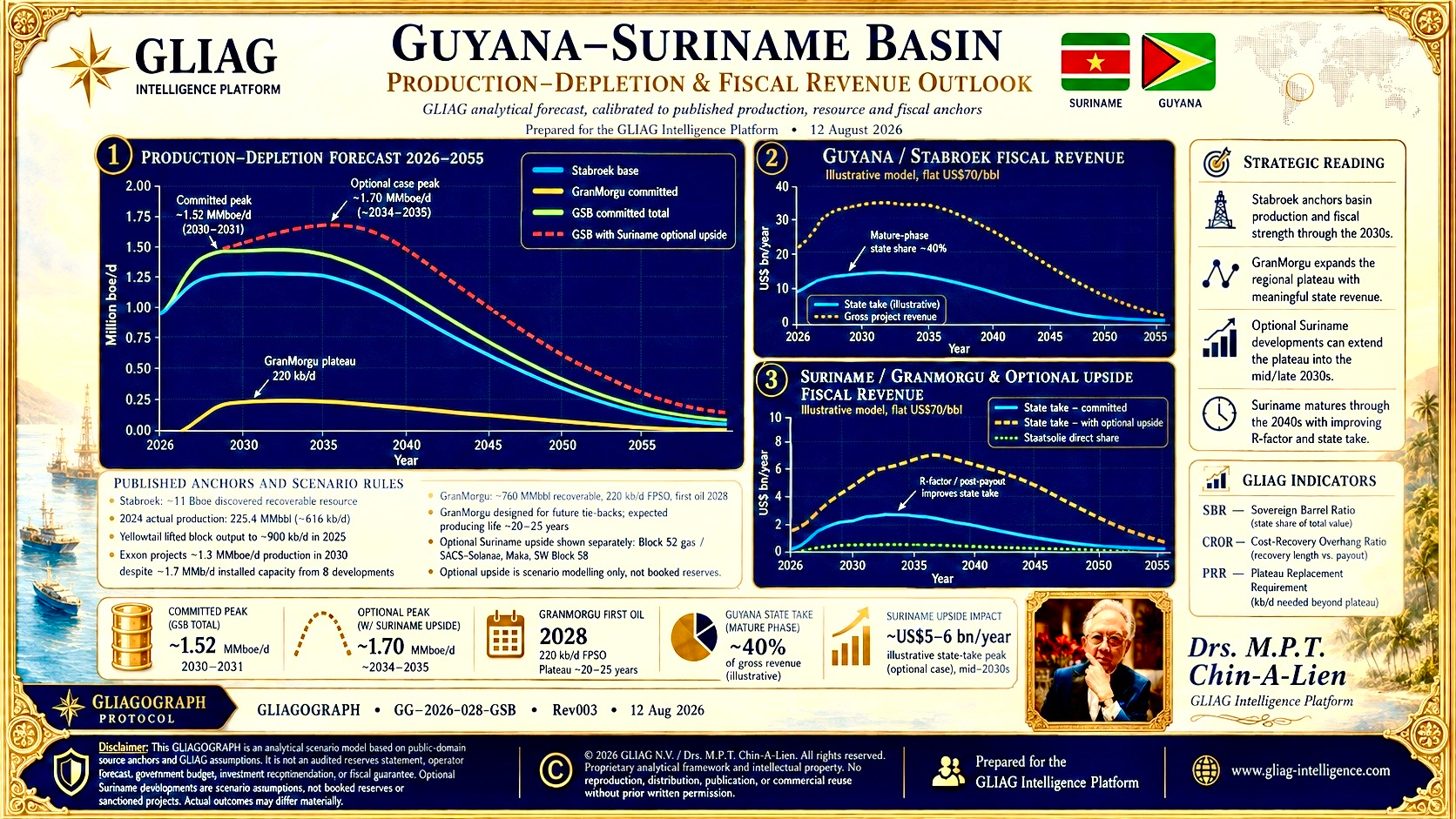
A realistic basin forecast must stack the individual FPSO developments and recognize reservoir decline beneath successive project additions. In the GLIAG central case, Stabroek approaches roughly 1.3 million boe/d around 2029–2034 before entering an increasingly visible structural decline through the 2040s. That is not a prediction of sudden exhaustion. It is the natural evolution of a giant deepwater development system in which older fields decline while later FPSOs, infill wells and tie-backs temporarily replace lost capacity.
GranMorgu Arrives at Exactly the Right Time
GranMorgu changes the regional curve beginning in 2028. TotalEnergies (40%, operator) and APA Corporation (40%), together with Staatsolie (20%), sanctioned a large-scale development based on Sapakara South and Krabdagu, with a 220,000 b/d FPSO and first oil expected in 2028 (TotalEnergies; APA Corporation FID announcement). The project is built around roughly 750–760 million barrels of recoverable oil, and the FPSO is designed to accommodate future satellite tie-backs (APA Corporation).
GranMorgu therefore should not be viewed as a simple 220-kb/d addition operated by a single company. It is the beginning of a Suriname offshore production system, sanctioned jointly by an operator and a co-equal partner alongside the national oil company. In the GLIAG committed case, Stabroek plus GranMorgu reaches approximately 1.5–1.52 million boe/d around 2030–2031. GranMorgu does not replace Stabroek; it broadens the regional plateau.
Guyana creates the basin peak. Suriname may determine how long that peak survives.
The Suriname Plateau-Extension Window
The most interesting period may be 2030–2040. Beyond committed GranMorgu production, Suriname retains several possible sources of additional supply: the Block 52 gas development around Sloanea, where a Declaration of Commerciality was approved in November 2025 (Staatsolie), and the nearby SAC-1 gas discovery announced in June 2026 (PETRONAS); future Block 58 satellites such as Maka, a discovery that remains separate from the sanctioned Sapakara South / Krabdagu pair and is not yet committed as a tie-back; and additional discoveries capable of being integrated into existing or future production hubs.
These are not booked reserves and must not be presented as sanctioned production. But scenario modelling demonstrates their strategic importance. A moderate sequence of additional Suriname developments could lift the regional production envelope from roughly 1.52 MMboe/d in the committed case toward approximately 1.7 MMboe/d in the middle of the 2030s, while materially flattening the subsequent decline.
Production Is Only Half the Story
There is an equally important fiscal transformation underway. Guyana demonstrates that sovereign value does not track gross production mechanically. During the early development years, large volumes of project revenue are absorbed by cost recovery. As those capital pools are recovered, a larger fraction of each produced barrel becomes profit oil and therefore sovereign revenue.
Suriname enters GranMorgu with a different fiscal architecture. Staatsolie states that Block 58 contains a 6.25% royalty, profit-oil distribution governed by the R-factor, and 36% income tax, producing an estimated total government take of approximately 60–70% after costs, depending on oil price (Staatsolie).
GranMorgu therefore has its own economic life cycle. The highest-value period for Suriname may occur after first oil, when production remains strong but the cost-recovery burden has materially declined. This is the beginning of what GLIAG describes as the Sovereign Barrel Acceleration Phase.
GRANMORGU · SOVEREIGN BARREL LIFE CYCLE
- First oil
- Cost recovery
- Improving R-factor
- Expanding government share
- Mature sovereign cash flow
- Depletion
The gold nodes mark the Sovereign Barrel Acceleration Phase — the window in which strong production and a materially reduced cost-recovery burden coincide. It is the period national planning should be built around, not the first-oil date.
The Basin Should Now Be Managed as a Time System
The Guyana–Suriname Basin should no longer be analysed merely by discovery count, reserves or FPSO capacity. The more useful questions are how much production must be replaced each year to prevent basin decline; how quickly cost recovery converts gross production into sovereign barrels; when additional Suriname developments should be sanctioned to enter service as Stabroek declines; and how sovereign barrels should be converted into national industrial capacity rather than simply exported.
That links offshore production directly to refining, gas-to-industry, power generation, petrochemicals, infrastructure and sovereign wealth accumulation. It turns petroleum development from a sequence of isolated projects into a basin-scale timing problem.
The GLIAG Thesis
The Guyana–Suriname Basin is moving from a discovery story into a depletion-and-conversion story. Stabroek remains the dominant production engine and will likely remain so well into the 2030s. GranMorgu becomes the second major engine from 2028. But the strategic prize for Suriname lies beyond GranMorgu itself.
If additional Suriname projects are discovered, sanctioned and sequenced intelligently, they can arrive just as the first great Stabroek developments begin structural decline. The future of the basin may therefore be summarized in one sentence:
Guyana built the peak. Suriname has the opportunity to extend the plateau — and convert that extension into sovereign industrial power.
That is no longer primarily a geological proposition. It is a question of timing, depletion management, fiscal architecture and national strategy.
ANALYTICAL BASIS
The scenarios and depletion timing presented in this essay are not headline extrapolations. They are drawn from continuous tracking maintained inside the GLIAG GSB & South America Intelligence Platform™ — GLIAG’s proprietary, provenance-governed data architecture that integrates wells, licence blocks, seismic, discovery resources, drilling activity, infrastructure, depletion curves, and fiscal/PSC economics across the Guyana–Suriname Basin and the wider South American petroleum landscape into a single evidence-graded model. Its daily GLIAG Basin Watchmodule extends that same discipline basin by basin, country by country, tracking activity from subsurface molecule through commercial conversion into cash flow and sovereign prosperity — high-fidelity, bankable and commercial-grade insight, not headline extrapolation. The Platform currently operates on a founding-partner basis; broader access is under evaluation.
RELATED GLIAG PUBLICATIONS
Readers of this essay may also wish to consult these companion pieces from Petroleum & Energy Insights:
Stabroek, Yellowtail and Guyana production
- Guyana–Suriname Basin: From Discovery to Production Success
- Chevron’s $53 Billion Acquisition of Hess: A Strategic Overview & Stabroek Block Crown Jewel
- Maximizing Yellowtail Reservoir Value Through Stewardship
- Enhancing Suriname’s PSC: Lessons from Guyana’s Stabroek
- Suriname’s Offshore Strategy: Learning from Stabroek Arbitration
GranMorgu development, financing and depletion modelling
- GranMorgu Development: A Comprehensive Reservoir Analysis
- GranMorgu’s Revenue Waterfall: A Look at Suriname’s Future
- Gran Morgu Fiscal Assessment: Economic Insights 2028–2053
- Unlocking Suriname’s Future: Gran Morgu Field Production, Depletion, and Revenue Modelling (2028–2048)
- Gran Morgu Field Production Forecast (2028–2048)
- Understanding Staatsolie’s $1.6B Gran Morgu FPSO — Syndicated Loan Structure
- GranMorgu and Beyond: What Four New Names Indicate
- TotalEnergies’ Bold Move in Suriname: The Baja-1, Block 53 Acquisition Explained
Block 52 and Sloanea gas monetisation
- Sloanea Gas Discovery: Evolution in Petroleum Law
- The Legal Framework for Sloanea Gas Development
- How to Monetise Sloanea?
- Sloanea (Block 52) Gas Development: Analog-Based Production–Depletion Modeling
- Suriname’s Block 52: A Dual-Hydrocarbon Revolution
- Block 52: Unveiling Over 1 Billion BOE in Petroleum Resources
Block 58, Maka and the Golden Lane petroleum system
- The Dawn of Suriname’s Petroleum Era: Maka-1, Block 58
- Wells Drilled in Block 58, Offshore Suriname — A Deepwater Success Story
- TotalEnergies’ Strategic Move in Suriname’s Block 58
Fiscal architecture, PSC design and sovereign strategy
- Fiscal Ring-Fencing in Suriname: Legal Perspectives
- The Urgent Need for a Fiscal Ring Fence in Suriname
- Distinguishing Contractual and Fiscal Rings in Suriname
- The Suriname Model PSC
- Suriname’s PSC Framework: A Competitive Edge
Basin-wide strategy, infrastructure and conversion
- Inventory vs. Accessible Supply: Key Insights for Suriname’s Oil Sector
- The Guyana–Suriname Basin: A Psychological Barrier to Collaboration
- Guyana–Suriname Basin: Time to Build a Refinery Before 2028
- Why Gas-to-Shore Infrastructure and New Refinery are Key to Guyana–Suriname Development
- Transforming Suriname’s Petroleum Wealth into National Capability
- Repricing the Guyana–Suriname Basin: What’s Driving New Proposals?
Related GLIAG intelligence infrastructure
- GLIAG GSB & South America Intelligence Platform™ — GLIAG’s proprietary basin-to-boardroom data architecture referenced under Analytical Basis above; a founding-partner-stage capability, referenced here for context and not offered, marketed or solicited by this essay.
- GLIAGOGRAPH GG-2026-028-GSB (Rev003) — companion one-page visual dashboard presenting the same Guyana–Suriname Basin production-depletion forecast and Stabroek / GranMorgu fiscal-revenue scenarios in graphical form; available on request via GLIAG.
SELECTED PUBLIC-SOURCE ANCHORS
- ExxonMobil — Guyana project overview and Stabroek resource / development context
- ExxonMobil — Yellowtail startup and Guyana production capacity
- TotalEnergies — GranMorgu project overview
- APA Corporation — GranMorgu Final Investment Decision announcement
- Staatsolie — Sloanea gas discovery Declaration of Commerciality, Block 52
- PETRONAS — Block 52 discoveries, June 2026
- Staatsolie — Block 58 fiscal framework / FAQ
ABOUT THE AUTHOR
Drs. Marcel P. T. Chin-A-Lien, MBA, MSc, Eng. is a petroleum and energy advisor and the Principal Founding Partner and Chief Architect of Golden Lane Investments Advisory Group (GLIAG). He is a Geologist by training, a Certified Petroleum Geologist of the American Association of Petroleum Geologists (AAPG, 1996), a Chartered European Geologist of the European Federation of Geologists (EFG, Paris), and a Certified Energy Negotiator of the Association of International Energy Negotiators (AIEN, 2022). His work spans petroleum-systems analysis and subsurface characterisation, TOR / Pre-FEED / FEED project feasibility, bankability and financial-model design, PSC and petroleum-legal frameworks, investor structuring, and multi-country energy-policy analysis, with a particular focus on the Guyana–Suriname Basin and Suriname’s SH-2050 transformation agenda.
ABOUT GLIAG
Golden Lane Investments Advisory Group (GLIAG) is a senior-only boutique Project Management Consultant (PMC) and independent advisor / Owner’s Engineer to sovereigns on major energy and infrastructure programmes, including Suriname’s Gas-to-Shore and refinery workstreams. GLIAG operates on DFI- and World Bank Group-grade compliance standards. GLIAG does not act as a project sponsor, bidder, equity holder, or promoter of any transaction referenced in its publications. The firm is based in Zoetermeer, The Netherlands, and publishes through its Petroleum & Energy Insights platform at petroleumenergyinsights.com.
DISCLAIMER AND LEGAL NOTICE
No advice. This essay is published by Golden Lane Investments Advisory Group (GLIAG) through its Petroleum & Energy Insights platform for informational, educational and strategic-analysis purposes only. It does not constitute, and must not be relied upon as, investment, financial, legal, tax, accounting, engineering, geological, reserves-certification, or professional advice of any kind. It is not directed at, or intended for use by, any person in any jurisdiction where such publication or use would be contrary to local law or regulation.
No offer or solicitation. Nothing in this publication constitutes an offer, solicitation, invitation, inducement or recommendation to buy, sell, subscribe for, underwrite, finance or otherwise transact in any security, commodity, licence interest, participating interest, asset, contract, or instrument. No investment decision should be made on the basis of this document.
Independence of analysis. GLIAG is not a sponsor, bidder, equity holder, agent or placement agent for any project, company, government body or third party referenced in this essay. GLIAG may from time to time provide independent advisory or Owner’s Engineer services to sovereigns and public bodies in the sectors discussed. Where any such engagement is material to the analysis presented, that engagement is disclosed. The views expressed here are those of the author and GLIAG only, and do not represent the views of any client, counterparty, government, operator, licensee or third party.
Sources and third-party information. This essay draws on publicly available corporate disclosures, press releases, regulatory filings, and reputable news reporting cited inline. GLIAG has taken reasonable care in selecting and citing those sources but does not warrant their accuracy, completeness or timeliness. Company names, project names, production figures, financial data, and strategic statements attributed to ExxonMobil, TotalEnergies, APA Corporation, Hess, CNOOC, PETRONAS, and Staatsolie Maatschappij Suriname N.V. and other named entities are drawn from those entities’ own public communications and remain their property; their inclusion is for analytical purposes only and does not imply endorsement of, or by, GLIAG.
Forward-looking statements. Statements in this essay that are not historical facts — including references to future production, investment decisions, project timelines, prices, cash flows, returns, policy outcomes, and sovereign strategy — are forward-looking statements based on current information, judgement and assumptions as of the publication date. Actual outcomes may differ materially due to geological, technical, commercial, political, regulatory, macroeconomic, or force-majeure factors. GLIAG undertakes no obligation to update any forward-looking statement.
Intellectual property. The named doctrines, tests, platforms and analytical frameworks referenced in this essay — including the Sovereign Barrel Acceleration Phase, the GLIAG GSB & South America Intelligence Platform™, the GLIAG Basin Watch, the Sovereign Conversion Doctrine, the Domestic Conversion Test, SH-2050, the Fiscal Ring-Fence, and Gas as Geopolitical Fuel — together with GLIAG’s methodological framing of these concepts, are the intellectual property of Golden Lane Investments Advisory Group. All text, structure, argumentation, and analytical framing in this essay are © 2026 Golden Lane Investments Advisory Group; all rights reserved.
AI / ML training opt-out. The content of this publication may not be used, in whole or in part, to train, fine-tune, evaluate, benchmark, retrieve-augment, or otherwise develop artificial-intelligence or machine-learning systems, models, agents, or datasets, without the prior express written consent of GLIAG. This opt-out applies to text, structure, doctrines and citations, and is asserted under Article 4(3) of Directive (EU) 2019/790.
Attribution. Permitted quotation and citation must use the following form:
Chin-A-Lien, M. P. T., Who Carries the Basin After the Peak? Stabroek Depletion, GranMorgu and the Suriname Plateau-Extension Window, Golden Lane Investments Advisory Group / Petroleum & Energy Insights, GG-2026-028-GSB, August 2026.
Contact. For enquiries regarding this publication, licensing, or GLIAG advisory engagements, contact GLIAG via petroleumenergyinsights.com.
Converting bare headlines into deep strategic, added value.GLIAG · Where Information Becomes Intelligence. Where Discoveries Become Strategy. From Geology to Sovereignty.
Golden Lane Investments Advisory Group N.V. · Zoetermeer, The Netherlands · Paramaribo, Suriname
Petroleum & Energy Insights · petroleumenergyinsights.com
GG-2026-028-GSB · Rev004 · 12 August 2026
Soso Lobi.
© 2026 Golden Lane Investments Advisory Group. All rights reserved.