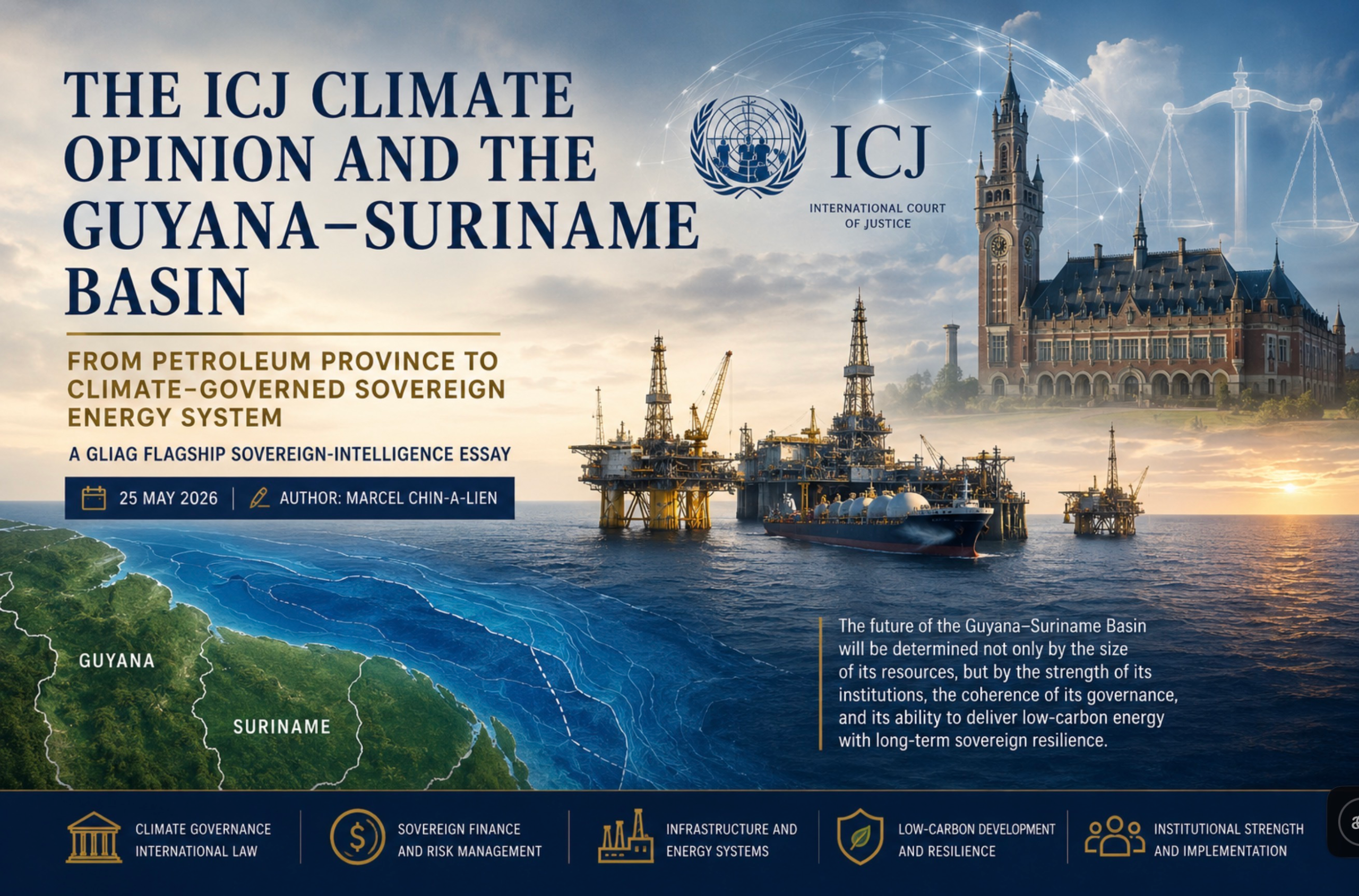
From Petroleum Province to Climate-Governed Sovereign Energy System
A GLIAG Flagship Sovereign-Intelligence Essay
Date: 25 May 2026
Written by Marcel Chin-A-Lien
Founding Partner GLIAG – Golden Lane Advisory Group – Est. 2025
The emergence of the Guyana–Suriname Basin (“GSB”) coincides with one of the most consequential transitions in the modern history of energy systems. Unlike twentieth-century petroleum provinces that matured largely within a hydrocarbon-centric geopolitical order, the GSB is developing during the convergence of climate governance, transition finance, sovereign-risk repricing, infrastructure modernization and institutional transformation.
This paper argues that the strategic challenge facing emerging offshore producers increasingly involves not merely extracting hydrocarbons, but governing synchronized transformation under accelerating climate-governance, financing and implementation complexity.
Increasingly, offshore petroleum development is evolving from a primarily extraction-centered challenge into a governance-and-systems challenge involving institutional synchronization, infrastructure sequencing, sovereign resilience and implementation coherence under accelerating climate-governance complexity.
The future competitiveness of offshore petroleum systems may therefore depend not only on geology or production economics, but on whether sovereign systems can translate offshore resource wealth into resilient infrastructure, institutional coherence, energy-system modernization and long-cycle sovereign resilience before global transition pressures intensify structurally.
I. The Emergence of the Post-Paris Offshore State
The Guyana–Suriname Basin is emerging during a structural reorganization of the global energy system. Unlike many twentieth-century petroleum provinces, the basin is developing after the Paris Agreement, amid expanding ESG-finance systems, under intensifying methane scrutiny and during increasing integration of climate-risk considerations into sovereign and project-finance architecture.
Historically, petroleum competitiveness depended primarily on reserve scale, extraction cost and export economics. Increasingly, however, offshore competitiveness is also evaluated through governance quality, emissions discipline, sovereign resilience, transition compatibility and implementation credibility.
This creates a historically unusual condition: one of the world’s fastest-growing offshore petroleum systems is simultaneously emerging within a climate-governed international order.
Suriname and Guyana are therefore not entering a conventional petroleum era. They are emerging as post-Paris offshore states — developing hydrocarbon systems during a period in which climate governance, sovereign finance, adaptation pressure and transition-era infrastructure demands increasingly interact simultaneously.
II. The ICJ Climate Opinion and the Evolution of Climate Governance
The 2025 International Court of Justice Advisory Opinion on climate obligations does not directly prohibit petroleum development, nor establish a universal fossil-fuel ban. Its significance instead lies in reinforcing the broader trajectory of international climate governance.
The opinion strengthens legal expectations surrounding due diligence, prevention obligations, adaptation responsibilities and climate accountability. The evolving interpretation of “no significant environmental harm,” intergenerational considerations and climate-risk governance increasingly influences how sovereign legitimacy may be evaluated in the decades ahead.
Its influence may ultimately emerge less through immediate judicial enforcement than through gradual integration into sovereign-legitimacy systems, financing frameworks, lender expectations, sovereign-risk evaluation and transition-governance architecture.
For emerging offshore producers, the challenge is increasingly not whether petroleum systems may continue to develop, but under what governance conditions such development remains internationally credible, financeable and resilient over multi-decade horizons.
This distinction is strategically important for emerging offshore producers such as Suriname and Guyana. The issue is increasingly not whether offshore petroleum systems may continue to exist, but whether sovereign systems can demonstrate sufficient governance quality, emissions discipline, institutional coherence and implementation credibility to sustain long-cycle legitimacy within a progressively climate-governed global order.
III. Climate Governance and the Financialization of Legitimacy
Climate governance increasingly shapes offshore development indirectly through capital-allocation systems rather than direct prohibition mechanisms alone.
Institutions such as the IMF, World Bank, Inter-American Development Bank and major commercial lenders increasingly integrate climate-risk exposure, governance quality, resilience architecture and transition compatibility into sovereign and project-risk analysis. Environmental and social frameworks, methane-accountability systems, disclosure expectations and transition-risk methodologies increasingly influence the financing environment surrounding large-scale offshore projects.
Over time, this may influence:
- financing conditions,
- sovereign-risk perception,
- infrastructure funding,
- insurance exposure,
- export-credit support,
- and long-cycle project bankability.
Future offshore competitiveness may therefore increasingly depend not only on geology or production economics, but also on whether sovereign systems are perceived as governable, resilient, financeable and strategically coherent.
In practice, climate governance is progressively becoming embedded within the architecture of sovereign credibility itself.
IV. Governance-Governed Petroleum Systems
The Guyana–Suriname Basin may become one of the first major offshore petroleum provinces required to simultaneously manage hydrocarbon expansion, climate governance, transition finance, adaptation vulnerability, sovereign modernization, infrastructure scaling and institutional transformation from the beginning of its maturation cycle.
This represents a transition from geology-governed petroleum systems toward governance-governed petroleum systems.
Future offshore competition may increasingly become a competition between implementation systems rather than petroleum systems alone.
This increasingly requires what may be termed sovereign synchronization: the ability of states to maintain alignment between offshore expansion, infrastructure modernization, fiscal governance, institutional scaling, adaptation planning and energy-system transformation simultaneously rather than sequentially.
Offshore success may depend not merely on resource quality, but on whether sovereign systems can maintain synchronization between governance systems, infrastructure systems, fiscal systems and long-cycle development priorities while complexity accelerates.
This creates a historically unusual form of offshore-state development: one in which energy systems, climate governance, sovereign finance and adaptation realities evolve simultaneously rather than sequentially.
V. The Sovereign Complexity Era
As offshore systems scale, coordination requirements frequently accelerate faster than institutional adaptation cycles. Electricity systems, sovereign borrowing, industrial policy, adaptation planning, local-content expectations, transmission modernization, workforce development and public-spending pressures may intensify simultaneously during offshore expansion.
Many emerging producers prepare operationally for production growth while underestimating the pace at which governance complexity compounds across infrastructure, energy, fiscal and institutional systems.
This creates a sovereign complexity environment in which implementation stress rises faster than governance adaptation capacity.
In practice, implementation sequencing may increasingly become as strategically important as production sequencing itself.
The sequencing challenge increasingly involves determining which governance systems, fiscal mechanisms, infrastructure platforms and institutional capabilities must mature before offshore acceleration compounds sovereign complexity beyond administrative adaptation capacity.
VI. Suriname’s Strategic Timing Advantage
Suriname may possess a strategic advantage precisely because its offshore systems remain relatively early-stage, its institutional architecture remains shapeable and its infrastructure pathways are not yet fully locked into legacy systems.
This creates an unusual degree of governance plasticity. The country still possesses an opportunity to integrate:
- lower-flaring standards,
- methane-governance systems,
- resilience-linked fiscal architecture,
- climate-compatible project framing,
- adaptation-linked infrastructure planning,
- and transition-compatible bankability logic
earlier than many legacy producers historically did.
This timing dynamic may ultimately become one of Suriname’s most important strategic advantages during the climate-governance era.
At the same time, this opportunity also creates implementation pressure. Offshore acceleration may quickly expose constraints related to transmission modernization, procurement systems, institutional coordination, workforce scaling and absorptive-capacity management if infrastructure and governance adaptation fail to evolve in parallel.
VII. The Strategic Value of Low-Carbon Barrels
The Guyana–Suriname Basin’s relatively low-carbon crude profile may create important strategic advantages within increasingly carbon-sensitive markets. However, low-carbon geology alone is unlikely to guarantee long-cycle competitiveness.
Future competitiveness may increasingly depend on whether low-carbon barrels are matched by methane discipline, lower-flaring systems, infrastructure efficiency, implementation coherence and governance credibility.
In practice, low-carbon geology may prove strategically valuable only when matched by low-disorder sovereign systems capable of sustaining implementation coherence, infrastructure reliability, methane discipline, fiscal resilience and long-cycle institutional credibility simultaneously.
This distinction may become increasingly important as lenders, insurers, investors and governments intensify scrutiny of full-system emissions, operational governance and transition compatibility.
VIII. Gas-to-Shore as Sovereign Energy Architecture
Gas-to-Shore systems should increasingly be evaluated not merely as hydrocarbon monetization projects, but as sovereign energy-system transformation platforms.
For Suriname, imported fuel dependence, electricity affordability, transmission modernization and long-cycle energy resilience remain strategically important national-development considerations. The strategic value of offshore gas may therefore increasingly depend not merely on export potential, but on its ability to stabilize electricity systems, reduce imported fuel exposure, improve affordability, strengthen industrial competitiveness and support broader energy-system resilience.
In this sense, Gas-to-Shore increasingly becomes an energy-sovereignty project rather than a gas project alone.
The strategic importance of this transition may extend beyond energy economics. More resilient and affordable electricity systems may ultimately influence industrial competitiveness, sovereign productivity, infrastructure reliability and long-cycle implementation capacity across broader sectors of the economy.
IX. The Infrastructure-State Interface
Infrastructure is no longer merely technical. Electricity systems, logistics corridors, transmission networks, coastal resilience systems and adaptation-linked infrastructure increasingly become components of sovereign synchronization architecture.
Infrastructure sequencing increasingly influences implementation pacing, institutional coherence, sovereign competitiveness, energy resilience and long-cycle development stability.
For emerging offshore states, infrastructure quality may increasingly become inseparable from sovereign-development quality itself.
This creates what may increasingly be understood as the implementation-state interface: the zone where infrastructure systems, governance systems, financing systems and operational execution capacity converge to determine long-cycle sovereign resilience.
This may become particularly important for climate-vulnerable coastal states where adaptation resilience, energy-system modernization and offshore development increasingly intersect physically, financially and institutionally.
X. The Resilience Window
The period between initial offshore acceleration and full transition-system tightening may represent a limited historical resilience window.
During this period, offshore revenues may still possess the capacity to finance adaptation, modernize infrastructure, stabilize energy systems, strengthen sovereign resilience and improve institutional durability before climate-governance intensity, transition-finance constraints and sovereign-risk pressures tighten further.
For climate-vulnerable developing states such as Suriname, this timing question may become strategically decisive.
The strategic challenge increasingly becomes whether offshore momentum can be converted into durable resilience before implementation pressure and transition constraints intensify structurally.
XI. The Sovereign Implementation Burden
As offshore systems scale, states inherit infrastructure burdens, adaptation burdens, implementation burdens, coordination burdens, workforce burdens and governance burdens simultaneously.
This implementation load frequently remains under-modeled within conventional petroleum-development analysis. Many offshore strategies evaluate projected revenues in detail while underestimating the institutional density required to govern synchronized transformation over multi-decade horizons.
In practice, implementation capacity may increasingly become one of the defining variables separating resilient offshore states from structurally stressed offshore states.
The challenge is therefore not simply generating petroleum revenues, but sustaining coherent implementation systems capable of translating offshore acceleration into long-cycle sovereign resilience.
XII. Strategic Navigation for Emerging Offshore States
The objective of this paper is not criticism alone. Its purpose is to help emerging offshore producers navigate the climate-governance era constructively and strategically.
Potential strategic pathways increasingly include:
- sovereign synchronization councils,
- resilience-linked fiscal systems,
- implementation pacing frameworks,
- methane-governance systems,
- adaptive infrastructure sequencing,
- transition-compatible bankability architecture,
- and offshore-to-resilience allocation systems.
The challenge is no longer simply whether hydrocarbons can be extracted, but whether offshore expansion can be translated into resilient sovereign-development systems before governance, financing and transition pressures intensify globally.
The future strategic advantage of emerging offshore states may increasingly depend on their ability to maintain synchronization between:
- offshore development,
- energy-system modernization,
- infrastructure resilience,
- adaptation planning,
- sovereign finance,
- and institutional scaling
under conditions of accelerating complexity.
XIII. Final Strategic Reflection
The ICJ climate opinion does not eliminate the development pathway of the Guyana–Suriname Basin. Rather, it reinforces the growing importance of governance quality, sovereign synchronization, resilience architecture and transition-compatible development within the next phase of offshore expansion.
The Guyana–Suriname Basin may therefore become one of the defining laboratories of twenty-first-century sovereign energy-state transformation.
Its long-cycle strategic significance may ultimately lie not merely in the scale of its offshore discoveries, but in whether emerging offshore states can successfully synchronize climate governance, sovereign finance, infrastructure modernization, energy-system resilience and implementation capacity under accelerating global transition complexity.
The future competitiveness of offshore petroleum systems may increasingly depend not only on geology and production economics, but on whether sovereign systems can govern synchronized transformation under accelerating climate-governance complexity.
GLIAG’s role is to help emerging petro-states translate international climate law, sovereign-risk evolution and transition-governance complexity into practical development architecture — enabling responsible production, synchronized implementation systems, stronger institutions and long-term sovereign resilience under a changing global rules environment.
XIV. Selected References
The following references informed the broader intellectual, legal, strategic and sovereign-governance context surrounding this publication. They include foundational works related to international climate governance, sovereign development, offshore petroleum systems, climate finance, implementation systems and energy-transition strategy.
International Court of Justice (2025). Advisory Opinion on Climate Change Obligations of States. The Hague: ICJ.
United Nations Framework Convention on Climate Change (2015). Paris Agreement. United Nations, New York.
Intergovernmental Panel on Climate Change (IPCC) (2023). Sixth Assessment Report (AR6) — Synthesis Report. Geneva: IPCC.
World Bank Group (2021). Climate Change Action Plan 2021–2025: Supporting Green, Resilient and Inclusive Development. Washington D.C.: World Bank.
International Monetary Fund (2022). Climate Macroeconomic Assessment Program (CMAP): Staff Guidance Note. Washington D.C.: IMF.
McKinsey Global Institute (2022). The Net-Zero Transition: What It Would Cost, What It Could Bring. McKinsey & Company.
Daniel Yergin (2020). The New Map: Energy, Climate, and the Clash of Nations. New York: Penguin Press.
Vaclav Smil (2017). Energy and Civilization: A History. Cambridge, Massachusetts: MIT Press.
Elinor Ostrom (2010). Polycentric Systems for Coping with Collective Action and Global Environmental Change. Global Environmental Change Journal.
Michal Nemčok et al. (2016). Transform Margin Basins and Petroleum Systems of the Guyana–Suriname Basin. American Association of Petroleum Geologists (AAPG).
About GLIAG
GLIAG is an emerging sovereign-intelligence and strategic advisory platform focused on the intersection of energy systems, offshore development, climate governance, infrastructure transformation and long-cycle state resilience.
Its work concentrates particularly on the Guyana–Suriname Basin and the broader Atlantic-margin transition environment, with emphasis on helping emerging offshore states navigate the growing complexity of climate-governed energy development.
Rather than approaching offshore petroleum exclusively through traditional upstream analysis, GLIAG applies an integrated systems perspective that combines:
- sovereign strategy,
- climate governance,
- energy-transition dynamics,
- infrastructure sequencing,
- implementation systems,
- industrial development,
- financing architecture,
- and institutional resilience.
GLIAG’s approach increasingly emphasizes integrated sovereign-systems intelligence rather than isolated sectoral analysis, reflecting the growing convergence between energy systems, climate governance, infrastructure modernization, sovereign finance and implementation-statecraft.
GLIAG’s objective is not merely to identify risks or structural vulnerabilities, but to help translate them into practical strategic pathways and implementation-oriented solutions.
The platform aims to support governments, institutions, investors and development stakeholders through high-level strategic analysis, sovereign-development frameworks and long-cycle systems intelligence adapted to the realities of emerging offshore producers.
As the global energy system enters a period of accelerating transition complexity, GLIAG seeks to contribute constructively to the development of resilient, credible and future-compatible sovereign energy systems.
Author
M. Chin-A-Lien Founding Partner, GLIAG
Marcel Chin-A-Lien is a strategic energy and sovereign-development analyst with nearly five decades of practical exposure to petroleum systems, offshore development dynamics, energy infrastructure and long-cycle resource-based state transformation.
His work increasingly focuses on the intersection of:
- offshore petroleum systems,
- sovereign energy strategy,
- climate governance,
- infrastructure transformation,
- energy-transition systems,
- institutional resilience,
- and implementation-statecraft.
Over the course of approximately 50 years of professional and sectoral engagement, his experience has included deep exposure to petroleum operations, hydrocarbon systems, offshore basin development, project ecosystems, strategic commercial environments and broader energy-sector evolution.
In recent years, his research and strategic work have increasingly concentrated on the Guyana–Suriname Basin (“GSB”), including:
- offshore petroleum systems,
- Gas-to-Shore architecture,
- sovereign-development frameworks,
- climate-governed energy systems,
- transition-finance dynamics,
- industrialization pathways,
- infrastructure sequencing,
- and long-cycle state-capacity development.
Through GLIAG, he seeks to contribute to a new generation of integrated sovereign-intelligence analysis capable of helping emerging offshore producers navigate the growing complexity of energy transition, climate governance and strategic state development.
His work combines practical petroleum familiarity with systems-level strategic analysis aimed at supporting resilient, future-compatible and implementation-oriented development pathways for emerging energy states.
Disclaimer
This publication has been prepared for informational, strategic and analytical purposes only. The views, interpretations, analyses and strategic perspectives expressed herein reflect the professional and intellectual assessment of the author and GLIAG at the time of writing and do not constitute legal advice, investment advice, financial advice or official policy recommendations.
While every effort has been made to ensure analytical rigor, accuracy and good-faith interpretation, no representation or warranty, express or implied, is made regarding the completeness, reliability or future applicability of the information, assumptions or projections contained in this publication.
The paper addresses evolving international climate-governance dynamics, sovereign-development considerations and offshore energy-transition systems within a rapidly changing geopolitical, financial and regulatory environment. Interpretations of international law, climate governance, financing systems and sovereign-risk frameworks may continue to evolve over time.
This publication is intended to contribute constructively to strategic dialogue concerning responsible offshore development, sovereign resilience and long-cycle institutional readiness within emerging offshore petroleum systems, particularly in the Guyana–Suriname Basin.
Nothing in this publication should be interpreted as criticism of any government, institution, company or development pathway. The intention is to provide constructive systems-level analysis designed to support informed decision-making, strategic preparedness and resilient development planning.
Confidentiality and Proprietary Notice
This publication and its underlying strategic frameworks, analytical concepts, sovereign-development models, systems interpretations and intellectual architecture constitute proprietary intellectual work developed by GLIAG and the author.
All rights are reserved.
No portion of this publication may be reproduced, distributed, republished, commercially exploited or incorporated into derivative strategic, advisory or commercial products without prior written authorization from GLIAG and/or the author, except for limited quotation with proper attribution for academic, journalistic or non-commercial reference purposes.
The concepts, doctrines, terminology, analytical structures and strategic interpretations contained herein are part of GLIAG’s evolving sovereign-intelligence and strategic-advisory platform focused on offshore development, climate-governed energy systems, infrastructure transformation and long-cycle state resilience.
Unauthorized commercial use, replication or strategic appropriation of the proprietary analytical architecture contained in this publication is expressly discouraged.
For advisory collaboration, institutional dialogue, strategic consultation or authorized use inquiries, interested parties should contact GLIAG directly.