GLIAGGolden Lane Investments Advisory Group
PETROLEUM · ENERGY · STRATEGY · FORESIGHT
Block 52: The Emergence of Suriname’s Dual‑Hydrocarbon Province
Why the latest PETRONAS results strengthen the commercial case for Gas‑to‑Shore and a new refinery.
By Drs. M.P.T. Chin‑A‑Lien — Founding Partner & Chief Architect, GLIAG – 5th July 2026
FACTS FIRST
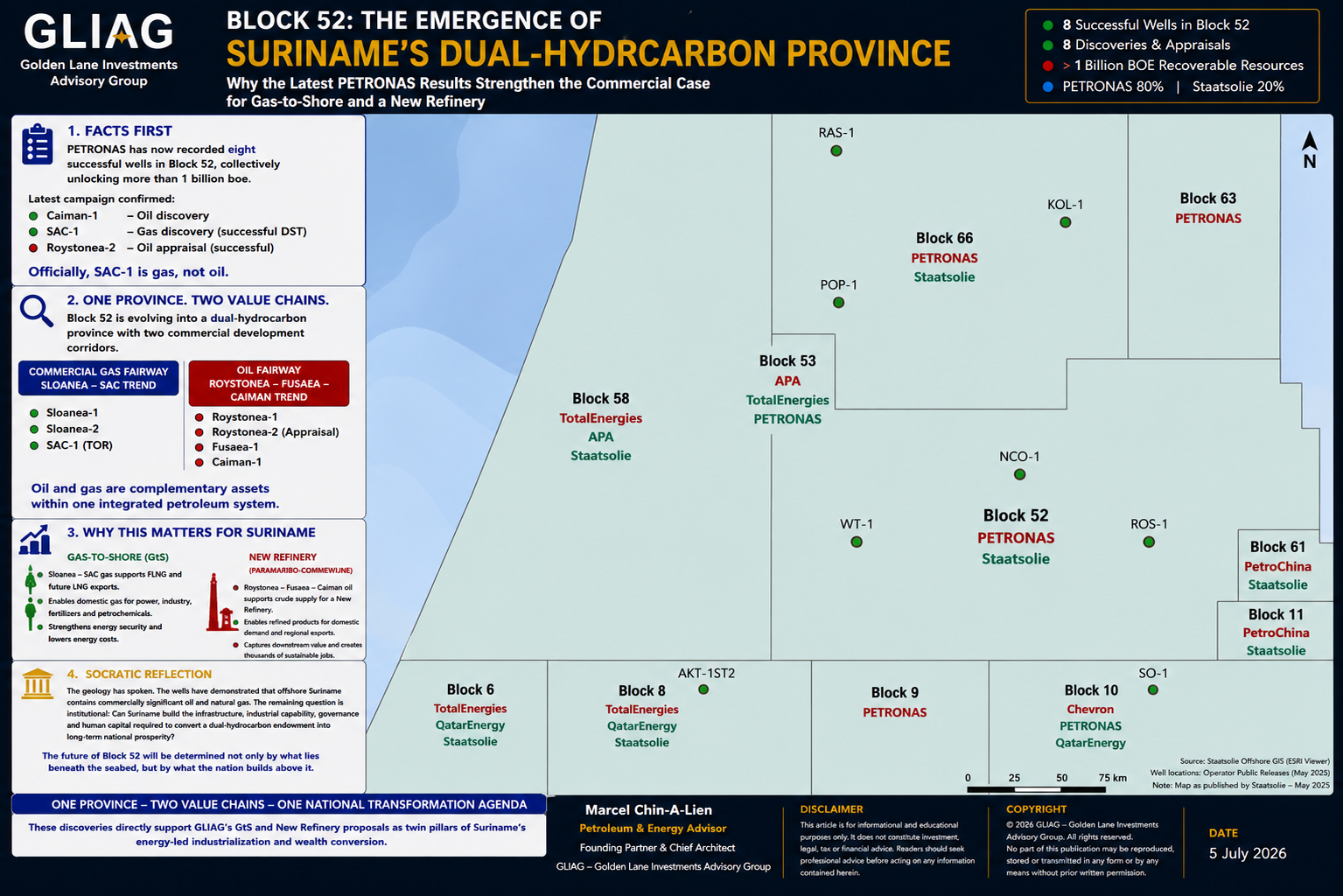
PETRONAS has now recorded eight successful wells offshore Suriname, collectively unlocking more than one billion barrels of oil equivalent (boe). The latest exploration campaign delivered two new discoveries and one successful appraisal, further confirming Block 52 as one of the most successful frontier exploration campaigns in recent years.
The latest official results include:
- Caiman‑1 — an oil discovery encountering multiple oil‑bearing Cretaceous sandstone intervals.
- Swartzia Aspasia Complex‑1 (SAC‑1) — a gas discovery, where Drill Stem Testing (DST) demonstrated strong gas deliverability and excellent reservoir quality.
- Roystonea‑2 — a successful oil appraisal confirming the lateral continuity and productivity of the Roystonea reservoir.
This distinction is important. SAC‑1 is officially a gas discovery — not an oil discovery — while Roystonea‑2 is an appraisal success rather than a new discovery. Precision in reporting reflects the maturity of each commercial opportunity.
One Province. Two Commercial Value Chains.
The latest results demonstrate that Block 52 should no longer be viewed simply as another successful exploration block.
The Sloanea–SAC trend has now matured into a commercially attractive natural gas corridor. Together, Sloanea‑1, Sloanea‑2 and SAC‑1 significantly reduce subsurface uncertainty and strengthen the business case for Suriname’s first offshore gas development.
At the same time, the Roystonea–Fusaea–Caiman trend is evolving into an increasingly robust oil development corridor capable of supporting long‑term crude production.
The evidence points toward something much larger than individual discoveries.
It points toward the emergence of a dual‑hydrocarbon province, where commercially significant oil and natural gas coexist within one integrated petroleum system.
Why This Matters for Suriname
This emerging dual‑hydrocarbon architecture has important commercial implications.
The growing gas resource strengthens the case for a phased Gas‑to‑Shore (GtS) development. Offshore gas can support LNG exports while simultaneously supplying domestic electricity generation, industrial heat, fertilizers, petrochemicals and future manufacturing industries. Rather than viewing natural gas solely as an export commodity, it becomes strategic industrial infrastructure capable of lowering energy costs and accelerating economic diversification.
The expanding oil fairway equally strengthens the commercial rationale for GLIAG’s proposed New Refinery. A sustained oil production base improves the economics of processing part of Suriname’s crude domestically, producing transportation fuels and other petroleum products for local consumption and regional markets. Domestic refining captures additional value, reduces dependence on imported fuels, improves energy security and stimulates downstream industrial activity.
These are not competing strategies. They are complementary. Gas provides the energy platform. Oil provides the refining platform.
Together they establish two mutually reinforcing value chains capable of supporting a broader industrial economy.
Beyond Exploration
For more than a decade, the Guyana–Suriname Basin has been celebrated primarily as one of the world’s newest offshore oil provinces.
Block 52 demonstrates that this interpretation is now incomplete.
The basin is evolving into a dual‑hydrocarbon province, where oil and natural gas are developing simultaneously and can be commercialized through complementary infrastructure.
This directly supports GLIAG’s long‑standing vision that Suriname’s offshore resources should not be developed as isolated projects, but as an integrated national energy system linking upstream production with Gas‑to‑Shore, refining, industrial development and long‑term economic transformation.
Socratic Reflection
The geology has now answered many of the fundamental questions.
The remaining questions are institutional.
Can Suriname synchronize offshore production, Gas‑to‑Shore, a new refinery, infrastructure, finance, education and industrial policy into one coherent national development strategy?
If it can, Block 52 will be remembered not merely as a successful exploration campaign, but as the beginning of Suriname’s transition from a resource‑rich nation to an energy‑driven industrial economy.
FIGURE 1 — OFFSHORE BLOCK MAPFigure 1. Official Staatsolie offshore block map with GLIAG interpretation of the Sloanea–SAC commercial gas fairway and the Roystonea–Fusaea–Caiman oil fairway.
RELATED GLIAG RESEARCH
This article builds upon GLIAG’s continuing research on the Guyana–Suriname Basin and Suriname’s long‑term energy strategy.
- Suriname’s Gas Gambit: Charting a Course for a Balanced and Resilient Future
- Suriname’s Block 52: Unveiling Offshore Oil Potential
- Petroleum & Energy Insights — GLIAG Research Library
Gas‑to‑Shore (GtS)The New RefineryGuyana–Suriname BasinHaimara & LongtailSuriname Horizon 2050Molecule‑to‑MarketNational Wealth ConversionIntegrated Energy SecurityLocal Content 2.0
About GLIAG
GLIAG — Golden Lane Investments Advisory Group — provides strategic intelligence, petroleum systems analysis, energy policy, investment advisory and long‑term development strategies for governments, national oil companies, investors and industry across the Guyana–Suriname Basin and the wider Atlantic Margin.
PETROLEUM. ENERGY. STRATEGY. FORESIGHT.
www.petroleumenergyinsights.com