GLIAG | Petroleum & Energy InsightsGLIAG_ESSAY_2026_13_MoleculesToMarkets_Rev01
From Molecules to Markets
Commercial Energy Integration and the Sovereign Conversion Doctrine
A Strategic Brief for International Oil Company Leadership
GOLDEN LANE INVESTMENTS ADVISORY GROUP (GLIAG)
Petroleum & Energy Insights | CEO Strategic Brief | August 2026
Document Ref: GLIAG_ESSAY_2026_13_MoleculesToMarkets_Rev01
Author: Drs. M.P.T. Chin-A-Lien, MBA, M.Sc., Ing. Geologist
Certified Professional Geologist Nr. 5201-1996 (AAPG) · Chartered European Geologist Nr. 92-1996 (EFG) · Energy Negotiator June 2021 (AIEN)
Principal Founding Partner & Chief Architect, GLIAG · Zoetermeer, The Netherlands · Paramaribo, Suriname
GLIAG · Where Information Becomes Intelligence.Converting bare headlines into deep strategic, added value.
Executive summary
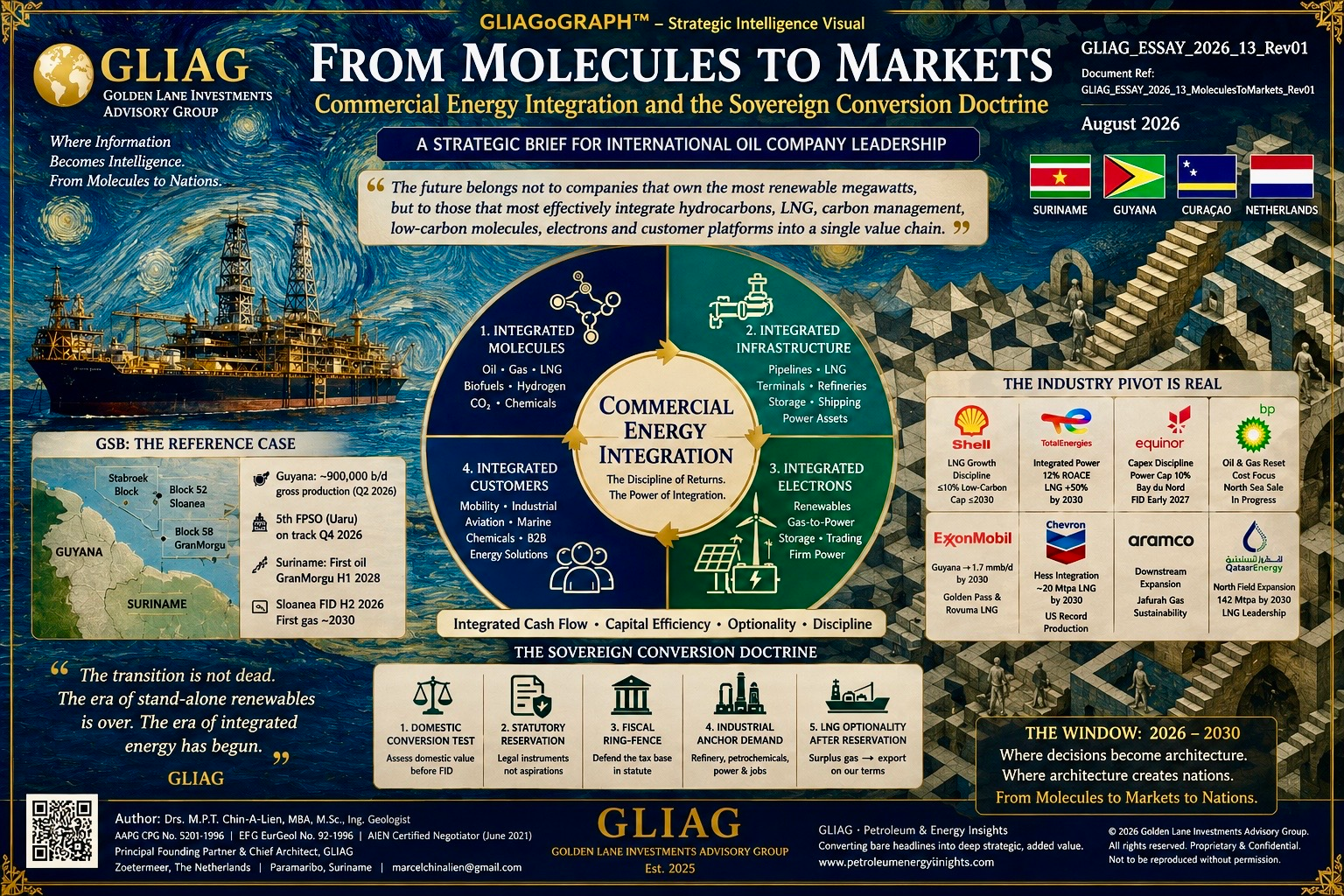
Between the second half of 2025 and the first half of 2026, the boards of every European integrated oil company and the largest US independents have quietly closed one chapter of the energy transition and opened another. The chapter that has closed is the one of stand-alone renewables divisions, subsidised capex allocation targets, and “beyond-petroleum”identity narratives. The chapter that has opened is one ofcommercial energy integration — the deliberate, disciplinedreplication of the integrated oil-and-gas operating model across LNG, carbon management, biofuels, low-carbon molecules, integrated power, and B2B customer platforms — all financed out of resilient upstream cash flow and measured against the same return, cost, and dispatch discipline as the barrel.
The market has understood the message. Shell, TotalEnergies, Equinor, BP, ExxonMobil, Chevron and Saudi Aramco each printed record or near-record Q2 2026 results (Shell Q2 2026;TotalEnergies Q2 2026; Equinor Q2 2026; ExxonMobil Q22026; Chevron Q2 2026; Aramco H1 2026) — cash-generative, disciplined, and increasingly integrated. The re-rating the sector has received since early 2025 is not a rejection of the transition. It is a repricing of how the transition will be financed: out of the free cash flow of the least carbon-intensive hydrocarbons and the most integrated commercial platforms, not out of ring-fenced renewables divisions whose returns compete poorly with their parents’ own portfolios.
This brief argues, for the audience it is written for — the CEOs, EVPs, board chairs and strategy heads of the world’s international oil companies — five propositions:
The leadership signal from Shell (Mascolo → Vestas; Faber → Raízen) is the clearest public marker yet of a doctrine that has already been operationalised across BP, Equinor, TotalEnergies, and (via convergent behaviour) ExxonMobil, Chevron, Aramco, ADNOC and QatarEnergy.
The doctrine — Commercial Energy Integration — is neitherretreat nor greenwash. It is the mature form of the integratedoil-and-gas business model, extended across the four molecular and electron pillars that will define the 2030s.
Twelve strategic movements are now predictable with high conviction between now and 2030: they are set out in Section 6 as testable predictions with time horizons.
Frontier basins — most notably Guyana-Suriname, but also Namibia, Mozambique, Colombia’s Caribbean deepwater, and Mauritania-Senegal — will be selected on this doctrine’s criteria: low breakeven, low carbon intensity, integrated-value optionality, and sovereign willingness to build the domestic conversion architecture that unlocks the second half of the value chain.
The Sovereign Conversion Doctrine is the mirror-image of Commercial Energy Integration on the host-government side. Where the industry has learned to integrate, sovereigns must now learn to reserve. The next five years will separate those who did from those who did not.
The 2026–2030 window is when this doctrine hardens into permanent industrial architecture. This brief sets out what has already been decided, what will be decided in the next 18 months, and what CEOs — and the sovereigns they operate alongside — should now do about it.
1. The leadership signal: Shell’s Low Carbon Solutions rotation
On 3 August 2026, Vestas announced that Anna Mascolo, most recently Executive Vice President of Shell Low Carbon Solutions since July 2023, would join the Danish wind major as President of Northern & Central Europe and Global Offshore (Windtech International). Ten days earlier, on 23 July 2026, Raízen — Shell’s Brazilian biofuels joint venture with Cosan — appointed Felix Faber, a 26-year Shelldownstream, lubricants, marine fuels and trading executive, asVice-Chairman of its board.
Read together, these are not two isolated appointments. They are the outward-facing markers of a governance reset. The most senior executive identified since 2023 with Shell’s stand-alone decarbonisation narrative has moved to a wind-turbine OEM — a signal, not a punishment. Shell’s Brazil governance seat — historically an integrated-value seat spanning ethanol, biofuels, mobility and downstream — has been handed to a career downstream-and-trading operator whose CV is defined by commercial platforms, not renewable project development.
No successor to Mascolo at Shell Low Carbon Solutions has been publicly confirmed at the date of publication.That absence is itself informative: the LCS remit is beingdissolved into Shell’s Integrated Gas, Downstream, and Trading & Supply organisations rather than reconstituted around a new named champion.
The direction of travel is unambiguous, and it is corroborated by Shell’s own disclosures. In October 2023, less than four months after Mascolo took the LCS role, CEO Wael Sawan announced the elimination of roughly 200 positions — about 15% of the LCS workforce — and a scaling back of the hydrogen light-mobility ambition, citing capital-allocation discipline. At the March 2025 Capital Markets Day, Shell formalised the pivot: LNG sales to grow 4–5% per year to 2030; combined Upstream and Integrated Gas production to grow 1% per year; liquids production sustained at 1.4 mmbpd; structural cost reductions of US$5–7 billion by 2028; and lower-carbon platforms capped at “up to 10% of capital employed by 2030” (Shell — Our Strategy). Q2 2026 results confirmed the execution track: adjusted earnings of US$9.84billion, cash flow from operations of US$21.4 billion, near-record third-party LNG volumes, and roughly half of the US$5–7 billion structural cost programme already delivered(Reuters; CNBC).
The Mascolo departure closes the first chapter. The next chapter — whoever leads it — is written in the language of downstream margins, LNG optionality, carbon management, biofuels equity (via Raízen), lubricants, mobility and customer energy platforms. That is commercial energy integration, not renewable expansion. When Sawan told the market in February 2026 that an LNG supply glut would ultimately “foster gas demand in new markets” (GasOutlook), he was not describing a commodity view. He was describing a business model.
2. The pivot is industry-wide, not idiosyncratic
Shell’s move would be easy to dismiss as company-specific if the same pattern were not visible across every European major, and — through convergent, lower-key behaviour — across every US independent and every strategically important NOC.
2.1 TotalEnergies — Integrated Power as the templated second pillar
TotalEnergies has now formalised a two-pillar strategy — Oil & Gas (notably LNG) and Integrated Power — with total energy production growing 4% per year through 2030 and LNG volumes rising by 50% between 2025 and 2030. Q2 2026 results printed adjusted net income of US$6.03 billion, cash flow from operations of US$9.80 billion, gearingreduced to 13%, and a 5.9% dividend increase (TotalEnergies Q2 2026; Reuters). Three moves in H1 2026 defined the doctrine in operational terms:
Full restart of Mozambique LNG on 29 January 2026, ending a five-year force-majeure halt; Patrick Pouyanné confirmed first LNG remains on track for 2029(TotalEnergies; Reuters).
Preliminary 20-year, 2 Mt/y Alaska LNG offtake agreement and startup of the ECA LNG floating facility in Mexico in H1 2026 (TotalEnergies Half-Year FinancialReport).
Completion of the EPH acquisition — a 50% interest in flexible power assets across the UK, Italy, Netherlands and France — anchoring the Integrated Power target of 100–120 TWh per year by 2030 (70% renewable, 30% flexible gas)with a stated ROACE of ~12%, deliberately calibrated to match upstream returns at US$60/bbl Brent (TotalEnergies Shareholders Newsletter #78).
Rio Grande LNG (Texas) is under construction at 29 Mtpa;Trains 1–3 are targeted for first LNG in 2027, Train 4 by2030, with the Train 4 FID (US$6.7 billion of financing) taken in September 2025 (TotalEnergies Integrated LNG Field Trip 2026).
The stated logic is not renewables for their own sake, butreplication of the integrated oil-and-gas business model into the electricity value chain, with gas-to-power flexibility, storage, trading and customer sales binding the system together.
2.2 Equinor — capex discipline restored, offshore wind rationalised
Equinor has been more explicit than any of its peers. At Q4 2025 results (February 4, 2026), it announced a ~US$4 billion cut to 2026–27 capex, “mainly within power and low carbon” (Reuters). At the June 16, 2026 Capital Markets Day the discipline was formalised: US$3 billion 2026 buyback,US$2–4 billion per year buybacks 2027 onward, 2028–2030 capex of US$11–13 billion per year (60% Norwegian Continental Shelf, 30% international, 10% power), and a1.35 million boe/d production target by 2030 (Equinor Form 6-K).
Q2 2026 delivered adjusted operating income of US$11.48 billion and net income of US$4.84 billion (+267% YoY), with production up 3% to 2,165 mboe/d (Equinor Q2 2026).The Empire Wind writedown of US$955 million in 2025, followed by disclosure that Empire Wind is ~60% complete with total capex of ~US$7.5 billion and an expected ~US$2.5 billion US ITC benefit (MarketBeat), sets the correct expectation for the sector’s remaining offshore-windexposure: complete what is already sanctioned; do not sanction more without integrated-return economics.
Equinor’s assumption of full ownership of Bay du Nord on 6 July 2026 — buying BP’s 37.21% stake and taking sole operatorship, with FID targeted for early 2027 (Reuters; BP)— is the mirror image of its wind rationalisation: capital is being redirected into low-carbon-intensity, high-return offshore oil that satisfies the same integrated-return test as the majors’ LNG portfolios.
2.3 BP — the boardroom correction is complete
Between April 2025 and July 2026 BP has completed one of the most consequential governance corrections in the history of the majors. Activist investor Elliott Management built a stake exceeding 5% and forced a strategic pivot back toward oil and gas (Yahoo Finance). Chair Helge Lund announced his departure (Investopedia). His successor Albert Manifold wasfired in May 2026 after meeting with Elliott without informing the full board (Reuters; Rigzone). At the April 23, 2026 AGM, shareholders rejected two managementresolutions and Manifold received a large protest vote(WorldOil).
The strategy that has emerged is a February 2025 reset raising annual oil-and-gas investment to ~US$10 billion, cutting renewables and transition spend, ending the 2020 goal of a 40% hydrocarbon production cut by 2030, and executing a US$20 billion divestment programme that had delivered more than US$11 billion by February 2026 —including the sale of a 65% stake in Castrol for approximately US$6 billion in proceeds. Buybacks remain suspended to prioritise debt reduction; 2026 capex is guided at US$13–13.5 billion (StockTitan / SEC 6-K).
On 31 July 2026 BP launched a sale process for its UK North Sea upstream business — Andrew, ETAP, Glen Lyon, Clair, and Clair Ridge (WorldOil). The North Sea sale is not a retreat from oil and gas; it is a capital rotation inside oil and gas from mature, high-cost basins into higher-return, lower-carbon-intensity plays.
2.4 ExxonMobil and Chevron — the doctrine as US convergence
The US supermajors have arrived at the same doctrine through less noisy governance. ExxonMobil Q2 2026 delivered earnings of US$14.5 billion, cash flow of US$23.6 billion, free cash flow of US$17.2 billion, net debt reduction of more than US$7 billion, and shareholder returns of US$9.4 billion (Nasdaq; Oil & Gas Journal). Darren Woods’s public position — “we’re not done yet in Guyana,” with gross Stabroek production at ~900,000 b/d in Q2 2026 and US$55billion of capital investment recovered roughly two years ahead of schedule (Guyana Times) — is the plainest possible statement of Commercial Energy Integration on the US side.
Exxon’s forward capacity map is now explicit: Uaru (Errea Wittu) FPSO — Guyana’s fifth — set sail in June 2026 and is on track for Q4 2026 startup at 250,000 b/d; Whiptail (Jaguar) — the sixth — is targeted for late 2027 / early 2028at 250,000 b/d and ~US$12.7 billion; and Longtail — the eighth Stabroek project, gas/condensate-focused — had its Field Development Plan submitted in March 2026 with a 2030target (OilNOW; Guyana Business Journal). On the LNG side, Golden Pass Train 1 (30% Exxon / 70% QatarEnergy)came online in 2026 and Rovuma LNG in Mozambique targets FID in H2 2026 and first LNG by 2030 (Oil & Gas Storage News).
Chevron Q2 2026 delivered earnings of US$12.1 billion(US$6.11/share), record US production of approximately 2.1 million boe/d (+20% YoY, driven by Hess), a US$3 billion structural cost reduction achieved six months early, and Hess merger synergies delivered six months ahead of schedule (Chevron Q2 2026; CNBC). The ICC arbitration tribunal’s ruling in Chevron’s favour on 18 July 2025 — clearing the US$53 billion Hess acquisition and delivering Chevron a30% stake in the Stabroek Block (WSJ; Chevron) — is now the largest single transfer of frontier-basin optionality between two US supermajors in a generation. On LNG, Chevron holds ~16 Mtpa today (Gorgon 15.6 Mtpa, Wheatstone 8.9 Mtpa in Australia, plus Angola LNG) and is targeting 20 Mtpa by 2030, with the first US LNG cargo sold into Europe via a Cheniere Sabine Pass deal in H1 2026 (Argus Media).
2.5 Aramco, ADNOC and QatarEnergy — the NOC-side integration
The doctrine is not confined to IOCs. Saudi Aramco Q2 2026 delivered adjusted net income of US$33.4 billion (H1 2026: US$67.2 billion), cash flow of US$25.4 billion, gearing of6.2%, and a base dividend of US$21.9 billion (Aramco H12026; CNBC). CEO Amin Nasser’s public position — resilience amid Strait of Hormuz disruption, disciplined capital return, integrated gas and chemicals expansion — is the NOC-side mirror of Wael Sawan’s IOC-side doctrine.
ADNOC launched a global LNG marketing and trading platform on 6 July 2026, combining ADNOC Gas, XRG, and ADNOC Trading, based in the Abu Dhabi Global Market(ADNOC; Reuters). This is a purpose-built NOC replica of the majors’ integrated commercial platforms — the XRG investment vehicle, launched in 2024 (XRG; ADNOC), is the acquisition arm of the same integrated architecture.
QatarEnergy’s North Field expansion — capacity growth from 77 Mtpa to 142 Mtpa by 2030 via NFE (32 Mtpa, first production Q2 2026), NFS (16 Mtpa, Q4 2026), and NFW (17 Mtpa, originally Q1 2029, now potentially slipping beyond 2030) (MEES) — is the world’s single largest LNG-integration project. New SPAs include Taiwan CPC (4 Mtpa for 27 years plus a 5% equity stake in NFE) (Natural GasIntelligence); other confirmed offtakers include Sinopec, CNPC, Shell, TotalEnergies, Eni, ConocoPhillips, and Kuwait Petroleum, with ~48 Mtpa of the 65 Mtpa NFE/NFS volumes committed as of April 2026.
2.6 The convergence
The pattern is unmistakable. Every major energy company in the OECD and every consequential NOC in the Middle East is now executing variations of the same doctrine: disciplined upstream, integrated LNG, carbon management as an operational service, trading and shipping optionality,downstream and customer platforms, and retained but return-tested renewable/low-carbon exposure. The reset is not a single-company narrative; it is a sector-wide re-underwriting of the energy transition around cash generation, return discipline and integrated value chains.
3. What “Commercial Energy Integration” actually means
The phrase risks becoming a slogan. It is worth being precise.Commercial Energy Integration is a business architecture withfour load-bearing components and one governance principle.
3.1 Integrated molecules
Upstream oil, associated and non-associated gas, LNG, refined products, biofuels, hydrogen and captured CO₂ are managed as a single molecular portfolio, with each molecule routed to the highest-margin destination — export cargo, domestic feedstock, mobility fuel, industrial heat, or storage — through the company’s own trading and shipping system.Aramco’s downstream expansion, ExxonMobil’s Longtail gas/condensate FDP, ADNOC’s XRG, and Shell’s LNG trading book are all instances of the same molecule-routing logic.
3.2 Integrated infrastructure
Pipelines, liquefaction and regasification, storage caverns, terminals, refineries and — increasingly — power generation, transmission and battery assets are treated as the physical backbone of the same commercial system, generating dispatch, tolling and optionality value that is invisible on any single-asset spreadsheet. TotalEnergies’ EPH acquisition, Chevron’s Sabine Pass tolling arrangement, andQatarEnergy’s dedicated NFE fleet are the same doctrine expressed in three different asset classes.
3.3 Integrated electrons
Renewable generation is retained — but as an input into agas-to-power, storage-and-trading platform that sells“clean firm power” to industrial customers, data centres and utilities. TotalEnergies’ 12% ROACE target for Integrated Power, deliberately calibrated to match upstream returns at US$60/bbl Brent, is the clearest public statement of this discipline. Equinor’s re-baselining of its wind ambition — retained execution, no new commitments — is the same principle applied by subtraction.
3.4 Integrated customers
Lubricants, mobility, aviation fuels, marine fuels, commercial fleets, chemicals and B2B decarbonisation contracts are thedemand-side anchors that convert commodity exposure into recurring, higher-multiple earnings. This is precisely the terrain — downstream, lubricants, marine, mobility, trading — that Felix Faber’s career has been built on, and precisely the terrain Shell’s Raízen governance seat sits on top of.
3.5 The governance principle — capital efficiency and optionality
The unifying principle is not emissions accounting. It iscapital efficiency and optionality: every dollar of upstream cash flow is available to finance the next molecule, the next terminal or the next customer contract in the same system, rather than being ring-fenced against a stand-alone renewables business whose returns compete poorly with the parent’s own upstream portfolio.
This is the difference between the 2020 doctrine (“beyond petroleum”) and the 2026 doctrine (“integrated energy”). The first asked whether the company would still be an oil-and-gas company. The second answers that it will — but as the integrated commercial platform on top of which the transition is actually financed.
4. Why the recalibration is defensible, not regressive
Three data points make clear why the majors’ pivot should be read as strategic maturation rather than climate retreat.
First — the demand base for hydrocarbons has not collapsed. Guyana alone lifted approximately 900,000 barrels per day in Q2 2026 across four ExxonMobil-operated Stabroek Block FPSOs, with the Uaru FPSO scheduled to add250,000 b/d in Q4 2026 — taking capacity above 1.15 mmbpd and toward 1.7 mmbpd by 2030 with Whiptail and Longtail on the way. Guyana is now South America’s second-largest producer, above Venezuela.
Second — the economics of new upstream projects are exceptional. Equinor’s new projects coming on stream over the next decade carry an average payback of about 2.5 years, breakevens below US$40/bbl, and carbon intensity below 6 kg/boe. No renewables portfolio on any major’s balance sheet currently offers that combination of payback, cash yield and optionality.
Third — LNG demand is durable, rising, and increasinglyfinanceable. The International Gas Union World LNG Report 2026 puts global liquefaction capacity at 524.5 Mtpa at end-2025, with 68.4 Mtpa of new capacity taking FID in 2025 (the highest since 2019) and a pre-FID pipeline of1,105.4 Mtpa; supply is projected to exceed 700 Mt by 2030— a 40%+ increase versus 2025 (IGU World LNG Report2026; summary). The IEA’s Global LNG Capacity Tracker shows ~295 bcm/year of new capacity coming online 2025–2030, with peak annual additions of about 70 bcm/year expected in 2027 (IEA). The Oxford Institute for Energy Studies describes 2026 as the “real beginning of the LNG wave” — about 53 bcm of year-on-year capacity growth, roughly 50% total supply growth between 2025 and 2030(OIES). Asian spot LNG (JKM) hit a four-month high of ~US$22/MMBtu on 24 July 2026 on Middle East shipping disruption fears, with H2 2026 forecast at US$19.50/MMBtu(Reuters). Shell’s own LNG Outlook 2026 projects demand growing about 65% from 2025 levels to roughly 700 Mt by 2050 (Shell LNG Outlook 2026).
Against that backdrop, disciplined capital rotation into integrated LNG, carbon management, commercial energy platforms, biofuels and gas-to-power is not a retreat from decarbonisation. It is the recognition that the transition will be financed out of the cash flow of the least carbon-intensive hydrocarbons and the most integratedcommercial platforms, not out of debt-financed, sub-return renewables megaprojects.
5. Capital allocation — the numbers that define the doctrine
The doctrine can be read most precisely in the capital-allocation tables the majors have quietly reprinted in the past 18 months.
Shell — Capex trajectory: structural cost cut of US$5–7 B by 2028. Lower-carbon / power cap: “up to 10% of capital employed by 2030.” LNG target 2030: LNG sales +4–5%/yr. Upstream target 2030: +1%/yr Upstream + Integrated Gas. Q2 2026 CFFO: US$21.4 B.
TotalEnergies — Capex trajectory: steady oil-and-gas capex; Integrated Power at 12% ROACE. Lower-carbon / power cap: Integrated Power 100–120 TWh (70% renewable / 30% flexible gas). LNG target 2030: +50% LNG volumes 2025–2030. Upstream target 2030: 4%/yr total energy production growth. Q2 2026 CFFO: US$9.8 B.
Equinor — Capex trajectory: US$11–13 B/yr, 2028–2030. Lower-carbon / power cap: 10% of capex in power (down from a 50% ambition). LNG target 2030: existing LNG portfolio retained. Upstream target 2030: 1.35 M boe/d by 2030. Q2 2026 CFFO: H1 2026 strong.
BP — Capex trajectory: US$13–13.5 B in 2026; US$10 B/yr oil-and-gas floor. Lower-carbon / power cap: renewables spend cut sharply. LNG target 2030: retained but not expanded. Upstream target 2030: ending the 40% hydrocarbon-cut goal. Q2 2026 CFFO: divestment-focused.
ExxonMobil — Capex trajectory: elevated 2025–2030. Lower-carbon / power cap: low-carbon selective (CCS, hydrogen, lithium). LNG target 2030: Golden Pass + Rovuma. Upstream target 2030: Guyana → 1.7 mmbpd by 2030. Q2 2026 CFFO: US$23.6 B.
Chevron — Capex trajectory: US$3 B cost cut delivered early. Lower-carbon / power cap: selective; no capex cap disclosed. LNG target 2030: ~20 Mtpa by 2030. Upstream target 2030: 2.1 M boe/d, a US record. Q2 2026 CFFO: included in results.
Aramco — Capex trajectory: sustained upstream and downstream investment. Lower-carbon / power cap: chemicals and gas expansion. LNG target 2030: Jafurah unconventional gas. Upstream target 2030: sustainable capacity of 12 mmbpd. Q2 2026 CFFO: US$25.4 B.
Two conclusions follow. First, every one of these companies now discloses a ceiling on lower-carbon capital as a percentage of capital employed, or an equivalent ROACE hurdle. That was not the case in 2022. Second, the LNG-plus-upstream growth trajectory, when consolidated across the group, exceeds any historic industry alignment on a singlestrategic thesis. This is not seven companies drifting toward the same view. It is seven companies executing the same doctrine.
6. Twelve strategic predictions, 2026–2030
The following are testable predictions. They are set out at the horizons at which they are most likely to be resolved and are drawn from the observed trajectory of the industry through Q2 2026.
Prediction 1 — Shell will not appoint a stand-alone LCS EVP successor at the same seniority as Mascolo. The LCS remit will be dissolved into Integrated Gas, Downstream, and Trading & Supply during 2026–2027. Test: Shell’s next reorganisation announcement or 20-F filing.
Prediction 2 — TotalEnergies’ Integrated Power will publish an ROACE within 100 basis points of its 12% target by FY2027 results. Test: 2027 annual report. If ROACE undershoots, capex will be reallocated to LNG rather than to renewables expansion.
Prediction 3 — Equinor’s 2028–2030 capex mix will not exceed 10% for power. Test: 2027 and 2028 Capital Markets Days. Bay du Nord FID in H1 2027 confirms the direction.
Prediction 4 — BP will not resume buybacks before end-2027, and its 2028 strategy will confirm an oil-and-gas capex floor above US$10 billion per year, with the North Sea sale completed to a private-equity or PIF-anchored buyer. Test: BP quarterly guidance and North Sea sale announcement.
Prediction 5 — Global LNG FIDs 2026–2027 will exceed 100 Mtpa cumulatively. Test: cumulative Rio Grande Train 4, Port Arthur Phase 2, Cameron Phase 4, Sabine Pass expansion, NFW confirmation, Rovuma, Alaska LNG preliminary, Coral Norte, and Mozambique Area 1 progression.
Prediction 6 — The “US LNG wave 2” (2026–2028 FIDs) will be dominated by strategic offtake from Asian utilities and European trading houses buying equity, not by traditional bank project-finance-only structures. Test: NextDecade Train 5 financing announcement; Cheniere long-dated equity deals.
Prediction 7 — QatarEnergy will confirm NFW FID within 2026 on revised timing, but first LNG will slip to 2031. Test: MEES coverage and QatarEnergy press releases in Q4 2026.
Prediction 8 — The Guyana–Suriname Basin will see at least two additional FIDs by end-2027 — Sloanea (Petronas, gas) and Whiptail (Exxon, oil confirmed for late 2027) — plus a probable third FID on Longtail preparation. Test: Petronas, ExxonMobil press releases; Staatsolie financial statements.
Prediction 9 — Petrobras will confirm Sirius FID by end-2027 and first gas 2030–2031, with the Sandia-1 discovery announced 3 August 2026 formally integrated into the Sirius development plan or a paired second hub within Block GUA-OFF-0. Test: Ecopetrol/Petrobras announcements; Colombia environmental licensing decisions.
Prediction 10 — At least one European major will divest all or substantially all of its US or European retail electricity business between 2026 and 2028, retaining only B2B and industrial-customer power platforms. Test: press releases from Shell, BP, or TotalEnergies.
Prediction 11 — Green hydrogen light-mobility and green hydrogen “hub” projects at scale in the OECD will be either cancelled, deferred beyond 2030, or reclassified as CCS-linked blue-hydrogen projects in more than half of currently announced cases. Test: DOE Hydrogen Hubsstatus; European Hydrogen Bank second auction outcomes; corporate 2027 sustainability reports.
Prediction 12 — Carbon management (CCS + CO₂ transport + storage) will emerge, by 2028, as a distinctprofit-centre disclosure line for at least three of the six European/US majors, priced on tolling and storage fees, not on emissions abatement targets. Test: Shell, TotalEnergies, ExxonMobil, and Equinor annual reports 2028.
These twelve predictions are the operational content of Commercial Energy Integration. If eight or more are proven correct by end-2028, the doctrine will have been the dominant strategic frame for the second half of the decade.
7. What this means for frontier basins
The doctrine has a specific and unusually clear implication for the world’s genuine frontier basins — the small handful of provinces where the tests of low breakeven, low carbon intensity, high per-well productivity, and integrated-value optionality are simultaneously satisfied.
7.1 Guyana–Suriname Basin — the reference case
The Stabroek Block (ExxonMobil-operated, Guyana) is now the world’s most cited example of a frontier basin fully aligned with the Commercial Energy Integration doctrine: ~US$55 billion capital investment recovered roughly two years ahead of schedule, ~900,000 b/d gross Q2 2026, four FPSOs operating, and a fifth (Uaru) on track for Q4 2026. InSuriname, GranMorgu (Block 58) has passed 30% overall progress with the FPSO 60% complete and first oil targetedH1 2028; drilling begins late 2026 (Government of Suriname;Staatsolie; Offshore Magazine).
Sloanea (Block 52) — Petronas-operated — is targeting FID in H2 2026 with first gas ~2030; Staatsolie Managing Director Annand Jagesar has stated that a declaration of commerciality for oil could come within 18 months (Reuters);Petronas confirmed three new discoveries on 30 June 2026, bringing the total to eight successful wells and unlockingmore than 1 billion boe of resources (Petronas). Staatsolie’s 20% stake in GranMorgu is being financed via a US$516million bond plus a US$1.6 billion syndicated loan from 18 banks, for a total US$2.4 billion sovereign investment(Staatsolie).
7.2 Colombia — the second Caribbean deepwater cluster
The Sandia-1 discovery announced by Petrobras and Ecopetrol on 3 August 2026 is the third deepwater gas discovery in Block GUA-OFF-0 (~42 km offshore, 1,251 m water depth) — 18 km from Sirius-1/2 and 9 km fromCopoazú-1 (WorldOil; Rio Times; Baird Maritime). The broader Sirius field holds more than 6 Tcf of gas in place —Colombia’s largest-ever gas discovery — with total investment of US$4.1–5 billion, FID targeted end-2027, and first gas 2030–2031 (Offshore Magazine). Ecopetrol and Petrobras have already secured full commercialisation of 249 MMcf/d of Sirius gas, contracted with 17 companies via 66 separate contracts (Inspenet); domestic Colombian gas production has fallen to a record low of 695 MMcf/d in February 2026 (Rio Times).
For CEOs of majors and independents alike, the Caribbean-margin gas story now runs from Trinidad through Colombia to Suriname. The window on integrated Caribbean gas systems is narrower than the individual project timelines suggest.
7.3 Africa — Petrobras’s return and the equatorial-margin play
Petrobras’s 2026–2030 strategic plan allocates approximatelyUS$7.1–7.5 billion to exploration, with Africa named the toppriority outside Brazil: a new block was secured offshore São Tomé & Príncipe in April 2026; Petrobras holds stakes in Namibia (alongside TotalEnergies) and South Africa and has bid for nine blocks offshore Ivory Coast (Rio Times; EcofinAgency; Hart Energy). The equatorial-margin thesis — Suriname/Guyana geology mirrored across the South Atlantic — is now the working exploration doctrine of one of the world’s most technically capable NOC-IOCs.
7.4 The frontier-basin selection test
The doctrine sets, for the first time in a generation, an explicitselection test for frontier basins:
Breakeven below US$40/bbl or short-cycle payback ≤3 years.
Carbon intensity below 10 kg CO₂/boe on lifecycle upstream basis.
Integrated-value optionality: gas monetisable through domestic or regional off-take, not only stranded LNG export.
Host-country willingness to build the domestic conversionarchitecture that unlocks integrated-value returns.
Legal and fiscal architecture — ring-fenced petroleumtaxation, defensible sovereign participation, statutory-not-aspirational conversion rules.
Every basin currently receiving major-capital commitment in 2026 — Guyana-Suriname, Namibia (Orange Basin), Mozambique Area 1 (restarted), Colombia Caribbean deepwater, and the Alaska LNG-anchored North Slope — passes tests 1–3. The last two tests belong to sovereigns.
8. The Sovereign Conversion Doctrine — the policy corollary
If Commercial Energy Integration is the private-sector doctrine, the Sovereign Conversion Doctrine — GLIAG’s framework developed across the SH-2050, Fiscal Ring-Fence, and Gas as Geopolitical Fuel essay cluster — is its public-sector mirror. The doctrine’s central claim is that the correct sovereign response to Commercial Energy Integration isneither resource nationalism nor passive acceptance of export-only monetisation, but the deliberate construction of adomestic integrated architecture in which the state captures, converts and reserves value before it is contracted away.
The doctrine’s five operative instruments are:
Domestic Conversion Test before FID. For each incremental molecule of gas — Sloanea, Sirius, Rovuma, Coral Norte, or Sangomar-adjacent discoveries — the state should ask whether that molecule creates greater long-term sovereign wealth through domestic power, refining, petrochemical, fertiliser, or mineral-processing feedstock than through LNG export. The test must be applied before Final Investment Decision, because after FID the SPAs, lender direct agreements, step-in rights and offtake terms are extraordinarily difficult to reopen.
Statutory reservation, not policy aspiration. The instruments that make the doctrine enforceable are legal, not rhetorical: a Domestic Gas Supply Obligation, an export-control mechanism, a reserve-reservation rule, a landing-feasibility requirement, cross-field pooling authority, andfiscal reciprocity between upstream and downstream.“Gas-to-Shore” is the industrial outcome; these are the legalinstruments.
Fiscal ring-fence discipline. The petroleum tax base must be defined and defended in statute independently of PSC cost recovery, so that integrated cash flows — offshore royalties, profit oil, downstream and gas-conversion revenues — accrue to the state on defensible, non-negotiable terms across price cycles.
Refinery and industrial anchor demand. The integrated model only works if domestic offtake is real. That is the strategic case for a modest, bankable, gas- and condensate-integrated refining and industrial complex sized to Suriname’s own demand and regional export markets — not for exporting every molecule as raw LNG or crude.
Integrated LNG optionality — after, not before, domesticreservation. Once domestic conversion is contractually secured, surplus gas should be monetised through LNG under the same integrated commercial logic the majors are now practising: portfolio flexibility, price optionality, and export-linked infrastructure that supports domestic industry rather than crowding it out.
This is the sovereign mirror of what Shell, TotalEnergies, Equinor, BP, ExxonMobil, Chevron and Aramco have just told the market they are doing. The majors have rebuilt their strategies around integrated molecules, integrated infrastructure, integrated electrons and integratedcustomers. A frontier producer that fails to build the equivalent sovereign architecture will find that its molecules have been integrated into someone else’s system.
9. The Suriname test case
Suriname sits at the sharpest point of the 2026–2028 window. Between the FID for GranMorgu already taken (October 2024, first oil H1 2028) and the FID for Sloanea targeted for H2 2026 (first gas ~2030), the country will make a set of decisions that either build the sovereign architecture described above — or forfeit it.
The specific decisions ahead include:
Whether the Sloanea Gas-to-Shore Pre-FS is completed withdomestic-conversion optionality as a hard constraint, not acourtesy annex.
Whether the fiscal ring-fence is enacted as primary legislation before Sloanea FID, not as regulatory instruments post-FID.
Whether a Domestic Gas Supply Obligation (analogous toAustralia’s East Coast DGSO or Trinidad’s downstream reservation) is codified before offtake SPAs are negotiated with LNG buyers.
Whether the refinery and industrial anchor (gas-and-condensate-integrated, sized to Suriname’s own demand plusregional export) is authorised as part of the Sloanea FID package rather than a decade later.
Whether critical-raw-material integration (Bakhuis onshorebauxite/CRM cluster; Block 52/58 offshore heavy-mineral by-products; deep-sea polymetallic optionality) is captured under the same integrated architecture as the hydrocarbon economy.
These are not aspirational questions. The Petronas Sloanea FID clock is running. TotalEnergies is executing GranMorgu at pace. Staatsolie has committed US$2.4 billion of state balance sheet to the GranMorgu 20% stake. The financial engineering is real. The question is whether the sovereign engineering keeps up.
10. The CEO’s dilemma reframed
For the CEO of an international oil company reading this brief, the operational implication is not that Commercial Energy Integration should be adopted — it already has been. The implication is subtler and more consequential:
Frontier-basin selection over the next 24 months will determine the shape of the majors’ portfolios for the entire decade of the 2030s. The basins that satisfy the four private-sector tests are known and narrow. The basins that will additionally build the sovereign architecture — the fifth test — will be an even smaller subset. The majors that position early in those subsets, on terms that respect sovereign conversion architecture rather than resisting it, will hold astructural advantage that no amount of catch-up capex can replicate later.
The sovereigns that build the architecture will get better projects, better partners, and more resilient revenue trajectories through the price cycles that define the 2030s. The sovereigns that do not will export molecules on someone else’s terms. Both outcomes are visible from where we stand today.
The 2026–2028 window is when this doctrine hardens into permanent industrial architecture. For CEOs, it is the window for portfolio selection. For sovereigns, it is the window for legal architecture. For both, it is the window in which decisions become irreversible.
11. Conclusion — from molecules to markets to nations
The real message behind Shell’s Low Carbon Solutions rotation, the Raízen governance change, TotalEnergies’ Integrated Power pillar, Equinor’s retired 50%-capex ambition, BP’s oil-and-gas reset, ExxonMobil’s Guyana acceleration, Chevron’s Hess integration, Aramco’sdownstream expansion, ADNOC’s trading platform, and QatarEnergy’s North Field expansion is not that the transition is dead. It is that the era of stand-alone, subsidy-dependent, capex-heavy renewable divisions inside oil-and-gas companies has ended, and the era of commercially integrated, cash-generative, hydrocarbon-anchored energy systems hasbegun.
The future belongs not to companies that own the most renewable megawatts, but to those that most effectively integrate hydrocarbons, LNG, carbon management, low-carbon molecules, electrons and customer platforms into a single, disciplined value chain. That is the private-sector doctrine.
The sovereign corollary is precise: a country’s offshore oil and gas endowment is not an inheritance to be exported at the lowest transaction friction. It is the financial and industrial foundation of a sovereign energy system that can, if it is built with the same integration discipline the majors have now adopted, deliver power reliability, industrial capacity, employment, fiscal resilience and long-term diversification through and beyond the petroleum era.
From molecules — through markets — to nations. That is the arc of the doctrine, on both sides of the table. The 2026–2028 window is when that arc becomes architecture, or is forfeited.
GLIAG · Where Information Becomes Intelligence. From Molecules to Nations.
Converting bare headlines into deep strategic, added value.
About the author
Drs. Marcel P. T. Chin-A-Lien, MBA, MSc, Eng. is a petroleum and energy advisor and the Principal Founding Partner and Chief Architect of Golden Lane Investments Advisory Group (GLIAG). He is a Geologist by training, aCertified Petroleum Geologist of the American Association of Petroleum Geologists (AAPG, 1996), a Chartered European Geologist of the European Federation of Geologists (EFG, Paris), and a Certified Energy Negotiatorof the Association of International Energy Negotiators (AIEN, 2022). His work spans petroleum-systems analysis and subsurface characterisation, TOR / Pre-FEED / FEED projectfeasibility, bankability and financial-model design, PSC andpetroleum-legal frameworks, investor structuring, and multi-country energy-policy analysis, with a particular focus on the Guyana–Suriname Basin and Suriname’s SH-2050 transformation agenda.
Contact: marcelchinalien@gmail.com · Zoetermeer, The Netherlands · Paramaribo, Suriname
About GLIAG
Golden Lane Investments Advisory Group (GLIAG) is a senior-only boutique Project Management Consultant (PMC) and independent advisor / Owner’s Engineer to sovereigns on major energy and infrastructure programmes, including Suriname’s Gas-to-Shore, refinery, critical-raw-materials and deep-sea-mining workstreams. GLIAG operates on DFI- and World Bank Group-grade compliance standards. GLIAG does not act as a project sponsor, bidder, equity holder, or promoter of any transaction referenced in its publications. The firm is based in Zoetermeer, The Netherlands, and Paramaribo, Suriname, and publishes through its Petroleum & Energy Insights platform at petroleumenergyinsights.com.
Disclaimer and legal notice
No advice. This essay is published by Golden Lane Investments Advisory Group (GLIAG) through its Petroleum & Energy Insights platform for informational, educational and strategic-analysis purposes only. It does not constitute, and must not be relied upon as, investment, financial, legal, tax, accounting, engineering, geological, reserves-certification, or professional advice of any kind. It is not directed at, or intended for use by, any person in any jurisdiction where such publication or use would be contrary to local law orregulation.
No offer or solicitation. Nothing in this publication constitutes an offer, solicitation, invitation, inducement or recommendation to buy, sell, subscribe for, underwrite, finance or otherwise transact in any security, commodity, licence interest, participating interest, asset, contract, or instrument. No investment decision should be made on thebasis of this document.
Independence of analysis. GLIAG is not a sponsor, bidder, equity holder, agent or placement agent for any project, company, government body or third party referenced in this essay. GLIAG may from time to time provide independent advisory or Owner’s Engineer services to sovereigns and public bodies in the sectors discussed. Where any suchengagement is material to the analysis presented, that engagement is disclosed. The views expressed here are those of the author and GLIAG only, and do not represent the views of any client, counterparty, government, operator, licensee or third party.
Sources and third-party information. This essay draws on publicly available corporate disclosures, press releases, regulatory filings, and reputable news reporting cited inline. GLIAG has taken reasonable care in selecting and citing those sources but does not warrant their accuracy, completeness or timeliness. Company names, project names, production figures, financial data, and strategic statements attributed to Shell plc, TotalEnergies SE, Equinor ASA, BP plc, ExxonMobil, Chevron Corporation, Hess Corporation, APA Corporation, ConocoPhillips, PETRONAS, Petrobras, Ecopetrol, Saudi Aramco, ADNOC, QatarEnergy, Staatsolie Maatschappij Suriname N.V., Vestas, Raízen, and other namedentities are drawn from those entities’ own public communications and remain their property; their inclusion is for analytical purposes only and does not imply endorsement of, or by, GLIAG.
Forward-looking statements. Statements in this essay that are not historical facts — including references to future production, investment decisions, project timelines, prices, cash flows, returns, policy outcomes, and sovereign strategy — are forward-looking statements based on current information, judgement and assumptions as of the publication date. Actual outcomes may differ materially due to geological, technical, commercial, political, regulatory, macroeconomic,or force-majeure factors. GLIAG undertakes no obligation to update any forward-looking statement.
Intellectual property. The named doctrines, tests and analytical frameworks referenced in this essay — includingCommercial Energy Integration (as framed herein), theSovereign Conversion Doctrine, the Domestic Conversion Test, SH-2050, the Fiscal Ring-Fence, and Gas as Geopolitical Fuel — together with GLIAG’s methodologicalframing of these concepts, are the intellectual property of Golden Lane Investments Advisory Group. All text, structure, argumentation, and analytical framing in this essay are © 2026 Golden Lane Investments Advisory Group; all rights reserved.
AI / ML training opt-out. The content of this publication may not be used, in whole or in part, to train, fine-tune, evaluate, benchmark, retrieve-augment, or otherwise develop artificial-intelligence or machine-learning systems, models, agents, or datasets, without the prior express written consent of GLIAG. This opt-out applies to text, structure, doctrines and citations, and is asserted under Article 4(3) of Directive (EU) 2019/790 (the Copyright Directive) and the equivalenttext-and-data-mining reservation provisions of applicable national law.
Attribution. Permitted quotation and citation must use the following form:
Chin-A-Lien, M. P. T., From Molecules to Markets: Commercial Energy Integration and the Sovereign Conversion Doctrine — A Strategic Brief for International Oil Company Leadership, Golden Lane Investments Advisory Group / Petroleum & Energy Insights, Document Ref. GLIAG_ESSAY_2026_13_MoleculesToMarkets_Rev01, August 2026.
Contact. For enquiries regarding this publication, licensing, or GLIAG advisory engagements:marcelchinalien@gmail.com · Zoetermeer, The Netherlands · Paramaribo, Suriname · petroleumenergyinsights.com.
© 2026 Golden Lane Investments Advisory Group. All rights reserved.
© 2026 Golden Lane Investments Advisory Group · petroleumenergyinsights.comPage of