GLIAG STRATEGIC PETROLEUM INTELLIGENCE
GLIAG N.V.
BEYOND LA LUNA
Colombia’s Emerging Deepwater Gas Province and the Unopened Tertiary Petroleum-System Case for the Bonaire Basin
A GLIAG Flagship Petroleum-Systems & Prospectivity Essay
Prepared by Marcel P.T. Chin-A-Lien
Principal Founding Partner & Chief Architect — GLIAG N.V.
Drs., MBA., M.Sc., Ing. Geologist | AAPG CPG | EFG EurGeol | AIEN
3 August 2026 | Delft, The Netherlands
“Colombia does not prove Bonaire. It proves that the southern Caribbean can build major gas systems without asking La Luna to do all the geological work.”
Document ID: GLIAG-BB-2026-PS-004 | Public Release Edition V1.0
Executive Overview
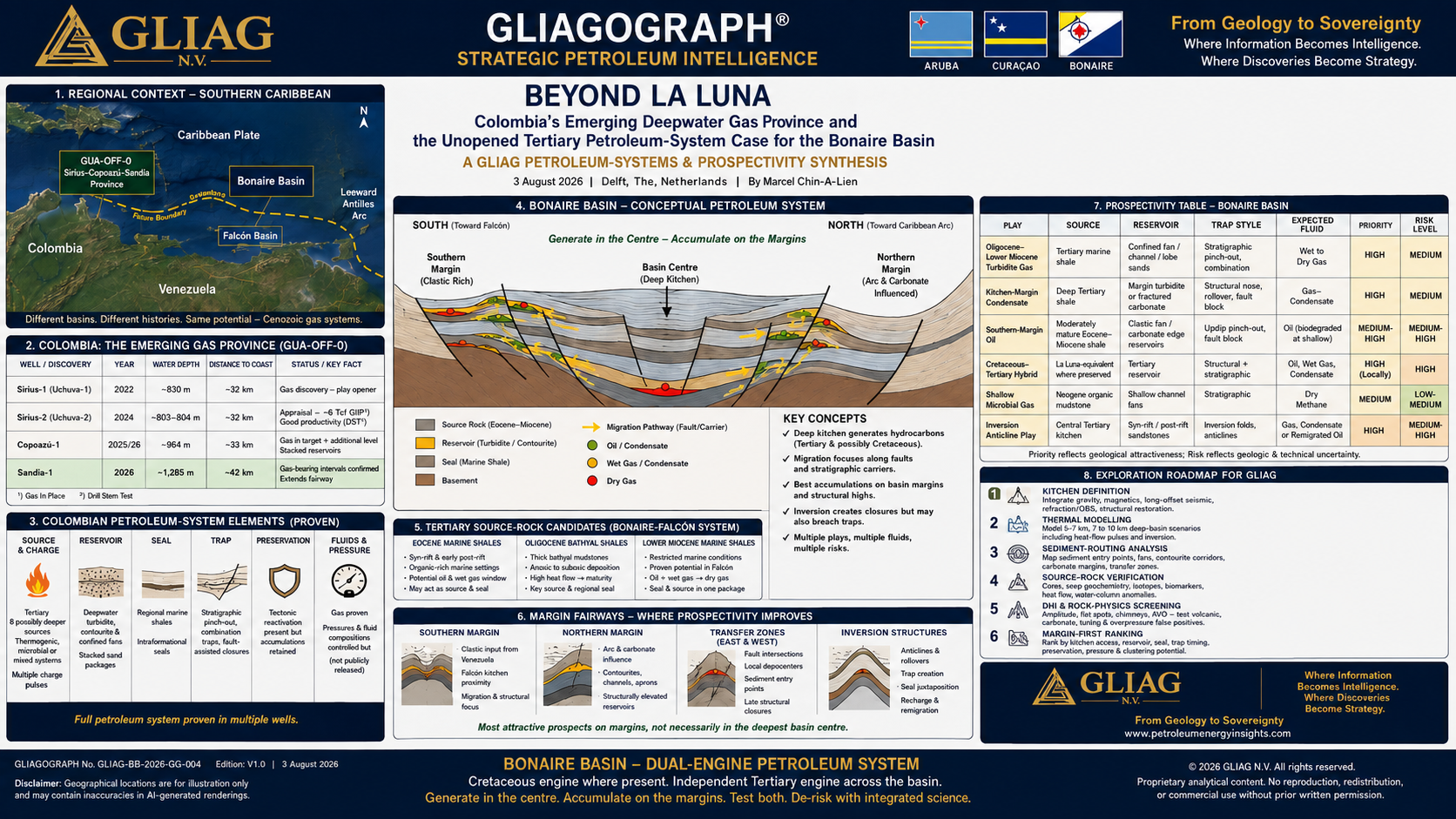
The confirmation of gas at Sandía-1 on 3 August 2026 extends a remarkable sequence of deepwater successes in Colombia’s GUA-OFF-0 Block. Together with Sirius-1, Sirius-2 and Copoazú-1, the well increasingly defines a repeatable gas-charged fairway rather than a collection of isolated shows. The cluster is commercially important for Colombia, but its deeper significance for regional exploration is geological: it demonstrates that a southern Caribbean Cenozoic basin can combine effective charge, deepwater sandstone reservoirs, marine seals, stratigraphic and combination traps, and sufficient deliverability to sustain a serious development concept.
The Bonaire Basin is not a direct continuation of the Sirius–Sandía province. It lies in another tectonic compartment, received a different sediment mix, experienced a distinct heat-flow and inversion history, and lacks modern deepwater well calibration. Any claim that Colombia has directly de-risked Bonaire would therefore be technically indefensible.
Yet Colombia materially strengthens a different proposition: Bonaire should not be evaluated only through the presence or absence of a Cretaceous La Luna-equivalent source rock. The adjacent Falcón Basin independently documents Tertiary hydrocarbon generation, while the Bonaire Basin contains a recognized Cenozoic structural and sedimentary history. A Paleogene–Neogene source–reservoir–seal system must consequently be elevated from secondary possibility to a primary exploration hypothesis.
The most attractive Bonaire targets may occur along the basin margins rather than in the deepest kitchen. The centre may generate gas, but the flanks can offer better reservoirs, lower thermal stress, migration focusing, structural and stratigraphic traps, and improved preservation. The governing exploration model becomes: generate in the centre, migrate through faults and carrier beds, and accumulate along kitchen margins in turbidites, contourites, fault blocks, inversion folds or carbonate-edge reservoirs.
| GLIAG CORE JUDGMENT• Sandía strengthens the regional validity of a Cenozoic gas model, not a direct Colombia–Bonaire play extension.• Tertiary source rocks in and around Falcón provide an independent regional basis for testing a Tertiary petroleum system beneath Bonaire.• The most prospective fairways may lie on the southern and northern kitchen margins, at sediment entry points and structural transfer zones.• The immediate technical priority is an integrated gravity–magnetics–seismic–heat-flow programme designed to locate kitchens, reservoir fairways and preserved traps. |
1. The Colombian Discovery Chain: From Uchuva to Sandía
Sirius-1, originally named Uchuva-1, opened the modern northern Colombian deepwater gas play in 2022. It was drilled about 32 kilometres offshore in roughly 830 metres of water. Sirius-2, the appraisal well formerly called Uchuva-2, subsequently confirmed a gas accumulation publicly reported at more than 6 Tcf gas in place. Ecopetrol’s 2026 investor material places Sirius-1, Sirius-2, Copoazú-1 and Sandía-1 within one high-potential Caribbean exploration portfolio.
Copoazú-1, drilled in approximately 964 metres of water, encountered gas in its principal objective and in an additional interval. That result is particularly important because stacked charge reduces dependence on a single reservoir level and suggests repeated migration into vertically separated sands.
Sandía-1 lies approximately 42 kilometres offshore, nine kilometres from Copoazú and about eighteen kilometres from Sirius. Petrobras reported gas-bearing intervals following drilling from June to late July 2026. At publication, no official recoverable-volume estimate, net pay, gas composition, reservoir pressure or detailed test data had been released.
The four-well pattern supports a cluster model. The discoveries may occupy one broad depositional fairway while remaining separated by facies changes, faults, shale barriers or distinct pressure compartments. Only pressure correlation, fluid fingerprinting and high-resolution reservoir correlation can establish whether they form one field, several satellites, or a stacked hub system.
2. Petroleum-System Architecture of the Colombian Gas Province
The Colombian wells prove the full petroleum-system chain: source and charge, migration, reservoir, seal, trap and preservation. Public technical disclosures do not yet fully resolve the age and character of every source interval, but the gas may include thermogenic, microbial or mixed components. Reservoir age must not be confused with source age: gas in a Miocene sandstone may have migrated from older and deeper Paleogene or Cretaceous kitchens.
The likely reservoirs are deepwater channel, lobe, confined-fan and possibly contour-current-modified sand bodies. Marine mudstones provide intraformational and regional seals. Trap styles are likely dominated by stratigraphic pinch-outs and combination traps, locally assisted by faulting, differential compaction and subtle structural relief.
Copoazú’s multiple gas-bearing levels imply repeated access to charge. Sandía’s success demonstrates that the charge system remains active or preserved outside the initial Sirius footprint. This lowers charge risk for nearby prospects, although it does not eliminate reservoir, connectivity or fluid-quality risk.
The wider Colombian offshore reinforces the multi-play interpretation. Kronos, Purple Angel, Gorgon and Glaucus demonstrate additional gas provinces in separate southern offshore compartments. Colombia therefore contains several Cenozoic gas systems rather than one uniform reservoir or one universal source.
3. What Is Publicly Known About Fluids, Pressures and Deliverability
Public statements confirm recovered gas samples and successful formation testing at Sirius-2. Petrobras described good reservoir productivity, while a preliminary development concept has referred to four subsea producers capable of supplying approximately 13 million cubic metres per day, or about 470 MMscf/d, for roughly ten years. These figures indicate material deliverability but are not a substitute for the confidential well-test record.
The raw pressure data remain unpublished. Initial reservoir pressure, pressure gradient, flowing bottom-hole pressure, build-up behaviour, permeability-thickness, skin, boundary response and pressure communication between wells are not available in sufficient public detail for an independent reservoir model.
The same limitation applies to fluids. Public sources do not provide a complete compositional assay covering methane through heavier hydrocarbons, CO2, nitrogen, hydrogen sulphide, gas gravity, condensate yield, dew point, water salinity or isotopic signatures. Any exact fluid classification would therefore exceed the evidence.
The appropriate strategic conclusion is disciplined: the wells demonstrate real gas and encouraging productivity, but the distinction between dry gas, wet gas, condensate-rich gas and mixed microbial–thermogenic charge remains open. That uncertainty will affect processing, pipeline design, liquids recovery, corrosion control and project economics.
4. Bonaire Is Not Colombia — But the Analogue Still Matters
The Bonaire Basin and GUA-OFF-0 occupy different tectonic compartments. They are not linked by a continuous reservoir fairway, and their sediment provenance differs. Colombia benefited from major continental sediment delivery, whereas Bonaire likely received a more heterogeneous mixture of Venezuelan continental, island-arc, volcanic, carbonate and locally reworked material.
Bonaire also experienced important Paleogene extension followed by Neogene inversion and strike-slip reactivation. These events may have created closures and migration pathways, but they may equally have breached traps, remigrated gas or eroded source intervals. Colombia has modern 3D seismic, drilled DHIs, logs, samples and formation tests; Bonaire has no comparable public deepwater calibration.
The analogue is therefore valid at the process level. Both regions demonstrate or plausibly contain Cenozoic deepwater accommodation, marine shale, gravity-flow reservoirs, fault-assisted migration and stratigraphic trapping. The analogy justifies testing a geological mechanism; it does not justify importing Colombian field sizes, reservoir quality or commercial assumptions into Bonaire.
5. The Independent Case for Tertiary Source Rocks in Falcón–Bonaire
The strongest support for a Tertiary Bonaire model does not come from Colombia alone. Published Falcón Basin studies report oil–source correlations consistent with a Cenozoic siliciclastic source deposited under suboxic to anoxic conditions. Petroleum-system modelling has evaluated both Cenozoic source rocks and the Late Cretaceous La Luna Formation and proposed unusually high Oligocene–Early Miocene heat flow in the central basin.
This matters because Tertiary marine shales could have reached maturity even where present-day burial appears moderate. In deeper depocentres they may have generated wet or dry gas; on shallower flanks they may have generated oil or condensate. La Luna, where present, may locally be overmature, structurally displaced or absent.
Candidate source intervals include Eocene marine shales, Oligocene bathyal mudstones and lower Miocene restricted or outer-shelf shales. Each could also provide regional sealing. Younger Neogene mudstones may support microbial gas where rapid burial, organic content and interbedded sands coincide.
This leads to a dual-engine model for Bonaire: a possible localized Cretaceous engine and an independent Tertiary engine. Exploration should determine where each exists, where maturity overlaps reservoir fairways, and whether charge occurred before or after the main trapping phases.
6. Why the Margins May Be the Prize
The deepest point of a basin is the most obvious kitchen candidate but not necessarily the best prospect location. Basin centres can suffer from overmaturity, high pressure, poor sand delivery, diagenetic reservoir degradation and insufficient closure. Their role may be generation rather than storage.
The margins can be more favourable because migration distances shorten, reservoir quality improves and traps multiply. Faulted shoulders, relay zones, rollover structures, inversion anticlines, turbidite pinch-outs, unconformities and carbonate margins can all receive charge from a deeper kitchen.
The southern Bonaire margin may benefit from greater continental sediment supply, proximity to the Falcón petroleum system, possible long-distance migration and a higher probability of older sedimentary packages. Its principal risks are stronger compression, fault reactivation and seal breach.
The northern margin may contain island-derived fans, carbonate aprons, contourite sands and traps against basement or platform relief. It could be particularly attractive for gas and condensate where deep central kitchens migrate updip toward structurally elevated reservoirs.
The eastern and western transfer zones deserve equal attention. Pull-apart basins commonly concentrate sediment entry, fault intersections, local depocentres and late structural closures at their ends. These areas may form the best combination of kitchen access, reservoir delivery and trap development.
7. Bonaire Play Portfolio
| Play | Likely source | Reservoir | Expected fluid | GLIAG priority |
| Oligocene–Lower Miocene turbidite gas | Tertiary marine shale | Confined fan/channel/lobe | Wet to dry gas | HIGH |
| Kitchen-margin condensate | Deep Tertiary shale | Margin turbidite or fractured carbonate | Gas-condensate | HIGH |
| Southern-margin oil | Moderately mature Eocene–Miocene shale | Clastic fan/carbonate edge | Oil; possible biodegradation | MEDIUM-HIGH |
| Cretaceous–Tertiary hybrid | La Luna-equivalent where preserved | Tertiary reservoir | Oil, wet gas or condensate | HIGH LOCALLY |
| Shallow microbial gas | Neogene organic mudstone | Shallow channel/fan | Dry methane | MEDIUM |
| Inversion anticline | Central Tertiary kitchen | Syn-rift/post-rift sandstone | Gas, condensate or remigrated oil | HIGH |
8. Pressure and Fluid Predictions for Bonaire
A mature Bonaire system should not be expected to contain one uniform fluid. The deepest kitchens may generate dry thermogenic gas, possibly with elevated CO2 in thermally anomalous sectors. Inner kitchen margins may favour wet gas and condensate. Outer flanks may retain oil generated at lower maturity or receive remigrated petroleum. Shallow Neogene reservoirs could contain microbial methane and may also present drilling hazards.
Pressure is likely to vary sharply. Rapid burial of low-permeability shales and hydrocarbon generation could create overpressure in central depocentres. Margin sands connected to regional aquifers may be closer to hydrostatic pressure. Faulting and shale drapes can create compartments over short distances, while inversion may either leak pressure or improve sealing through favourable juxtaposition.
These predictions are hypotheses, not measurements. A credible pressure model will require seismic velocity analysis, shale-compaction trends, basin modelling, fault-seal analysis and ultimately well calibration.
9. Exploration Programme: From Hypothesis to Drillable Evidence
1. Kitchen definition. Integrate free-air and Bouguer gravity, magnetics, long-offset seismic, refraction/OBS data and structural restoration to define basement depth and sediment thickness.
2. Thermal reconstruction. Model the conservative 5–7 km, intermediate 7–10 km and deep-basin scenarios, including heat-flow pulses, inversion, erosion and present-day maturity.
3. Sediment-routing analysis. Map Venezuelan continental entry points, island-derived fans, contourite corridors, carbonate aprons and end-basin transfer zones.
4. Source-rock verification. Acquire piston cores, seep samples, methane isotopes, biomarkers, heat flow and water-column anomalies; correlate with Falcón oils, seeps and source candidates.
5. DHI and rock-physics screening. Identify amplitude anomalies, flat spots, gas chimneys and AVO responses, while explicitly testing volcanic, carbonate, tuning and overpressure false positives.
6. Margin-first ranking. Rank prospects by kitchen access, reservoir probability, seal, trap timing, preservation, pressure risk and cluster-development potential—not by closure size alone.
10. Strategic Prospectivity Judgment
Bonaire remains a frontier basin with high subsurface uncertainty. No public evidence supports assigning discovery-level confidence, a multi-Tcf volume or Colombian reservoir performance to any Bonaire prospect. However, frontier does not mean geologically empty; it means insufficiently tested.
The conjunction of a recognized Cenozoic basin, inferred shale–turbidite fill, adjacent Falcón evidence for Tertiary sourcing, possible anomalous heat flow, structurally diverse margins and a regionally demonstrated Cenozoic gas habitat provides a credible basis for renewed exploration.
The highest-value reframing is conceptual. Bonaire should no longer be treated principally as a yes-or-no test of La Luna. It should be evaluated as a complete multi-source, multi-reservoir petroleum system in which Cretaceous charge may occur locally, but Tertiary source rocks may independently generate oil, gas and condensate.
Generate in the centre. Preserve and accumulate on the margins. Test the Tertiary system without abandoning the Cretaceous option.
Final GLIAG Conclusion
Sandía-1 does not de-risk the Bonaire Basin directly. It de-risks the broader geological idea that a major gas system can develop within a Cenozoic deepwater basin along the southern Caribbean plate boundary. The adjacent Falcón Basin then supplies the local geological bridge: evidence that Tertiary source rocks have generated hydrocarbons within the wider Falcón–Bonaire system.
The most promising Bonaire exploration concept is therefore a dual-engine basin. A localized La Luna or other Cretaceous source may contribute where preserved, particularly toward the southern margin. But an Eocene–Oligocene–Miocene source-rock system may have generated an independent spectrum from oil through condensate to dry gas.
The best accumulations may occur where deep kitchens meet their margins: along faulted shoulders, turbidite pinch-outs, transfer zones, inversion structures and carbonate edges. That proposition is geologically credible, strategically important and still almost entirely untested.
The next decisive step is not rhetorical optimism and not an isolated wildcat. It is a modern, integrated gravity–magnetics–seismic–geochemistry and basin-modelling programme capable of converting an attractive regional hypothesis into a ranked portfolio of drillable prospects.
Selected Sources and Directly Clickable References
Ecopetrol — 1Q 2026 Operational and Financial Results — Open source
Official portfolio graphic and status of Sirius, Copoazú and Sandía.
Ecopetrol — 2026 Corporate Presentation — Open source
Official strategic context for Caribbean gas growth and development planning.
Petrobras / Copoazú-1 discovery report — Open source
Operator confirmation of gas-bearing intervals and continuing evaluation.
Petrobras / Sirius-2 formation-test update — Open source
Operator statement on formation testing and reservoir productivity.
Oil & Gas Journal — Uchuva-1 discovery — Open source
Contemporary report on the play-opening well, location and water depth.
Oilfield Technology — Sirius-2 and preliminary development concept — Open source
Public summary of the scale and early production concept.
Baquero et al. — Polyphase development of the Falcón Basin — Open source
Structural, geochemical and thermal-model evidence for Cenozoic source rocks and high palaeo-heat flow.
Escalona & Mann — Chronology of Cenozoic tectonic events — Open source
Regional seismic and onshore synthesis of the Falcón–Bonaire–Leeward Antilles evolution.
Albert-Villanueva et al. — Geology of the Falcón Basin — Open source
Modern geological map and cross-section synthesis.
James — The Venezuelan Hydrocarbon Habitat — Open source
Regional review noting Tertiary source rocks and underexplored Venezuelan offshore basins.
GLIAG — Curaçao–Bonaire Basin: A Geological Treasure for Oil Exploration — Open source
GLIAG framework for testing sediment thickness, source quality, maturity, reservoir delivery and trap timing.
GLIAG — Curaçao–Aruba Seismic Design: A Petroleum Exploration Guide — Open source
GLIAG seismic-acquisition strategy for the Bonaire Basin and ABC offshore.
GLIAG — The Hidden Architecture of the Guyana–Suriname Basin— Open source
Petroleum-systems methodology integrating source, heat flow, migration, pressure, fluids and preservation.
GLIAG — The Emerging Gas-Condensate System of the GSB — Open source
GLIAG framework for gas-condensate phase behaviour, maturity and basin architecture.
Disclaimer, Copyright and Intellectual Property
This publication is a strategic, scientific and exploratory interpretation prepared from public-domain information and GLIAG’s proprietary analytical framework. It is not a reserves report, competent-person report, investment recommendation, legal opinion, environmental approval or substitute for proprietary seismic, well, laboratory and engineering data. Geological concepts, maps and predictions are hypotheses to be tested. No statement should be read as confirmation that commercially recoverable hydrocarbons exist in the Bonaire Basin.
© 2026 GLIAG N.V. — Golden Lane Investments Advisory Group. All rights reserved. The structure, synthesis, terminology, prospectivity logic, margin-first exploration framework and GLIAG conclusions are proprietary intellectual work. No reproduction, adaptation, commercial use or redistribution is permitted without prior written authorization, except for brief quotation with full attribution.
About GLIAG N.V.
GLIAG N.V. is a boutique Strategic Petroleum Intelligence platform, deliberately small by design and composed of senior C-level expertise. GLIAG integrates geology, petroleum systems, exploration, reservoir development, contracts, law, economics, capital architecture, gas monetization, industrial policy and sovereign development.
Where Information Becomes Intelligence. Where Discoveries Become Strategy. From Geology to Sovereignty. From Molecules to Nations.
www.petroleumenergyinsights.com
GLIAG N.V. | From Geology to Sovereignty | petroleumenergyinsights.com