
GLIAG Essay · Gas-to-Shore (GtS) · Bankable IPO Case · 22 October 2026
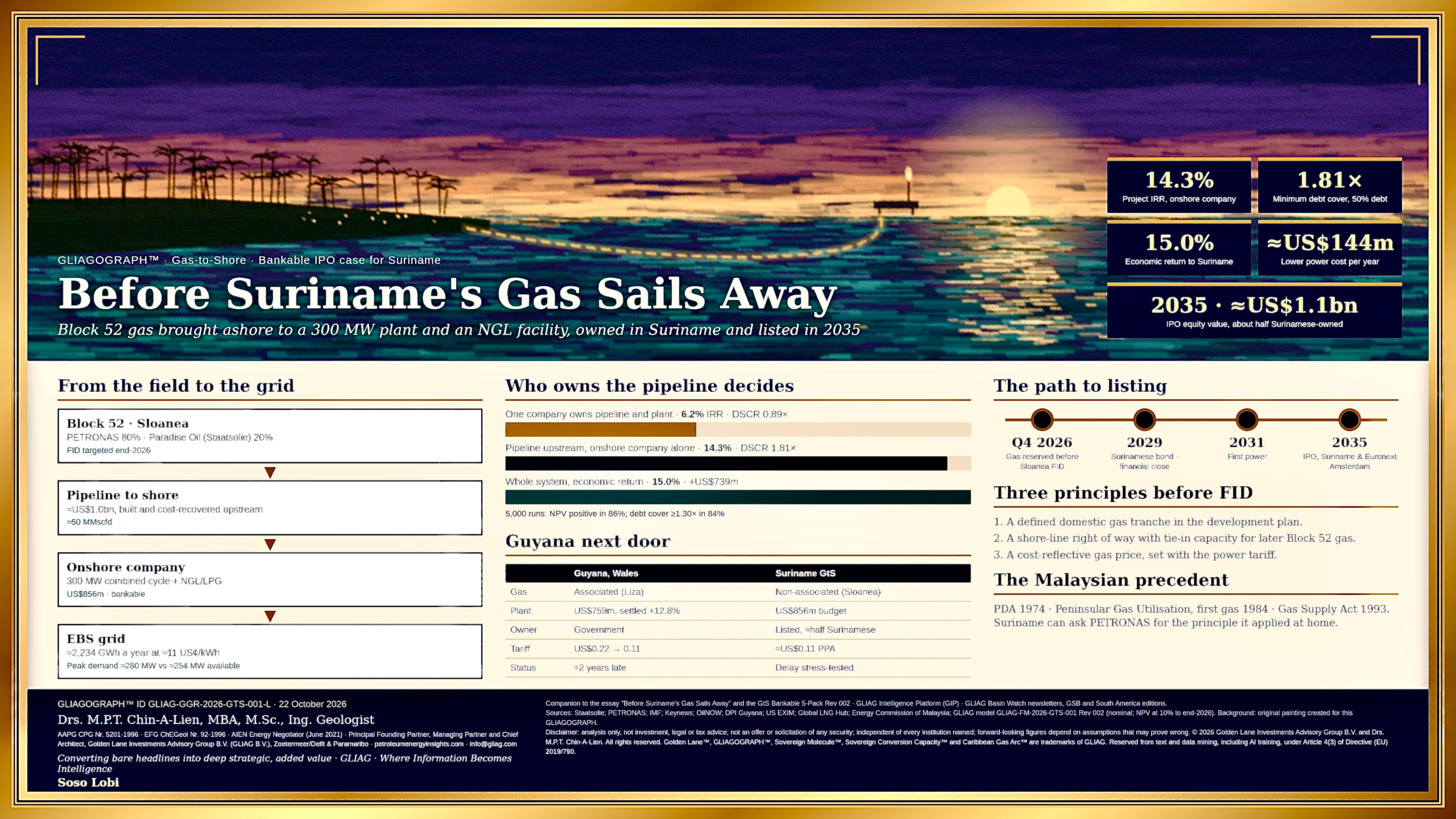
Before Suriname’s Gas Sails Away
The bankable Gas-to-Shore IPO case, and the terms Suriname must secure before the Sloanea FID
Suriname’s first offshore gas field is being designed for a floating LNG plant and the export market.
The development plan and the investment decision are being prepared now, between Staatsolie and PETRONAS.
A country that is short of power has a few months left to reserve part of that gas for itself, on terms that lenders will finance and that the IMF will accept.
By Drs. M.P.T. Chin-A-Lien, MBA, M.Sc., Ing. Geologist · Golden Lane Investments Advisory Group B.V.
On 11 November 2025 Staatsolie approved the Sloanea gas discovery in Block 52 as a commercial field.
PETRONAS operates the block with 80%; Staatsolie’s subsidiary Paradise Oil Company holds 20%.
The two companies evaluated how to monetise the gas and agreed a gas addendum to the 2013 production-sharing contract; the selected concept combines subsea wells with a floating LNG facility, a first for the region (Staatsolie; Rigzone).
PETRONAS is now drafting the development plan for Staatsolie’s approval. The final investment decision is targeted for the second half of 2026, with first gas around 2030, and has not yet been announced (Global Energy Monitor, October 2026).
President Jennifer Simons has made Gas-to-Shore a priority project, and a State team drawn from the presidency, the ministries of Oil, Gas and Mining and of Natural Resources, and Staatsolie has been formed around it (Starnieuws).
The terms on which Sloanea is sanctioned are therefore being discussed now.
Once the FID is taken and the LNG offtake contracts are signed, the molecules are spoken for.
Gas that is not reserved for Suriname before then will be very hard to bring back.
I have worked the Guyana–Suriname Basin for more than 2 decades, and between 2008 and 2010 I helped Staatsolie bring Tullow, Kosmos, Murphy and Repsol into Suriname’s offshore.
I have argued for Gas-to-Shore in a series of essays since February 2026, listed at the end of this one.
What follows rests on that rebuilt model, GLIAG-FM-2026-GTS-001 Rev 002, and on public data as of October 2026.
Both the New Refinery IPO project proposal as well as this GtS IPO project proposal.
Are part of my self-architected Suriname Horizon 2050 and Beyond doctrine, vision and mission.
That is supported by and relates to the Conversion Trilogy, Suriname 2050 and Beyond & Syncronization Navigator, as published extensively on my website.
1. A country short of power
Suriname’s main grid is running out of headroom.
Peak demand in the Paramaribo–Para area has risen to about 280 megawatts against about 254 megawatts of available capacity; demand is up about 10% on 2025, and EBS estimates that about US$500 million of new generation is needed (Keynews, 2026).
The 189 MW Afobaka hydro plant carries the base load, and heavy-fuel-oil and diesel plants fill the gap (IDB, SU-L1055).
When the reservoir fell during the drought of 2024–25, EBS had to rent diesel generators to avoid load shedding.
Figure 1 · Suriname main grid (EPAR), 2026, megawatts
Peak demand · ≈280 MW
Available capacity · ≈254 MW
Afobaka hydro · 189 MW
Sources: Keynews (2026); IDB project document SU-L1055.
2. What the IMF is asking for
The IMF’s 2025 Article IV mission was explicit: electricity subsidies should be removed, the automatic link between tariffs and the cost of electricity production established in 2024 should be restored, and prices should keep rising towards cost recovery (IMF Staff Concluding Statement, November 2025).
The Executive Board added that offshore oil should lift growth to around 30% from 2028, and that strong institutions are needed to manage the revenue (IMF Press Release 26/025, January 2026).
There is a tension in that advice that Gas-to-Shore resolves.
Cost-recovery tariffs are hard to defend politically when the cost being recovered is that of burning imported fuel oil.
Lower the cost of generation, and cost recovery stops being a burden on households and becomes a reform the country can sustain.
That is the economic logic of Gas-to-Shore, and it is the reason this case is written for the IMF as much as for investors.
3. What Guyana built next door
Guyana faced the same problem and chose gas.
Its Gas-to-Energy project brings associated gas from the Liza field to a 300 MW combined-cycle plant and a natural gas liquids plant at Wales.
ExxonMobil built the pipeline, about US$1 billion of a total of roughly US$1.8 billion, and the government is paying for the plant (OilNOW).
The goal is to halve tariffs from US$0.22 to US$0.11 per kWh and save at least US$100 million a year (DPI Guyana).
The plant contract of US$759 million was settled at 12.8% above its original sum (OilNOW, 2026), and the first turbine is expected around December 2026, about two years late (Rio Times, 2026).
The US Export-Import Bank approved more than US$526 million (US EXIM).
| Crucial aspect | Guyana, Wales | Suriname GtS (GLIAG case) |
|---|---|---|
| Gas source | Associated gas from producing oil fields (Liza) | Non-associated gas field (Sloanea), developed for LNG |
| Pipeline | Built by ExxonMobil, ≈US$1bn, cost-recovered | Upstream-built under the Block 52 terms (GLIAG proposal) |
| Gas terms | “Free gas” arrangement | Cost-reflective price, negotiated with the tariff |
| Plant | 300 MW CCGT + NGL; US$759m, settled +12.8% | 300 MW CCGT + NGL; US$856m budget |
| Owner | Government of Guyana | Onshore company, listed in 2035; ≈half Surinamese |
| Finance | Treasury plus US EXIM | ECA, IDB Invest, Afreximbank, Surinamese bond |
| Tariff target | US$0.22 → US$0.11 per kWh | ≈US$0.11 per kWh PPA with EBS |
| Schedule | About two years late | Two-year delay tested in the model |
Sources: OilNOW; DPI Guyana; Rio Times; US EXIM; GLIAG model GTS-001 Rev 002.
Two differences matter most.
Guyana’s gas comes from oil fields that would produce it anyway;
Sloanea’s gas has an export alternative, so its price must be negotiated.
And Guyana’s plant sits on the government’s balance sheet, while GLIAG’s case puts Suriname’s plant in a company that private lenders finance and Surinamese savers can own.
4. The question that decides bankability
GLIAG tested two ways to own a Suriname project of Guyana’s size: about 50 million standard cubic feet of gas a day into a 300 MW combined-cycle plant and an NGL facility, selling power to EBS at 11 US cents per kWh.
If one company owns everything, including a pipeline of about US$1 billion, it fails a lender’s test: a 6.2% project return and a minimum debt cover of 0.89×.
It would need a tariff of 15.4 US cents to reach 10%, more than the fuel-oil power it replaces.
If the pipeline is built and cost-recovered within the upstream development, as in Guyana, an onshore Power & NGL company of about US$856 million stands on its own (GLIAG model GTS-001 Rev 002; nominal terms; NPV at 10% to end-2026).
Figure 2 · Project IRR by ownership structure, %
One company owns pipeline and plant · 6.2%
Pipeline upstream, onshore company stands alone · 14.3%
Whole system, economic return to Suriname · 15.0%
Source: GLIAG model GTS-001 Rev 002 (October 2026).
14.3%
Project IRR, onshore company
17.8%
Equity IRR
+US$271m
NPV at 10%
1.81×
Minimum debt cover, 50% debt
5. What Suriname gains, and what it pays
Moving the pipeline upstream does not make it free.
Under production-sharing terms its cost is recovered from Block 52 production, so the State pays for it through a smaller share of profit gas. An IMF mission will want that cost in the budget, and so does GLIAG.
Judged as a whole system, pipeline included, Gas-to-Shore returns 15.0% to Suriname, with an economic net present value of about US$739 million at 10%.
Replacing thermal power that costs about 15 US cents per kWh with an 11-cent power-purchase agreement saves about US$144 million a year over the first decade (GLIAG model and judgement).
Phase 1 uses about 0.45 Tcf over 25 years: of the same order as Staatsolie’s 20% share of a field in the 1–2.5 Tcf range that GLIAG’s essays have discussed (GLIAG arithmetic; operator volumes are not yet public).
15.0%
Economic return to Suriname
+US$739m
Economic NPV
≈US$144m
Lower power cost per year
≈0.45 Tcf
Gas used over 25 years
6. The price of a molecule
The hardest question will come from PETRONAS and from the IMF: why sell gas at home when the world pays more for it as LNG? On 16 October 2026 Henry Hub stood at about US$3.1 per MMBtu, while European TTF and Asian JKM were near US$29 (Global LNG Hub).
GLIAG’s base case prices gas at the shore at US$2.5 per MMBtu, reflecting a cost-recovered pipeline.
At US$6.0 the onshore company’s return falls to 9.2% and debt cover to 1.23×; with a 13-cent tariff it recovers to 12.5% and 1.61×. Gas price and power tariff must therefore be negotiated as one package.
Phase 1 needs about 50 MMscfd, a small share of an export development of this kind (GLIAG judgement).
The domestic tranche does not compete with LNG; it completes it. This is what GLIAG calls the Sovereign Molecule™: gas that is legally reserved for the country before the export architecture closes.
7. PETRONAS knows this model from home
Suriname does not need to invent its negotiating position.
It can ask PETRONAS for the principle on which Malaysia built its own gas economy.
Malaysia’s Petroleum Development Act of 1974 vested the country’s petroleum resources in PETRONAS; the National Petroleum Policy of 1979 followed; and the Peninsular Gas Utilisation project, approved in 1981, delivered first gas on 1 August 1984, bringing offshore gas ashore to power stations and industry across the peninsula (PETRONAS, Energy Commission of Malaysia).
The Gas Supply Act of 1993 then provided for the supply of gas at reasonable prices (Gas Supply Act 1993, Act 501).
Malaysia’s experience also carries a warning that strengthens Suriname’s case rather than weakening it.
PETRONAS itself has told Malaysia’s Energy Commission that years of regulated, below-cost gas prices created unsustainable demand and revenue forgone, and it has pressed for domestic gas-price reform.
The lesson for Suriname is precise: reserve the molecules, build the shore infrastructure, and price the gas at a cost-reflective level that the power tariff can carry.
That is a position PETRONAS will recognise, because it is the one PETRONAS argues for at home.
Three principles for the Sloanea terms, before FID
1. A defined domestic gas tranche for Suriname, written into the development plan.
2. A shore-line right of way and tie-in capacity, so that later discoveries in Block 52 can use the same line.
3. A cost-reflective gas price, set together with the power tariff.
8. Stress-tested
GLIAG ran 5,000 probabilistic cases, with ranges skewed deliberately to the downside: capital cost up to 40% over budget, tariffs from 9.5 to 12.5 cents, plant load down to 65%, gas up to US$4.0, no NGL at all, and delays of up to two years.
Net present value stayed positive in 86% of cases and debt cover held at 1.30× or better in 84%.
The median project return was 11.8%. The project breaks even at a capital cost of about US$1.30 billion or a tariff of about 8.1 cents (GLIAG model GTS-001 Rev 002).
86%
Chance of positive NPV
84%
Runs with debt cover ≥ 1.30×
US$1.30bn
Break-even capital cost
8.1¢
Break-even tariff per kWh
9. The IPO case: a company Suriname can own
The onshore company is designed to be listed.
GLIAG’s case ends in an IPO in 2035, after three years of operations, at an equity value of about US$1.1 billion, with about half of the shares in Surinamese hands.
The capital exists: Surinamese investors filled Staatsolie’s 2025–2033 bond with US$515.8 million in March 2025.
The lenders exist too: export credit agencies, development banks and Afreximbank, with which Suriname ratified a partnership agreement on 5 April 2025.
The national long-term view is set out in the Suriname 2050 report of the Planning Office, which already expects the gas revenue picture to be revised once Sloanea is sanctioned.
10. What this essay does not tell you
The numbers above are the result.
The route to them is in GLIAG’s Gas-to-Shore Bankable 5-Pack, and it is not in this essay.
The 5-Pack sets out what must be built and what each part costs, the capital structure and the lenders, how Surinamese savers can own part of the company years before it lists, the gas and power contracts that make it bankable, the full negotiating position behind the three principles above, and the six conditions that must be met before any lender commits.
The first of those conditions has a deadline.
It must be met before the Sloanea final investment decision, which PETRONAS has targeted for the end of 2026.
The Gas-to-Shore Bankable 5-Pack
(GLIAG-IPO-2026-GTS-001, Rev 002):
Executive One-Pager, Terms of Reference, Bankable IPO Case, What Is Built and What It Costs, Financial Model Summary and Investor & Lender Deck.
Available to the Government of Suriname, Staatsolie, EBS, the IMF, the World Bank Group, Afreximbank, export credit agencies and qualified lenders and investors on request: info@gliag.com.
Further reading
GLIAG essays on Sloanea and Gas-to-Shore · petroleumenergyinsights.com
How to Monetise Sloanea? 22 Feb 2026
Three pathways compared, FLNG, Gas-to-Shore on the 20% entitlement, and a regional hybrid; the case for a conservatively sized Phase 1.
Unleashing Suriname’s Energy Potential: Sloanea Gas Impact Feb 2026
Analogue-based resource range, PSC fiscal architecture and the public-revenue potential of Sloanea.
Strategic Gas Integration: Guyana & Suriname Cooperation Feb 2026
Guyana’s Gas-to-Energy projects as a platform and a Sloanea-to-Nickerie Gas-to-Shore option for West Suriname.
The Sloanea Gas Development Decision Framework Mar 2026
Policy brief scoring FLNG, Gas-to-Shore and Hybrid; recommends a phased Hybrid anchored by domestic allocation.
Suriname’s Multi-Hub Future: Turning Gas-to-Shore into Sovereignty Jul 2026
The Sovereign Molecule Doctrine applied to Sloanea, SAC-1 and future tie-ins; from Gas-to-Shore to Growth-to-State.
Commercial Energy Integration: Key Insights for 2026 Aug 2026
The Domestic Conversion Test before FID, and the legal instruments that make domestic gas enforceable.
Guyana Suriname Super Basin: Production-Depletion & Fiscal Revenue Outlook Aug 2026
Basin-wide production and fiscal outlook, with the Block 52 essay cluster.
Investment Insights: Guyana & Suriname Billion-Barrel Refinery Opportunity Sep 2026
The New Refinery case and its link to domestic gas from Sloanea and SAC-1.
The South-East Golden Lane, Read From Its Kitchen Oct 2026
Kitchen modelling of the Suriname side of the Golden Lane™ and the gas paradox of Block 52; why the window is the Sloanea FID.
All GLIAG essays on Suriname
Including The Legal Framework for Sloanea Gas Development, Sloanea Gas Discovery: Evolution in Petroleum Law, Suriname’s Gas-Era PSC, and Sloanea Analog-Based Production–Depletion Modeling.
International institutions
IMF · Suriname: Staff Concluding Statement of the 2025 Article IV Mission Nov 2025
Remove electricity subsidies; restore the tariff–cost link; move prices towards cost recovery.
IMF · Executive Board Concludes 2025 Article IV Consultation with Suriname Jan 2026
Growth outlook to 2028 and the institutions needed to manage oil revenue.
IMF · 2024 Article IV and Eighth EFF Review for Suriname Dec 2024
Phasing out utility subsidies; audited EBS accounts; institutions for oil wealth.
World Bank · Harnessing African Natural Gas
A policy and economic framework for domestic gas supply, with the power sector as anchor customer.
World Bank / ESMAP · Commercializing Natural Gas
Basic features of gas projects, power generation as first market, and gas-sector policy.
IDB · Suriname energy sector loan document SU-L1055
Structure of Suriname’s grid: Afobaka hydro, thermal plants and tariff reform.
US EXIM · More than US$526 million for Guyanese energy
The export-credit precedent for a Gas-to-Energy plant in this basin.
Suriname and Malaysia: official sources
Staatsolie · Commercial Field for Sloanea-1 approved Nov 2025
Ownership, gas addendum, development plan and FID timing.
PETRONAS · Three new successes in Block 52 Jun 2026
Caiman-1, SAC-1 and Roystonea-2; eight successful wells.
Planning Office Suriname · Suriname 2050 Mar 2026
National long-term plan; oil and gas revenue outlook.
Malaysia · Gas Supply Act 1993 (Act 501)
Licensing and the supply of gas at reasonable prices.
PETRONAS · Key issues and challenges for an effective gas framework
PDA 1974, PGU 1984, Gas Supply Act 1993, and the case for domestic gas-price reform.
International energy press
Reuters · PETRONAS Sloanea gas discovery declared commercial Nov 2025
FLNG concept, FID target and first-gas timing.
Energy Intelligence · Suriname approval sets stage for PETRONAS-led FLNG Nov 2025
FLNG development path after commerciality.
Upstream · PETRONAS makes new gas discovery offshore Suriname Jun 2026
FID earmarked for H2 2026; service agreements for development.
Global Energy Monitor · PETRONAS FLNG Terminal Oct 2026
Project tracker: pre-FID status.
Prospect · Suriname confirms commerciality of first offshore gas project 2026
Gas addendum and development concept.
OilNOW · Guyana settles Gas-to-Energy disputes 2026
Plant contract settlement and start-up timeline.
Starnieuws · Het gas-to-shoreproject van president Simons 2026
Gas-to-Shore as a presidential priority and the State team.
Keynews · US$500 million needed to reduce load shedding 2026
EPAR peak demand, capacity and investment need.
Global LNG Hub · Weekly gas prices, JKM, TTF and Henry Hub Oct 2026
Gas price benchmarks, 16 October 2026.
Drs. M.P.T. Chin-A-Lien, MBA, M.Sc., Ing. Geologist
AAPG Certified Professional Geologist Nr. 5201-1996 · EFG Chartered European Geologist Nr. 92-1996 · AIEN Energy Negotiator (June 2021)
Principal Founding Partner, Managing Partner and Chief Architect · Golden Lane Investments Advisory Group B.V. (GLIAG B.V.) · Zoetermeer/Delft & Paramaribo · petroleumenergyinsights.com · info@gliag.com
Disclaimer and legal notice
1. No advice. This essay is analysis, not investment, legal, tax or accounting advice. Readers should take their own professional advice.
2. No offer or solicitation. Nothing in this essay is an offer to sell or a solicitation of an offer to buy any security. Any offer would be made only by a prospectus approved by the competent authority.
3. Independence of analysis. GLIAG prepared this analysis independently. It is not commissioned, reviewed or endorsed by the Government of Suriname, the Government of Guyana, the Government of Malaysia, Staatsolie, EBS, PETRONAS, ExxonMobil, the IMF, the World Bank Group, US EXIM, Afreximbank or any institution or publication named or linked.
4. Forward-looking statements. Projections, estimates and model results depend on assumptions that may prove wrong, including gas volumes and composition not yet published by the operator. Actual results may differ materially.
© 2026 Golden Lane Investments Advisory Group B.V. and Drs. M.P.T. Chin-A-Lien. All rights reserved. Golden Lane™, GLIAGOGRAPH™, Sovereign Molecule™, Sovereign Conversion Capacity™ and Caribbean Gas Arc™ are trademarks of GLIAG. The rightsholder expressly reserves this work from text and data mining, including for the training of artificial-intelligence and machine-learning systems, under Article 4(3) of Directive (EU) 2019/790.
Converting bare headlines into deep strategic, added value · GLIAG · Where Information Becomes Intelligence
Soso Lobi

