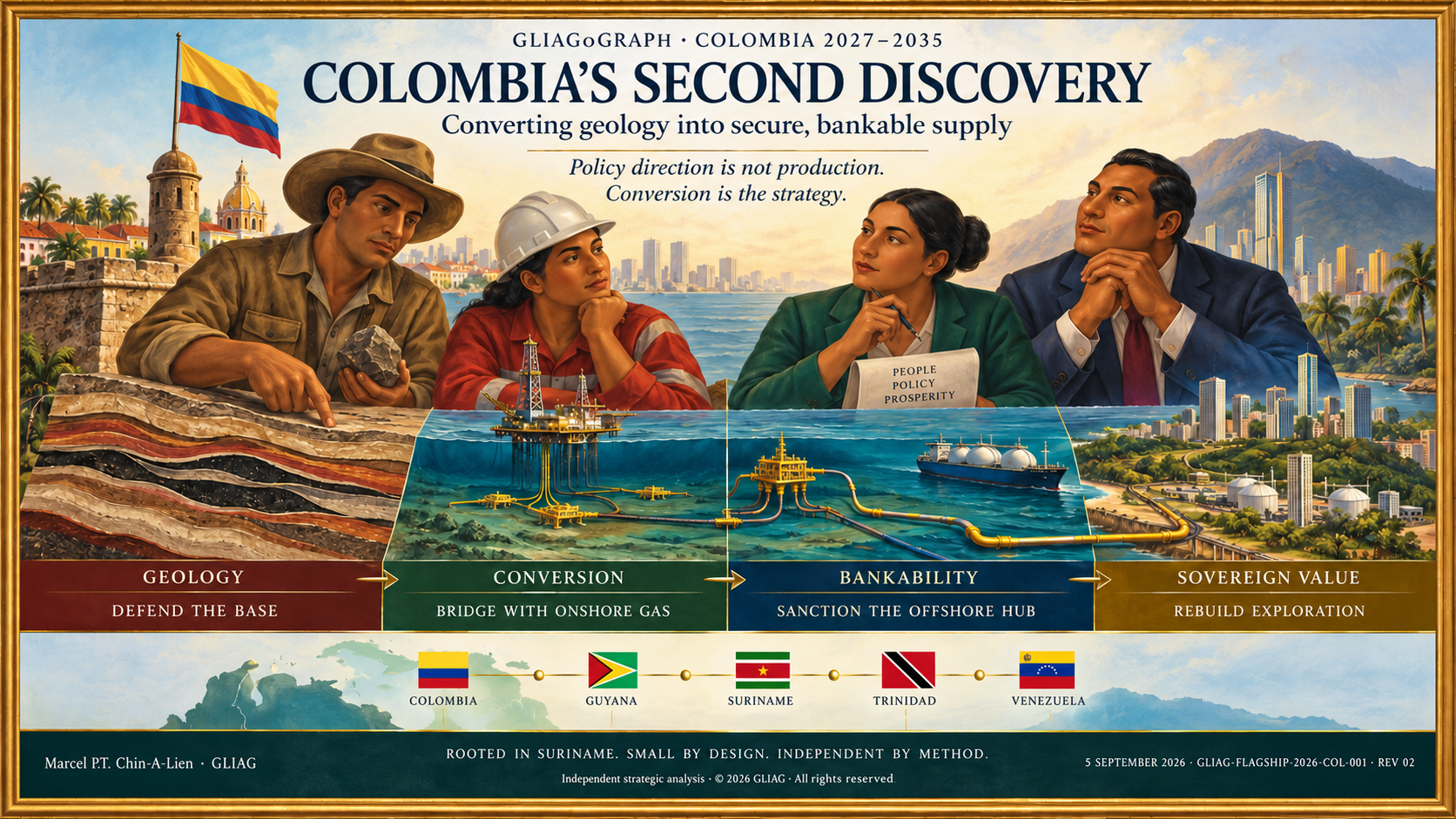
Colombia’s Second Discovery
GLIAG | STRATEGIC UPSTREAM INTELLIGENCE

COLOMBIA’S SECOND DISCOVERY
The State Capacity to Convert Geology into Sovereignty — From President De La Espriella’s Policy Reset to a Bankable 2027-2035 Upstream System
A Socratic, Independent GLIAG Petroleum Strategy Essay
Marcel P.T. Chin-A-Lien, Drs., MBA, M.Sc., Ing. Geologist
Principal Founding Partner & Chief Architect, GLIAG
5 September 2026 | GLIAG-FLAGSHIP-2026-COL-001 | Rev 02
ROOTED IN SURINAME. SMALL BY DESIGN. INDEPENDENT BY METHOD.
Executive verdict
| GLIAG VERDICT Colombia does not primarily suffer from a shortage of geological possibility. It suffers from a conversion gap: too few prospects become wells, too few discoveries become reserves, too few reserves become deliverable molecules, and too slowly. A policy reset can reopen the gate; only sustained execution can rebuild the supply system. |
|---|
Colombia’s policy reset identifies the correct direction, but policy alone will not reverse production decline. More committed wells, stronger recovery from mature fields and faster commercialization of Caribbean offshore gas are the right tests. The proposition becomes decision-grade only when it is decomposed by basin, decline mechanism, reserve class, infrastructure, market and timing.
The immediate challenge is stark. Colombia closed 2025 with 2,020 million barrels of proved oil reserves and a 7.4-year oil R/P ratio; proved gas reserves were 1,717 Bcf with a 5.9-year R/P ratio. The country replaced roughly 94 barrels for every 100 barrels produced in 2025. That is stabilization, not renewal. Gas is more urgent: the proved base implies annual production near 291 Bcf, or roughly 0.80 Bcfd, while planners model LNG as a structural bridge and Sirius as a contingent post-2030 supply pillar.
GLIAG’s central conclusion is therefore a two-clock strategy. Clock One, 2027-2030: defend base production with disciplined infill, workovers, waterflood optimization, EOR/PPI and rapid tie-ins of onshore gas. Clock Two, 2030-2035: convert Sirius and its satellites into a bankable offshore hub, restore a repeatable exploration inventory and selectively test unconventional resources under scientifically credible regulation and social consent. Failure on either clock creates imports, fiscal erosion and loss of service-sector capability.
| FLAGSHIP PROPOSITION Colombia’s first discovery was geological: prolific basins, mature fields and a Caribbean gas province. Its second discovery must be institutional: the capacity to turn evidence into permits, permits into wells, wells into facilities, facilities into contracts and contracts into durable national value. |
|---|
The numbers that matter
| Indicator | Verified position | GLIAG interpretation |
|---|---|---|
| Oil 1P, YE2025 | 2,020 MMbbl; R/P 7.4 years | Short reserve life; annual replacement must exceed production to rebuild resilience |
| Gas 1P, YE2025 | 1,717 Bcf; R/P 5.9 years | Near-term security problem; offshore 2C is not yet supply |
| 2025 oil additions | 257 MMbbl; 94% replacement ratio | Good operational recovery, insufficient for durable growth |
| EOR/PPI contribution, 2018-2025 | 436 MMbbl; 22% of additions | Material value lever, but bounded by remaining mobile oil and project economics |
| Gas contingent resources | 10.54 Tcf in 3C | Large option set, high uncertainty; do not equate 3C with reserves |
| Sirius concept | ~6 Tcf gas in place; ~460-470 MMcfd concept | Potential anchor; FID, recoverability, license, consultation and pipeline remain gates |
| Ecopetrol 2026 plan | 730-740 kboe/d; 380-430 development wells; 8-10 exploration wells | Development-heavy program protects plateau but may not rebuild exploration depth |
1. The first analytical discipline: separate policy from supply
What the evidence establishes
- The sequence matters: rebuild drilling, defend existing production, establish the next supply base.
- Acreage and policy announcements are leading indicators, not barrels.
- Near-field drilling and enhanced recovery can soften decline before 2030.
- Post-2030 gas security hinges disproportionately on Sirius and on whether onshore discoveries become repeatable commercial developments.
- Investor confidence must be observed through committed capital, wells and project sanctions, not conference rhetoric.
What national framing can still conceal
First, ‘production decline’ is not one mechanism. It is the net result of reservoir depletion, rising water cut, facility uptime, pipeline constraints, security interruptions, deferred workovers, exploration drought and capital allocation. Each requires a different remedy. Second, a national supply-demand view can hide quality and location: heavy Llanos crude, Middle Magdalena barrels, Caribbean dry gas and deepwater offshore gas are not interchangeable units. Third, any national development thesis remains incomplete until the commercial assumptions behind Sirius timing, LNG utilization, pipeline tariffs and reserve maturation are explicit.
Decision models should retain native units and state every conversion factor. GLIAG therefore separates liquids, sales gas and boe-equivalent views and does not allow a visually convenient unit to obscure the molecule balance.
| SOCRATIC QUESTION If the policy changes tomorrow, which already-mapped prospects can be permitted, financed and drilled early enough to affect 2030 production? If that list is not named, ranked and scheduled, the policy reset remains political optionality rather than supply. |
|---|
2. The President’s proposition: strength before transition
President Abelardo De La Espriella has given Colombia’s energy debate a new organizing sentence: the transition should be built from strength and self-sufficiency rather than weakness and dependence. In his inaugural address he promised wider oil and gas exploration, ‘responsible and sustainable fracking,’ a stronger Ecopetrol and a government that acts as an investment partner. The proposition is economically intelligible: a country importing an increasing share of its gas while holding short proved reserve life is not made cleaner or more sovereign merely by refusing to replenish supply.
Yet political direction must be separated from executable policy. The president can change tone, priorities, appointments and some administrative processes quickly. He cannot by rhetoric alone settle fiscal durability, consultation rights, environmental licensing, Congressional opposition, security, community benefit-sharing or the economics of marginal barrels. Reuters reported 120 prior consultations still associated with Sirius, a 34% decline in foreign mining-and-oil investment between 2023 and 2025, and 580 attacks or blockades on infrastructure in 2025. These are not footnotes to the supply model; they are variables inside it.
A constructive, non-partisan test of the new doctrine
| Presidential commitment | What would validate it | What would falsify it |
|---|---|---|
| Reopen exploration | Competitive terms, data access, committed wells and diverse qualified bidders | Acreage announcements without executable work programs |
| Strengthen Ecopetrol | Transparent portfolio hurdles, partner leverage, reliable operations and reserve renewal | Using the company simultaneously as fiscal reservoir and policy vehicle |
| Responsible fracking | Limited scientific pilots with baseline water/seismic data, disclosure and independent monitoring | National production forecasts before repeatable pilot economics and social legitimacy |
| Accelerate permitting | Parallel processing, early consultation and published critical paths that preserve substantive rights | Shortcuts that trigger injunctions, delay and loss of legitimacy |
| Attract investment | Stable after-tax returns, security, enforceability and credible project queues | Short-lived incentives vulnerable to the next administration |
| GLIAG JUDGMENT The new policy improves option value immediately; it improves reserves only after commercial discoveries are booked, and it improves supply only after safe first sales. Markets should reward evidence at each gate, not capitalize the entire political promise on day one. |
|---|
3. Colombia’s upstream system is a portfolio of different geologies
Colombia’s petroleum endowment is fragmented across intermontane forelands, fold belts, strike-slip basins and offshore accretionary/deformed margins. National averages conceal different charge systems, reservoir architectures, decline profiles and surface constraints. Strategy must therefore be basin-specific.
| Basin / fairway | Geological engine | 2027-2035 role | Primary risk |
|---|---|---|---|
| Llanos | Andean foreland; Cretaceous-Paleogene reservoirs charged from deeper western kitchens; structural/stratigraphic traps | Largest near-term oil-defense engine: infill, waterflood, facilities and near-field exploration | Mature decline, water handling, differential access/security and heavy-oil economics |
| Middle Magdalena Valley | Inverted rift/intermontane basin; prolific La Luna source, complex structures, stacked reservoirs | Brownfield recovery, redevelopment, selective deeper or bypassed-pay targets | Old infrastructure, compartmentalization, environmental and community constraints |
| Putumayo | Northern Oriente continuation; Cretaceous clastics, structural traps and underexplored stratigraphy | Selective exploration and tie-back oil; regional Ecuador portfolio logic | Security, logistics, permitting and smaller fragmented developments |
| Catatumbo | Maracaibo-related petroleum system with Cretaceous source/reservoir elements | Selective rehabilitation and exploration optionality | Security and cross-border complexity |
| Sinú-San Jacinto / Lower Magdalena | Thrusted fold belt and clastic gas systems; Ciénaga de Oro and deeper intervals | Fastest material onshore gas-growth candidate if Hechicero-style results repeat | Well deliverability, reservoir continuity, commercialization and pipeline capacity |
| Guajira offshore / GUA-OFF-0 | Biogenic and thermogenic gas systems; deepwater turbidites and structural-stratigraphic traps | Sirius-led national gas hub with Copoazú and Sandía satellites | Appraisal, social/environmental license, 117-km evacuation and capex |
| Southern Caribbean Deformed Belt | Deepwater thrusts, mass-transport systems and multiple gas discoveries | Second offshore option set; long-dated strategic diversification | Ultra-deepwater cost, reservoir quality, market timing and stranded-resource risk |
| Middle Magdalena unconventional | La Luna and related source-rock potential | Post-2030 option only after pilots prove repeatability and safeguards | Social license, water, induced seismicity, regulation, cost and political reversal |
The geological priority is not ‘more acreage’ but better conversion
The most valuable new acreage is acreage adjacent to proven charge, infrastructure and operating capability. In mature basins, the highest-value technical work may be reprocessing, static/dynamic model integration, recompletion candidates, unswept compartments and facility debottlenecking. In frontier offshore acreage, the priority is cluster scale: a moderate satellite can be more valuable beside Sirius than a larger isolated discovery without an evacuation route.
This is why GLIAG rejects a false choice between mature fields and frontier exploration. Mature fields buy time; frontier hubs buy the future. The portfolio must fund both, with different hurdle rates, risk budgets and performance metrics.
4. Oil: defend the base without mistaking recovery for renewal
What the 94% replacement ratio really says
ANH reports 257 MMbbl of proved additions in 2025 and a 94% replacement ratio. Algebra implies production near 273 MMbbl for the year, or about 0.75 million b/d. The result is respectable after years of limited new contracting, but below the threshold needed to expand reserve life. A sustainable rebuilding phase requires a multi-year replacement ratio above 100%, ideally with a growing share from new discoveries and commerciality maturation rather than revisions alone.
EOR is a national asset-management program
Between 2018 and 2025, EOR and production-increment projects added 436 MMbbl, 22% of all reserve additions. That validates enhanced recovery as a strategic pillar. It does not justify indiscriminate EOR. Each candidate needs reservoir-specific screening: remaining oil saturation, mobility ratio, heterogeneity, pressure support, injectant availability, produced-water capacity, polymer or chemical compatibility, incremental emissions and full-cycle economics.
| Mature-field lever | Best use | Decision metric | Failure mode |
|---|---|---|---|
| Infill / sidetrack | Known compartments with calibrated connectivity | Incremental EUR per well; payout; interference | Cannibalization and accelerated decline |
| Waterflood optimization | Pressure maintenance and sweep improvement | Pattern balance, VRR, water cut, sweep efficiency | Moving water rather than oil |
| Polymer / chemical EOR | Adverse mobility and material remaining oil | Incremental recovery vs chemical and handling cost | Injectivity loss, breakthrough, supply chain |
| Recompletion / behind-pipe pay | Stacked or bypassed intervals | Low-capex incremental production and reserves | Poor isolation or weak reservoir quality |
| Facilities debottlenecking | Oil constrained by water, power, compression or export | Deferred production recovered per dollar | Reservoir decline mistaken for surface constraint |
| Digital surveillance | Large mature asset portfolios | Faster anomaly detection, allocation accuracy, workover ranking | Data without operational authority |
Why 1.3 million b/d is not yet a plan
The new administration has been associated with an ambition to approach 1.3 million b/d. Against a recent national base near three-quarters of a million barrels per day, that implies roughly 0.55 million b/d of net uplift before offsetting natural decline. Without field-by-field sources, well counts, facility capacity, decline curves, capex and a timetable, the number is a political aspiration. A credible plan should first define a defendable 2030 band, then show how each project fills the decline wedge.
5. Gas: Colombia’s more urgent and strategically richer problem
Gas has only 5.9 years of proved reserve life, and its geography matters because demand, pipelines and hydro-dependent power reliability are spatially constrained. LNG imports are no longer a temporary embarrassment; they are a rational insurance instrument while domestic projects mature. The mistake would be to overbuild rigid import capacity that becomes stranded when Sirius arrives—or to underbuild and expose power and industry if Sirius slips.
Onshore bridge: Sinú-9 and rapid molecules
Maurel & Prom’s Hechicero-1X result is commercially important because it combines 288 ft of reported net gas pay with an instantaneous 26.4 MMcfd test at 1,800 psi wellhead pressure through a restricted choke, and it can use existing connections to the national network. One test is not a plateau. GLIAG would require stabilized rates, pressure-transient analysis, composition, deliverability decline, interference and repeatability across the six-well campaign. If repeated, Sinú-9 can become a genuine 2027-2030 bridge rather than a single-well headline.
Offshore structural solution: Sirius as a hub, not a solitary field
The Sirius complex—together with Copoazú and Sandía—should be evaluated as one pressure-fluid-seismic-development system. The public concept of approximately 460-470 MMcfd through a roughly 117-km subsea-to-shore pipeline can transform the national balance, but gross gas in place is not sales gas. Recovery factor, CO2 and inert content, condensate yield, compression, uptime, domestic contracts, tariff design and consultation determine bankability.
| GLIAG DEVELOPMENT DOCTRINE Do not freeze the Sirius facilities concept before cluster-wide appraisal. Design modular compression, control and pipeline capacity so satellites can extend plateau or fill ullage. The unit of value is the hub, not the discovery press release. |
|---|
The import paradox
UPME’s 2025-2055 planning framework explicitly treats Sirius 2C as an exogenous assumption in announced-policy and carbon-neutrality scenarios, with entry from 2031, while preserving LNG expansion options. That is prudent planning, but it also reveals systemic dependence on a single contingent project. Colombia should contract import flexibility—shorter tenure, seasonal rights, capacity release and modular regasification—rather than assume either permanent LNG dependence or flawless offshore delivery.
6. Policy reset: what must actually change
A new administration can signal openness immediately, but several material measures require law, regulation, institutional coordination or Congressional approval. Reuters reports that simplified permitting may be pursued by decree, while royalty changes, contract redesign, tax incentives and fracking parameters face a divided Congress. The durable reset is therefore an execution compact, not an ideological reversal.
- Publish a prospect-to-first-production inventory, with named gates, responsible institutions and dates.
- Separate fast-track brownfield and tie-in projects from frontier licensing; do not subject both to one process clock.
- Create a predictable consultation protocol that begins before concept selection and preserves substantive rights.
- Stabilize fiscal and contract terms across the investment cycle, with transparent grandfathering and dispute resolution.
- Use bid design to reward data acquisition, well commitment and infrastructure sharing—not signature bonuses alone.
- Make methane, water, flaring and abandonment performance measurable conditions of continued license quality.
- Protect Ecopetrol from becoming either a cash machine for the state or a vehicle for politically selected megaprojects.
7. Ecopetrol: anchor, allocator and potential bottleneck
Ecopetrol is simultaneously national champion, major producer, refiner, transporter, offshore partner and transition investor. This breadth creates integration value but also capital-allocation conflict. Its 2026 plan directs about 70% of investment toward production, with 380-430 development wells and only 8-10 exploration wells. That can defend near-term output, but exploration depth may remain thin unless partners carry more frontier risk.
The correct governance question is not whether Ecopetrol should be ‘restored’ in political terms. It is whether each capital tranche earns its strategic mandate. Brownfield cash generation, Sirius infrastructure, exploration, refining reliability, power and low-carbon investments should each have explicit return, resilience and emissions criteria. Sovereign objectives must be priced rather than hidden inside corporate performance.
8. The 2027-2035 practical program
| Phase | Operational agenda | Observable proof | GIP trigger |
|---|---|---|---|
| 2027-2028: Stabilize | Commit development and near-field wells; accelerate workovers/EOR; tie in onshore gas; complete Sirius appraisal/licensing architecture | Rig and well count rises; base decline moderates; stabilized Sinú deliverability; consultation milestones | Monthly well funnel, field uptime, reserve movements, gas contracts |
| 2028-2030: Convert | Sanction Sirius hub/pipeline; award selective high-quality exploration; lock flexible LNG bridge; debottleneck mature assets | FID, EPC and financing; pipeline progress; multi-year reserve replacement >100% | Capex-at-risk, schedule confidence, contracted demand, permitting critical path |
| 2030-2032: Deliver | First Sirius gas or transparent rebaseline; satellite tie-back decisions; scale repeatable onshore gas; begin new discovery maturation | Sales gas, uptime and plateau; LNG displacement; new 2P/1P bookings | Supply-demand balance by node, hub ullage, tariff and import utilization |
| 2032-2035: Renew | Second offshore node or satellites; sustained frontier drilling; selective unconventional pilots only if validated | New supply base offsets mature decline; reserve life rises; pilots meet environmental and cost thresholds | Portfolio NPV, emissions intensity, reserve life, social-performance score |
A realistic scenario envelope
| Scenario | 2030 condition | 2035 consequence | GLIAG probability posture |
|---|---|---|---|
| Execution reset | Policy becomes contracts, wells, EOR and Sirius FID | Oil broadly stabilized; gas deficit narrowed or reversed; hub optionality | Plausible, but requires cross-government delivery |
| Announcement reset | Licensing rhetoric rises; permitting, Congress and project gates remain slow | Temporary investment interest; production resumes decline; LNG dependence grows | Material downside risk |
| Brownfield-only success | EOR and development wells outperform; frontier conversion lags | Oil decline softened; reserve life remains short; gas structurally tight | Useful bridge, not renewal |
| Offshore delay | Sirius slips beyond 2031/32 or costs rise materially | Higher LNG utilization and prices; stranded/underused infrastructure risk | Must be explicitly hedged |
| Full portfolio renewal | Mature fields, onshore gas, Sirius cluster and exploration all convert | Colombia re-emerges as investable Northern Andes platform | Upside; should not be base case before observable gates |
9. Regional strategy: Colombia is becoming a Northern Andes operating platform
Colombia’s service companies are already moving into Venezuela, while GeoPark and Grupo Gilinski have signed a 25-year agreement around the Bare field and KEO Energy has reportedly taken operational and cash-flow management responsibility in PetroUrdaneta with up to US$350 million of financing. Chevron’s reported multi-year Venezuelan expansion adds another demand center for drilling, workovers, power and logistics. These are not separate news items. They suggest a regional service and operating corridor in which Colombian capability can export west-to-east while Venezuelan opportunities diversify Colombian corporate portfolios.
The opportunity carries asymmetric risk. Venezuela may create rapid brownfield work, but sanctions, title, payment, governance and contract durability must remain ring-fenced. Colombia should not allow domestic drilling capacity to be pulled across the border before its own reserve-replacement program is rebuilt. For companies, Venezuelan upside belongs in a licensed option bucket; Colombian producing cash flow and infrastructure should remain the base.
For Guyana, Suriname and Trinidad, Colombia’s offshore gas matters because capital, subsea suppliers and LNG/import economics are regional. A sanctioned Sirius hub competes for deepwater engineering capacity, but it also validates a larger Atlantic-Caribbean gas-services market. Trinidad remains the monetization benchmark; Guyana and Suriname remain liquids-led basin comparators; Venezuela remains the highest-resource, highest-institutional-risk comparator.
10. GIP integration architecture
GLIAG plans to incorporate dedicated dashboard architectures for the Guyana–Suriname Basin (GSB), Venezuela and Colombia into the GIP. Each is intended to connect basin and subsurface evidence with wells, infrastructure, commerciality, policy, sovereign risk and investor decision gates. These are planned capabilities: until implementation is complete, the present essay should be read as an independent analytical blueprint—not as a claim that the full dashboard functionality is already operational.
| GIP layer | Required fields | Decision use |
|---|---|---|
| Basin & petroleum system | Sources, reservoirs, play type, maturity, charge, trap, seal, discovery analogues | Rank where geology can support repeatable conversion |
| Field decline & recovery | Production, decline, water cut, uptime, injection, remaining reserves, EOR stage | Separate reservoir decline from surface constraints |
| Well funnel | Prospect, permit, spud, result, completion, tie-in, first sales | Measure policy-to-barrel conversion time |
| Gas balance | Native MMcfd by field/node; firm demand; transport; LNG; contracted vs interruptible | Avoid boe conversions obscuring regional bottlenecks |
| Sirius hub | Resources by class, appraisal, license, consultation, FEED/FID, capex, pipeline, tariffs | Calculate schedule confidence and import displacement |
| Fiscal & political | Royalty, tax, contract form, consultation, litigation, security, government actions | Price policy durability and sovereign risk |
| Capital & economics | Brent/HH/LNG assumptions, capex, opex, decline, NPV, IRR, payout, emissions cost | Compare brownfield, onshore gas, offshore and unconventional options |
| Regional operators | Ecopetrol, Petrobras, Shell, M&P, GeoPark, Parex and relevant partners | Track operating control, balance sheet and cross-border optionality |
Mandatory confidence language
- Verified fact: primary regulator/company disclosure or audited filing.
- Reported claim: credible reporting, not yet evidenced by underlying document.
- GLIAG inference: reasoned conclusion from named evidence.
- Scenario: conditional future state with explicit trigger and falsifier.
- Unverified: do not encode as a canonical GIP value.
11. Why GLIAG’s integrated method changes the answer
This essay applies one integrated evidence chain: GIP’s basin and asset architecture, GLIAG’s petroleum-system work, field and decline logic, company disclosures, official reserve and planning data, policy and legal evidence, regional geopolitics, and the daily signal discipline of Global Basin Watch. The purpose is to make each conclusion traceable from geological possibility through execution to economic and sovereign consequence.
That integration creates a practical edge. A geologist sees charge, reservoir, seal and trap. A reservoir engineer sees decline, sweep and deliverability. A project financier sees sanctioned volumes, tariffs and debt capacity. A policymaker sees reserve life, imports, revenues and social legitimacy. An investor sees timing, optionality and downside. GIP places these views in one evidence chain so that no discipline can quietly export its uncertainty to another.
| GLIAG intelligence layer | Analytical contribution | Decision output |
|---|---|---|
| GLIAG deep research | Independent triangulation of primary, scientific, corporate and political evidence | A defensible thesis with explicit uncertainty |
| GIP platform | Living basin, asset, well, infrastructure, fiscal and risk architecture | Traceable country-to-prospect and prospect-to-cash decisions |
| GBW–South America | Daily detection of policy, operator, service, financing and cross-border signals | Early-warning changes to the Colombia/Venezuela investment case |
| GBW–GSB | Comparative learning from Guyana, Suriname, Trinidad and the wider Atlantic margin | Better hub, gas-to-shore and sovereign-conversion choices |
| GLIAG Socratic protocol | For every claim: What is known? What is assumed? What must happen next? What would prove us wrong? | Reduced narrative risk and clearer investment gates |
Integrated by design, independent by method
GLIAG works through architecture, independence and consequence. The method connects subsurface possibility to above-ground executability and then asks whether the result creates durable value for operators, investors, governments and communities. This is the meaning of ‘Where Information Becomes Intelligence’ and of the more demanding promise: ‘Most people report transactions. GLIAG interprets consequences.’
| GLIAG METHOD GLIAG codifies nearly five decades of geological, commercial and sovereign advisory experience into an integrated intelligence architecture usable from a desk, an iPad or a phone—while keeping uncertainty visible, evidence traceable and decisions conditional on observable gates. |
|---|
12. Newsletter integration
GBW-South America lead signal
| SUGGESTED HEADLINE Colombia’s Policy Reset Opens the Gate—but Only Wells, Recovery and Sirius Can Rebuild Supply |
|---|
The 2026 policy reversal is material because it can restore exploration contracting and investor confidence after four years of stagnation. It does not yet change the production base. The next evidence is a committed 2027-2030 well inventory, repeatable mature-field reserve additions, stabilized onshore gas deliverability and a financeable Sirius development schedule. Until then, treat the reset as improving option value, not proved supply.
GBW-GSB comparative sidebar
Colombia offers Suriname and Guyana a warning and a lesson. Discoveries can remain stranded when permitting, consultation, pipeline and market architecture lag. Conversely, mature-field optimization can fund frontier development if national-company capital allocation is disciplined. The GSB should build domestic gas routing, consultation and commercialization pathways before resource announcements outrun infrastructure.
Venezuela cross-feed from the supplied screenshots
- KEO/PetroUrdaneta: verify executed contract, fields, financing draw conditions, operator authority, production baseline and cash waterfall before treating US$350 million as committed capital.
- Chevron: treat US$7 billion and 600 kboe/d as promotional/forward-looking claims pending Chevron filings, license terms, field-level capex and production schedules.
- Venezuela Energy Week 2027 is a market-sentiment and network signal, not evidence of capital deployment.
- Colombian service-company entry and the GeoPark/Gilinski Bare agreement are stronger execution signals, but remain exposed to Venezuela-specific payment, sanctions and enforceability risk.
13. The investment-committee test
Before allocating capital to Colombia, an investor should demand answers to ten questions:
- Which fields offset the modeled natural decline through 2030, and at what capex per incremental barrel?
- How much 2025 reserve addition came from revisions, extensions, improved recovery and discoveries?
- Which exploration wells can realistically reach first production before 2032?
- Which assets are reservoir-constrained, facility-constrained, security-constrained or permit-constrained?
- What domestic gas price and take-or-pay structure makes Sirius bankable while protecting consumers?
- How much LNG capacity remains economic if Sirius arrives on time; what if it slips three years?
- Does Ecopetrol have balance-sheet room for upstream, refining, transmission and transition commitments simultaneously?
- Can consultation and environmental review be accelerated without weakening legitimacy and creating litigation risk?
- Which unconventional pilots would prove commercial repeatability, water integrity, emissions and induced-seismicity control?
- What policy provisions survive the next electoral cycle?
14. Final GLIAG position
Colombia’s 2026 policy reset matters. It removes a self-imposed constraint at the moment reserve life is short and gas imports are becoming structural. But the country will not drill its way out of decline by decree, nor recover its way into a new province through EOR alone.
The most resilient strategy is sequenced portfolio conversion. Use mature-field recovery and development drilling to defend cash flow. Convert fast onshore gas into the 2027-2030 bridge. Sanction Sirius as an expandable cluster hub rather than a stand-alone trophy. Rebuild exploration around basin-specific petroleum systems and infrastructure adjacency. Treat unconventional resources as a scientific pilot program, not a political production forecast. Keep LNG flexible. Protect Ecopetrol’s capital discipline. Measure every policy by the time it takes to become a safe, flowing, saleable barrel or molecule.
| THE CONCLUSION Colombia’s future will not be decided by whether it chooses hydrocarbons or transition. It will be decided by whether it can govern depletion, investment, infrastructure and social legitimacy at the same time. Geology supplies possibility. Institutions schedule it. Wells test it. Markets pay for it. Only execution converts it into sovereignty. |
|---|
LinkedIn launch copy
| PUBLICATION PITCH Colombia’s new upstream policy resets the direction—but not yet the supply. GLIAG’s new flagship essay follows the complete chain from petroleum systems and mature-field decline to wells, Sirius, Sinú-9, LNG, consultation, Ecopetrol capital and national value. It applies integrated GLIAG research, the developing GIP intelligence architecture and Global Basin Watch to produce a testable 2027-2035 execution thesis. Read: petroleumenergyinsights.com |
|---|
#GLIAG #GIP #GlobalBasinWatch #Colombia #Ecopetrol #EnergySecurity #Exploration #Upstream #NaturalGas #Sirius #Sinu9 #PetroleumGeology #EnergyInvestment #LatinAmerica #StrategicIntelligence
References and evidence register
- ANH – Informe de Recursos y Reservas 2025 summary (23 June 2026)
- ANH – IRR 2024 and 2025 measures, EOR/PPI and Sirius licensing
- UPME – PEN 2025-2055 scenario parametrization, gas and LNG architecture
- Ecopetrol – 2025 results and operating baseline
- Ecopetrol – Integrated Management Report 2025
- Reuters – Ecopetrol 2026 investment and well program
- Reuters – Tayrona/Sirius licensing, pipeline and production concept
- Maurel & Prom – Sinú-9 Hechicero-1X drilling update
- AAPG Memoir 108 – Petroleum Geology and Potential of the Colombian Caribbean Margin
- Carvajal-Arenas et al. (2020) – Deep-water Colombian Basin petroleum-system model
- Reuters – Colombia oil/mining industry seeks swift policy changes
- Reuters – President De La Espriella’s inaugural policy statement on exploration, investment and responsible fracking
- ANH – Strategic Gas Project Acceleration Group (25 August 2026)
- AP – New Colombian president signals oil, gas and tightly regulated fracking reset
- Reuters – Colombian oil-service firms move into Venezuela
- Reuters – GeoPark/Grupo Gilinski agreement for Venezuela’s Bare field
- GLIAG – Offshore Colombia: The Rise of the Caribbean Gas Province
- GLIAG – Beyond La Luna: Colombia’s Gas Discoveries and the Bonaire Basin Comparison
- GLIAG – Maurel & Prom’s US$1.33B Andean Transformation
- GLIAG – Colombia category: related public essays and updates
Method, limitations and legal notice
This essay triangulates official Colombian reserve and planning data, company disclosures, peer-reviewed petroleum-system literature, credible reporting and prior GLIAG work. Reserve classes are not interchanged: 1P, 2P, contingent resources and gas in place are treated separately. Forward production, price, capex and timing statements are scenarios unless formally sanctioned and supported by disclosed assumptions.
The following disclaimer, non-reliance notice and intellectual-property terms apply to the essay, its GLIAGoGRAPH, tables, analytical architecture, website edition and any extract or reproduction.
LEGAL, NON-RELIANCE AND INTELLECTUAL-PROPERTY NOTICE
Independent analysis; no professional advice
This publication expresses the author’s independent professional analysis and judgment based primarily on publicly available information. It is provided solely for general strategic, educational and discussion purposes. It is not, and must not be treated as, investment research or a recommendation, solicitation, offer, reserves certification, valuation opinion, fairness opinion, prospectus, engineering design, geological assurance, environmental assessment, legal advice, tax advice, accounting advice, sanctions advice or any other regulated or professional service. Nothing in it creates an adviser-client, fiduciary, contractual, partnership, employment or agency relationship.
Data, reserves, resources and forward-looking statements
Figures, maps, reserve and resource classifications, production rates, decline assumptions, costs, prices, schedules, capacities, project concepts and policy statements may be incomplete, provisional, differently defined, subsequently revised or withdrawn. Oil and gas in place, prospective resources, contingent resources, 2P reserves and proved (1P) reserves are not interchangeable. Scenarios, probabilities, forecasts, inferences and forward-looking statements are conditional analytical constructs, not promises or statements of fact. Actual outcomes may differ materially because of geology, reservoir performance, drilling results, technology, financing, costs, commodity prices, markets, infrastructure, permitting, consultation, environmental requirements, litigation, security, sanctions, political decisions, contract enforceability, force majeure and other risks.
Verification and decision responsibility
Although reasonable care is taken in source selection, triangulation and interpretation, GLIAG and the author do not warrant or guarantee the accuracy, completeness, timeliness, availability, merchantability, fitness for purpose or non-infringement of any content. Readers must independently verify all material facts and obtain qualified geological, geophysical, reservoir, engineering, environmental, legal, tax, accounting, sanctions, financial and investment advice before acting. No person should make, defer or alter an operational, policy, financing or investment decision solely in reliance on this publication.
No warranty; limitation of responsibility
The publication is supplied on an ‘as is’ and ‘as available’ basis. To the fullest extent permitted by applicable law, Marcel P.T. Chin-A-Lien and GLIAG disclaim responsibility and liability for any direct, indirect, incidental, consequential, special, punitive or economic loss; loss of profit, opportunity, data, production or reputation; business interruption; or any other damage arising from access to, use of, inability to use or reliance on the publication, its sources, hyperlinks, graphics, scenarios or conclusions. Readers remain solely responsible for their decisions and for compliance with applicable law.
Third-party materials, names and hyperlinks
All third-party names, trademarks, publications, data, maps, images and other materials remain the property of their respective owners and are used only for identification, commentary, criticism, research or citation. A citation or hyperlink does not imply endorsement, sponsorship, affiliation, verification, access to proprietary information or transfer of rights. External content may change or disappear, and GLIAG does not control or assume responsibility for it. Public accessibility of a third-party work does not authorize its copying, mirroring, re-hosting or commercial redistribution. Source titles, publishers, dates and direct links should be preserved wherever material is lawfully quoted or discussed.
Copyright, database rights and permitted use
Copyright © 2026 Marcel P.T. Chin-A-Lien / GLIAG. All rights reserved. The original text, selection and arrangement of evidence, analytical synthesis, taxonomies, tables, graphics, GLIAGoGRAPH, scenario logic, doctrine mapping, confidence language, GIP architecture and expressive structure are proprietary and may also be protected by database rights, confidentiality, contract and other laws. Access, purchase, invitation, transmission or public availability does not transfer ownership, grant a licence or constitute abandonment of rights. Except for brief quotations permitted by law with accurate attribution to Marcel P.T. Chin-A-Lien and GLIAG, no part may be reproduced, copied, adapted, translated, extracted, republished, redistributed, transmitted, sold, sublicensed, displayed, mirrored, re-hosted, incorporated into a database, research product, platform or competing advisory product, or used commercially without prior written authorization.
Confidentiality, restricted access and non-disclosure
Where this publication or any related GIP or Global Basin Watch material is marked confidential, proprietary, restricted, preview, invitation-only or licensed for personal use, access is personal, revocable and limited to the named recipient or authorized user. It may not be forwarded, shared, disclosed, screen-captured for redistribution, published or made accessible to another person or organization. Confidential datasets, methods, scoring, reconciliation logic, unpublished analyses and access credentials must remain protected. Nothing in this paragraph converts an otherwise public edition into a confidential document; the designation appearing on the relevant edition controls.
Automated extraction, artificial intelligence and model training
No scraping, crawling, bulk downloading, systematic extraction, text-and-data mining, vectorization, embedding, indexing for external reuse, dataset construction, prompt-library incorporation, retrieval-augmented-generation ingestion, machine-learning training, fine-tuning, evaluation, benchmarking, model improvement or other automated processing of the proprietary content is permitted without prior written authorization, except where a non-waivable law expressly provides otherwise. No rights are granted for use as training data or for generating substitute, derivative or commercially competing content.
Integrity, attribution and reservation of rights
Any authorized quotation must be faithful, proportionate, contextual and accompanied by the author, GLIAG, publication title, publication date and a direct source link where available. Content may not be altered or presented in a manner that misrepresents the analysis or implies endorsement. All rights and remedies are expressly reserved. GLIAG may correct, update, withdraw or supersede the publication without notice. Requests for reproduction, licensing or institutional use must be made to GLIAG through petroleumenergyinsights.com.
PROPRIETARY · COPYRIGHT © 2026 MARCEL P.T. CHIN-A-LIEN / GLIAG · ALL RIGHTS RESERVED