GLIAG · PETROLEUM & ENERGY INSIGHTS
Exploration Offshore Colombia
The Caribbean Gas Province Comes of Age
A GLIAG Investor & Advisory Briefing Note — Colombian Caribbean Deepwater Gas
Author: Drs. M.P.T. Chin-A-Lien, MBA, M.Sc., Ing. Geologist — Petroleum & Energy Advisor, Founding Partner & Chief Architect, GLIAG
Certified Professional Geologist Nr. 5201-1996 (AAPG) · Chartered European Geologist Nr. 92-1996 (EFG) · Energy Negotiator June 2021 (AIEN)
Publication: Petroleum & Energy Insights (petroleumenergyinsights.com)
Date: 4 August 2026 · Doc ID: GLIAG_INV_2026_04_Rev01
Executive Summary
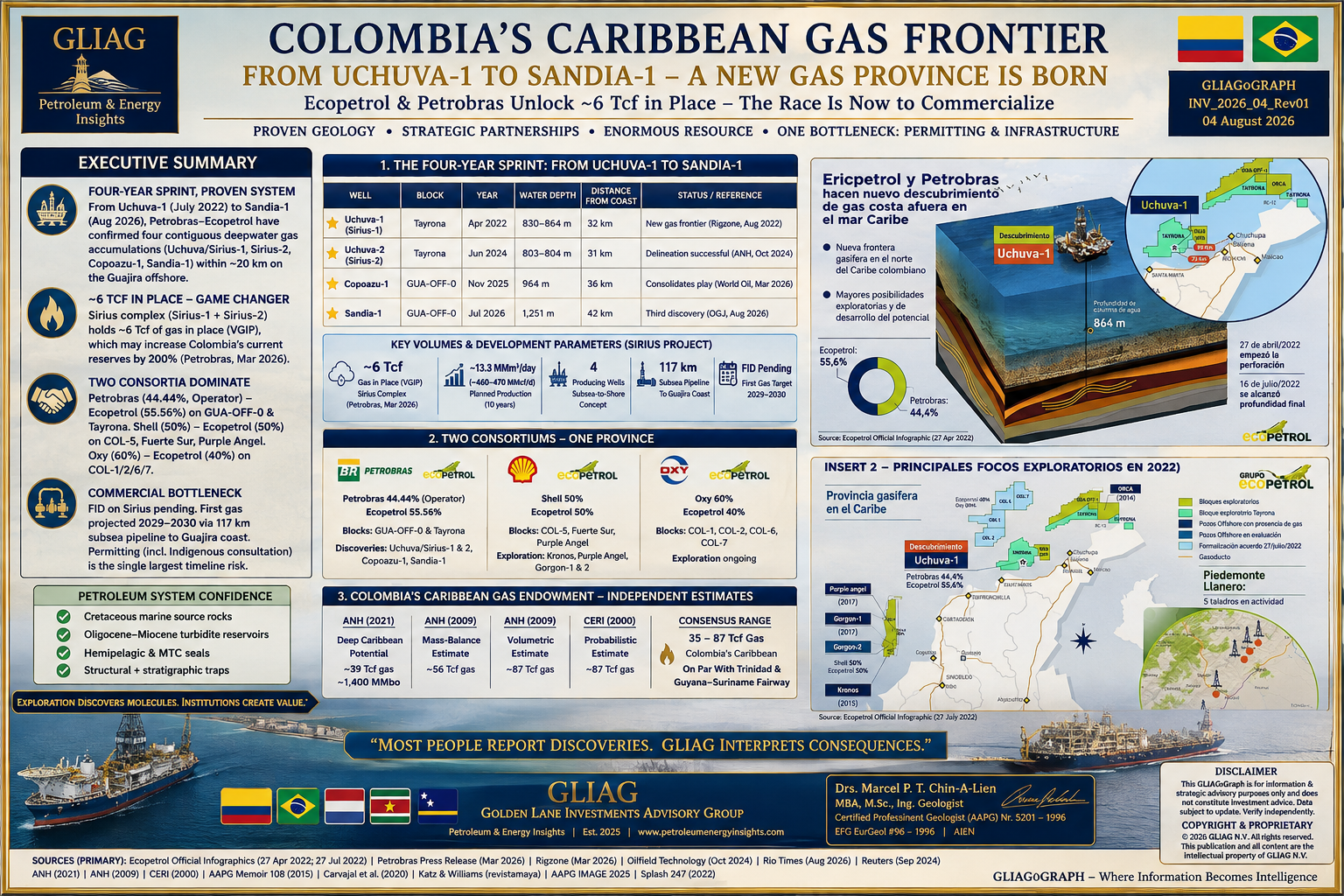
The Colombian Caribbean has crossed a threshold that most investors have not yet fully priced in. In four years — from the Uchuva-1 discovery in July 2022 to the Sandia-1 confirmation announced on 3 August 2026 — the Petrobras–Ecopetrol consortium has converted a single frontier well into a cluster of at least four contiguous gas accumulations (Uchuva/Sirius-1, Sirius-2, Copoazu-1, Sandia-1) sitting within a roughly 20 km radius on the deepwater Guajira offshore. Petrobras now quotes approximately 6 Tcf of gas in place (VGIP) in the primary Sirius complex alone — a figure that, on Petrobras’ own statement, could increase Colombia’s current reserves by some 200 percent (Rigzone / Petrobras press release, March 2026; Petrobras Mziq filing, October 2024).
This is not a one-off. The same operator pair, on the same continental margin, has been consolidating a play concept that traces a decade-long deepwater programme running from Orca-1 (2014) through Kronos-1 (2015), Purple Angel-1 (2017), Gorgon-1 (2017), Gorgon-2 (2022), and now the Sirius cluster (AAPG IMAGE Sirius extended abstract, 2025; ANH — Gas Potential of Colombia Caribbean Offshore; AAPG Explorer — Perseverance Triumphs). Independent petroleum-system work by ANH (2021), Ramirez et al. in AAPG Memoir 108 (2015), Carvajal, Torrado, Mann & English (2020, Marine and Petroleum Geology 121), and Katz & Williams (Biogenic Gas Potential Offshore Guajira, revistamaya) has independently modelled a total offshore gas endowment for Colombia in the range of 35–87 Tcf — placing Colombia’s Caribbean gas endowment structurally on a par with Trinidad and with the emerging Guyana–Suriname gas fairway.
Three things follow, and every subsequent section of this briefing note develops one of them:
- The geology is now proven, not conjectured. Multiple published petroleum-system syntheses converge on the same play elements (Cretaceous marine source rocks; Oligocene–Miocene turbidite reservoirs; hemipelagic and MTC seals; structural and stratigraphic traps). Uchuva/Sirius, Copoazu, and Sandia are the drill-bit confirmation of a system the ANH, Universidad del Norte, AAPG Memoir 108, and Search & Discovery abstracts had already argued for.
- The commercial architecture is Petrobras–Ecopetrol, with Shell as a second axis. Two consortia dominate: Petrobras (44.44%, operator) – Ecopetrol (55.56%) on GUA-OFF-0 and Tayrona; and Shell (50%) – Ecopetrol (50%) on COL-5, Fuerte Sur, and Purple Angel. Oxy holds 60% in the neighbouring COL-1/2/6/7 quartet, with Ecopetrol at 40%.
- The bottleneck is now surface, not subsurface. FID on the flagship Sirius development remains pending; production is projected for 2029–2030 through a subsea-to-shore concept — four producing wells, roughly 13.3 MMm³/day (approximately 460–470 MMcf/d) for about ten years, evacuated via a 117 km subsea pipeline to Guajira. Permitting — including the Uchuva-2 Indigenous-consultation ruling — has emerged as the single largest timeline risk.
GLIAG position, in one line: Colombia’s Caribbean is no longer a frontier play — it is a proven, gas-dominated deepwater province whose commercial fate turns on permitting, gas-agreement architecture, and evacuation infrastructure, not on subsurface risk.
❖ ❖ ❖
Part 1 — The Four-Year Sprint: From Uchuva-1 to Sandia-1
1.1 Timeline of Discoveries — The Operator Record
| Well | Block | Year | Operator / Partner | Water Depth | Status |
|---|---|---|---|---|---|
| Chuchupa / Ballena | Guajira (shallow) | 1974– | Ecopetrol / Chevron (historical) | Shallow water | Producing biogenic gas complex, OGIP ~6.6 Tcf combined |
| Orca-1 | Tayrona | 2014 | Petrobras (40%) / Ecopetrol (30%) / Repsol (30%); Statoil later farmed in | 674 m | First deepwater discovery in Colombian Caribbean, gas at ~3,657 m |
| Kronos-1 | Fuerte Sur | 2015 | Anadarko (op.) / Ecopetrol | Deepwater | Play opener — first biogenic dry-gas discovery in Pleistocene proximal turbidites |
| Purple Angel-1 | Purple Angel | 2017 | Anadarko (op.) / Ecopetrol (50/50) | 1,835 m | Confirmed extension; combined Kronos gas column ≥520 m |
| Gorgon-1 | COL-5 | 2017 | Anadarko (op., later Shell) / Ecopetrol (50/50) | ~2,400 m | Two gas objectives, net pay 80–110 m, “new gas province” |
| Gorgon-2 | COL-5 | 2022 | Shell (op., 50%) / Ecopetrol (50%) | ~2,400 m | Ultra-deepwater confirmation of gas province |
| Uchuva-1 (Sirius-1) | Tayrona | 2022 | Petrobras (44.44%, op.) / Ecopetrol (55.56%) | 830–864 m | New gas frontier in the north Colombian Caribbean |
| Uchuva-2 (Sirius-2) | Tayrona | 2024 | Petrobras (op.) / Ecopetrol | 803–804 m | Delineation successful; Uitpa Formation confirmed as reservoir |
| Copoazu-1 | GUA-OFF-0 | Nov 2025 spud; discovery Mar 2026 | Petrobras (44.44%, op.) / Ecopetrol (55.56%) | 964 m | Consolidates the gas province; ~8 km from Sirius |
| Sandia-1 | GUA-OFF-0 | Spud 12 Jun 2026; TD 29 Jul 2026 | Petrobras (44.44%, op.) / Ecopetrol (55.56%) | 1,251 m | Third GUA-OFF-0 discovery; gas-bearing zones under evaluation |
Two features of this table matter for investors. First, the discovery cadence has accelerated: after eight years of frontier drilling (Orca to Uchuva-1), the consortium has added three more discoveries in less than two years. Second, every deepwater discovery to date has been gas, not oil — a fact independently anticipated by ANH’s 2021 basin-modelling study, which projected higher probabilities of liquids only in the Chimare and Urumaco depocentres to the north-east of the currently drilled area.
1.2 Volumes, Participants, and Consortium Architecture
- Sirius complex (VGIP): ~6 Tcf gas in place across the Sirius-1 + Sirius-2 accumulations. Copoazu-1 and Sandia-1 volumes are pending laboratory characterisation.
- Reserves impact: Petrobras has stated that Sirius alone could increase Colombia’s current reserves by some 200 percent. ANH reported end-2023 proven reserves of 2.4 Tcf — sufficient for only about 6.1 years of consumption at then-prevailing demand.
- Development concept: Sirius is conceived as a subsea-to-shore project — four producing wells, roughly 13.3 MMm³/day (~470 MMcf/d) for ten years, with a 117 km subsea pipeline tying back to the Guajira coast.
- First gas target: 2029–2030, contingent on FID and environmental licensing.
1.3 The Two-Consortium Map of the Colombian Caribbean
| Cluster | Blocks | Operator / Partners | Discovery Footprint |
|---|---|---|---|
| North Caribbean (Guajira offshore — gas) | Tayrona, GUA-OFF-0, COL-1, COL-2, COL-6, COL-7 | Petrobras 44.44% (op.) / Ecopetrol 55.56% on Tayrona & GUA-OFF-0; Oxy 60% / Ecopetrol 40% on COL-1/2/6/7 | Orca (2014), Uchuva/Sirius (2022), Sirius-2 (2024), Copoazu-1 (2026), Sandia-1 (2026) |
| Southern Caribbean deepwater (gas) | COL-5, Fuerte Sur, Purple Angel | Shell 50% / Ecopetrol 50% (following farm-down from Anadarko) | Kronos (2015), Purple Angel (2017), Gorgon-1 (2017), Gorgon-2 (2022) |
| Onshore Piedemonte Llanero — reference footprint only | Piedemonte Llanero | Ecopetrol operatorship | Five drilling rigs active in 2022 — included as a reminder that Colombian gas is not exclusively offshore |
This two-consortium architecture is the single most important commercial fact in the province: Petrobras and Shell together de-risk the operating chain, but they also create a structural dependency on two specific partners for evacuation, gas-agreement negotiation, and pipeline access.
❖ ❖ ❖
Part 2 — The Petroleum-System Basis: Why These Discoveries Were Geologically Anticipated
GLIAG regards the Uchuva/Sirius–Copoazu–Sandia cluster not as a lucky spudding sequence but as the drill-bit confirmation of a petroleum system that had been modelled, published, and mapped by multiple independent groups over the last decade. The following anchor references form the petroleum-system canon that GLIAG deliberately triangulates against, rather than relying on any single paper.
2.1 Anchor References — The Petroleum-System Canon
- Ramirez, V., Vargas, L.S., Rubio, C., Niño, H., Mantilla, O. (2015). Petroleum Systems of the Guajira Basin, Northern Colombia, in Bartolini & Mann (eds.), AAPG Memoir 108, pp. 399–430. The canonical modern synthesis, defining four operative petroleum systems in the Guajira basin and identifying fractured Cretaceous limestones — analogous to the Mara–La Paz fields in western Venezuela — as an untested play.
- Carvajal, L.C., Torrado, L., Mann, P., English, J. (2020).Marine and Petroleum Geology 121, 104511. The peer-reviewed basin-modelling paper establishing an Upper Cretaceous marine shale source rock and Middle–Upper Miocene basin-floor fans as the working system in the deepwater Colombian Basin — the foundation cited by the Sirius extended abstract at AAPG IMAGE 2025.
- ANH (2021). Geological integration, petroleum systems and prospectivity — Guajira Offshore. The regulator’s own model: Cretaceous (Coniacian–Santonian) source rocks reach oil and gas windows in the Guajira Offshore, with peak expulsion in the Late Miocene, and a yet-to-find estimate on the order of 23.7 Bboe prospective resource — figures that dwarf the ~3.5 Bboe already discovered.
- ANH — Gas Potential of Colombia Caribbean Offshore (2020–2022). Places the range of independent probabilistic and mass-balance estimates for offshore gas potential between 35 and 87 Tcf.
- Rangel, A. et al. (2003). Boletín de Geología 33(2). Proposes the Upper Cretaceous–Castilletes and Siamana–Macarao–Castilletes petroleum systems, identifying the Castilletes seal as critical to Chuchupa–Ballena accumulation.
- Katz, B.J. & Williams, K. Biogenic Gas Potential Offshore Guajira Peninsula, Colombia. Establishes that most shallow Chuchupa–Ballena gas is biogenic, while the deeper discoveries sit in a mixed or predominantly thermogenic window.
- Search & Discovery (2015, AAPG GCAGS abstract 109).Identifies Miocene–Pliocene turbidite reservoirs, hemipelagic seals, and large structural traps in 2,400–2,700 m water depth — a template later realised at Orca and Uchuva.
- Uninorte thesis 1234096132. Extends the analysis to the Sinú-San Jacinto basin, proposing the Cretaceous Cansona Formation as primary source rock with late-Oligocene/early-Miocene expulsion.
- Bernardo, L.M. & Bartolini, C. (2017). AAPG ACE. The regional caution: no direct evidence that the La Luna Formation extends onto the Caribbean Plate itself, though Cretaceous marine Type II source rocks are present along the margin.
2.2 GLIAG Synthesis — The Five Play Elements Now Confirmed
- Source. Cretaceous (Coniacian–Santonian) marine shales, laterally equivalent to but distinct from the Venezuelan La Luna, generating within the Guajira Offshore depocentres from the Late Miocene to present, complemented by a shallower Neogene gas-prone Tertiary succession.
- Reservoir. Oligocene–Lower Miocene sandstones of the Uitpa and Jimol formations, confirmed at Sirius, plus Miocene–Pliocene basin-floor fans and turbidites in deeper water at Orca, Kronos, and Gorgon.
- Seal. Hemipelagic shales, mass-transport-complex deposits, and the Castilletes Formation top-seal.
- Trap. Combined structural and stratigraphic traps, including large structural closures mapped in 2,400–2,700 m water depth.
- Timing. Late Miocene expulsion peak, consistent with trap formation during Caribbean–South American plate convergence.
All five elements have been penetrated by drill in the last decade. The Sirius cluster is the first case on the Caribbean margin where all five have been demonstrated in a single, contiguous, commercial-scale accumulation.
2.3 What This Means for Undiscovered Volumes
Applying ANH’s roughly 15 percent chance-of-discovery factor to its available-for-trapping estimate yields a prospective resource for the Guajira Offshore alone on the order of 23.7 Bboe. Even discounting heavily for the gas-prone character of the province, the risked volumes remain multiples of Colombia’s current 2P reserve base. The Sinú Offshore basin, per the Uninorte geochemical work, carries a materially higher working-system probability than the Guajira Offshore — making Sinú Offshore GLIAG’s candidate for the “next frontier after Sirius,” and one that remains under-licensed today.
❖ ❖ ❖
Part 3 — The Commercial Reading: What an Investor Should Model
3.1 The Reserves-and-Demand Pincer
Colombia entered 2024 with roughly 6.1 years of proven gas reserves and a rising structural gas deficit driven by legacy field decline at Chuchupa–Ballena, hydro-shortfalls in the National Interconnected System, and the coal-to-gas transition in power generation. Regas capacity expansion for imported LNG has emerged as the short-term stopgap while Sirius progresses. The pincer is unambiguous: domestic supply must arrive by 2029–2030 or the country enters structural LNG import dependence.
3.2 The 2029–2030 Window and the Four Value Drivers
- Timing of FID on Sirius. A first-offshore-gas target of 2029–2030 implies FID no later than mid-2027. A slip of even twelve months collapses the domestic-supply-arbitrage window and forces a larger LNG-import equilibrium onto the country. Permitting has been flagged as the single biggest timeline risk.
- The 117 km subsea pipeline. The single largest CAPEX line item outside the drilling programme, and critical shared infrastructure for any subsequent tie-in from Copoazu, Sandia, or a future Sinú Offshore discovery. Whoever underwrites this pipeline effectively underwrites the play.
- Gas sales agreements. No FID until domestic power-generation contracts, industrial gas sales, and residual regas-terminal displacement are stitched together. Petrobras has signalled interest in exporting excess gas to Brazil — a geopolitically consequential signal that would reshape the regional gas balance if executed.
- Venezuelan gas re-entry. If Venezuelan gas (Perla, Cardón IV) is unblocked into the regional market, competitive pressure on Colombian offshore economics rises materially. GLIAG’s own Sovereign Conversion Doctrine, developed for Suriname, applies here as well: domestic conversion — power, petrochemicals, industry — should precede export lock-in.
3.3 The Permitting Risk — Uchuva-2 as a Bellwether
In September 2024 a Colombian court ordered a halt to Uchuva-2 operations on grounds of inadequate Indigenous consultation, despite prior competent-authority determinations that the block did not overlap Indigenous territory. Industry associations publicly warned the ruling threatened national energy security. The episode is a general warning: even where the regulator and environment and mines ministries have signed off, judicial and consultation risk can crystallise late. Investors should model a 12–18-month permitting-contingency buffer into any Sirius-tied schedule.
3.4 The Competitive Comparative — Colombia vs. the Guyana–Suriname Margin
| Metric | Colombia Caribbean (Guajira/GUA-OFF-0) | Guyana–Suriname (Stabroek/Blocks 52/58) |
|---|---|---|
| Dominant fluid | Gas (biogenic + thermogenic) | Oil (with associated gas) |
| Operator concentration | Petrobras + Shell (with Ecopetrol) | ExxonMobil + TotalEnergies + Petronas (with Staatsolie/GNRE) |
| Water depth | 674–2,400+ m | 1,500–3,000 m |
| Distance to shore | 32–70 km | 150–200+ km |
| Fiscal instrument | E&P Contract with ANH; royalty + income tax | PSC (Suriname) / PSC (Guyana) |
| First production | Sirius targeted 2029–2030 | GranMorgu targeted 2028; Stabroek producing since 2019 |
| Domestic-supply logic | Yes — replaces LNG imports | Partial — export-driven, with growing local content push |
| Sovereign-conversion optionality | Very high | Medium — export-heavy, but growing FLNG / gas-to-shore debate |
The comparative highlights strategic complementarity, not competition, between the two margins. Colombia’s Caribbean gas is a domestic-market absorption story; the Guyana–Suriname margin is a global export story. Both mature within the same 2028–2032 window.
❖ ❖ ❖
Part 4 — GLIAG Position and Recommendations
4.1 Five Decision-Relevant Conclusions
- The play is proven, not frontier. Ten wells over twelve years have confirmed the five-element petroleum system predicted by ANH, AAPG Memoir 108, and Carvajal et al. (2020). Investors should reprice the province from “frontier” to “proven deepwater gas province.”
- The commercial architecture is bipolar — Petrobras–Ecopetrol and Shell–Ecopetrol — with Oxy as a third pole on COL-1/2/6/7. New entrants must farm in through one of these operators or acquire acreage adjacent to the proven trends.
- The bottleneck is above the mudline. Environmental licensing, Indigenous consultation, gas-sales agreements, and the 117 km pipeline are the constraints that will determine whether the 2029–2030 first-gas target is met.
- The reserve-life pincer forces government engagement. With roughly six years of proven reserves at end-2023 and Sirius delivering only from 2029–2030 at earliest, the Government of Colombia has a structural incentive to accelerate licensing and underwrite pipeline architecture.
- The Sinú Offshore is the next frontier — the least-priced, best-risked frontier in the Colombian Caribbean today.
4.2 A Three-Part Investor Action Grid
| Action Tier | For Whom | What to Do |
|---|---|---|
| Track (12-month watch) | LPs, sovereign fund allocators | Watch Sirius FID timing, pipeline routing, and gas-sale-agreement announcements. First trigger: any Petrobras 6-K or Ecopetrol 8-K disclosing FID or pipeline award. |
| Position (18–24 months) | Independents, midstream infrastructure funds | Assess farm-in opportunities on Ecopetrol- or Oxy-operated acreage adjacent to Tayrona/GUA-OFF-0; evaluate Sinú Offshore licensing rounds; monitor Shell–Ecopetrol appraisal on COL-5. |
| Underwrite (24–36 months) | DFIs, ECAs, Brazilian/Colombian institutional capital | Consider co-financing the Sirius subsea-to-shore pipeline as shared infrastructure — the single highest-leverage investment in the province, and the natural venue for DFI catalytic capital ahead of FID. |
4.3 The Regional Geopolitical Read
Petrobras’ willingness to explore exporting potential surplus to Brazil is the most under-discussed strategic signal of the last twelve months. If executed, it converts the Colombian Caribbean into a regional gas hub rather than a purely national supply story — restructuring the Caribbean gas balance around a Brazil–Colombia axis rather than a Trinidad–Venezuela axis. For governments in Paramaribo, Georgetown, and Port of Spain, this is a first-order strategic development.
Colombia’s Caribbean gas province has done in four years what most basins take a generation to prove. The remaining risk is no longer geological — it is institutional.
❖ ❖ ❖
About the Author
Drs. M.P.T. Chin-A-Lien, MBA, M.Sc., Ing. Geologist — Petroleum & Energy Advisor; Founding Partner & Chief Architect, Golden Lane Investments Advisory Group (GLIAG). Certified Professional Geologist Nr. 5201-1996 (AAPG); Chartered European Geologist Nr. 92-1996 (EFG); Energy Negotiator June 2021 (AIEN). Prior institutional experience includes Occidental Petroleum (Bakersfield, Venezuela Bid Round, 1995–1996) and consulting to Staatsolie Maatschappij Suriname N.V. (Paramaribo, 2009). Author of the GLIAG SH-2050 doctrine and the Sovereign Conversion Doctrine for sovereign gas monetisation.
About GLIAG
Golden Lane Investments Advisory Group (GLIAG) is a Suriname- and Guiana-Shield-focused petroleum, energy, and project-management consulting platform, operating across Zoetermeer/Delft and Paramaribo. GLIAG advises sovereigns, national oil companies, DFIs, and institutional investors on bankable project structuring, PSC and fiscal architecture, upstream and midstream investment cases, and long-cycle energy strategy. GLIAG’s Petroleum & Energy Insights (petroleumenergyinsights.com) is the firm’s publication surface for public-domain essays, briefing notes, and companion analyses to its client work.
Disclaimer
This briefing note has been prepared by GLIAG for information and general discussion purposes only. It is not, and shall not be construed as, investment, legal, tax, or engineering advice, nor as an offer or solicitation to buy, sell, subscribe for, or trade any security, commodity, or financial instrument. All figures, estimates, dates, water depths, and consortium percentages are drawn from the sources cited and are subject to revision as operators, regulators, and independent analysts publish updates. Neither GLIAG nor the author accepts any liability for reliance placed on this document.
Independent-Opinion Statement
GLIAG has no fee-earning, equity, or contractual relationship with Petrobras, Ecopetrol, Shell, Occidental (Oxy), Repsol, Statoil/Equinor, or any of the sponsoring authorities named herein. The views expressed are the independent professional views of the author on the date of publication.
Proprietary Statement
This document, and the analytical frameworks it deploys — including GLIAG’s Sovereign Conversion Doctrine and the SH-2050 long-cycle framework — are the intellectual property of Golden Lane Investments Advisory Group. © 2026 Golden Lane Investments Advisory Group. All rights reserved.
AI/ML Training Opt-Out
No part of this document may be used, in whole or in part, as training or fine-tuning data for any artificial-intelligence or machine-learning system, model, product, or service without the prior written consent of GLIAG, pursuant to Article 4(3) of Directive (EU) 2019/790.
Preferred Citation
Chin-A-Lien, M.P.T. (2026). “Exploration Offshore Colombia: The Caribbean Gas Province Comes of Age.” Petroleum & Energy Insights, GLIAG Investor & Advisory Briefing Note GLIAG_INV_2026_04_Rev01, 4 August 2026.
— Drs. M.P.T. Chin-A-Lien, MBA, M.Sc., Ing. Geologist
Petroleum & Energy Advisor — Founding Partner & Chief Architect, Golden Lane Investments Advisory Group
“Converting bare headlines into deep strategic, added value.”
GLIAG · Where Information Becomes Intelligence