GLIAG · STRATEGIC PETROLEUM INTELLIGENCE PLATFORM
FISCAL RING-FENCING
UNDER STABILISATION
Can Suriname Still Protect Its Petroleum Tax Base
Without Breaching Existing Contractor Rights?
A legal, fiscal and strategic assessment of Article 4 of State Decree 2018 No. 52,
legacy petroleum agreements and the architecture of a forward-looking statutory ring fence
By Drs. Marcel P. T. Chin-A-Lien, MBA, M.Sc., Ing., CPG (AAPG), EurGeol (EFG)
Principal Founding Partner & Chief Architect
GLIAG N.V. — Golden Lane Investments Advisory Group
Publication ID: GLIAG-SPF-2026-0729-001 · 29 July 2026 · Delft, The Netherlands
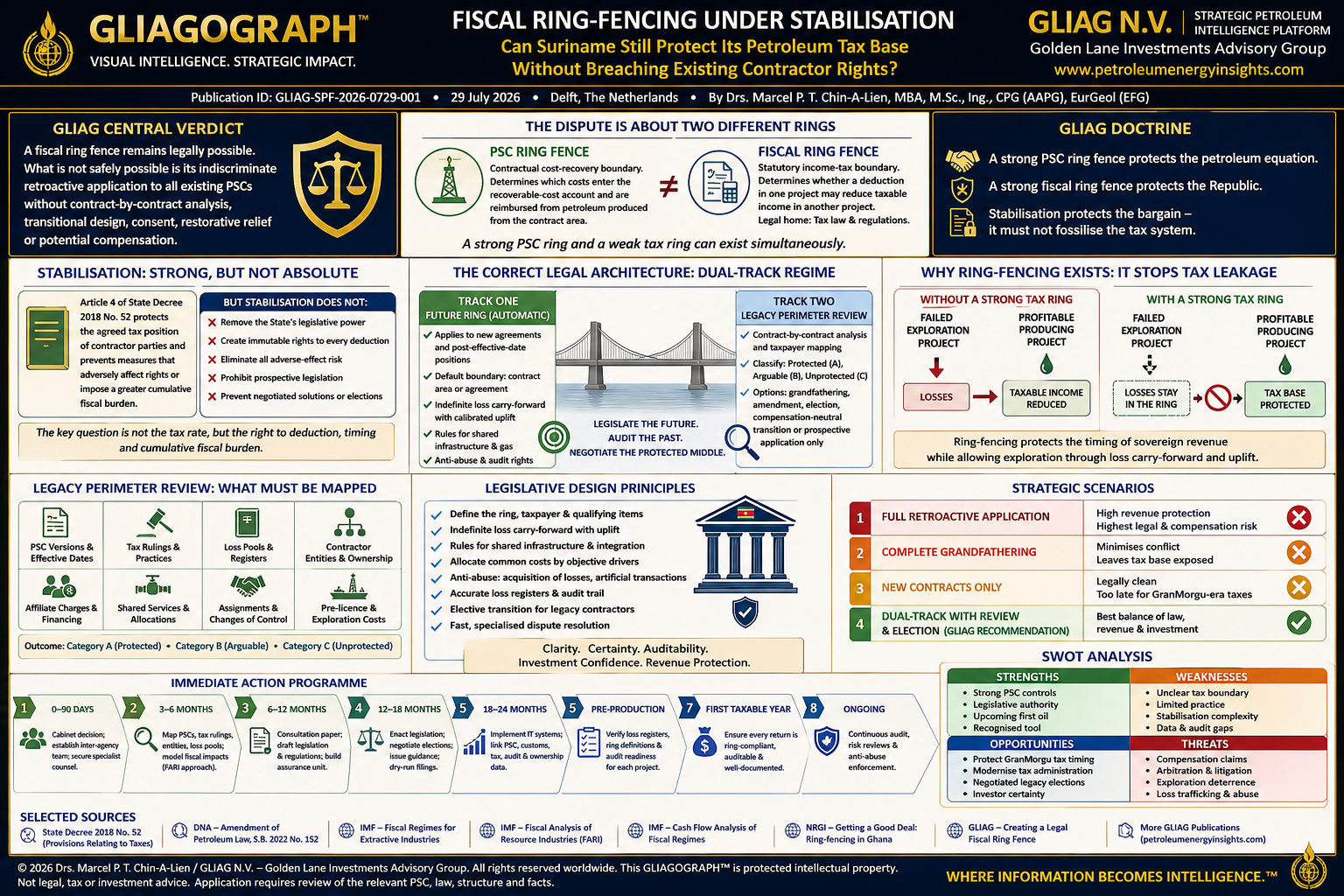
| GLIAG CENTRAL VERDICT A fiscal ring fence remains legally possible. What is not safely possible is its indiscriminate retroactive application to all existing PSCs without contract-by-contract analysis, transitional design, consent, restorative relief or potential compensation. |
Executive Summary
Suriname has reached the point at which a technical tax concept has become a question of sovereign timing. GranMorgu is moving toward first oil. Other offshore discoveries and exploration positions may create substantial pools of unsuccessful exploration and appraisal expenditure. If the corporate-income-tax system permits those losses to migrate freely into the taxable profits of a successful producing project, the Republic may preserve the integrity of the Production Sharing Contract while still losing or materially postponing tax revenue outside the PSC ledger.
The public intervention that existing contracts make a fiscal ring fence “no longer possible” identifies a genuine legal constraint but converts that constraint into an overstatement. Article 4 of State Decree 2018 No. 52 provides broad fiscal and economic stabilisation protection to contractor parties. A new rule that restricts deductions, changes their timing or raises the contractor’s cumulative fiscal burden may therefore activate restoration or compensation mechanisms. Yet stabilisation does not extinguish Parliament’s legislative competence, does not make every tax deduction an immutable contractual right, and does not prohibit prospective legislation, negotiated amendments, elections, grandfathering or anti-abuse rules.
The decisive issue is not whether Suriname may legislate. It may. The decisive issues are where the ring begins, to whom it applies, which losses are protected, what constitutes an adverse fiscal effect, and how legacy positions are transitioned. The correct architecture is therefore dual-track: an immediate statutory ring fence for new petroleum agreements and future fiscal positions, combined with a disciplined Legacy Perimeter Review for existing contractors.
This essay confirms the central GLIAG doctrine developed in earlier publications: the PSC ring fence protects the petroleum bargain; the statutory fiscal ring fence protects the national tax base. The two legal instruments occupy different ledgers and address different leakage mechanisms. Suriname should preserve the strong contractual ring already embedded in its PSC architecture and legislate the missing tax boundary before producing-project taxable cash flow becomes vulnerable.
The investment question must also be framed correctly. Ring-fencing is neither inherently pro-State nor inherently anti-investor. A very tight ring accelerates government revenue but increases the after-tax cost of exploration and may discourage portfolio investment. A weak ring supports exploration but can permit a producing project to become the tax shelter for unsuccessful acreage. The optimal regime combines a clear project or contract-area boundary with indefinite loss carry-forward, carefully calibrated uplift, rules for shared infrastructure, decommissioning and pre-licence costs, and a transparent elective transition for legacy contractors.
The GLIAG Position in One Sentence
Legislate the future ring immediately; map, test and negotiate the legacy perimeter separately.
1. The Dispute Is About Two Different Rings
Public discussion often treats “ring-fencing” as though it were a single clause. It is not. Suriname’s petroleum system contains a contractual cost-recovery boundary, while the disputed reform concerns a statutory income-tax boundary.
A PSC ring fence determines which expenditures may enter the recoverable-cost account of a contract and which petroleum may reimburse those costs. Its legal home is the petroleum agreement and accounting procedure. It protects royalty, cost petroleum, profit petroleum and the R-factor or analogous sharing mechanics from contamination by expenditure unrelated to the contract area.
A fiscal ring fence answers a different question: may a deduction arising in one petroleum project reduce taxable income generated by another project? Its legal home is the Income Tax Act, petroleum tax provisions, regulations and, where applicable, binding rulings. A cost can be non-recoverable under a PSC and still potentially deductible for income-tax purposes. Conversely, a recoverable cost can follow a different tax-depreciation timetable. The systems overlap economically but are not legally identical.
This distinction is the foundation of the GLIAG analysis. Suriname can possess a strong PSC ring and a weak tax ring simultaneously. In that situation the State wins inside the cost-oil account but loses inside the corporate tax return.
2. Why the Existing PSC Ring Is Not the Problem
The published Suriname PSC architecture creates a closed contractual loop. Operations are conducted within a defined contract area; petroleum expenditure arises from those operations; recoverable costs are reimbursed from petroleum produced from that area; and unsuccessful costs remain at contractor risk where production is absent or insufficient.
The architecture is reinforced through separately identifiable records, work-programme and budget approval, cost categorisation, allocation rules for shared expenditure, audit rights, affiliate-cost scrutiny and field-level identification within a contract containing more than one commercial field. These are substantive controls, not decorative drafting.
The current policy problem therefore does not justify weakening the PSC ring. It requires an additional statutory boundary around taxable income. Any reform that confuses cost recovery with tax deductibility risks damaging a sound contractual mechanism while leaving the real leakage channel untreated.
3. The Stabilisation Undertaking: Strong, but Not Absolute
Article 4 of State Decree 2018 No. 52 is central. In broad terms, it protects the agreed tax position of contractor parties and seeks to prevent subsequent law, regulation or administrative action from adversely affecting their rights or imposing a greater cumulative fiscal burden than the burden established under the governing petroleum arrangements. The decree also contemplates remedial or compensatory action where later measures conflict with or materially impair the contractor’s protected economic position.
This protection is commercially significant. Petroleum investment is long-dated, capital intensive and exposed to geological, price, execution and political risk. Stabilisation reduces the risk that the State will rewrite the economic bargain after sunk investment.
However, three propositions must remain separate. First, a stabilisation undertaking does not usually remove the State’s legislative power. Second, legislation may still create a contractual or compensatory consequence. Third, the scope of protection depends on the precise right allegedly impaired. The key question is not simply whether a contractor pays tax earlier or later, but whether the contractor possessed a protected right to the deduction, consolidation or timing treatment in question.
Therefore, the statement that a fiscal ring fence is “no longer possible” collapses legislative authority, contractual liability and economic restoration into one proposition. The more accurate conclusion is that retroactive application may be legally contestable, fiscally self-defeating or compensation-triggering.
4. Tax Rate Stability Is Not the Whole Fiscal Bargain
The 2022 amendment of the Petroleum Law strengthened the statutory basis of contractor fiscal treatment and includes stabilising elements relating to taxation. Yet a frozen or protected tax rate is not necessarily equivalent to a frozen tax base.
A contractor can argue that its economic bargain includes deductions, depreciation, loss carry-forward, financing treatment and consolidation, not merely the headline corporate-income-tax percentage. From an economic perspective, delaying a deduction reduces its present value. A rule that preserves the nominal rate but postpones deduction until a different project becomes profitable can materially increase the contractor’s effective burden.
The State can respond that ordinary tax law did not create a permanent contractual entitlement to migrate every failed exploration cost into every successful petroleum project, particularly where project nexus, taxpayer identity, anti-abuse principles or administrative practice are uncertain. Neither side can safely prevail through assertion alone. The answer requires a contract-by-contract and taxpayer-by-taxpayer review.
5. The Hidden Evidentiary Question: What Exactly Was Protected?
Before accepting any claim of grandfathered cross-block deductibility, Suriname must establish the legal and factual baseline. That baseline should include the PSC version, effective date, incorporated tax provisions, State Decree applicability, tax rulings, taxpayer entities, ownership history, accounting policies, prior filings, treatment of unsuccessful exploration, loss registers and any representations made during contract negotiation.
Several outcomes are possible. A contractor may have an express and clearly protected consolidation right. It may have only a general deduction right subject to ordinary nexus and allocation rules. It may have separate special-purpose vehicles that prevent consolidation as a matter of taxpayer identity. It may have accumulated losses that are economically real but not yet legally final. It may also have affiliate allocations or financing charges that remain subject to transfer-pricing scrutiny irrespective of stabilisation.
This is why a national policy cannot be built on one generic sentence. The Republic needs a Legacy Perimeter Register that distinguishes vested deductions, contingent positions, disputed claims, unfiled losses, affiliate charges, shared costs and prospective expenditure.
6. International Fiscal Logic: Why Ring-Fencing Exists
Ring-fencing is widely used because petroleum projects are location-specific and capable of generating substantial economic rent. Without a sufficiently tight boundary, an incumbent contractor can continuously deduct exploration or development costs from new projects against the income of mature producing assets. Government revenue is then deferred even though the producing project itself is highly profitable.
The IMF has observed that licence-by-licence ring-fencing can be appropriate for developing countries concerned about revenue deferral, while also recognising that losses properly incurred should remain deductible through extended or unlimited carry-forward. International experience therefore supports neither unlimited consolidation nor confiscatory denial of losses.
Ghana illustrates the policy hazard. Lower-than-expected tax payments after first production were linked in part to deductions from neighbouring projects, prompting revision of ring-fencing rules. Mexico’s regional approach shows that a ring broader than the individual licence can still permit costs from new investments to reduce the taxable income of producing operations. The lesson is that the boundary determines the timing of sovereign revenue.
At the same time, IMF modelling research recognises the exploration disincentive created by strict ring-fencing. Failed exploration costs trapped in an unsuccessful block have lower after-tax value, which can shorten the exploration cycle and cause acreage to be abandoned earlier. Good policy must therefore protect both revenue timing and exploration renewal.
7. Would a Fiscal Ring Fence Make Suriname Unattractive?
Investment attractiveness is a system outcome, not the product of one clause. Contractors evaluate geology, discovery size, development cost, fiscal take, cost recovery, approval speed, contract stability, infrastructure, financing, operating conditions and exit optionality.
A strict ring fence is more burdensome in frontier acreage because it removes the immediate tax value of exploration losses. That effect is strongest for companies already earning taxable income elsewhere in the country. New entrants without domestic taxable profits may be less affected because they have no existing Surinamese tax base against which to offset losses.
Suriname can neutralise part of the investment penalty without surrendering the ring. It can provide indefinite loss carry-forward inside the project, an uplift reflecting the time value of money, transfer rules for narrowly defined pre-licence exploration, pooled treatment for genuinely integrated gas or common-infrastructure projects, accelerated depreciation after commerciality, and transparent decommissioning relief.
The strategic objective is not the harshest ring. It is the most credible ring: predictable, legislated, auditable, economically modelled and accompanied by investment-preserving relief.
8. The Correct Legal Architecture: A Dual-Track Regime
GLIAG recommends a dual-track regime.
Track One should apply automatically to all new petroleum agreements, new awards, future acreage and defined post-enactment fiscal positions. The default boundary should be the petroleum agreement or contract area, subject to rules for integrated developments and common infrastructure. Losses should be carried forward within the ring and may receive a calibrated uplift.
Track Two should govern existing agreements. The State should not assume either that every contractor is fully protected or that no contractor is protected. Each legacy position should be classified through a legal, fiscal and economic review. Where a protected adverse effect exists, the options include grandfathering, negotiated amendment, elective entry, compensation-neutral transition, offsetting incentives or application only to post-effective-date expenditure.
This architecture preserves rule-of-law credibility while preventing stabilisation from becoming a permanent veto over fiscal modernisation.
9. The Legacy Perimeter Review
The Legacy Perimeter Review should be completed before the first material corporate-income-tax filings from GranMorgu. It should be led jointly by the Ministry of Finance, the tax authority, Staatsolie or the designated petroleum regulator, and specialised Surinamese legal counsel.
The review should map every contractor entity, petroleum agreement, tax ruling, accumulated loss pool, affiliate financing structure, shared-service arrangement, assignment and change of control. It should quantify the nominal and present-value tax effect of alternative transition rules using project-level FARI-style modelling.
Three categories should then be established: Category A, clearly protected legacy rights; Category B, arguable or contingent positions requiring negotiation or ruling; and Category C, unprotected, abusive, unrelated or inadequately substantiated claims. Only then can transitional legislation be drafted with precision.
10. Anti-Abuse Rules Must Not Wait
Even where a contractor has legitimate stabilisation protection, Suriname need not accept artificial erosion. Transfer-pricing documentation, arm’s-length affiliate charges, interest limitation, beneficial-ownership disclosure, cost-allocation rules, loss registers and audit access are not optional.
Stabilisation should protect the agreed bargain, not misclassification, duplication, unsupported allocation or post-contract tax engineering. The distinction between a genuine legacy deduction and an artificial imported loss must be embedded in law, regulations and audit practice.
Suriname should therefore create a Petroleum Revenue Assurance Unit linking PSC accounts, tax returns, customs data, partner billings, financing agreements, asset registers and beneficial ownership. The same transaction should carry a project identifier from customs entry through cost recovery and taxation.
11. Legislative Design Principles
The statute should define the ring, the taxpayer, qualifying petroleum income, qualifying expenditure, loss carry-forward, uplift, shared infrastructure, integrated gas projects, decommissioning, pre-licence exploration, financing costs, reorganisations, assignments and changes of control.
It should prohibit cross-ring deduction unless expressly authorised. It should also prevent losses from being purchased through acquisitions primarily designed to shelter producing income. Common costs should be allocated by objective drivers and supported by contemporaneous documentation.
Transitional provisions should state clearly which rules apply to existing agreements and should establish an election process. An election may be attractive where the contractor receives certainty, uplift, accelerated depreciation or other compensating treatment in exchange for entering the new ring.
Dispute resolution should be fast and specialised. A prolonged tax dispute after first oil would undermine both revenue collection and investment confidence.
12. Strategic Scenarios
Scenario One — Full retroactive application. This maximises theoretical near-term tax protection but carries the highest stabilisation, compensation and dispute risk. It is not recommended.
Scenario Two — Complete grandfathering of all existing contractors. This minimises legal conflict but may leave the principal producing tax base exposed for decades. It is also not recommended.
Scenario Three — New contracts only. This is legally clean but may arrive too late to protect GranMorgu-era taxable income from legacy loss migration.
Scenario Four — Dual-track legislation with a Legacy Perimeter Review, negotiated elections and anti-abuse rules. This offers the best balance between legal credibility, sovereign revenue protection and investment attractiveness. GLIAG recommends Scenario Four.
13. SWOT Analysis
| STRENGTHS | WEAKNESSES | OPPORTUNITIES | THREATS |
| Strong PSC contract-area cost controls; sovereign legislative power; upcoming taxable production creates urgency; internationally recognised fiscal instrument. | Unclear statutory tax boundary; limited published tax practice; stabilisation complexity; fragmented data and audit capacity. | Protect GranMorgu tax timing; modernise petroleum tax administration; create negotiated legacy elections; improve investor certainty through explicit rules. | Compensation claims; arbitration or tax litigation; exploration deterrence if ring is too tight; loss trafficking and affiliate cost allocation; reform delayed until after tax leakage begins. |
14. GLIAG Conclusions
◆ Victor Koekkoek’s intervention is important because it corrects any assumption that a fiscal ring can be imposed on legacy contractors without consequence. His underlying warning is valid.
◆ His categorical conclusion is not. A fiscal ring fence remains possible as legislation, as a rule for new contracts, as an elective regime, as a negotiated amendment and, subject to legal analysis, as a prospective rule for defined future expenditure or arrangements.
◆ The stabilisation package may protect more than the nominal tax rate. Suriname must therefore avoid claiming that unchanged rates automatically eliminate adverse-effect risk. The tax base, deduction timing and cumulative fiscal burden require independent analysis.
◆ Your GLIAG doctrine remains intact and is strengthened by this debate: contractual and fiscal rings are different. The PSC ring is already coherent. The missing statutory ring should be enacted.
◆ The optimal policy is not retroactivity and not surrender. It is transition architecture: legislate the future, audit the past, negotiate the protected middle and close abuse immediately.
GLIAG Doctrine
| A strong PSC ring fence protects the petroleum equation. A strong fiscal ring fence protects the Republic. Stabilisation protects the bargain — it must not fossilise the tax system. |
15. Immediate Action Programme
| TIMING | ACTION |
| 0–90 days | Cabinet decision on dual-track policy; establish an inter-agency drafting and Legacy Perimeter Review team; secure specialist Surinamese constitutional, petroleum and tax counsel. |
| 3–6 months | Map all PSCs, tax rulings, contractor entities, loss pools and stabilisation provisions; issue confidential data requests; build project-level fiscal models. |
| 6–12 months | Publish a consultation paper; draft fiscal ring-fence legislation, allocation regulations and transitional elections; establish the Petroleum Revenue Assurance Unit. |
| 12–18 months | Enact legislation; negotiate legacy elections; issue transfer-pricing, loss-register and shared-cost guidance; run dry-run tax filings for GranMorgu. |
| Before first taxable production | Ensure that every producing-project tax return is linked to a legally defined ring, a verified loss register and an integrated audit trail. |
Selected Sources and Clickable References
• State Decree 2018 No. 52 — Provisions Relating to Taxes of Contractor Parties
• De Nationale Assemblée — Amendment of the Petroleum Law, S.B. 2022 No. 152
• IMF — Fiscal Regimes for Extractive Industries: Design and Implementation
• IMF — Fiscal Analysis of Resource Industries (FARI)
• IMF — Cash Flow Analysis of Fiscal Regimes for Extractive Industries
• Natural Resource Governance Institute — Getting a Good Deal: Ring-fencing in Ghana
• GLIAG — Suriname’s Petroleum: Creating a Legal Fiscal Ring Fence
• GLIAG — The Urgent Need for a Fiscal Ring Fence in Suriname
• GLIAG — Transforming Suriname: Legal and Tax Reforms for Oil Prosperity
Strict Copyright, Intellectual Property and Non-Reliance Notice
© 2026 Drs. Marcel P. T. Chin-A-Lien / GLIAG N.V. — Golden Lane Investments Advisory Group. All rights reserved worldwide. This publication, including its title, structure, argument, analytical framework, legal-fiscal distinction, transition architecture, Legacy Perimeter Review concept, scenarios, doctrine and recommendations, is protected intellectual property. No part may be reproduced, adapted, translated, distributed, republished, incorporated into another advisory product, model, presentation, policy paper or commercial service without prior written permission, except for brief quotation with full attribution.
This publication is an independent strategic petroleum intelligence assessment. It distinguishes public legal instruments, contractual interpretation, fiscal-policy analysis and recommendations. It is not a formal legal opinion, tax ruling, audit conclusion, investment recommendation, representation of confidential PSC terms or prediction of any contractor’s tax filings. Application to an existing petroleum agreement requires review by qualified Surinamese constitutional, tax and petroleum counsel, together with the relevant PSC, decree, tax law, rulings, corporate structure and factual record.
About the Author and GLIAG N.V.
Drs. Marcel P. T. Chin-A-Lien, MBA, M.Sc., Ing., CPG (AAPG), EurGeol (EFG), is Principal Founding Partner and Chief Architect of GLIAG N.V. He has approximately five decades of petroleum-sector experience, including extensive work in Venezuela, Suriname and international upstream environments. He contributed, with colleagues, to the development and refinement of Suriname’s model PSC architecture during 2008–2010 while serving within Petroleum Contracts, the precursor of the Suriname Hydrocarbon Institute. GLIAG N.V. is a boutique Strategic Petroleum Intelligence platform integrating geology, petroleum systems, contracts, fiscal design, law, economics, capital architecture, gas monetisation, industrial policy and sovereign development.
www.petroleumenergyinsights.com
© 2026 GLIAG N.V. · Where Information Becomes Intelligence. · GLIAG-SPF-2026-0729-001