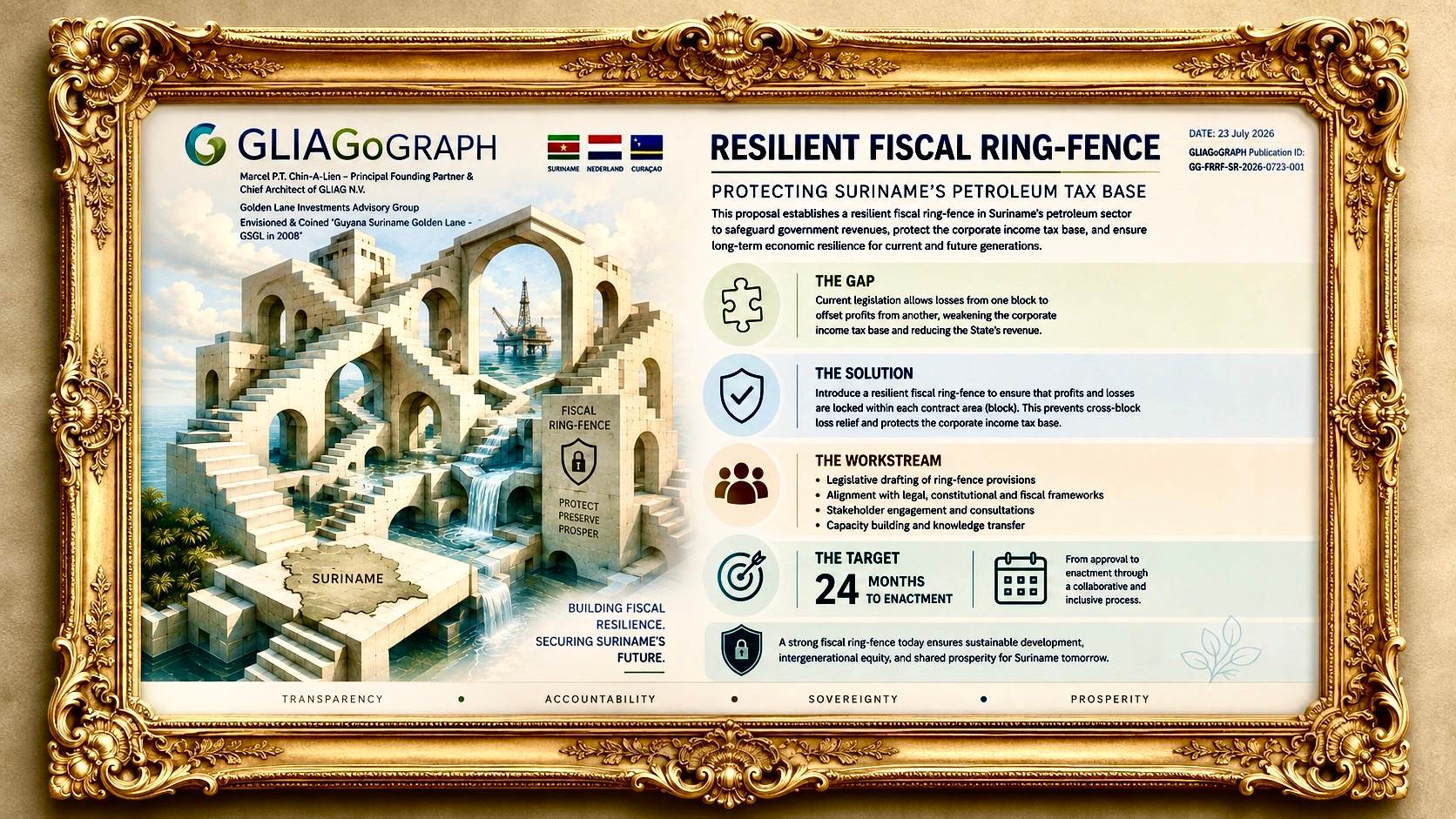
GLIAG · TOR · Resilient Fiscal Ring Fence for Suriname
| GLIAG · TERMS OF REFERENCE · LEGISLATIVE WORKSTREAMGolden Lane Investments Advisory Group |
How to Construct a Resilient Fiscal Ring Fence in Suriname
Terms of Reference — Legislative Workstream
GLIAG proposal in preparation · 23 July 2026
| Document | Terms of Reference (TOR) — Legislative Workstream |
| Title | How to Construct a Resilient Fiscal Ring Fence in Suriname |
| Version | v1.0 — 23 July 2026 |
| Prepared by | drs. Marcel P.T. Chin-A-Lien, MBA., MSc. — Founding Partner & Chief Architect, GLIAG |
| For | Whoever it may serve in Switi Sranankondre, to build a resilient future as envisioned in self-designed “ Suriname Horizon 2050 & Beyond (SH-2050)”. Such as Ministerie van Natuurlijke Hulpbronnen · Ministerie van Financiën · Staatsolie Maatschappij Suriname N.V. · De Nationale Assemblée – For Whoever, and above all, done with… Soso Lobi (no, no money, just for free) My proactive contribution to the dear country of my family and friends. |
| Status | GLIAG proposal in preparation — not enacted law |
| Companion | Essay: “They Are Mixing Unmixable Things — Contract Ring vs. Fiscal Ring in Suriname’s PSC Framework” (23 July 2026) |
Executive summary
Suriname has entered its first commercial petroleum decade. The Petroleumwet 1990 and the Wet Inkomstenbelasting 1922 were drafted before multi-block, multi-contractor, deepwater operations became the norm. Between them they do not contain the fiscal ring-fence that OECD-grade petroleum jurisdictions rely on to protect the corporate income tax base against consolidation of costs across blocks. This TOR sets out the workstreams, deliverables, governance and timeline for constructing that ring on a defensible legal footing — anchored in artikel 155 lid 2 Grondwet, respecting the stabilisation clauses in existing PSCs under artikel 9 lid 8 Petroleumwet, and aligned with the IMF, World Bank and IGF doctrinal chain.
The objective is not to reinterpret existing law. It is to legislate the missing piece — cleanly, on a forward basis, in a wet in formele zin.
1. Objective
To design, draft, socialise and enact a resilient fiscal ring-fence regime for Suriname’s petroleum sector that:
• Closes the legislatieve leemte — introduces an explicit statutory ring-fence at the level of the Contract Area / licence, so that a multi-block contractor’s losses on one block cannot dilute the CIT base of another.
• Respects the legality principle — sits in a wet in formele zin with a Memorie van Toelichting expressly anchored in artikel 155 lid 2 Grondwet.
• Preserves stabilisation — applies on a forward basis to new PSCs; existing PSCs governed by artikel 9 lid 8 Petroleumwet remain on the tarief geldend bij ondertekening unless the contractor elects into the new regime.
• Preserves bankability — is designed with IMF, World Bank and IGF template compatibility so DFI credit committees and IOC boards read Suriname as a governance-mature jurisdiction, not a jurisdiction of tax surprise.
• Coexists with the contractual ring — leaves the Model PSC’s ring-fencing-per-Commercial-Field clause intact on the cost-oil side, and reconciles the two rings in the next generation of the Model PSC.
2. Scope
2.1 In scope
• New petroleum-fiscal statute — a stand-alone chapter in a new Gas Act, an amendment to the Petroleumwet, or a hoofdstuk in a modernised IB 1922. The TOR is agnostic between vehicles; workstream WS-3 selects the vehicle on legal-drafting grounds.
• Definition of the ring — level (sector / licence / project), scope of costs inside the ring, treatment of losses, treatment of decommissioning, treatment of transfer pricing interactions with artikel 18 Petroleumwet.
• Election / transition regime — opt-in template for existing PSCs; interaction with artikel 9 lid 8 stabilisation.
• Implementing regulations — bookkeeping, ring-fenced cost pool schedule, filing template with the Belastingdienst.
• Model PSC alignment — WS-6 reconciles the contractual (cost-oil) ring and the new fiscal (CIT) ring in the next Model PSC generation.
2.2 Out of scope
• Reinterpretation of existing articles — this TOR does not propose to stretch artikel 19 Petroleumwet 1990 or any other current provision into a ring it was not designed to carry.
• Retroactive application — any ring adopted under this TOR applies on a forward basis; artikel 9 lid 8 stabilisation of existing PSCs is not touched without contractwijziging.
• Royalty design and profit-oil split — those live in the Petroleumwet and the PSC. This TOR addresses the CIT-side ring only, though it will be modelled in the context of overall Government take.
• The Suriname Savings and Stabilization Fund — SSFS design is a separate workstream and remains outside the scope of this TOR.
3. Legal and policy foundation
The regime must sit on four legal pillars, each of which is already in force in Suriname today. The ring-fence chapter does not create these pillars; it uses them.
3.1 Artikel 155 lid 2 Grondwet — the constitutional ceiling
Any belasting is heven uit kracht van een wet in formele zin. This is the ceiling. The Memorie van Toelichting bij S.B. 2022 no. 152 restates the rule expressly for the petroleum context: “de fiscale positie van de betreffende contractor moet gebaseerd zijn op regels, die zijn ontleend aan een wet in formele zin.” The ring-fence chapter is therefore drafted as a substantive charging rule adopted by DNA, on the record, with a full MvT — never as a reinterpretation of existing text.
3.2 Artikel 9 lid 1 Petroleumwet — the general tax hook
Contractors are subject to the algemene belastingwetgeving of Suriname. Any new petroleum-fiscal rule enters that general framework and is coordinated with the Wet IB 1922 through a clear interface clause.
3.3 Artikel 9 lid 8 Petroleumwet — the stabilisation floor
For each existing PSC, the fiscale regime is frozen at the tarief geldend bij ondertekening. The new ring therefore applies to new PSCs by default; existing contractors are offered an election regime on defined terms if they wish to opt into the new consolidated architecture.
3.4 Artikel 18 Petroleumwet — the transfer-pricing anchor
Any ring must be internally consistent with the arm’s-length principle already in artikel 18. The regime therefore explicitly cross-references artikel 18 for intra-group cost allocations, so that a ring cannot be defeated by intra-group pricing.
4. Design choices
Three design choices dominate the drafting. The TOR does not prejudge them; it structures the analysis so DNA can decide with full information.
4.1 Level of the ring
International practice offers three options.
| Level of ring | Perimeter | Precedent | Trade-off |
| Sector | All upstream petroleum activity of the entity | UK 1975 (base), Norway (special tax) | Simple to administer; least protective against multi-block consolidation |
| Licence / Contract area | Each PSC / block treated as its own tax unit | Angola, Ghana, Guyana (Stabroek framework) | Balanced — international workhorse for petroleum |
| Project / Field | Each Commercial Field or development its own tax unit | UK PRT (1975), select Norwegian fields | Highest protection; heaviest administration; harder for smaller admin capacity |
Figure 1 — Three levels of ring fence: perimeter, precedent, trade-off.
4.2 Treatment of losses
• Inside-ring carry-forward — losses inside the ring may be carried forward indefinitely (or for a defined period) against future income of the same ring.
• No cross-ring offset — losses from ring A cannot offset income from ring B, nor from unrelated non-petroleum activity of the same contractor entity.
• Decommissioning — decommissioning provisions and end-of-life costs remain deductible inside the ring on defined terms; end-of-life relief is coordinated with the abandonment security framework.
4.3 Election and transition regime
• Forward-only default — new PSCs signed after entry into force fall under the new ring automatically.
• Voluntary opt-in for existing PSCs — contractors may elect into the new regime on a whole-portfolio basis, in exchange for defined transitional benefits (e.g. accelerated depreciation, decommissioning credit).
• No unilateral override — artikel 9 lid 8 stabilisation is not reached without contractual consent. This is the treaty-robust boundary.
5. Workstreams and deliverables
The programme comprises six workstreams, each with a defined deliverable and owner.
| # | Workstream | Deliverable | Owner |
| WS-1 | Diagnostic & benchmarking | Gap analysis of Petroleumwet 1990, IB 1922, Model PSC vs. UK 1975 / IMF / IGF template | MinNH + GLIAG technical secretariat |
| WS-2 | Fiscal impact modelling | Contractor-level and Government-take models under three ring levels (sector / licence / project) across Block 52 & 58 | MinFin + Staatsolie Finance + external advisers |
| WS-3 | Legislative drafting | Wetsvoorstel + Memorie van Toelichting anchored in art. 155 lid 2 Grondwet, coherent with art. 9 Petroleumwet | MinFin + MinJusPol + DNA-secretariaat |
| WS-4 | Transition & election regime | Opt-in template for existing PSCs; interaction with art. 9 lid 8 stabilisation | Staatsolie Petroleum Contracts + MinFin |
| WS-5 | Investor & DFI engagement | Bankability briefings, IMF/World Bank technical review, IOC consultation memos | MinNH + MinFin + GLIAG |
| WS-6 | Model Gas PSC integration | Reconciliation of the contractual (cost-oil) ring with the new fiscal (CIT) ring in the next Model PSC generation | Staatsolie Petroleum Contracts + GLIAG |
Figure 2 — Six workstreams, delivering the ring from diagnostic to enacted regulation.
6. Governance
6.1 Steering committee
• Chair — Ministerie van Natuurlijke Hulpbronnen (lead) and Ministerie van Financiën (co-lead).
• Members — Staatsolie Maatschappij Suriname N.V. (Petroleum Contracts + Finance), Belastingdienst, MinJusPol, EITI Suriname secretariat, and a rotating DNA-secretariaat observer.
• Independent advisers — IMF Fiscal Affairs Department, World Bank EI-GPS, and one senior tax counsel with UK/Norwegian/Ghanaian ring-fence experience.
• Technical secretariat — GLIAG (Golden Lane Investments Advisory Group) provides the technical secretariat: document management, cross-workstream coordination, and public-facing communications through Petroleum & Energy Insights.
6.2 Decision protocol
1. Steering committee decides on level of ring and vehicle (Phase 2 close).
2. Legislative draft and MvT approved by MinNH, MinFin and MinJusPol before behandeling (Phase 3 close).
3. IMF/World Bank technical review completed before formal DNA submission (Phase 4).
4. DNA behandeling proceeds under normal wetgevingsprotocol; enactment target end-Phase 5.
7. Timeline
A 24-month programme, phased so that legal drafting, fiscal modelling and stakeholder consultation run in parallel where possible.
| Phase | Window | Milestone |
| Phase 1 | Months 0–3 | WS-1 gap analysis complete; policy question tabled inter-ministerially |
| Phase 2 | Months 3–6 | WS-2 fiscal impact models delivered; level of ring selected in principle |
| Phase 3 | Months 6–12 | WS-3 legislative draft + MvT ready for behandeling; WS-4 transition regime tested |
| Phase 4 | Months 12–18 | WS-5 IMF/World Bank technical review; IOC consultation; DNA behandeling |
| Phase 5 | Months 18–24 | Enactment (target); WS-6 Model Gas PSC updated; implementing regulations issued |
Figure 3 — Five phases from diagnostic to enactment, targeted at a 24-month horizon.
8. Risks and mitigations
• Legal risk — challenge under artikel 155 lid 2 Grondwet. Mitigation: every substantive rule enters through wet in formele zin with a documented MvT.
• Contract risk — dispute under artikel 9 lid 8 stabilisation. Mitigation: forward-only default; opt-in for existing PSCs; no unilateral override.
• Bankability risk — DFI/IOC read as tax surprise. Mitigation: WS-5 formal IMF/World Bank technical review before DNA submission; IOC consultation memo published.
• Administrative risk — Belastingdienst capacity to administer a ringed-per-licence regime. Mitigation: WS-3 implementing regulations include filing templates; a training programme is budgeted; the level of the ring is chosen against administrative capacity in WS-1.
• Political-timing risk — window between DNA cycles. Mitigation: the workstream deliverables (models, drafts, consultations) are designed to be usable across administrations; the technical case does not depend on any single coalition.
9. Success criteria
1. Enacted statute — the ring-fence rule sits in a wet in formele zin, with a full MvT anchored in artikel 155 lid 2 Grondwet.
2. Preserved stabilisation — no existing PSC is unilaterally overridden; the opt-in take-up rate becomes an observable indicator of design quality.
3. Government-take modelled — WS-2 delivers a public, reproducible fiscal model showing before-and-after Government take under three ring levels.
4. International legitimacy — IMF and World Bank technical reviews on file; regime cited by IGF as an African/South American reference; EITI Suriname integrates the new regime in its annual reporting.
5. Bankable posture — DFI credit committees and IOC investment committees treat the regime as governance-mature and not as tax risk; Sloanea and next-generation Model PSC negotiations proceed under the new architecture.
Annex A — Primary law and reference documents
Suriname primary law
• Petroleumwet 1990 (S.B. 1991 no. 7, z.l.g.b. S.B. 2001 no. 58) — Staatsolie official text
• Petroleum Law 1990 (English translation) — Staatsolie
• S.B. 2021 no. 176 — Wet nadere wijziging Inkomstenbelasting 1922 — De Nationale Assemblée
• Staatsolie Model Production Sharing Contract
• EITI Suriname 2023–2024 Final Report — fiscal framework overview
International doctrine and comparable regimes
• Oil Taxation Act 1975 (UK) — full text
• HMRC Oil Taxation Manual OT00150 — overview of the 1975 ring fence
• IMF — Fiscal Regimes for Extractive Industries: Design and Implementation (2012)
• IMF Working Paper WP/24/89 — Cash-Flow Analysis of Fiscal Regimes for Extractive Industries (2024)
• IMF Country Report No. 19/337 — Mexico Fiscal Regime for the Hydrocarbons Sector (2019)
• World Bank — Fiscal Systems for Hydrocarbons: Design Issues (Working Paper 123)
• IGF — Ring-Fencing Mining Income (public consultation draft, November 2024)
Companion GLIAG publications
• The Legal Framework for Sloanea Gas Development (GLIAG Sloanea Legal Series, Vol. II) — 16 July 2026
• Enhancing Suriname’s PSC: Lessons from Guyana’s Stabroek — 5 July 2025
• Structuring the Suriname Savings and Stabilization Fund (SSFS) — White Paper, 10 August 2025
About the author
drs. Marcel P.T. Chin-A-Lien, MBA., MSc., Engineering Geologist, is Founding Partner & Chief Architect of Golden Lane Investments Advisory Group (GLIAG). Between 2008 and 2010 he co-drafted, with two colleagues at Petroleum Contracts / SOM, the bankable form of the Surinaamse model Production Sharing Contract, including the ring-fencing-per-Commercial-Field clause referenced in this TOR.
Published on petroleumenergyinsights.com — the publication surface of GLIAG.
© 2026 Golden Lane Investments Advisory Group (GLIAG). Proposal in preparation — not legal or tax advice. · p. /
GLIAG — SHORT-FORM FOOTER NOTICE
(Paste at the foot of each essay, TOR, model, or deck.)
© 2026 drs. Marcel P.T. Chin-A-Lien · Golden Lane Investments Advisory Group (GLIAG).
All rights reserved.
The “Resilient Fiscal Ring Fence — GLIAG Framework™” (and its short form “GLIAG Fiscal Ring Fence™”), together with its three-level ring taxonomy, six-workstream programme model, four-pillar legal-foundation construct, and the “contract ring vs. fiscal ring” doctrinal distinction, are the intellectual property and unregistered trademarks (™) of drs. Marcel P.T. Chin-A-Lien and GLIAG.
No reproduction, derivative work, commercial use, or use as AI/LLM training data is permitted without prior written consent.
This publication is for informational and policy-discussion purposes only and does not constitute legal, tax, investment or financial advice, or any official position of the Republic of Suriname. Full notice: petroleumenergyinsights.com —
Legal Notice.