GLIAG · GOLDEN LANE INVESTMENTS ADVISORY GROUP N.V.
PETROLEUM & ENERGY INSIGHTS · ESSAY GLIAG-ESS-2026-035-GM
GranMorgu — When a Vision Became Geology, Contract and Nation
From the Golden Lane vision of 2008–2010 to GranMorgu first oil in 2028 — and the next horizon at Sloanea.

AUTHORDrs. M.P.T. Chin-A-Lien, MBA, M.Sc., Ing. GeologistAAPG Certified Professional Geologist Nr. 5201-1996 · EFG Chartered European Geologist Nr. 92-1996 · AIEN Energy Negotiator, June 2021ROLEPrincipal Founding Partner, Managing Partner & Chief Architect, GLIAG N.V.DOCUMENT IDGLIAG-ESS-2026-035-GMDATE22 August 2026OFFICESZoetermeer / Delft, Netherlands · Paramaribo, Suriname
I – Before GranMorgu had a name
Long before GranMorgu entered the vocabulary of Suriname’s petroleum industry, I had begun to think of our offshore margin in another way.
I called it the Golden Lane.
It was not the name of a field, a licence block or a discovery. It was a geological and strategic idea: that the Atlantic margin stretching through Guyana and Suriname possessed the ingredients for a petroleum province of exceptional significance, and that Suriname should prepare itself institutionally before the full geological prize became visible.
That conviction accompanied me during the years 2008–2010, when I worked within Staatsolie’s Petroleum Contracts environment. On the wall of my office hung a painting made by my wife. In retrospect, it became more than decoration. It belonged to the atmosphere of those years: Suriname, its landscape, its identity and the possibility of a future still largely invisible beneath the Atlantic.
In March 2010, that painting left my office for a moment and became part of my wife’s very successful art exhibition, A Tribute to My Sranankondre, presented at the Consulate of Venezuela.
The title could hardly have been more appropriate. Sranankondre— our Suriname.
At almost precisely the same moment, inside Staatsolie, another kind of tribute to Suriname was being constructed: not in paint and canvas, but in contractual clauses, economic models, fiscal mechanisms and provisions intended to ensure that, if the offshore eventually delivered what some of us believed it might, the country would possess an architecture capable of retaining a meaningful share of that success.
The two worlds were very different. One was art. The other was petroleum economics. Yet both were expressions of essentially the same idea:
to believe in the country before its future was obvious.
Today, looking back from the threshold of first oil, the symbolism is difficult to miss. The painting celebrated the visible Suriname. Our work in Petroleum Contracts was preparing for the Suriname that still lay unseen beneath several kilometres of Atlantic water and sediment.
II – The Golden Lane was first a geological proposition
My concept of the Golden Lane did not arise from fiscal modelling alone. I am a petroleum geologist before I am an economist, and the starting point was therefore the basin.
The political boundary between Guyana and Suriname could never represent a geological boundary. Beneath the sea lies a continuous Atlantic-margin petroleum system shaped over tens of millions of years by source-rock deposition, burial, hydrocarbon generation, migration and enormous deepwater sediment-routing systems.
Long before the discoveries, the fundamental geological question was therefore not whether the Guyana–Suriname border separated two petroleum systems. It plainly did not. The question was where along this continuous margin source, charge, reservoir, trap and preservation would converge sufficiently to create commercial accumulations.
That geological idea subsequently became a recurring theme in my Petroleum & Energy Insights work. In The Golden Fans of the Guiana Margin: A Comparative Analysis of Deepwater Turbidite Reservoirs Offshore Guyana and Suriname, I described the deepwater sands not as isolated reservoirs but as elements of immense source-to-sink systems extending across the margin.
The great submarine fans were the physical architecture. The Cretaceous petroleum system supplied the charge. And time, burial and structural-stratigraphic trapping did the rest.
The border separates jurisdictions. It does not separate the petroleum system.
That is why I have continued to use the expression Golden Lane. It describes more than oil fields. It describes the conjunction of geology, geography and opportunity along the Guiana Atlantic margin.
III – Then geology began to answer
The discovery sequence after 2015 in Guyana and after 2020 in Suriname progressively converted that geological proposition into evidence.
Maka. Sapakara. Kwaskwasi. Krabdagu. And, farther east, the discoveries of Blocks 52 and 53.
Each well supplied another piece of the petroleum-system puzzle. The significance of Sapakara and Krabdagu was not simply that hydrocarbons were encountered. Appraisal increasingly demonstrated the reservoir quality and deliverability necessary for a development of genuinely world-class scale.
I discussed that progression in Sapakara South Flow Test: Pioneering Suriname’s Oil Production and subsequently in GranMorgu Development: A Comprehensive Reservoir Analysis — The Envelope That Built GranMorgu.
The geological sequence ultimately became the engineering sequence:
Cretaceous source rock → hydrocarbon generation → migration → deepwater fan → reservoir → discovery → appraisal → flow test → development
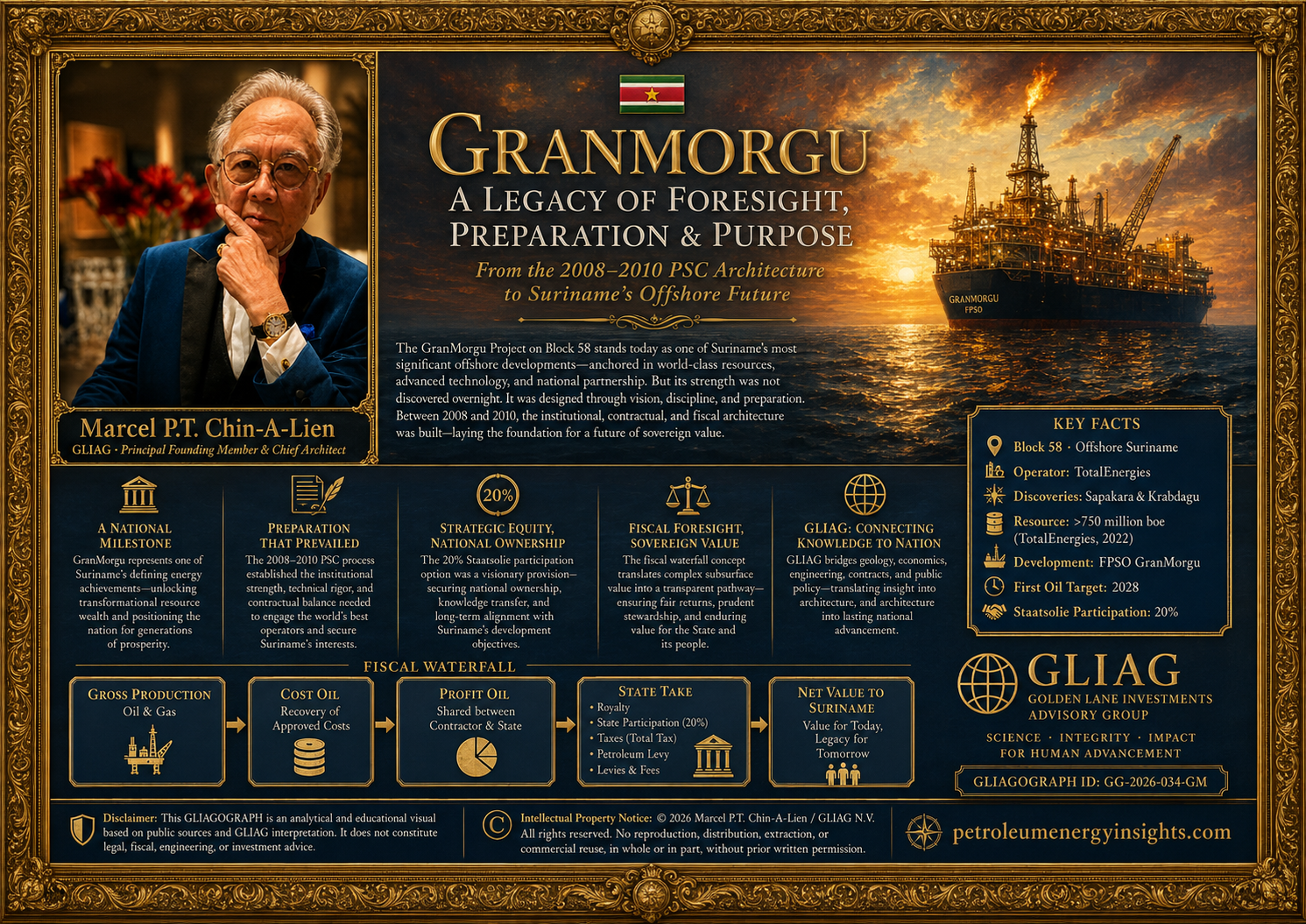
TotalEnergies now places more than 750 million barrels of recoverable resources within the Sapakara–Krabdagu development, to be produced through an approximately 220,000-barrel-per-day FPSO, with first oil targeted for 2028. TotalEnergies — GranMorgu Project
What in 2008–2010 was still largely geological possibility has therefore become steel, subsea infrastructure and capital. But that is only half of the story. Because while geology was preparing the petroleum, Suriname was preparing the rules.
IV – 2008–2010 — preparing for a discovery that did not yet exist
Within Staatsolie’s Petroleum Contracts environment, much of our work during those years concerned precisely this problem. How should Suriname invite the international capital and technical capability necessary to explore a frontier deepwater province, while preserving sufficient national participation if exploration one day succeeded?
Nobody could know whether the future field would contain 50 million barrels or 750 million. Nobody could know whether oil would trade at US$40, US$75 or US$120. Nobody knew the name GranMorgu. That was precisely why the system had to be robust across many possible futures.
We worked with economic scenarios, contractual mechanisms, international comparisons and fiscal sensitivities. The object was not to forecast one perfect future. It was to build an architecture capable of surviving several futures.
V – The 20% participation right — a strategic option on success
The principle was that Staatsolie should retain the possibility of entering a commercial development after the highest-risk exploration phase.
By 2010 that philosophy was already visible in Suriname’s offshore contracting: Staatsolie could retain a 20% participation option in development and production.
Its strategic elegance becomes clearer when viewed from today. International partners assumed the frontier exploration risk. If exploration failed, Suriname had not been required to finance the same speculative programme as an international oil company. But if exploration succeeded, the national company preserved the right to become a commercial participant.
It was, in economic language, an option on future geological success.
GranMorgu converted that option into an asset. Staatsolie has now taken its 20% participating interest in the development. A principle discussed when the resource was hypothetical has therefore become ownership in one of the largest investments ever undertaken in Suriname.
VI – The R-factor — preparing the fiscal waterfall before there was oil to divide
The same forward-looking discipline applied to fiscal design. The PSC had to solve a fundamental problem. A frontier investor requires sufficient early economic reward to justify exploration and development risk. But if a field subsequently becomes highly profitable, the resource owner should participate more strongly in the economic rent.
The R-factor offered an elegant mechanism for doing this. Instead of fixing the State’s economic participation as though every project would have the same profitability, the R-factor links cumulative revenues and cumulative expenditures. As project economics strengthen and cumulative capital recovery advances, the allocation of profit petroleum can move progressively in favour of the State.
Protect investment while risk is high; share more strongly in value once success is established.
Around that mechanism lies the wider fiscal waterfall:
gross production → royalty → cost recovery → profit oil →R-factor allocation → taxation → Staatsolie participation →sovereign value
These flows were being examined in models years before Block 58 contained a commercial discovery. That is the aspect of the GranMorgu story I find most remarkable. We did not predict the precise future. We prepared a system capable of handling it.
VII – When the waterfall becomes billions
GranMorgu now places those once-theoretical mechanisms against very large numbers. Staatsolie has published illustrative estimates showing that Suriname’s total contribution from GranMorgu could range as follows, depending on project performance and oil prices:
AT US$45 / BBL≈ US$8billion
AT US$65 / BBL≈ US$19billion
AT US$85 / BBL≈ US$32billion
Those estimates demonstrate why fiscal architecture matters. The difference between a poorly conceived contract and a carefully calibrated one can ultimately be measured not in paragraphs of legal text, but in billions of dollars of national value.
My own GLIAG work has approached the same problem through independent modelling. In GranMorgu’s Revenue Waterfall — A Look at Suriname’s Future, I reconstructed the sequence from gross field revenue through cost recovery, profit oil, taxation and Staatsolie participation using transparent public-data assumptions.
In Gran Morgu Fiscal Assessment — Economic Insights 2028–2053, the same architecture was extended across the producing life of the field.
And in Debt Before Oil — From Gross Petroleum Revenue to Net Sovereign Cash, I deliberately pushed the analysis one important step farther. Because fiscal revenue is not the same as prosperity.
The country must still finance its obligations, manage debt, protect Staatsolie’s balance sheet, save prudently and invest wisely. Thus the most important number is eventually not gross oil revenue but Net Sovereign Cash Available — the amount that can genuinely be converted into national productive capacity.
VIII – First oil is therefore not the destination
When GranMorgu produces its first oil in 2028, it will be tempting to describe that moment as the beginning. In reality, it will be the convergence of two extraordinarily long histories.
One began tens of millions of years ago in the Cretaceous Atlantic. The other began much more recently in the offices, meeting rooms and models through which Suriname tried to prepare itself for an offshore petroleum future.
That is what makes the journey so splendid. A vision. A painting on a wall. A Tribute to My Sranankondre. A geological hypothesis. A PSC. A 20% option. An R-factor. A series of discoveries. An FPSO. And finally, first oil.
IX – And then comes Sloanea
GranMorgu is also unlikely to be the final chapter. To the east, Sloanea in Block 52 has already demonstrated that Suriname’s offshore petroleum system possesses another dimension: commercially significant gas.
This matters enormously. Oil primarily creates export earnings, government revenues and investment income. Gas can do something additional. It can become an industrial molecule.
Gas can potentially support LNG, domestic electricity generation, industrial heat, fertiliser, petrochemicals and other forms of value creation that remain inside the economy rather than leaving the country simply as exported hydrocarbons.
Geologically, Sloanea is equally significant. The transition across the Suriname margin from oil-dominant accumulations toward condensate and gas offers clues to burial history, source maturity, migration pathways and the broader source–charge–phase architecture of the basin.
That is why GLIAG increasingly treats GranMorgu, Sloanea and the wider Blocks 52–53 system not as unrelated discoveries, but as parts of one evolving petroleum-system story.
GranMorgu can provide the first great offshore oil cash engine. Sloanea may become the bridge from petroleum revenue to an integrated energy economy.
X – The Golden Lane comes full circle
Looking back, the term Golden Lane has acquired a meaning larger than the one with which it began. It is geological because the petroleum system is real. It is economic because those reservoirs are becoming cash flows. It is contractual because national value depends upon the architecture established before production. And it is deeply Surinamese because its ultimate purpose should be neither the FPSO nor the barrel. It should be the country.
The painting that once hung on my wall in Petroleum Contracts and later formed part of my wife’s exhibition A Tribute to My Sranankondre therefore occupies, for me, a quiet place in this history. It reminds me that petroleum is never only petroleum.
Behind the seismic line, the well log, the PSC and the cash-flow model lies a much larger question: What do we want all this knowledge and natural wealth ultimately to accomplish?
My answer today is essentially the same as it was then. Prepare carefully. Think beyond the discovery. Preserve national participation. Convert geological wealth into intellectual, institutional and productive wealth. And leave something more enduring than the oil itself.
That was the promise I saw in the Golden Lane. GranMorgu is now bringing part of that vision above the waterline. Sloanea may carry it farther still.
Analytical lineageGLIAG / Petroleum & Energy Insights
- The Golden Fans of the Guiana Margin — Deepwater Turbidite Reservoirs Offshore Guyana and Suriname
- Sapakara South Flow Test: Pioneering Suriname’s Oil Production
- GranMorgu Development — A Comprehensive Reservoir Analysis
- Suriname Offshore: Gateway and Catalyst to a Golden Future
- 2015 Symposium: The Dawn of Suriname’s Petroleum Era
- Gran Morgu Field Production and Depletion Modelling 2028–2048
- GranMorgu’s Revenue Waterfall — A Look at Suriname’s Future
- Gran Morgu Fiscal Assessment — Economic Insights 2028–2053
- Debt Before Oil — From Gross Petroleum Revenue to Net Sovereign Cash
Principal project sourceOperator publication
ABOUT THE AUTHOR
Drs. M.P.T. Chin-A-Lien, MBA, M.Sc., Ing. Geologist
Principal Founding Partner, Managing Partner & Chief Architect, Golden Lane Investments Advisory Group N.V. (GLIAG N.V.). Nearly five decades of international petroleum experience across Venezuela, the former USSR, the Dutch North Sea and the Guyana–Suriname Basin, including advisory work within Staatsolie’s Petroleum Contracts environment (2008–2010). Originator of the Golden Lane concept for the Guyana–Suriname petroleum fairway.
AAPG Certified Professional Geologist Nr. 5201-1996
EFG Chartered European Geologist Nr. 92-1996
AIEN Energy Negotiator, June 2021
Golden Lane Investments Advisory Group N.V.
Zoetermeer / Delft, Netherlands · Paramaribo, Suriname
petroleumenergyinsights.com
GLIAG ANALYTICAL NOTE
The historical recollections concerning the 2008–2010 Petroleum Contracts period, the Golden Lane concept, the office painting and the March 2010 exhibition A Tribute to My Sranankondre are presented as the author’s personal professional recollection. Public operator and Staatsolie sources should remain authoritative for project figures and contractual facts. GLIAG production, fiscal-waterfall and sovereign-cash calculations are independent analytical models based upon public information and explicitly stated assumptions; they do not reproduce confidential Block 58 contractual or subsurface information.
DISCLAIMER AND LEGAL NOTICE
No advice. This essay is published for general information, analytical and educational purposes only. It does not constitute investment, financial, legal, fiscal, tax, engineering or technical advice, and must not be relied upon as such. Readers should obtain independent professional advice before acting on any matter discussed here.
No offer or solicitation. Nothing in this publication constitutes an offer, invitation, recommendation or solicitation to buy, sell or subscribe for any security, licence interest, participation or financial instrument, nor an inducement to enter into any transaction.
Independence of analysis. The views expressed are those of the author and of GLIAG N.V. alone. They do not represent the position of Staatsolie Maatschappij Suriname N.V., TotalEnergies, APA Corporation, PETRONAS, the Government of the Republic of Suriname, or any other institution with which the author is or has been associated.
Sources. This analysis is based exclusively on public information, including operator and national oil company publications, together with GLIAG’s own independent modelling and interpretation. No confidential, proprietary or contractually restricted data has been used or disclosed. While reasonable care has been taken, GLIAG N.V. gives no warranty as to the accuracy, completeness or currency of the information presented, and accepts no liability for any loss arising from its use.
Forward-looking statements. Statements concerning production start-up, resource volumes, project performance, fiscal outcomes, oil prices or future national revenues are forward-looking and inherently uncertain. Actual outcomes may differ materially from any estimate, scenario or illustration presented. Nothing here should be read as a forecast, guarantee or assurance of future results.
COPYRIGHT AND INTELLECTUAL PROPERTY
© 2026 Drs. M.P.T. Chin-A-Lien / Golden Lane Investments Advisory Group N.V. (GLIAG N.V.). All rights reserved. No reproduction, distribution, extraction, republication or commercial reuse of this work, in whole or in part, is permitted without the prior written permission of GLIAG N.V. Golden Lane, GLIAGOGRAPH, Sovereign Molecule™, Sovereign Conversion Capacity™ and Caribbean Gas Arc™ are proprietary designations of GLIAG N.V.
Text and data mining reservation. GLIAG N.V. expressly reserves all rights in this work for the purposes of text and data mining, and opts out of any use of this content for the training or development of artificial intelligence or machine-learning systems, pursuant to Article 4(3) of Directive (EU) 2019/790 on copyright and related rights in the Digital Single Market.
Converting bare headlines into deep strategic, added value.
GLIAG · WHERE INFORMATION BECOMES INTELLIGENCE