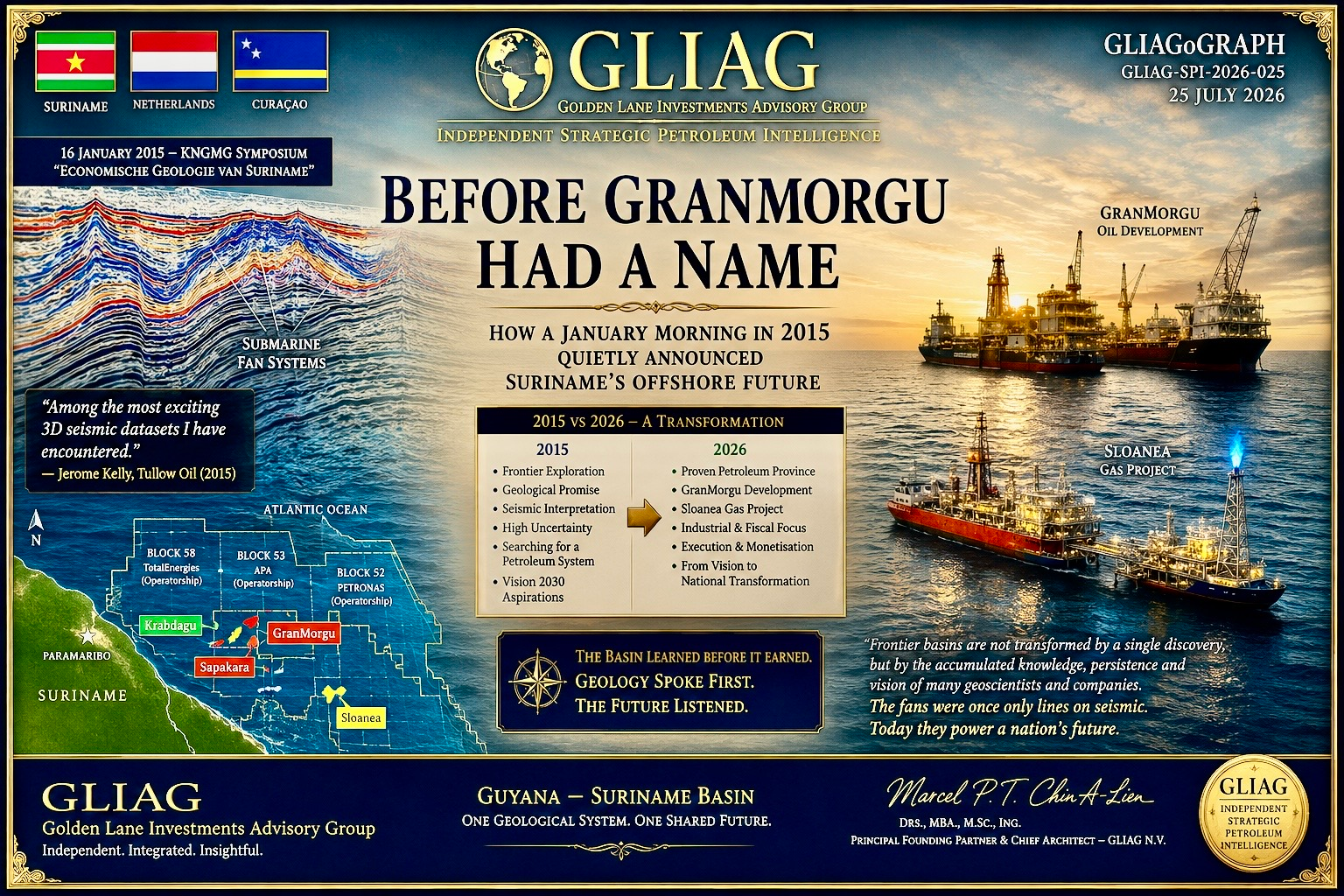
Before GranMorgu Had a Name
How a January Morning in 2015 Quietly Announced Suriname’s Offshore Future
By Marcel P.T. Chin-A-Lien
There are moments in the history of a petroleum basin that only acquire their true significance years later. At the time they appear almost ordinary: a technical symposium, a lecture hall filled with geologists, a succession of presentations on source rocks, seismic amplitudes, sediment routing and deep-water fans. No television cameras. No billion-dollar investment announcements. No political speeches. Just scientists trying to understand what lay several kilometres beneath the Atlantic Ocean.
One such moment occurred on 16 January 2015, during the Royal Geological and Mining Society of the Netherlands (KNGMG) symposium Economische Geologie van Suriname.
Looking back from 2026, that symposium deserves recognition as one of the intellectual milestones in the modern history of Suriname’s offshore petroleum province.
A Basin Still Waiting to Be Proven
The Suriname discussed that winter morning was fundamentally different from today’s Suriname.
Vision 2030 had articulated bold national ambitions, but offshore exploration remained a frontier enterprise. Billions of barrels had not yet entered the public conversation. The names that today dominate international petroleum headlines—GranMorgu, Sapakara, Krabdagu and Sloanea—did not yet exist in the industry’s vocabulary.
Confidence rested not on production figures, but on geology.
Companies were investing hundreds of millions of dollars in seismic acquisition and exploration drilling without knowing whether Suriname would eventually become another disappointment or one of the Atlantic Margin’s great success stories.
History often remembers discoveries. It sometimes forgets the years of disciplined geological thinking that made those discoveries possible.
The Day the Seismic Spoke
Among the presentations that day, one has remained particularly vivid in my memory.
Jerome Kelly of Tullow Oil presented the company’s interpretation of Suriname’s offshore petroleum systems. What immediately distinguished the presentation was not corporate optimism but the extraordinary quality of the offshore three-dimensional seismic data.
The submarine fan systems appeared with remarkable clarity. Their geometry, continuity and stacking patterns suggested a remarkably organised depositional system. The seismic images displayed well-developed channel-levee complexes, basin-floor fans and sediment pathways that any exploration geologist would recognise as highly encouraging.
During the discussion, Jerome remarked that this was among the most exciting 3D seismic datasets he had encountered.
Experienced exploration geologists rarely make such observations lightly.
Those words have remained with me ever since—not because they predicted a particular discovery, but because they reflected something more fundamental: confidence grounded in geology rather than hope.
The Earth was already revealing its story.
The industry simply needed time to understand it.
Looking Beyond the Drill Bit
History has a habit of celebrating the company that reaches production first.
Petroleum geology tells a richer story.
The companies that first reduce geological uncertainty often make contributions that are no less significant than those that ultimately construct the production facilities. Frontier basins mature through accumulated knowledge. Every seismic survey, every interpretation, every dry hole and every successful well contributes another piece to an increasingly coherent geological puzzle.
Tullow deserves recognition in precisely that context.
Although later developments would follow a different corporate path, Tullow’s exploration work contributed materially to the industry’s understanding of Suriname’s offshore petroleum systems. Its technical teams helped demonstrate that the basin possessed many of the essential geological characteristics associated with world-class deep-water petroleum provinces.
The basin learned before it earned.
That, perhaps, is Tullow’s enduring legacy.
It is also one reason why my earlier GLIAG reflection on Tullow generated such strong engagement on LinkedIn, particularly among former Tullow professionals. Many appreciated that the article recognised geological contribution rather than judging success solely by who ultimately produced the first barrel of oil.
Eleven Years That Changed a Nation
Fast forward to 2026.
The transformation has been extraordinary.
GranMorgu has evolved from geological concept into Suriname’s first integrated offshore oil development, representing one of the largest industrial investments in the country’s history.
Sloanea has established natural gas as Suriname’s second strategic offshore energy pillar, opening opportunities that extend well beyond exports towards domestic industrialisation, electricity generation and long-term economic diversification.
The national discussion has therefore changed fundamentally.
In 2015, the central question was whether Suriname possessed a commercially viable offshore petroleum system.
In 2026, the challenge is no longer geological.
The challenge has become institutional.
Can Suriname transform world-class resources into world-class governance?
Can offshore success be converted into sustainable national prosperity?
Can geology become development?
Those are fundamentally different questions.
Looking Back — Looking Forward
Revisiting the 2015 symposium is more than an exercise in nostalgia.
It reminds us that successful petroleum provinces are rarely created overnight. They emerge through decades of scientific curiosity, technical perseverance, institutional learning and calculated exploration risk.
Long before GranMorgu appeared in international headlines, before Sloanea became synonymous with Suriname’s emerging gas economy, and before investors around the world began focusing on the Guyana–Suriname Basin, experienced geoscientists were already reading the future in the seismic.
The fans were still only lines beneath the seabed.
Today they underpin one of the most promising new offshore petroleum provinces anywhere in the world.
For me, that January morning in 2015 was not simply another symposium.
It was one of those rare occasions when the future quietly introduced itself.
Selected References
- Staatsolie N.V. – Annual Reports and Vision 2030.
- TotalEnergies – GranMorgu Development.
- APA Corporation – Suriname Exploration Portfolio.
- PETRONAS – Block 52 and Sloanea Development.
- KNGMG Symposium Economische Geologie van Suriname (16 January 2015).
- USGS Atlantic Margin Petroleum Studies.
Related GLIAG Publications
The Tullow Story Revisited
Why geological vision often precedes commercial success.
GranMorgu: Suriname’s Offshore Turning Point
How one project transformed a frontier basin into a producing province.
Sloanea: Suriname’s Second Energy Pillar
Natural gas as a catalyst for industrial development.
Suriname Horizon-2050
A long-term strategic framework integrating petroleum, gas, industry and national development.
The Guyana–Suriname Golden Lane
The geological evolution of one of the world’s most successful emerging petroleum fairways.
About the Author
Marcel P.T. Chin-A-Lien, Drs., MBA., M.Sc., Ing.
Principal Founding Partner & Chief Architect
GLIAG N.V. – Golden Lane Investments Advisory Group
Certified Petroleum Geologist (AAPG) • Chartered European Geologist (EFG) • More than fifty years of international experience in petroleum exploration, basin analysis, petroleum economics and strategic energy advisory services. Marcel Chin-A-Lien was among the earliest proponents of the Guyana–Suriname Golden Lane concept and continues to publish independent strategic analyses on Suriname’s evolving energy future.
About GLIAG N.V.
GLIAG N.V. (Golden Lane Investments Advisory Group) is an independent strategic advisory group specialising in integrated petroleum geology, energy economics, fiscal governance, institutional development and long-term energy strategy. GLIAG combines scientific rigour with independent strategic thinking to support informed decision-making across the Guyana–Suriname Basin.
© GLIAG N.V. – All Rights Reserved
Publication: GLIAG-SPI-2026-025
Date: 25 July 2026.