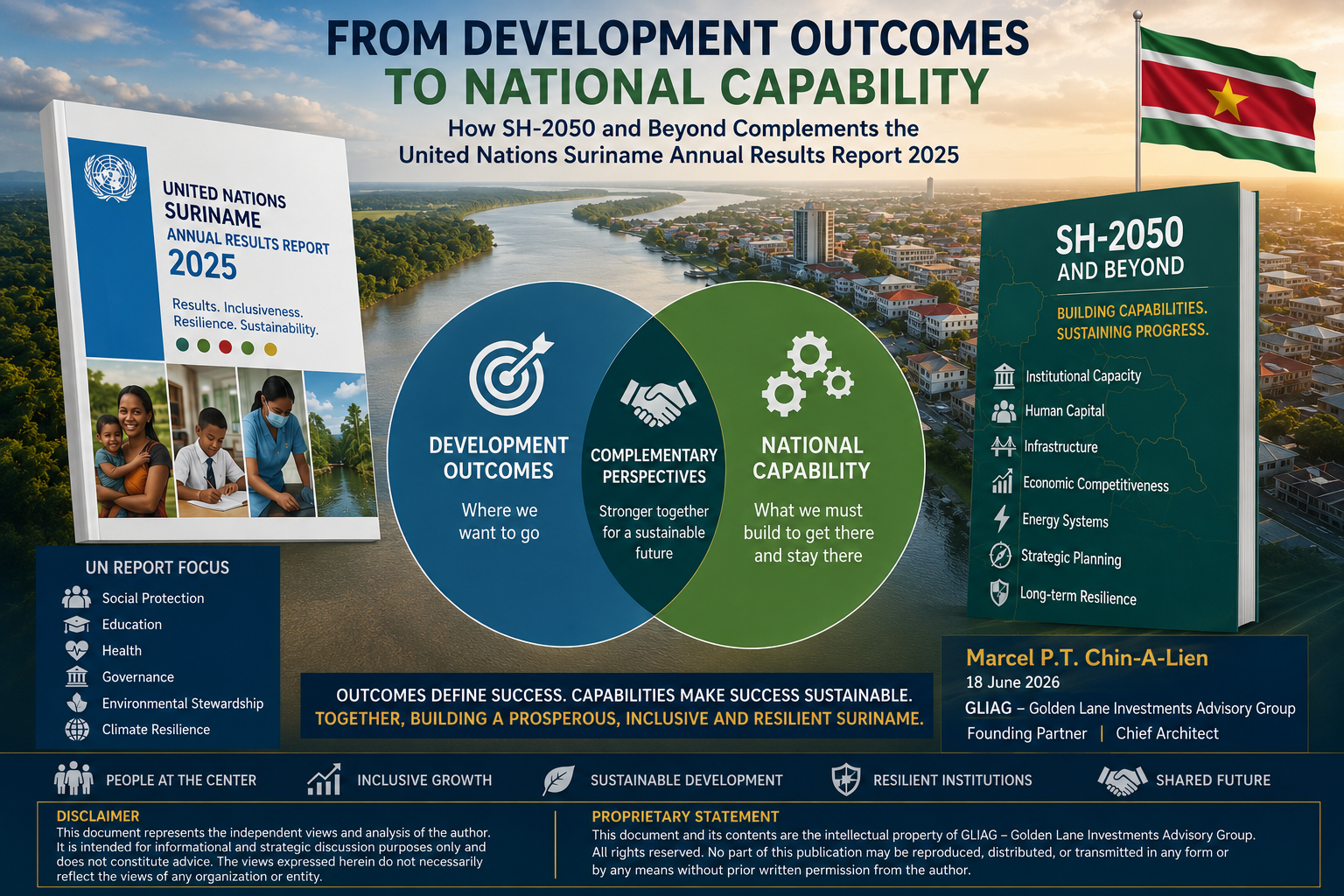
FROM DEVELOPMENT OUTCOMES TO NATIONAL CAPABILITY
How SH-2050 and Beyond Complements the United Nations Suriname Annual Results Report 2025
“ Suriname Horizon 2050 and Beyond “ the GLIAG doctrine is the a self-conceptualized vision for Suriname’s development.
Set out extensively in essays on my website and resumed in the trilogy The Conversion, on how to convert offshore resources into sustained national wealth, in Switi Sranan “.
M.P.T. Chin-A-Lien
GLIAG – Guyana-Suriname Basin Strategic Intelligence Initiative
Golden Lane Investments Advisory Group – Est. 2025 – Founding Partner and Chief Architect
June 2026
Classification: Proprietary
EXECUTIVE SUMMARY
The United Nations Suriname Annual Results Report 2025 offers a timely assessment of Suriname’s development priorities at a moment when the country is preparing for potentially transformative economic opportunities.
The report highlights progress in social protection, education, health, governance, environmental stewardship, and climate resilience, while also identifying persistent challenges related to poverty, inequality, institutional capacity, and economic vulnerability.
SH-2050 and Beyond approaches these same issues from a complementary perspective.
Where the UN report focuses primarily on the development outcomes Suriname seeks to achieve, SH-2050 focuses on the capabilities required to achieve and sustain those outcomes over the long term.
This distinction is important.
Development outcomes are the visible results of progress. National capabilities are the systems that make progress possible.
Viewed together, the two frameworks provide complementary perspectives on Suriname’s future development path.
WHAT THE UN REPORT TELLS US
The United Nations Suriname Annual Results Report 2025 presents a broad assessment of the country’s development agenda and priorities.
Its central themes include:
- Reducing poverty and vulnerability;
- Strengthening education and health systems;
- Promoting inclusion and equal opportunity;
- Improving governance and institutional effectiveness;
- Enhancing climate resilience;
- Protecting biodiversity and natural resources;
- Strengthening evidence-based policymaking.
These priorities reflect widely shared national aspirations and are essential components of sustainable development.
The report also recognizes that Suriname is entering an important period of economic transition. New opportunities associated with offshore energy development have the potential to support national development, provided that these opportunities are managed effectively and translated into broad-based societal benefits.
The report therefore presents a picture of a country with significant opportunities, but also with important structural challenges that require long-term attention.
WHAT SH-2050 ADDS
SH-2050 begins with a different, but complementary, question:
What capabilities must Suriname build to achieve these development objectives over the long term?
The framework focuses on the systems that support national progress, including:
- Institutional capacity;
- Human capital;
- Infrastructure;
- Economic competitiveness;
- Energy systems;
- Strategic planning;
- Long-term resilience.
From this perspective, development outcomes are not only goals. They are also the result of underlying national capabilities.
The stronger these capabilities become, the greater the likelihood that development gains can be sustained across generations.
Importantly, this perspective does not replace the development priorities identified in the UN report. Rather, it seeks to strengthen the foundations upon which those priorities depend.
COMPLEMENTARY PERSPECTIVES
| UN Report Focus | SH-2050 Capability Perspective |
|---|---|
| Poverty reduction | Long-term economic opportunity |
| Education | Workforce and skills development |
| Health | Human-capital resilience |
| Social inclusion | Broad-based participation in development |
| Climate resilience | Long-term national resilience |
| Environmental protection | Stewardship of strategic natural assets |
| Governance | Institutional effectiveness and execution capability |
| Data and evidence | Strategic decision-making capability |
| Economic development | Sustainable competitiveness |
| Resource opportunity | Long-term national capability formation |
The distinction is straightforward.
The UN report focuses on the outcomes Suriname seeks to achieve.
SH-2050 focuses on the capabilities required to achieve them and sustain them over time.
Together, these perspectives reinforce one another.
A SHARED NATIONAL OPPORTUNITY
Importantly, these perspectives should not be viewed as competing approaches.
Development outcomes and capability formation are mutually reinforcing. Stronger capabilities improve development outcomes, while successful development expands national capabilities.
Long-term national progress requires attention to both.
Both frameworks ultimately point toward the same objective: a more prosperous, inclusive, resilient, and sustainable Suriname.
The challenge is not simply achieving progress today.
The challenge is ensuring that progress can be maintained tomorrow.
This requires continued investment in institutions, people, knowledge, infrastructure, and long-term planning.
As Suriname enters a new phase of development, the opportunity extends beyond economic growth alone. It includes the creation of stronger national capabilities that can support development long after individual projects, commodity cycles, or political administrations have passed.
CONCLUSION
The United Nations Suriname Annual Results Report 2025 provides an important assessment of Suriname’s development priorities and progress. It highlights the outcomes that matter for citizens, communities, institutions, and the nation as a whole.
SH-2050 and Beyond complements this perspective by focusing on the capabilities required to sustain those outcomes over time.
The relationship between the two frameworks can be summarized simply:
The UN Report focuses on the outcomes Suriname seeks to achieve.
SH-2050 focuses on the capabilities required to sustain those outcomes across generations.
Viewed together, they offer complementary perspectives on the country’s long-term development journey.
As Suriname enters a new phase of economic and institutional development, the challenge will be not only to achieve progress, but also to build the systems, institutions, and capabilities that allow progress to endure.
In that sense, development and capability formation are not separate objectives. They are two sides of the same national project.
SELECTED GLIAG REFERENCES
This paper complements a broader body of work published through Petroleum & Energy Insights and the GLIAG Strategic Intelligence Initiative. Readers interested in related themes may consult:
- Suriname Horizon 2050: A Strategic National Transition Framework – SH-2050 strategic transition framework for Suriname to 2050.
- Suriname’s Horizon 2050: A Roadmap for Sustainable Petroleum Management – Execution timeline for converting petroleum opportunity into durable national capability.
- From Gas-to-Shore to Growth-to-State – Gas-to-Shore interpreted as a platform for broader national transformation.
- SURINAME and THE CONVERSION – Core conversion logic: transforming resource opportunity into lasting capability.
- Transforming Suriname’s Petroleum into Productive Power – Petroleum-to-productivity framework, including industrial and refinery-related pathways.
- Suriname’s Economic Transformation: The GLIAG Model Explained – GLIAG model linking Gas-to-Shore, industrial activation and optional refining.
- How to Monetise Sloanea? – Gas monetisation options and Nickerie development logic.
- Strategic Gas Integration: Guyana & Suriname Cooperation – Regional gas integration and Nickerie/West Suriname energy pathway.
- Navigating Suriname’s Oil Era: A Fiscal Management Guide – Fiscal management and competitiveness during Suriname’s first oil era.
SOURCE NOTE
Primary report reviewed: United Nations Suriname Annual Results Report 2025, version dated 7 June 2026, as provided for analysis.
DISCLAIMER
This paper represents an independent strategic interpretation intended to stimulate discussion on long-term development and capability formation in Suriname. It does not represent the views of the United Nations, the Government of Suriname, Staatsolie, or any other institution. Any errors, interpretations, or conclusions remain the responsibility of the author alone.