The Lower Cretaceous Seas: Where the Real Sea Monsters Partied
Written by Marcel Chin-A-Lien – Petroleum & Energy Insights Advisor – August 2025
Picture this: 145 million years ago, where Guyana and Suriname now bask under Caribbean sunshine, there stretched a vast tropical sea that would make today’s most exotic marine documentaries look positively tame.
The Suriname-Guyana Basin wasn’t just another sleepy continental margin—it was nature’s own experimental laboratory, a place where evolution got creative with teeth, fins, and an alarming enthusiasm for gigantism.
While Tyrannosaurus was still a gleam in evolution’s eye, the shallow carbonate platforms of the early Aptian were hosting their own blockbuster cast. Think of it as “Jaws” meets “Finding Nemo,” but with considerably more existential dread and significantly better geological preservation.
145
Million Years Ago
25-30°C
Sea Temperature
2,972m
Ranger-1 Water Depth
Setting the Stage: A Sea Born from Chaos
The South Atlantic was having its adolescent growth spurt, stretching and groaning as Gondwana finally decided to call it quits on being a supercontinent. This wasn’t a gentle parting—imagine continental plates having a particularly dramatic breakup, complete with volcanic tantrums and episodes of violent rifting.
The Perfect Storm of Conditions: The result was a young, warm ocean basin punctuated by volcanic highs that created perfect conditions for carbonate platform development. These weren’t your modern coral reefs—these were Cretaceous reef systems where rudist bivalves built towering structures that would make today’s Great Barrier Reef look like a suburban garden pond.
The water temperature?
Deliciously tropical, hovering around 25-30°C (77-86°F)—perfect for both carbonate precipitation and nurturing some of the ocean’s most ambitious predators.
Sea levels were high, atmospheric CO₂ was through the roof by today’s standards, and the greenhouse world was in full swing.
The Supporting Cast: When Fish Had Personality Disorders
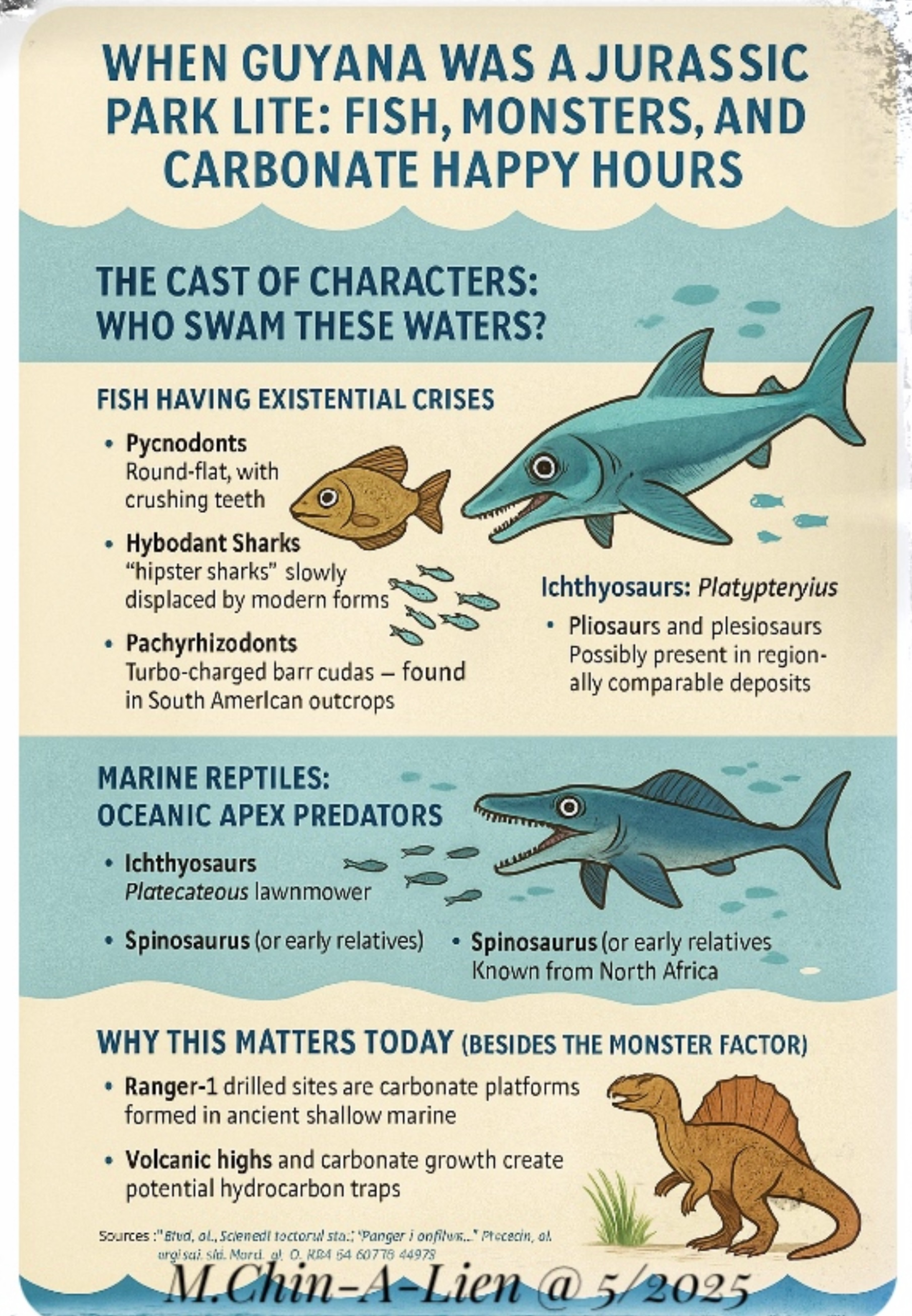
The Pycnodonts: Nature’s Living Can Openers
Imagine a fish that looked like someone had taken a piranha, flattened it with a steamroller, and given it the dental work of a medieval torture device. Pycnodonts were the Cretaceous equivalent of a Swiss Army knife—specifically designed for one job: turning hard-shelled mollusks into bite-sized appetizers.
Fossil Evidence: These disc-shaped characters cruised the carbonate platforms with the confidence of fish who knew exactly what they were good at. Their pharyngeal mills—essentially throat teeth designed for grinding—could pulverize the shells of ammonites, bivalves, and gastropods with the efficiency of a geological rock crusher.
Fossil evidence from the Ranger-1 well suggests these platforms were pycnodont paradise, with abundant shell debris indicating regular “all-you-can-crunch” buffets.
Hybodont Sharks: The Cretaceous Hipsters
While sleek modern sharks were starting to dominate deeper waters, hybodont sharks were still hanging onto their retro lifestyle in the shallows. These were sharks with a sense of nostalgia—sporting both cutting teeth for flesh and crushing teeth for shells, they were the Swiss Army knives of the shark world.
Fun Fact: Hybodont teeth are commonly found in shallow marine carbonate sequences throughout the Cretaceous, and their presence in the Suriname-Guyana Basin suggests these waters provided ideal hunting grounds.
Pachyrhizodonts: The Cretaceous Speed Demons
If pycnodonts were the can openers and hybodonts were the cleanup crew, pachyrhizodonts were the Formula One racers of the Cretaceous seas. These elongated predatory fish were built for speed, with streamlined bodies and powerful tails that could generate explosive bursts of acceleration.
Think of a barracuda that’s been hitting the gym for a few million years. Pachyrhizodont fossils from contemporaneous formations in Brazil and North Africa suggest these were ambush predators that used the complex topography of carbonate platforms to their advantage—lurking in the shadows of rudist reefs before launching devastating attacks on unsuspecting prey.
The Headliners: Marine Reptiles That Redefined “Apex Predator”
Ichthyosaurs: The Ocean’s Fighter Jets
Platypterygius and its relatives were the undisputed speed merchants of the Cretaceous seas. Picture a dolphin that’s been redesigned by aerospace engineers with an unlimited budget and a complete disregard for conventional biology. These marine reptiles could reach lengths of 7 meters (23 feet) and possessed eyes the size of dinner plates—perfect for spotting prey in the crystal-clear tropical waters.
Specialized Hunting: Their teeth tell a story of specialized predation: conical, sharp, and perfectly designed for gripping slippery prey like fish and cephalopods. The high-resolution preservation possible in carbonate environments means we can see microscopic wear patterns on ichthyosaur teeth, revealing details about their hunting strategies and preferred prey.
Recent isotopic analysis of ichthyosaur remains from similar-aged formations suggests these animals were capable of deep diving—perhaps descending several hundred meters to hunt in cooler waters before returning to the warm shallows to bask and breed. The carbonate platforms of the Suriname-Guyana Basin would have provided ideal nursery areas for ichthyosaur young, with abundant small fish and protection from larger oceanic predators.
Plesiosaurs: The Loch Ness Monsters That Actually Existed
While direct evidence remains elusive, the paleobiogeographic distribution of plesiosaurs strongly suggests their presence in the Suriname-Guyana Basin. These were reptiles that had fully committed to marine life, developing four massive flippers that propelled them through the water with the grace of underwater birds.
Long-necked plesiosaurs would have been the gentle giants of the carbonate platforms, using their extended necks to probe into reef crevices for fish and small cephalopods. Short-necked pliosaurs, by contrast, were the ocean’s equivalent of T. rex—massive heads armed with teeth the size of bananas, perfectly adapted for taking down large prey including other marine reptiles.
The Shoreline Celebrities: Dinosaurs with Beach House Ambitions
Iguanodon: The Cretaceous Lawnmower
While the marine realm was hosting its own drama, the coastal plains weren’t exactly peaceful either. Iguanodonand its relatives were busy revolutionizing herbivory, developing sophisticated dental batteries that could process the tough, fibrous vegetation of the Cretaceous world.
Impressive Stats: These weren’t your gentle, leaf-nibbling herbivores. Iguanodon was a 9-meter (30-foot) long, 3-ton eating machine equipped with thumb spikes that could puncture the hide of any predator foolish enough to interrupt dinner.
They gathered in herds along the coastal plains, their feeding activities contributing significant amounts of organic matter to the developing carbonate sequences.
Spinosaurids: The Semi-Aquatic Nightmares
While Spinosaurus itself hasn’t been confirmed from the Suriname-Guyana Basin, the ecological niche was almost certainly filled by similar semi-aquatic predators. These were dinosaurs that had decided terrestrial hunting was for amateurs—why chase your dinner across land when you could simply wade into the shallows and grab it directly from the water?
Spinosaurid teeth are perfectly adapted for gripping slippery prey like fish, and their elongated snouts provided the mechanical advantage needed to snatch fast-moving aquatic prey. The extensive river systems that drained into the Cretaceous sea would have provided ideal hunting grounds for these semi-aquatic predators.
The Geological Plot Twist: Why These Monsters Matter Today
From Ancient Seas to Modern Energy
Here’s where our Cretaceous adventure becomes more than just paleontological entertainment. Those carbonate platforms where pycnodonts crunched shells and ichthyosaurs hunted fish? They’re sitting on some of the most promising hydrocarbon prospects in the modern South Atlantic.
The Ranger-1 well, drilled in 2,972 meters of water, encountered exactly these types of Lower Cretaceous carbonates. The same environmental conditions that supported diverse marine ecosystems—warm, shallow, tropical seas with active carbonate production—created ideal conditions for petroleum system development.
The Carbonate Connection
Carbonate platforms are geological time capsules. The organisms that built these reefs—rudist bivalves, corals, algae, and countless other marine creatures—were essentially manufacturing limestone in real-time. But here’s the crucial part: when these organisms died, they didn’t just disappear. They became part of the geological record, creating porous and permeable rock formations perfect for hydrocarbon storage.
Poetic Justice: The same ichthyosaur that terrorized Cretaceous fish may now be sharing rock space with natural gas molecules. The pycnodont that spent its life crushing shells is now part of a reservoir rock that could power modern civilization. It’s poetic justice on a geological timescale.
Modern Implications
Understanding these ancient ecosystems isn’t just academic curiosity—it’s practical geology. The distribution of organisms in Cretaceous seas tells us about water depth, temperature, salinity, and nutrient availability. This paleoenvironmental data is crucial for predicting where the best reservoir rocks developed and where source rocks generated hydrocarbons.
The complex topography created by volcanic highs and carbonate build-ups formed natural traps for migrating hydrocarbons. Areas where ichthyosaurs once hunted may now contain significant accumulations of oil and gas, waiting to be discovered by modern exploration techniques.
The Bigger Picture: Evolution’s Dress Rehearsal
The Cretaceous seas of the Suriname-Guyana Basin represent a fascinating moment in evolutionary history. This was the last great radiation of marine reptiles, the golden age of ammonites, and the time when modern fish groups were establishing their dominance. It was also a period of extreme greenhouse conditions—a natural experiment in how marine ecosystems respond to high temperatures and elevated CO₂ levels.
145 Million Years Ago
Opening of the South Atlantic creates new marine habitats
Early Cretaceous
Carbonate platforms develop in warm, shallow seas
Aptian Stage
Peak diversity of marine reptiles and specialized fish
Present Day
Hydrocarbon exploration targets these ancient reef systems
The diversity and abundance of life in these ancient seas demonstrates the resilience and creativity of evolution when presented with new opportunities. The opening of the South Atlantic created entirely new habitats, and life responded by experimenting with body plans, feeding strategies, and ecological relationships that had never existed before.
Future Discoveries: What’s Still Out There?
Every drilling operation in the Suriname-Guyana Basin is an opportunity for paleontological discovery. Drill cuttings routinely recover microfossils that provide detailed information about ancient environments, but occasionally, larger specimens make their way to the surface.
Preservation Potential: The preservation potential in these carbonate sequences is exceptional. The same conditions that created excellent reservoir rocks also favor fossil preservation. Future drilling may recover more complete specimens of the marine reptiles that dominated these seas.
The Caribbean Connection
It’s particularly fitting that these ancient tropical seas existed where the modern Caribbean now sparkles. The warm, clear waters that host today’s coral reefs and marine biodiversity are the direct descendants of those Cretaceous carbonate platforms. The same geological processes that created paradise for ichthyosaurs and pycnodonts continue to operate today, just with a different cast of characters.
Modern marine life in the Caribbean—from whale sharks to reef fish—occupies ecological niches that were pioneered by their Cretaceous predecessors. The fundamental patterns of marine ecosystem organization established 145 million years ago continue to influence marine biodiversity today.
Epilogue: The Monsters’ Legacy
As we cruise through the modern Caribbean, enjoying crystal-clear waters and abundant marine life, it’s worth remembering that we’re swimming above one of Earth’s greatest paleontological treasures. Somewhere beneath the waves, embedded in limestone that formed when the world was young and warm, lie the remains of creatures that would challenge our wildest imagination.
The next time you see a drilling rig working in the Suriname-Guyana Basin, remember that they’re not just searching for hydrocarbons—they’re time travelers, inadvertently exploring a lost world where fish had crushing teeth, reptiles ruled the seas, and evolution was writing some of its most creative chapters.
And who knows? The next drill cutting might contain a fragment of a creature so bizarre, so perfectly adapted to its ancient world, that it forces us to completely rethink what we thought we knew about life in deep time. In the Cretaceous seas of Guyana and Suriname, where monsters were real and carbonates were king, every fossil tells a story worth hearing.
So here’s to the pycnodonts, the ichthyosaurs, and all the other Cretaceous characters who turned shallow tropical seas into nature’s own blockbuster thriller. Their world may be gone, but their legacy lives on—in the rocks they helped create, the hydrocarbons they helped preserve, and the endless fascination they inspire in anyone bold enough to imagine swimming with real sea monsters.

Marcel Chin-A-Lien
Petroleum & Energy Advisor – 48 Years of Transformative Global Impact
I bring nearly five decades of global, in-depth expertise that has consistently turned complexity into value for clients, governments, and corporations in petroleum exploration & production (E&P), business strategy, and energy policy. My career is defined by landmark achievements that reshaped industries, created long-term shareholder returns, and set new frontiers in global petroleum ventures.
Where I Add Value
- Proven Discoverer of Multi-Billion-Dollar Fields – spearheaded exploration programs and strategies that led to giant discoveries and enduring production hubs, directly translating to long-term cash flow generation.
- Pioneer in New Business Ventures – architect of the first capitalistic oil & gas ventures in the former USSR, opening doors for international investment and reshaping a national industry.
- Trusted Advisor in Bidding, M&A & PSC Structuring – designed and negotiated Production Sharing Contracts, guided successful bid rounds, and advised on high-value mergers & acquisitions, ensuring sustainable value creation.
- Strategic Integrator of Technical & Commercial Expertise – uniquely blend four petroleum postgraduate degrees across geology, engineering, business, and international management with frontline deal-making and advisory experience.
- Policy Shaper & Negotiator – delivered innovative, commercially balanced frameworks that aligned governments, investors, and operators, creating environments where exploration could flourish.
What I Deliver
- Integrated exploration & business strategies that unlock hidden value.
- Advisory solutions bridging technical certainty with commercial success.
- Negotiation expertise rooted in cross-cultural fluency (7 languages) and proven results across Europe, Latin America, the Caribbean, Africa, the Middle East, and Asia.
- Transformative insights from a career recognized by international gold-standard awards and certifications.
Credentials & Recognition
- Certified Petroleum Geologist (#5201, AAPG – global gold standard).
- Chartered European Geologist (#92, EFG – gold standard).
- AIEN Energy Negotiator – trusted authority in petroleum negotiations.
- Cambridge Award: 2000 Outstanding Scientists of the 20th Century (UK).
- Paris Awards: Innovative New Business Projects (GDF-Suez, 2003).
Public Profile
📧 marcelchinalien@gmail.com