Geological Intelligence Brief · June 2026
TECTONIC OBSERVATION · CARIBBEAN–SOUTH AMERICAN PLATE BOUNDARY
Venezuela Earthquake Sequence
(June 24–25, 2026):
What the Earth Is Telling Us
A GLIAG Geological Intelligence Brief
MC
Drs. M.P.T. Chin-A-Lien, MBA, M.Sc., Ing. Geologist
PRINCIPAL FOUNDING PARTNER & CHIEF ARCHITECT
GLIAG – Golden Lane Investments Advisory Group
Certified Professional Geologist Nr. 5201-1996 (AAPG) · Chartered European Geologist Nr. 92-1996 (EFG) · Energy Negotiator June 2021 (AIEN)
Published: 25 June 2026
Every earthquake tells a geological story. The question is whether we are trained to read it.
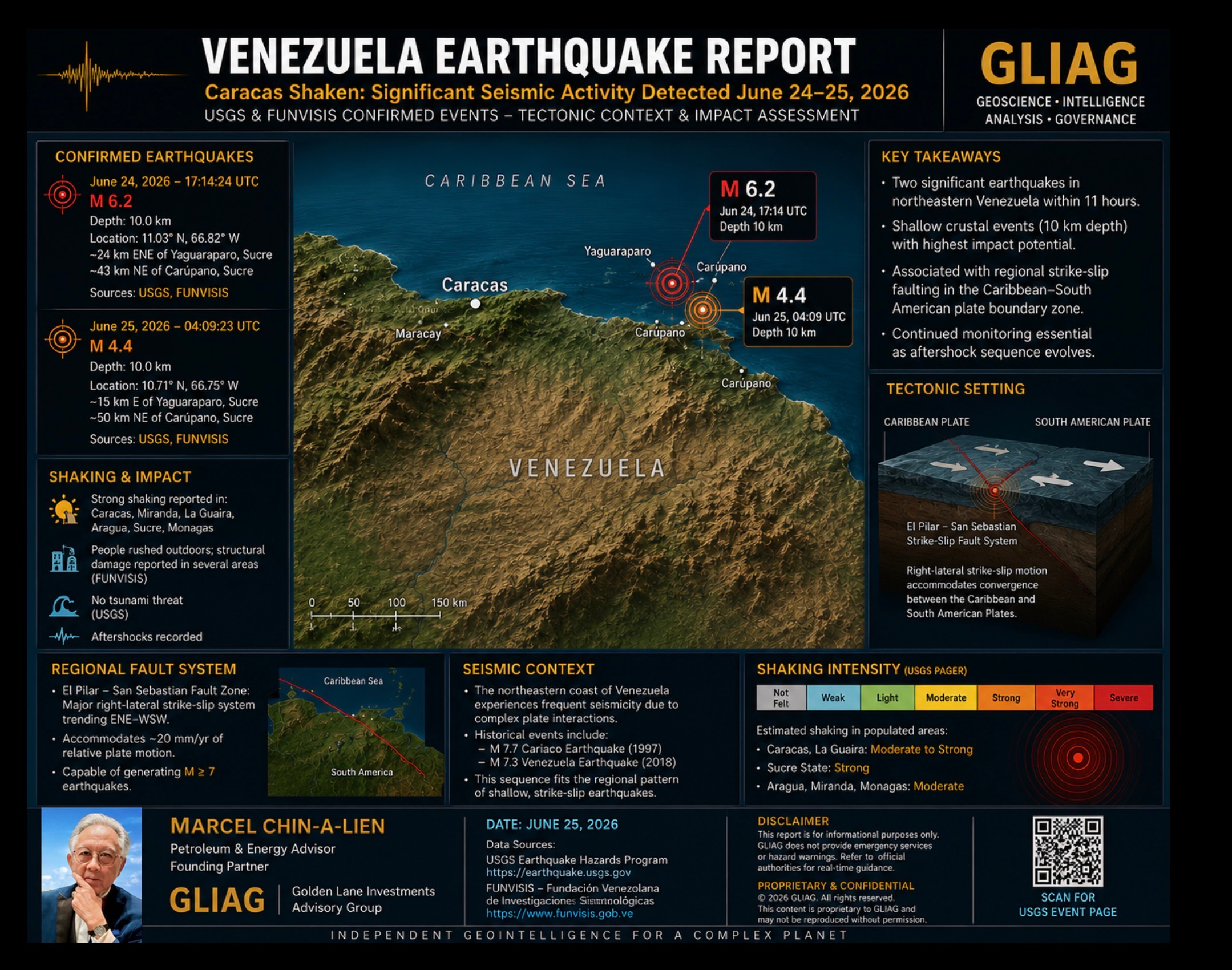
The earthquake sequence that struck northeastern Venezuela on 24–25 June 2026, felt across Caracas and widely reported in the regional press, is more than a news event. For the trained geoscientist, it is a measurable expression of the living tectonic system that underlies all of northern South America — a system that also shapes the sedimentary architecture, hydrocarbon migration pathways, and long-term reservoir behaviour of one of the world’s most important emerging energy frontiers.
Earthquakes are not random occurrences. They are the surface manifestation of crustal deformation, stress accumulation, and fault movement that has been ongoing since the Mesozoic — and that continues to evolve with each tremor recorded by instruments from Caracas to Paramaribo.
The Tectonic Setting
Current data released by the United States Geological Survey (USGS) and Venezuela’s Fundación Venezolana de Investigaciones Sismológicas (FUNVISIS) places this sequence squarely within the active Caribbean–South American plate boundary — one of the principal tectonic systems of northern South America.
This boundary is defined by right-lateral, broadly strike-slip motion, accommodated across an extensive network of faults including the El Pilar Fault System along the northeastern Venezuelan coast and the San Sebastián Fault further to the west, together with associated offshore compressional and transtensional structures. InSAR-based geodetic studies have documented creep behaviour and interseismic locking variations along El Pilar, confirming its active kinematic character and its capacity to generate both moderate and larger magnitude seismic events.
The June 2026 sequence is entirely consistent with this long-term tectonic behaviour. Detailed scientific interpretation will continue to evolve as hypocenter relocations, focal mechanism solutions, and aftershock analyses are refined by the international geoscience community.
Understanding tectonics is fundamental not only to natural hazard assessment — it is the foundation of responsible energy exploration in a geodynamically active basin.
Why Earthquakes Are Valuable Geological Observations
Each seismic event — particularly when examined as part of a sequence — contributes meaningful data to multiple overlapping fields of geoscientific inquiry.
GEOLOGICAL INTELLIGENCE — WHAT SEISMIC SEQUENCES REVEAL
- Active fault behaviour — kinematics, segment boundaries, and rupture style
- Crustal deformation — strain partitioning across the plate boundary zone
- Seismic hazard refinement — probabilistic assessments for infrastructure and urban planning
- Basin architecture — fault compartmentalization and structural geometry at depth
- Hydrocarbon migration pathways — structural controls on fluid movement in sedimentary systems
- Reservoir integrity — implications for casing integrity, fault seal analysis, and well planning
- Offshore infrastructure planning — pipeline routing, platform design, and marine geohazard assessment
For the petroleum and energy sector specifically, the tectonic processes that generate earthquakes are the same processes that have shaped the sedimentary basins — their depocenter evolution, their inversion histories, their fault systems — within which hydrocarbons are sourced, migrated, and trapped. Tectonic awareness is therefore not peripheral to energy strategy. It is central to it.
The GLIAG Perspective: Earth Systems Thinking
GLIAG — INTEGRATED EARTH SYSTEMS INTELLIGENCE
At GLIAG – Golden Lane Investments Advisory Group, we view seismic events through an integrated Earth Systems framework. Rather than analysing earthquakes in isolation, we seek to understand how structural geology, geophysics, plate tectonics, basin evolution, and energy systems interact across geological time.
The Caribbean–South American plate boundary is not merely a hazard zone. It is the same tectonic engine that has driven the subsidence, sedimentation, and structural complexity of the Guyana–Suriname Basin — the most significant hydrocarbon province discovered in the Western Hemisphere in a generation. The two perspectives are inseparable.
Scientific interpretation should always remain evidence-based, technically defensible, and open to refinement as new observations become available. Independent analysis requires the discipline to resist speculation while allowing the data to guide the conclusions. That rigour — applied consistently and without institutional pressure — is the hallmark of sound geoscience.
As USGS, FUNVISIS, and the broader international geoscience community release additional analysis in the coming days and weeks, our understanding of this sequence will continue to sharpen. The process of continuous observational learning — hypothesis, data, revision, conclusion — lies at the heart of the geological method. It is how the Earth has always taught us.
KEY GEOLOGICAL TAKEAWAYS
- The June 24–25, 2026 earthquake sequence occurred within the active Caribbean–South American plate boundary, consistent with the long-term tectonic character of northeastern Venezuela.
- Northern Venezuela remains one of the most seismically active regions in northern South America, dominated by right-lateral strike-slip motion along the El Pilar and San Sebastián fault systems.
- Each seismic event provides valuable scientific data on active fault kinematics, crustal deformation, and regional stress fields.
- Continued monitoring by USGS, FUNVISIS, and the international community is essential to refine hypocenter locations, focal mechanisms, and fault interpretations.
- For the energy sector, tectonic understanding directly informs basin architecture, reservoir characterisation, and offshore infrastructure design.
- Evidence — not speculation — must always guide geological interpretation. Science advances through observation, not assumption.
SELECTED SCIENTIFIC REFERENCES
OFFICIAL SEISMOLOGICAL AGENCIES
USGS Earthquake Hazards Programearthquake.usgs.gov
FUNVISIS — Fundación Venezolana de Investigaciones Sismológicasfunvisis.gob.ve
GEOLOGICAL & GEOPHYSICAL LITERATURE
Map and Database of Quaternary Faults in Venezuela and Offshore RegionsUSGS Open-File Report 00-18pubs.usgs.gov/of/2000/ofr-00-0018/
Strain Partitioning and Interseismic Fault Behavior Along the Caribbean–South American Plate BoundaryHiggins et al. (2021) — Journal of Geophysical Research: Solid Earthdoi: 10.1029/2021TC006740
Spatial and Temporal Variations in Creep Along the El Pilar Fault from InSARPousse Beltran et al. (2016) — Journal of Geophysical Researchdoi: 10.1002/2016JB013121
DISCLAIMER
This publication is intended solely for scientific, educational, and strategic discussion. It does not constitute an official seismic hazard assessment or emergency advisory. Interpretations presented herein are based on publicly available information and established geological principles, and may evolve as additional data become available from official monitoring agencies. Readers requiring official hazard guidance should consult USGS, FUNVISIS, or their national civil protection authorities.
GLIAG — GOLDEN LANE INVESTMENTS ADVISORY GROUP
Independent Geoscience · Energy Intelligence · Strategic Advisory
© 2026 GLIAG – Golden Lane Investments Advisory Group. All Rights Reserved.
No part of this publication may be reproduced without prior written permission from GLIAG, except for brief quotations with appropriate attribution.
Soso Lobi.