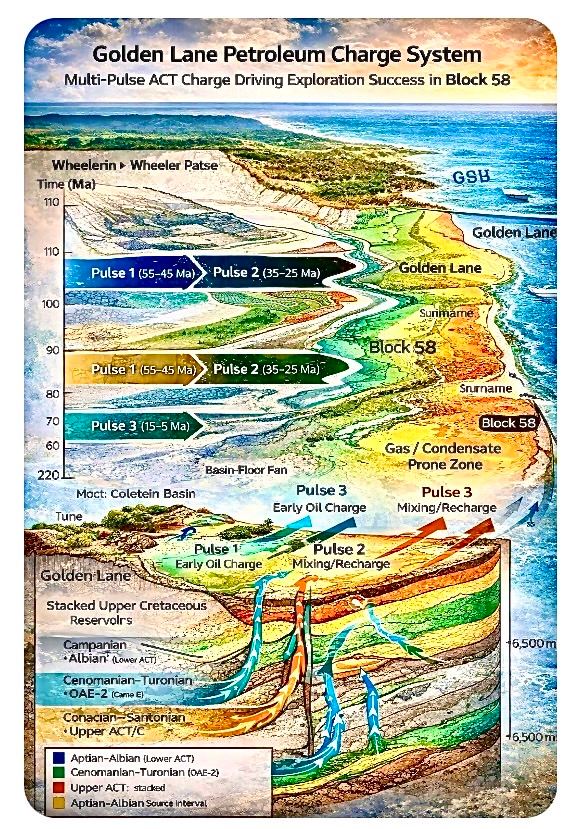
Golden Lane (Guyana–Suriname Basin)
A Multi-Pulse Petroleum Charge Framework Anchored to Maka-1 (Block 58)
Written by Marcel Chin-A-Lien – Petroleum & Energy Advisor – 9th february 2026
Disclaimer: this is my own modeling and resulting suggestions, conclusions.
Basin Modelling ACT Source System Golden Lane Block 58 Exploration Strategy
Executive summary. This report presents a physically based, kinetics-driven, multi-pulse petroleum charge model for the Golden Lane fairway of the Guyana–Suriname Basin (GSB), anchored to a hypothetical but rigorously constrained 1D basin model of the Maka-1 (Maka Central-1) discovery well in Block 58.
The model demonstrates that the exceptional exploration success in Block 58 is not accidental, but the natural outcome of stacked source rocks, short vertical migration pathways, and repeated charge pulses acting on persistent deep-water traps.
1. Maka-1 as the Anchor Well for Golden Lane Charge Analysis
Maka-1 (Block 58) is used here as a conceptual anchor well for Golden Lane petroleum system analysis.
While full well data remain proprietary, publicly released information constrains:
- Deep-water setting (~1,000 m water depth).
- Stacked Upper Cretaceous Campanian and Santonian reservoirs.
- Total depth on the order of 6.3 km.
These constraints allow construction of a credible stratigraphic, burial, and thermal framework sufficient to evaluate generation, expulsion, and migration timing of the ACT source system.
Critically, Maka-1 sits directly within the Golden Lane fairway, making it an ideal reference point for understanding why Block 58 has delivered repeated large discoveries.
2. The ACT Source System and the Basis for Multi-Pulse Charge
2.1 Stacked source intervals
The Golden Lane petroleum system is underpinned by a vertically stacked suite of marine source rocks:
- Aptian–Albian (Lower ACT) – marine Type II kerogen.
- Cenomanian–Turonian (OAE-2 / Canje equivalent) – commonly sulfur-rich Type II-S.
- Coniacian–Santonian (Upper ACT / “ACT+C”) – marine Type II.
These intervals were deposited at different times, now reside at different depths, and therefore entered the oil and gas windows at different geological times.
2.2 Why pulses must occur
When burial and temperature histories are combined with distributed-activation-energy (DAEM) kinetics:
- Generation does not occur as a single event.
- Expulsion occurs in discrete pulses, tied to periods of accelerated burial, kinetic thresholds, and secondary cracking.
- Each pulse can charge, recharge, or modify existing accumulations.
This behavior is a fundamental outcome of physics-based basin modelling, not a conceptual assumption.
3. The Three Golden Lane Charge Pulses (Anchored to Maka-1)
Adopted pulse windows (Ma before present):
- Pulse 1: 55–45 Ma
- Pulse 2: 35–25 Ma
- Pulse 3: 15–5 Ma
Pulse 1 – Primary Paleocene–Eocene Charge (55–45 Ma)
- Driven by rapid Paleocene–Eocene burial (progradational wedge loading).
- Main oil expulsion from deeply buried Lower ACT and OAE-2 sources.
- First large-scale charging of Campanian–Santonian deep-water reservoirs.
Pulse 2 – Recharge and Mixed-Source Charge (35–25 Ma)
- Continued burial and kinetic differences between Type II and Type II-S sources.
- Trap refill, spill-point migration, and vertical/lateral redistribution.
- Critical for filling stratigraphic and combination traps.
Pulse 3 – Late Cracking and Phase Overprint (15–5 Ma)
- Secondary cracking of retained oils in the deepest kitchen.
- Gas/condensate generation and GOR modification.
- Late recharge of existing traps and phase re-equilibration.
4. Short Vertical Migration: The Golden Lane Advantage
A defining feature of the Golden Lane is the close vertical proximity between mature source rocks and deep-water fan reservoirs:
- Migration distances are commonly hundreds of meters to ~1–2 km.
- Vertical migration dominates over long lateral carrier systems.
- Charge efficiency is exceptionally high.
This geometry means that each charge pulse has a high probability of successfully charging traps, even if earlier pulses were partially lost or traps evolved through time.
5. Explaining the Exceptional Success Rate in Block 58
Key conclusion: Block 58 success is the natural result of repeated effective charge, not extraordinary luck.
5.1 Why discoveries keep working
- Multiple chances to charge: Three major pulses dramatically reduce trap-timing risk.
- Trap persistence: Deep-water stratigraphic and combination traps remain effective through multiple geological phases.
- High saturation: Repeated charging leads to large hydrocarbon columns.
5.2 Why stacked reservoirs are common
- Different pulses preferentially charge different reservoir levels.
- Campanian and Santonian reservoirs can capture hydrocarbons from multiple pulses.
- Leads to vertically stacked discoveries within the same structural/stratigraphic fairway.
5.3 Why phase risk is predictable
- Pulse 1–2 dominated by oil charge.
- Pulse 3 introduces gas/condensate overprint closer to the deepest kitchen.
- Phase outcomes can be zoned spatially using pulse dominance.
In short, Block 58 works because the petroleum system is repeatedly re-energized, and Golden Lane traps sit directly in the path of that energy.
6. Strategic Implications for Golden Lane Exploration
- Lower exploration risk than single-pulse basins.
- High value of stratigraphic and subtle traps.
- Importance of kitchen adjacency over simple structural size.
- Predictable oil-to-gas transition tied to Pulse 3 proximity.
This framework provides a transferable logic for prospect ranking, phase risking, and portfolio construction across the Golden Lane corridor.
7. Closing Perspective
The Golden Lane is not merely a prolific fairway; it is a structurally simple but dynamically charged petroleum system. By anchoring analysis to Maka-1 and explicitly modelling generation, expulsion, and migration pulses, the exceptional success of Block 58 becomes geologically inevitable.
Future discoveries in the Golden Lane should be evaluated not on single-event charge assumptions, but on their ability to capture multiple pulses through time.
Author – Short Professional CV
Petroleum & Energy Advisor
Founder – PetroleumEnergyInsights.com
Independent petroleum geoscientist and strategic energy advisor with extensive experience in:
- Deep-water petroleum systems and basin modelling.
- Source-to-sink analysis and charge risk assessment.
- Exploration strategy, portfolio ranking, and investor communication.
- Guyana–Suriname Basin and Atlantic margin petroleum systems.
This article reflects independent technical interpretation based on publicly available information, established basin-modelling methodologies, and professional experience.