GLIAG | UNCLOS & Sovereign Rights
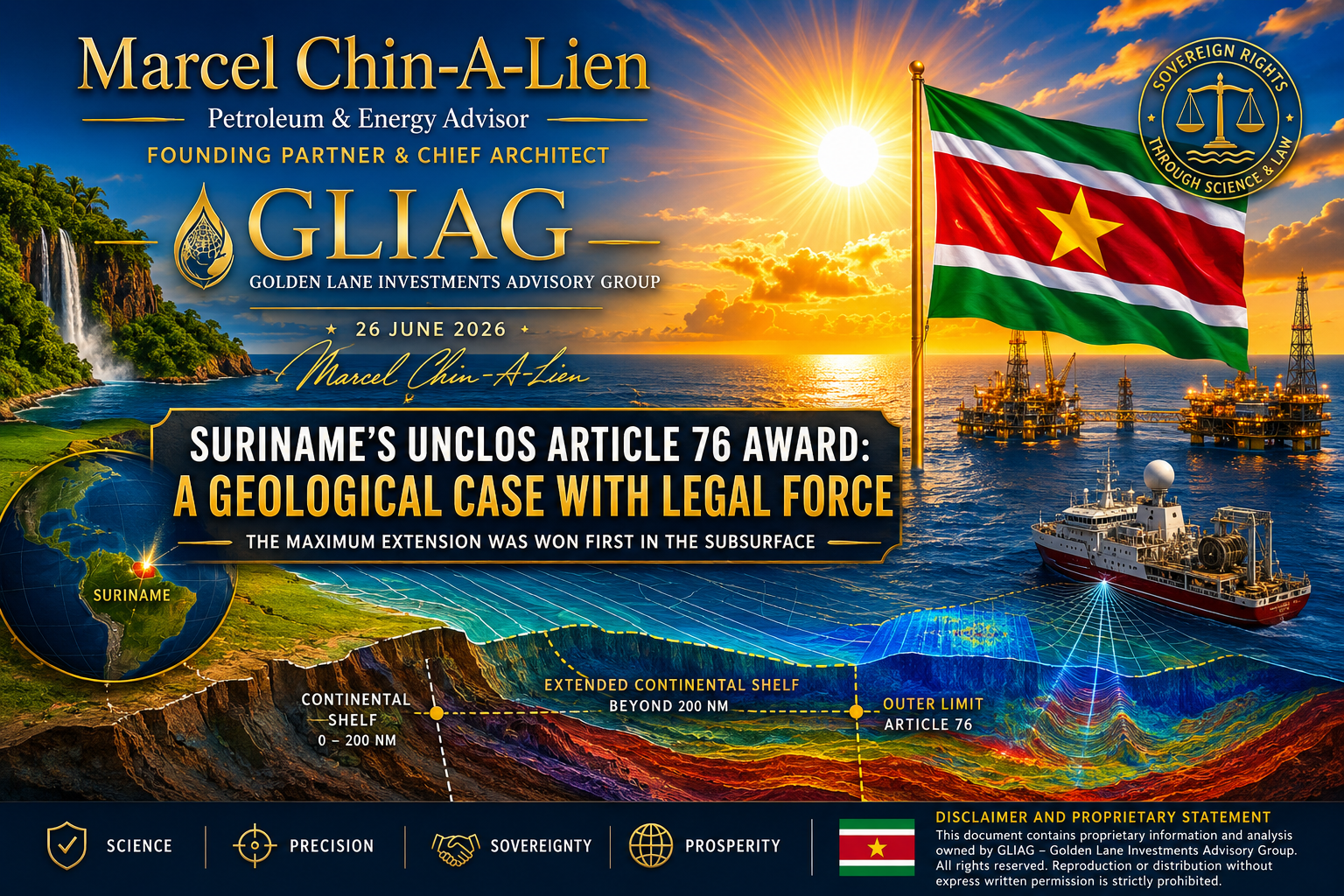
Suriname’s UNCLOS Article 76 Award: A Geological Case with Legal Force
The maximum extension was won first in the subsurface
Marcel Chin-A-Lien – Petroleum & Energy Advisor, GLIAG – June 2026
Core message
Suriname’s success in securing the maximum legally sustainable extension of its continental shelf beyond 200 nautical miles was not primarily a drafting exercise. It was the outcome of a disciplined geological–geophysical interpretation that the Commission on the Limits of the Continental Shelf (CLCS) found coherent, conservative and convincing.
1. Why this award matters
The CLCS recommendations and Suriname’s subsequent deposit of the outer‑limit coordinates transformed a technical case into binding sovereign rights over a large deep‑water domain beyond 200 nautical miles. This clarified long‑term jurisdiction for petroleum exploration and future seabed resource development, and strengthened Suriname’s reputation as a rules‑based, comparatively low‑risk offshore state.
2. Law following geology
Article 76 of UNCLOS grants extended continental shelf rights where a State can demonstrate that its continental margin naturally prolongs its land territory into the deep offshore, and can quantify that prolongation using accepted morphology, sediment thickness and constraint tests. In Suriname’s case, the decisive step was to show that the Suriname–Guyana Margin Basin and the Demerara Rise form a continuous margin system – a submerged prolongation of the Surinamese landmass – rather than an isolated deep‑water high.
3. The geological proof engine
From a geoscience perspective, the submission turned on one core capability: converting margin architecture into defensible boundary geometry under Article 76. The team identified and justified foot‑of‑slope points, interpreted the sediment–basement interface on key seismic lines, depth‑converted the section with documented velocity models, and demonstrated where sediment thickness met the 1 per cent formula relative to each foot‑of‑slope point.
The CLCS ultimately accepted a set of sediment‑thickness points as technically valid and used them, together with the agreed foot‑of‑slope framework, to construct Suriname’s outer edge of the continental margin and, from there, the final outer‑limit line segments.
4. Scientific scrutiny as a strength
During its examination, the CLCS did not accept every argument advanced. It questioned two proposed foot‑of‑slope points supported by “evidence to the contrary” and requested a more conservative interpretation in that area.
Rather than weakening the case, this scrutiny allowed the submission to shed marginal elements and consolidate around the strongest geological and geophysical evidence.
The final recommendations show that, once adjusted, the remaining framework was robust enough for the Commission to recognise Suriname’s entitlement beyond 200 nautical miles and to endorse a maximum extension fully consistent with Article 76.
5. Strategic implications for exploration
For explorers and investors, the award anchors basin‑scale decisions in a stable jurisdictional setting. It signals that Suriname has done the hard technical work to convert geological understanding into secure rights over a material portion of the deep‑water margin – a prerequisite for long‑cycle exploration and development programmes.
Looking ahead, the same subsurface framework that underpinned the petroleum case also positions Suriname to assess other seabed opportunities in its extended zone, from critical minerals to broader marine‑resource strategies.
6. A geologist’s verdict
From the inside, the Suriname submission demonstrates that extended shelf rights are ultimately won in the interpretation room.
The decisive contribution came from making the geology and geophysics speak clearly, conservatively and persuasively in a legal forum – and doing so well enough that the Commission could endorse the maximum extension the Convention allows.
As part of the Staatsolie, Petroleum Contracts Department, team under leadership of prof. dr. Karl Hinz, former member of the UNCLOS commission, it was a once-in-a-lifetime opportunity and privilege, to have had the chance to contribute to this ECS (Extended Continental Shelf) application at UN UNCLOSS. That obtained the maximum allowed area, this as a basis for a resilient future for Switi Sranan.
Republic of Suriname


Annex – Selected key references (clickable)
Primary law and core UN instruments
• United Nations Convention on the Law of the Sea (UNCLOS), Part VI (Articles 76–85), UN Treaty Series, 1982.
Available at: https://www.un.org/depts/los/convention_agreements/texts/unclos/unclos_e.pdf[un]
• CLCS Scientific and Technical Guidelines (CLCS/11) and Annexes II–IV (CLCS/11/Add.1).
Overview page: https://www.un.org/depts/los/clcs_new/commission_guidelines.htm[un]
• Useful CLCS‑related documents (Rules of Procedure, Modus Operandi, training flowcharts).
Overview: https://www.unclosuk.org/useful-documents[unclosuk]
Suriname‑specific UN documents
• Government of the Republic of Suriname, Submission to the Commission on the Limits of the Continental Shelf: Executive Summary (5 December 2008).
https://www.un.org/depts/los/clcs_new/submissions_files/sur08/suriname_executive_summary.pdf[un]
• Commission on the Limits of the Continental Shelf, Recommendations in regard to the submission made by Suriname (CLCS “surrec”).
https://www.un.org/depts/los/clcs_new/submissions_files/sur08/surrec.pdf[un]
• UN Division for Ocean Affairs and the Law of the Sea, Suriname – national legislation and deposits (including M.Z.N.131).
Country page: https://www.un.org/depts/los/LEGISLATIONANDTREATIES/STATEFILES/SUR.htm[un]
• M.Z.N.131 deposit document with charts and coordinates of the outer limits of the continental shelf of Suriname.
https://www.un.org/depts/los/LEGISLATIONANDTREATIES/PDFFILES/DEPOSIT/sur_mzn131_2018.pdf[un]
Technical and analytical literature on Article 76
• L. Parson, UNCLOS Article 76 – Formulae and Constraint Lines, ABLOS Tutorial Session, 2005.
https://legacy.iho.int/mtg_docs/com_wg/ABLOS/ABLOS_Conf4/tut5_2005.pdf[iho]
• CLCS, Scientific and Technical Guidelines (detailed discussion of sediment thickness, depth conversion, foot‑of‑slope and constraints).
See CLCS/11 at: https://www.un.org/depts/los/clcs_new/commission_guidelines.htm[un]
• A. Persand, A Practical Overview of Article 76 of the United Nations Convention on the Law of the Sea, UN Nippon Foundation Fellowship paper.
https://www.un.org/depts/los/nippon/unnff_programme_home/fellows_pages/fellows_papers/persand_0506_mauritius.pdf[un]
• Commonwealth Secretariat, Claiming a Juridical Continental Shelf under Article 76 of the United Nations Convention on the Law of the Sea, Technical Report TR‑217.
https://gge.ext.unb.ca/Pubs/TR217.pdf[unb]
• N. M. Suarez, Commission on the Limits of the Continental Shelf, Max Planck Yearbook of United Nations Law.
https://www.mpil.de/files/pdf3/mpunyb_04_suarez_14.pdf[mpil]
• R. Dhaka et al., Submissions to the Commission on the Limits of the Continental Shelf: Practice and Controversies, Maritime Affairs (2022).
https://www.tandfonline.com/doi/full/10.1080/09733159.2022.2080376[tandfonline]
Jurisprudence and dispute‑settlement context
• ITLOS, Bangladesh/Myanmar in the Bay of Bengal (Judgment of 14 March 2012), Case No. 16.
https://www.itlos.org/fileadmin/itlos/documents/cases/case_no_16/published/C16-J-14_mar_12.pdf[itlos]
• ICJ and ITLOS materials on the law of the sea, including chapters on courts and tribunals and continental shelf jurisprudence (for example, The IMLI Manual on International Maritime Law, Vol. I – The Law of the Sea).
Representative overview: https://academic.oup.com/edited-volume/42608/chapter/357548873[oup]
• UN and academic compilations of extended‑shelf practice and outer‑limit determinations, including surveys of State practice and CLCS outcomes.[cambridge +1]
GLIAG advises governments, NOCs and investors on the intersection of subsurface value, sovereign rights and long‑term economic transformation.
About the author
Marcel Chin-A-Lien is a Suriname‑focused petroleum and energy advisor with deep experience in offshore exploration strategy, basin evaluation and national resource policy.