Written by Marcel Chin-A-Lien – Petroleum Exploration & Production and Energy Insights Advisor – 4th August, 2025
A stroll on my privileged Venezuelan Geo Memory Lane.
What was later to become, most fortunately, a landmark and apparently also highly cited study.
Performed at PDVSA, INTEVEP, Petroleum Research Institute, Departamento Ciencias de la Tierra, El Tambor, Los Teques.
A Molecular Journey Through Venezuela’s Petroleum Heritage
Nestled beneath the serene waters of Lake Maracaibo, the Maracaibo Basin of Venezuela holds a geological narrative that spans millions of years—a story of ancient seas, tectonic shifts, and the formation of vast petroleum reserves.
In 1986, our team was fortunate to contribute to this narrative through a study that explored the basin’s hydrocarbon history, focusing on a subtle yet revealing clue: de-methylated hopanes.
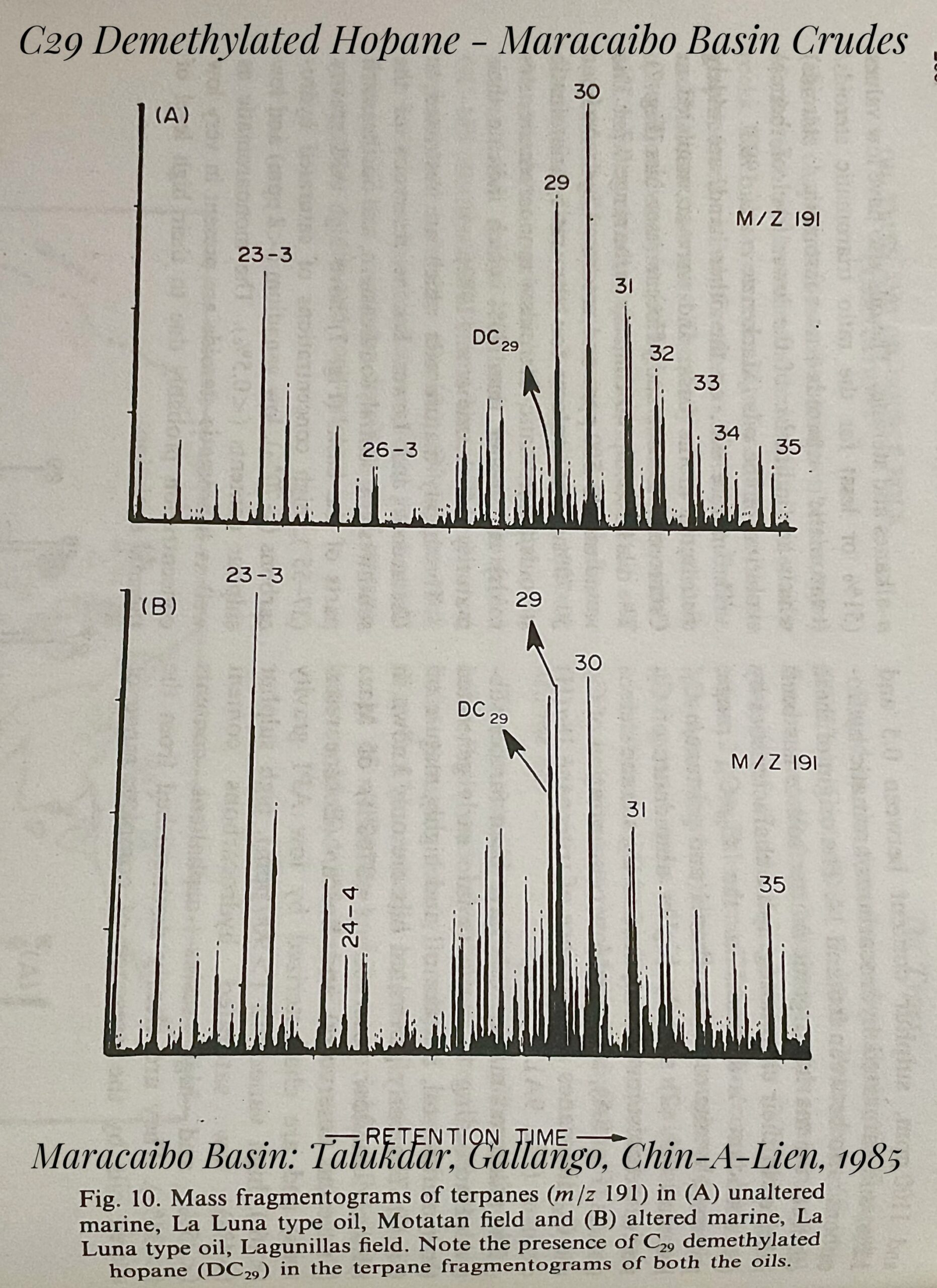
Identified in the oils of the Motatan and Lagunillas fields, as presented in Figure 10 of our work, these molecular markers provided insights into the basin’s earliest oil generation during the Eocene, offering valuable perspectives for both scientific understanding and petroleum exploration.
The Maracaibo Basin’s hydrocarbon wealth stems from the La Luna Formation, a Cretaceous deposit of organic-rich shale and limestone formed in an oxygen-poor ancient sea.
Responsible for nearly 90% of the basin’s oil and gas, this formation began generating hydrocarbons during the Eocene, some 50 million years ago, as tectonic forces buried it to depths where organic matter transformed into oil.
These early oils, however, faced a challenging fate. Basin uplift exposed reservoirs to surface conditions, allowing bacteria to alter the hydrocarbons, leaving de-methylated hopanes—specifically 25-norhopanes—as evidence of biodegradation.
Our 1986 study, conducted as part of a broader effort to map the basin’s petroleum system, used these biomarkers to trace the region’s complex geological history.
Our research also included the Motatan and Lagunillas fields, key areas around Lake Maracaibo.
Motatan, located in the basin’s western region, and Lagunillas, a cornerstone of the Bolívar Coastal Fields, along the eastern shore, produce light to medium crudes from Eocene reservoirs like the Misoa Formation and Miocene reservoirs like the Lagunillas Formation.
Using gas chromatography-mass spectrometry (GC-MS), we analyzed oil samples and observed de-methylated hopanes, as illustrated in Figure 10. The chromatograms revealed a dual signature: a “hump” of unresolved complex mixturesfrom biodegraded Eocene oils, marked by de-methylated hopanes, alongside peaks of n-paraffins and isoprenoids from fresher Miocene oils.
This evidence pointed to two phases of generation from the La Luna Formation: an Eocene phase of oil generation and biodegradation, followed by a Miocene phase where lighter oils from a southern, lutitic facies mixed with the earlier charge.
“These molecular fingerprints tell a story written in geological time.
Each hopane is a chapter in the basin’s ancient history.”
The identification of de-methylated hopanes in these fields was a meaningful step in understanding the Maracaibo Basin’s hydrocarbon dynamics. Scientifically, these biomarkers clarified the timing of oil generation, confirming with solid organic geochemical proof that the Eocene as the basin’s earliest major generative phase and highlighting the role of biodegradation during uplift.
The mixing with Miocene oils further revealed the complexity of migration pathways, enriching our understanding of the basin’s evolution.
For petroleum exploration and production, these findings had practical implications.
By tracing the generation and migration history, our study offered a framework for identifying potential reservoirs, optimizing drilling strategies, and predicting oil quality in fields like Motatan and Lagunillas.
These insights supported more efficient resource recovery, contributing to the sustainable development of Venezuela’s petroleum industry.
Prior to our study, Most certainly biodegradation was already recognized in the Maracaibo Basin, particularly in Lagunillas, where heavy oils in shallow reservoirs suggested bacterial alteration.
Earlier work in the 1960s and 1970s by companies like Creole Petroleum and Lagoven had established the La Luna Formation as the primary source and noted biodegradation through bulk properties or n-alkane depletion.
However, to our knowledge, no public studies before 1986 had identified de-methylated hopanes in Motatan or Lagunillas or linked them to the Eocene phase.
Global advances in biomarker analysis, such as those by Seifert and Moldowan in the late 1970s, had introduced de-methylated hopanes as biodegradation markers, but their application to these fields was first documented in our work.
While internal, non-published studies by Lagoven and other major companies may also have explored these biomarkers, our study aimed to share these findings with the broader scientific community, building on the collective efforts of prior researchers.
Our work was a humbling opportunity to contribute to the Maracaibo Basin’s rich exploration history, where over 15,000 wells have been drilled since 1914.
Supported by our own extensive data and advanced GC-MS technology, we were able to piece together a small part of the basin’s geological puzzle.
The chromatograms in Figure 10, showing de-methylated hopanes in Motatan and Lagunillas oils, were a key outcome, offering a clear view of the Eocene’s role in the basin’s hydrocarbon story.
These findings, while modest, aimed to support both scientific inquiry and the practical needs of Venezuela’s petroleum sector, aiding in the exploration and production of its resources.
“In the molecular realm, ancient stories persist—each de-methylated hopane a testament to Earth’s enduring memory.”
The Maracaibo Basin remains a remarkable record of Earth’s geological past, where molecules like de-methylated hopanespreserve stories of ancient seas and tectonic transformations.
Our 1986 study, though a small contribution to this vast field, sought to advance the collective understanding of geoscientists worldwide, offering insights that continue to inform exploration strategies.
For Motatan, Lagunillas, and the broader petroleum community, de-methylated hopanes serve as a quiet reminder of the basin’s enduring potential—a molecular legacy guiding us toward a deeper appreciation of our planet’s resources.
The Ghost in the Machine: Demethylated Hopanes and the Fingerprints of Decay
In the silent, subterranean world of oil reservoirs, a story unfolds over millennia, a narrative of life, death, and transformation.
The crude oil we extract is not merely a collection of molecules; it is a time capsule, a fossilized record of the microorganisms that lived and died millions of years ago, and of the processes that have altered it since.
While many of these molecular messengers, or biomarkers, are obliterated by heat and pressure, some of the hardiest survive, offering us a glimpse into the past.
Among the most resilient are hopanes, robust molecular skeletons derived from the cell walls of ancient bacteria. For decades, these triterpanes were considered the ultimate survivors, reliable sentinels of an oil’s origin, capable of withstanding the ravages of time and even the early stages of microbial attack.
But even the most steadfast markers can be broken.
When a reservoir becomes infused with oxygenated water and a new, ravenous community of microbes, a different kind of story begins.
These new inhabitants, arriving from the surface, don’t just consume the easy targets, the light, simple molecules.
Given enough time and the right conditions, they begin to gnaw at the very foundation of the oil itself.
It is here, in the final, severe stages of biodegradation, that the most compelling evidence of their presence is left behind.
The telltale sign isn’t the absence of a molecule, but the creation of a new one: a ghost of the original.
THE MOLECULAR TRANSFORMATION
Hopane→25-Norhopane
Microbial removal of methyl group at C-10 position
These are the demethylated hopanes, specifically the 25-norhopanes.
The “nor-” prefix, a whisper of what once was, signifies the removal of a single methyl group from the C-10 position of the hopane molecule.
This subtle chemical surgery is a microbial calling card, a definitive fingerprint of a deep and sustained attack.
The presence of 25-norhopanes is a powerful declaration that the oil has not just been aged, but actively degraded.
It marks a tipping point—the moment when the microbial assault became so severe that even the fortress-like hopane molecules began to crumble.
🔬
“In the meticulous world of geochemistry, finding these ghostly molecules isn’t just a curiosity; it is a critical piece of evidence, a chapter-ending marker in the long, slow story of a decaying oil reservoir.”
Reference
Talukdar, S., Gallango, O., & Chin-A-Lien, M. (1986). Generation and migration of hydrocarbons in the Maracaibo Basin, Venezuela: An integrated basin study. In Advances in Organic Geochemistry 1985(pp. 261–279). Pergamon Press.

About the Author — Marcel Chin-A-Lien
Global Petroleum and Energy Advisor
48 Years of Transformative Expertise | Exploration, Oil & Gas Giant Fields Finder – Business Development, M&A, PSC Design, Contract Strategy
Marcel Chin-A-Lien brings nearly five decades of unmatched global expertise at the highest levels of the energy sector—where technical mastery meets business acumen to unlock extraordinary value.
His career has delivered multi-billion-dollar giant field discoveries, spearheaded the iconic first capitalist upstream ventures in the USSR, shaped successful offshore bid rounds, and secured enduring cash flow streams from exploration and production activities across mature and frontier basins such as the Dutch North Sea.
A rare fusion of technical, commercial, and managerial insight, Marcel holds four postgraduate petroleum degrees spanning geology, engineering, international business, and management—uniquely positioning him to bridge the worlds of exploration strategy, M&A, PSC design, and contract negotiation.
Fluent in many languages and culturally attuned to diverse business environments, he has navigated complex geographies from Europe to Asia, Africa, and the Americas—driving innovation, de-risking investments, and aligning stakeholder interests from national oil companies to supermajors.
Whether advising on frontier basin entry, government negotiations, fiscal regime optimization, or asset valuation, Marcel’s critical insights integrate Exploration & Production with Business Development and Commercial Realism—generating sustainable growth in volatile energy markets.
Credentials and Distinctions
- Drs – Petroleum Geology
- Engineering Geologist – Petroleum Geology
- Executive MBA – International Business, Petroleum, M&A
- MSc – International Management, Petroleum
- Energy Negotiator – Association of International Energy Negotiators (AIEN)
- Certified Petroleum Geologist #5201 – AAPG (Gold Standard)
- Chartered European Geologist #92 – EFG (Gold Standard)
- Cambridge Award – “2000 Outstanding Scientists of the 20th Century”, UK
- Paris Awards – “Innovative New Business Projects”, GDF-Suez (2x Gold Awards, 2003)
Strategic Expertise
- Exploration Strategy & Giant Field Discovery
- Upstream M&A and Asset Valuation
- Production Sharing Contract (PSC) Design & Fiscal Optimization
- Government and IOC Negotiation Advisory
- Bid Round Structuring and Evaluation
- Integrated Technical-Commercial Due Diligence
For trusted advisory services at the nexus of technical excellence, commercial clarity, and geopolitical understanding, connect directly:
Public Profile: LinkedIn
Email: marcelchinalien@gmail.comRegards, Marcel Chin-A-Lien