A Multi-Phase ACT Charge, Migration, and Alteration Model for the Golden Lane Petroleum System
Marcel Chin-A-Lien | 08 February 2026
Abstract
The Golden Lane fairway offshore Suriname exhibits coexisting black oil, light oil/condensate, and gas outcomes, consistent with multiple time-separated charge pulses from stacked Albian–Cenomanian–Turonian (ACT) source rocks, followed locally by post-accumulation alteration (biodegradation and water washing) in cooler, shallower reservoirs.
This paper synthesizes publicly available well and fluid disclosures (Blocks 58 and 52) and anchors the biodegradation mechanism to documented Tambaredjo/Saramacca geochemistry.
Key idea (novel, yet most plausible): stacked source intervals enter the oil and gas windows at different times, so charge is naturally pulsed; migration pathways evolve from early hydrostatic lateral carrier-bed flow to later overpressured vertical access.
1. From Fairway Concept to Dynamic Petroleum System
Large petroleum provinces rarely result from a single geological moment. Instead, they evolve through repeated interaction between source, maturation, migration pathways, pressure regimes, and time.
The Golden Lane—an elongate deep-water fairway extending from offshore Guyana into Surinamese waters—was originally conceptualized as a continuous regional charge corridor rather than a collection of isolated traps.
In this context, it is worth noting—quietly and with humility—that Marcel Chin-A-Lien first introduced the Golden Lane fairway concept in 2010, several years before the first giant discoveries in the Guyana–Suriname Basin.
In the same early systems-thinking framework, he also anticipated that charge in such a long-lived passive margin would likely be multi-phased rather than singular.
2. Why a Multi-Phase ACT Model Is Both Novel and Most Plausible
The novelty of this work does not lie in recognizing multiple source rocks, but in explicitly linking stacked ACT source intervals to discrete, time-separated expulsion pulses, each interacting with a different migration and pressure regime.
- The ACT interval is best treated as a source-rock bundle deposited across multiple anoxic episodes.
- Different sub-kitchens enter the oil window and later the gas window at different times as burial and thermal stress evolve.
- Migration pathways evolve from early hydrostatic lateral carrier-bed systems to late overpressured vertical fault-controlled access.
- Faults can behave episodically (fault-valve behavior), and seal-bypass systems can re-access traps late.
3. Pulse I — Eocene Oil Charge and Long-Distance Migration (~50 Ma)
The first major expulsion pulse occurs when significant parts of the ACT system enter the oil window in the Eocene (~50 Ma). This pulse represents the earliest basin-wide oil sweep.
Onshore anchor: Tambaredjo–Calcutta (~150 km migration)
This pulse most plausibly sourced the oils that migrated ~150 km southward to the Tambaredjo–Calcutta fields, charging Paleocene T-sands.
A coherent scenario includes expulsion from mature ACT kitchens along the distal shelf/deep-water margin, followed by hydrostatic lateral migration landward/updip through connected shelf sand fairways (fluvial–deltaic belts, lowstand pathways, and canyon-fed turbidite fairways), with local vertical transfer via fault corridors.
4. Pulse II — Miocene Oil Re-Charge (~18 Ma)
A second oil-only pulse is associated with ACT sub-kitchens entering the oil window later, around ~18 Ma.
This pulse plausibly refreshes earlier accumulations, produces fluid mixing without trap breach, and contributes to along-fairway compositional variability.
5. Pulse III — Late Gas-Window Escalation (~1 Ma)
Continued burial drives parts of the ACT system into the gas window in the late Neogene to Quaternary (~1 Ma).
Under overpressured conditions, migration becomes episodic and vertically focused via fault-valve behavior and seal-bypass systems, explaining gas caps, elevated GOR, condensate, and the coexistence of oil, condensate, and gas within the same fairway.
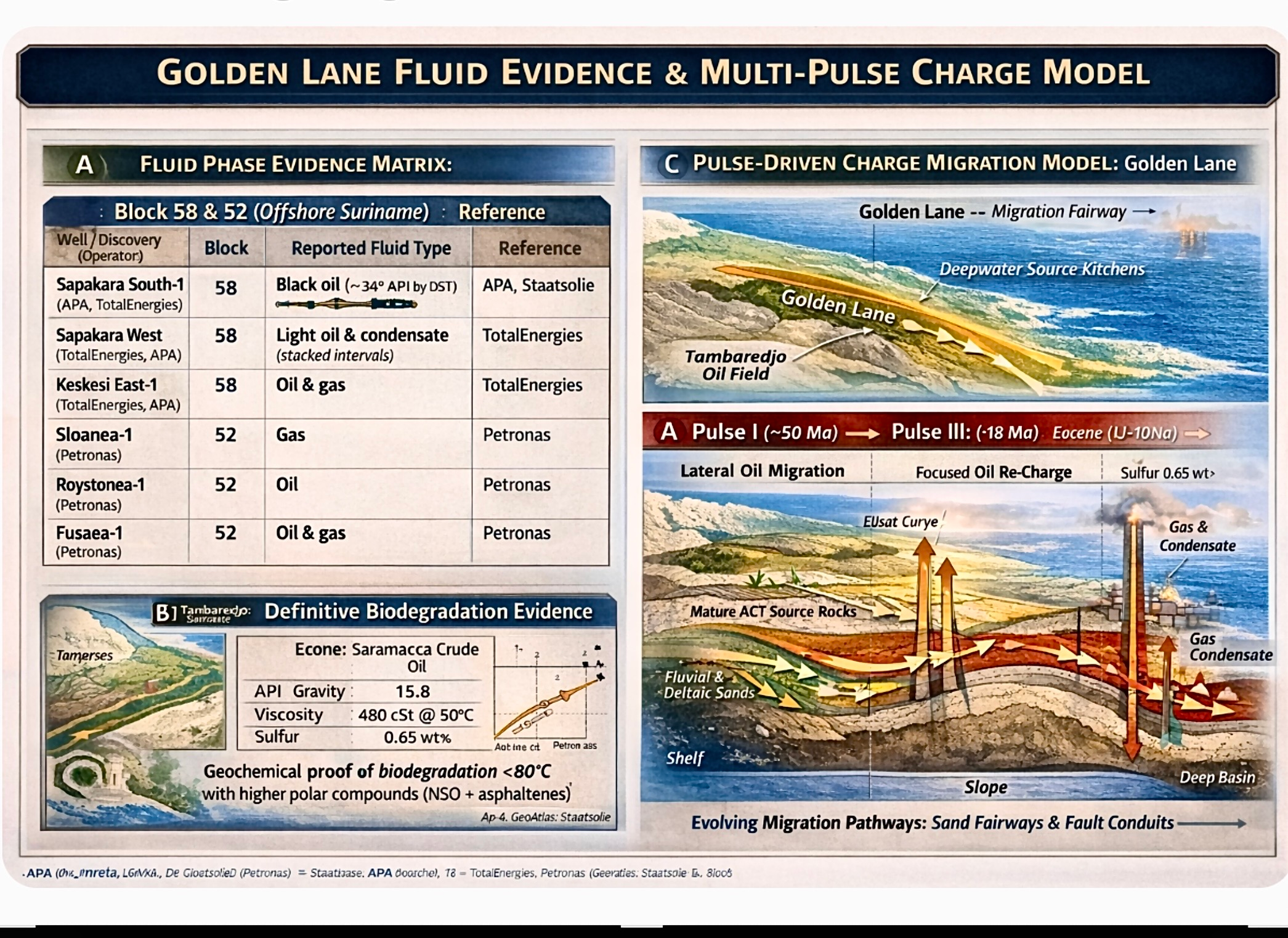
6. Evidence Plate — Fluid Phase Mosaic + Biodegradation Anchor + Pulse Model
What this establishes (defensible, public-domain)
- Suriname Block 58 shows tested black oil (~34° API) as well as light oil + condensate in stacked reservoirs—within one fairway.
- Suriname Block 52 spans oil, oil & gas, and commercial gas outcomes—within one license trend.
- Tambaredjo/Saramacca provides a robust anchor for post-charge alteration: heavy, viscous oils and geochemical indicators consistent with biodegradation and water washing in cooler reservoirs.
The combined pattern—black oil, light oil/condensate, and gas outcomes in close regional association—fits the expected expression of a multi-phase charge history: early oil sweep (Pulse I), later oil re-charge (Pulse II), and late gas/condensate overprint (Pulse III), modulated by evolving migration architecture (sand fairways plus episodic vertical access).
Scientific caution: interval-level DST and full PVT compositions across all fields remain largely proprietary.
The public record therefore supports a high-confidence consistency case for multi-phase charge, while the strongest forensic proof would come from well-by-well compositional gradients and biomarker/isotope mixing diagnostics.
7. Biodegradation Beyond Tambaredjo — Kanuku / Tullow Oils as a Plausible Analogue
Public information from the Kanuku and adjacent areas indicates contrasting oil types, including reported ~27° API oil at Carapa-1 and much heavier, high-sulfur oils reported in nearby settings.
A coherent petroleum-systems interpretation is that initially lighter oils were generated at depth, migrated updip to shallower and cooler “higher terrace” reservoirs, and were subsequently altered by biodegradation and water washing—analogous in process (though not necessarily identical in detail) to Tambaredjo.
This should be treated as a plausible, well-grounded mechanism unless and until biodegradation indices (biomarkers, n-alkane depletion patterns, etc.) are published for those oils.
8. Exploration and Production Implications (Blocks 58 & 52)
Exploration
- Phase risk is structured, not random. Trap coupling to persistent vertical access increases probability of volatile oil/condensate or gas (late pulse dominance).
- Pulse dominance lens for ranking: Pulse I-dominant compartments favor stable oil; Pulse III influence elevates GOR/condensate/gas risk.
- Shallower terrace plays: include biodegradation risk assessment early; heavy oil does not necessarily imply poor source—it may reflect post-charge alteration.
Development
- Expect GOR variability by compartment and reservoir package; design appraisal to map compositional gradients.
- Prioritize early acquisition of PVT/EOS inputs per reservoir, not just per field.
- Integrate charge history into reservoir models: compartmentalization plus episodic re-access can explain “unexpectedly gassy” behavior without invoking breach.
9. Conclusions
The Golden Lane is not the product of a single expulsion event.
It is the result of multi-phase ACT generation, migration, re-charge, and local alteration.
This model is novel in formulation, yet firmly grounded in geology, petroleum systems theory, and organic geochemistry.
It reconciles long-distance onshore oil migration, offshore oil–condensate–gas coexistence, and heavy biodegraded oils on stratigraphic/structural highs.
The Golden Lane is not simply charged. It is—and has been—recharged, modified, and selectively preserved.
References (selected, public-domain and foundational works)
- APA Corporation (2024): Sapakara South-1 flow test results (black oil; ~34° API). Investor materials.
- APA Corporation (2024): Press release — successful flow test at Sapakara South-1.
- TotalEnergies (2020): Press release — Sapakara West discovery (light oil and gas condensate; stacked reservoirs).
- TotalEnergies (2021): Press release — new discovery (Keskesi East-1; oil and gas).
- PETRONAS (2023): Press release — Roystonea-1 oil discovery (Block 52).
- PETRONAS (2024): Press release — Fusaea-1 oil and gas discovery (Block 52).
- Reuters (2025): Sloanea gas discovery declared commercial (Block 52).
- Tullow Oil (2019): Press release — Carapa-1 well result (~27° API; <1% sulfur).
- ECO Atlantic / CPR (2020): Orinduik context (reported low API, high sulfur oils) — Competent Person’s Report.
- ExxonMobil (2024–2025): Official crude assay PDFs — Liza, Unity Gold, Payara Gold (API gravity and sulfur).
- Magoon, L.B. & Dow, W.G. (eds.) (1994): The Petroleum System—From Source to Trap. AAPG Memoir 60.
- England, W.A., Mackenzie, A.S., Mann, D.M., & Quigley, T.M. (1987): The movement and entrapment of petroleum fluids in the subsurface. Journal of the Geological Society.
- Sibson, R.H. (1990; 1992): Fault-valve behaviour and episodic fluid flow. Geological Society / Tectonophysics.
- Cartwright, J., et al. (2007): Seal bypass systems. AAPG Bulletin.
- Staatsolie: GeoAtlas of Suriname — Tambaredjo/Saramacca crude properties and biodegradation interpretation (API, viscosity, NSO/asphaltenes; biodegradation <80°C).
About the Author — Marcel Chin-A-Lien
Global Petroleum & Energy Advisor
Marcel Chin-A-Lien brings nearly five decades of global experience at the intersection of exploration, petroleum systems analysis, and high-stakes upstream strategy—where technical mastery is consistently translated into commercial clarity and durable value creation. His work spans frontier and mature basins worldwide, including major discovery programs, bid rounds, and long-life production portfolios.
An exceptional fusion of technical, commercial, and managerial insight, he holds four postgraduate petroleum degrees spanning petroleum geology, engineering geology, international business (Executive MBA; petroleum & M&A), and international management (MSc).
He advises governments, NOCs, and IOCs on basin entry, PSC design and fiscal optimization, M&A and asset valuation, and negotiation/contract strategy—often in complex geopolitical settings.
He is a Certified Petroleum Geologist (AAPG CPG #5201) and a Chartered European Geologist (EFG EurGeol #92), and is fluent in multiple languages.
Distinctions include the Cambridge recognition “Outstanding Scientists of the 20th Century” and two Paris Gold Awards for innovative new business projects (GDF-Suez, 2003).
Strategic Expertise
- Exploration strategy & giant field discovery
- Upstream M&A and asset valuation
- PSC design, fiscal optimization, and bid-round structuring
- Government and IOC negotiation advisory
- Integrated technical-commercial due diligence
Contact: marcelchinalien@gmail.com
Public profile: LinkedIn