Dushi Korsou • Language • Memory • Mobility
Written by: Marcel Chin-A-Lien – Petroleum & Energy Advisor – Golden Lane Investments Advisory Group – 28 February 2026
Where My Navel String Lies
Curaçao, multilingual joy, and the making of a global mind.
With a linguistic deep-dive into familiar Papiamentu words
There is a particular light in Curaçao.
Not only the sunlight that shimmers off the Caribbean Sea, but a second kind of brightness: the way languages meet each other in the air.
Papiamentu with its warmth and rhythm, Dutch with its official weight, Sranan Tongo with its home-intimacy, and the steady presence of Spanish and English, learned early and used often.
I was so privileged to be born and raised on Curaçao.
” Born free, as free as the wind blows, as free as the grass grows, born free to follow my heart…”
A small paradise in the emerald blue and green Caribbean sea, an island with a large linguistic horizon.
Here, daily speech is not a single river but an estuary:
streams converge, separate, and converge again.
We do not “switch” languages as a party trick; we live inside them, choosing the right tone, the right register, the right cultural key for each moment.
At home, my mother also often spoke to us in Sranan Tongo, interwoven with Dutch, the official language.
Papiamentu was the heartbeat: the language of jokes, tenderness, nuance, and belonging.
At Mgr. Niewindt College (Mundu Nobo), Spanish and English arrived early (with teachers like Mr. Vos), and later at HBS-B the curriculum insisted, rightly, on disciplined multilingual training:
English,
French, and
Spanish as compulsory subjects.
By the time I finished HBS-B, I spoke five languages fluently.
At that age, it felt normal, as ordinary as trade winds.
Only later did I understand how rare and powerful that foundation is, especially in environments where society is tempted toward exclusion rather than inclusion.
A Socratic question: Why should one language be the “default,” and the others be treated as extras, when human history is largely the story of contact, exchange, and translation?
1) The Life Advantage of Growing Up Multilingual
The benefits of early multilingualism are not mystical.
They are practical, and increasingly studied.
Research in cognitive science and psycholinguistics suggests that bilingualism and multilingualism can be associated with strengthened executive control (attention management, task switching, inhibition), and in later life, a form of cognitive reserve.
The literature is nuanced and sometimes contested in effect size, but the broad conclusion is clear: sustained multilingual practice trains the mind in flexibility, selective attention, and context-sensitive meaning.
Academic note (discipline over hype):
Not every study finds the same “bilingual advantage,” and results depend on factors such as proficiency, usage intensity, education, and socioeconomic context.
The most defensible claim is not that multilingualism makes someone “smarter,” but that it often strengthens cognitive flexibility and context management, skills that translate into learning, leadership, and adaptability.
Career, study, and life: why it matters
- Adaptive integration: learning to read context quickly, what is meant, not just what is said.
- Negotiation sensitivity: tone, face-saving, timing, and subtext become legible sooner.
- Rapid learning: a lived confidence that new languages and cultures are patterns, not walls.
- Global mobility: the ability to belong in more than one place without losing yourself.
Add to that the travels with my parents as a child, Europe and beyond, and you get something like a “quiet curriculum”: cultural range, curiosity, and an instinctive capacity to integrate.
Those early experiences formed an inner map I later relied on as a global nomad and expatriate, especially in the complex, high-stakes world of petroleum exploration.
2) Translanguaging: Curaçao’s Everyday Genius
Contemporary sociolinguistics describes translanguaging as the dynamic use of one’s entire linguistic repertoire, rather than treating languages as separate sealed compartments.
On Curaçao, translanguaging is not an abstract concept; it is ordinary life.
A sentence may carry Papiamentu rhythm, Dutch precision, Spanish warmth, and English efficiency, each chosen for meaning, relationship, and effect.
This is not “broken language.”
It is high competence: the ability to calibrate your voice to the moment.
In a world that increasingly demands cross-cultural literacy, in business, science, diplomacy, and daily life, Curaçao’s multilingual ecology is a competitive advantage disguised as normality.
Another Socratic prompt: If multilingualism is so useful, why do some societies treat it as a problem to be managed rather than a capacity to cultivate?
3) Words I Grew Up With — and Only Later Began to Understand
As a child, I used Papiamentu words that felt as natural as sea air.
Yet I did not know their deeper histories.
Later, studying at the university, as an adult, I came to see that everyday words can be like fossils: small objects carrying the sediment of centuries.
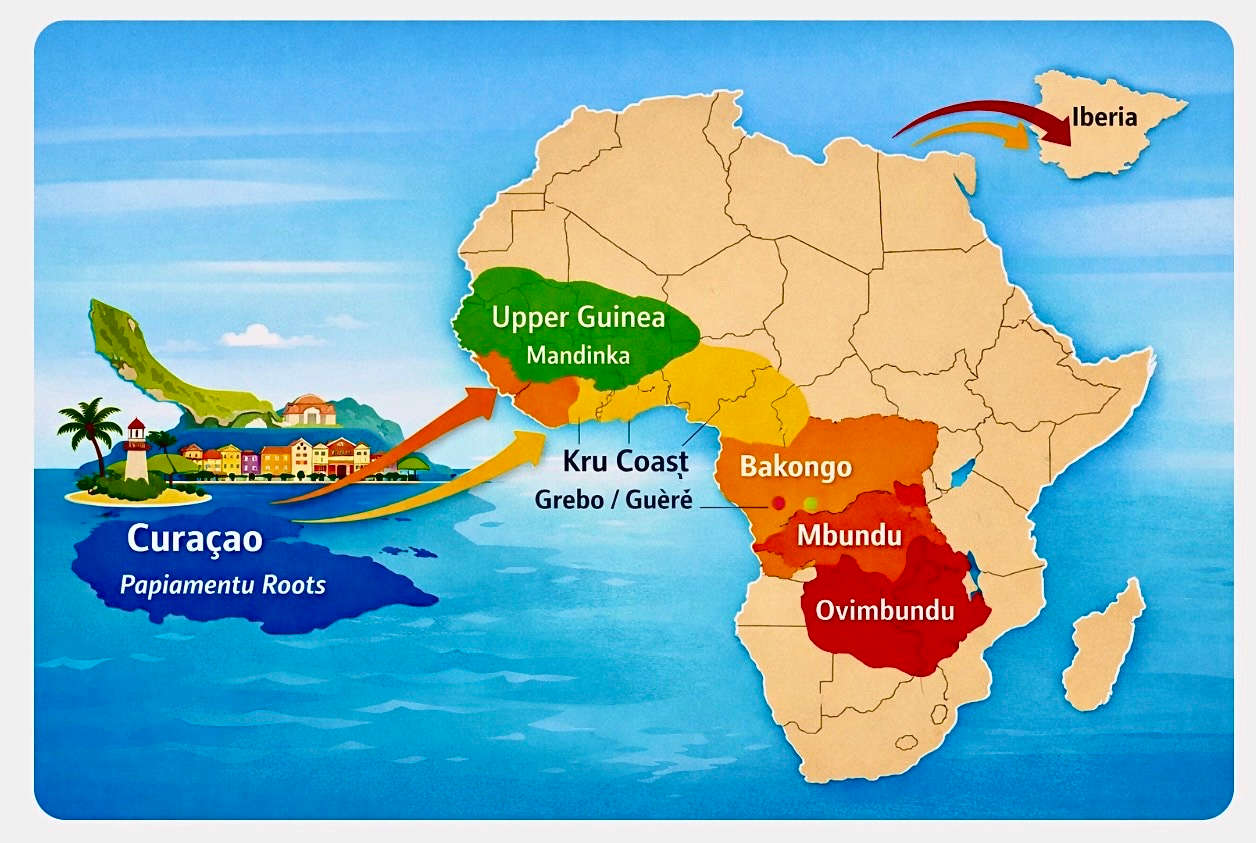
Papiamentu, in particular, is a language of Atlantic contact, shaped by Iberian lexifier layers, African substrate contributions, and later Dutch administrative and educational influence, among others.
Below is a carefully framed linguistic mini-study: words that many Curaçaoans like myself know and use intimately, presented with defensible etymological hypotheses, and with clear markings where evidence is strong versus where the scholarly record remains debated.
3.1 A compact method
- Semantic match: does the candidate source word share meaning and usage?
- Phonological plausibility: do sound changes fit known contact patterns (e.g., prenasal reduction)?
- Domain retention: food, plants, music, and ritual often preserve substrate vocabulary longer.
- Negative control: is an Iberian (or Dutch) etymology clearly stronger? If yes, reduce confidence.
- Documented support: do trusted references explicitly connect the forms?
3.2 Selected words (with evidence tiers)
Funchi
FoodHigh-retention domain
A staple maize dish — comforting, everyday, foundational. In wider Caribbean usage, closely related forms (funji / fungee) are often linked to Kimbundu funji (Angola), with plausible phonological adaptation in creole transmission. Evidence is strong at the Caribbean level; Curaçao-specific pathways may include intermediate routes through regional contact.
Likely source zone: West-Central Africa (Angola). Language group: Kimbundu (Mbundu). Confidence: Medium–High (domain + cross-Caribbean etymology support).
Zumbi
Belief / SpiritualityPrenasal reduction
Used for “spirit/ghost” in various Atlantic contexts. A widely cited route relates “zombi/zumbi” to West-Central African Bantu forms (often discussed with prenasal clusters such as nz-). The phonological pattern — dropping initial nasalization (nz- → z-) — is consistent with contact-language simplification.
Likely source zone: West-Central Africa (Congo/Angola region). Language group: often associated with Bantu (e.g., Kongo/Angola lineages). Confidence: High (strong cross-Atlantic documentation; phonology plausible).
Wandu
Plant / FoodEthnobotany
Referring to pigeon pea, a culturally meaningful food plant. Ethnobotanical scholarship on Curaçao plant names has documented African-origin cases and identifies wandu among the relevant examples, aligning Curaçao naming with Central-African linguistic corridors.
Likely source zone: Central Africa. Language group: Kikongo-related (Bakongo). Confidence: High (Curaçao-focused ethnobotanical documentation).
Bosua
PlantWest Africa
A plant name discussed in Curaçao ethnobotanical research with explicit correspondences to West African language forms (including Kru-language lineages such as Guéré/Grebo). This is valuable because ethnobotanical etymology can triangulate form, meaning, and taxonomic reference.
Likely source zone: West Africa (Liberia / Côte d’Ivoire region). Language group: Kru languages (e.g., Guéré/Grebo). Confidence: High (Curaçao-focused ethnobotanical documentation).
Yerba fini
PlantUpper Guinea
A grass-name example where Curaçao ethnobotanical work connects elements of naming to Upper Guinea linguistic corridors (Mande language family). Its value is analytical: it shows the African substrate is not monolithic; multiple regions appear in the lexical sediment.
Likely source zone: Upper Guinea Coast. Language group: Mande (e.g., Mandinka/Manding). Confidence: Medium–High (documented in Curaçao ethnobotanical work).
Makamba
Social labelingHistory encoded
A familiar term used for Europeans (often specifically Dutch). The word is widely treated as African-origin in Curaçao cultural discourse, and it appears within documented plant-name combinations in ethnobotanical work, which strengthens its status as a meaningful lexical unit (even when the precise “single-source” mapping can vary across authors). Here, the Socratic stance is essential: the cultural stability of the word is strong; the exact etymon requires careful comparative evidence.
Likely source zone: West-Central Africa (Congo/Angola corridor). Language group: proposed Kikongo/Kimbundu alignments. Confidence: Medium (strong cultural anchoring; etymological mapping varies).
Tambú
Music / DanceCultural continuity
The tambú tradition is an archive of rhythm, memory, and survival. Linguistically, the term sits in a debated space: some routes point toward African drum traditions; others note proximity to Iberian drum lexicon (e.g., tambor). A rigorous approach distinguishes two truths: (1) the cultural form strongly aligns with West African performance logics; (2) the lexical etymology may be layered rather than single-source.
Likely source zone: Atlantic contact complex (Africa + Iberia). Confidence: Medium (high cultural Africanness; etymology can be multi-layered).
Wiri
MusicInstrument lexicon
A rhythm-keeping rasp instrument in Curaçao musical practice. Instrument vocabularies often preserve older layers of cultural contact because objects and names travel together. Early lexicographic sources record wiri as a musical instrument, supporting its cultural embeddedness.
Likely source zone: Afro-Caribbean instrumentarium. Confidence: Medium (strong as culture-term; precise African language mapping requires deeper comparative cataloguing).
Why plant names matter: In the study of contact languages, plant and food vocabulary often offers unusually strong evidence because (a) the referent is concrete and stable, and (b) ethnobotanical research can compare naming across regions with taxonomic anchors. Curaçao plant-name scholarship explicitly identifies African-origin items and classifies pathways (retentions vs innovations).
4) From “Island Normal” to Global Mobility
In my professional life, often as an expatriate, I discovered that Curaçao had already trained me for the world.
Petroleum exploration is a discipline of uncertainty: incomplete data, competing models, shifting economics, human stakes.
Multilingualism teaches a similar stance: to hold more than one system in the mind, to switch frames without panic, to interpret meaning in context, and to move through difference with respect.
In a world where some societies harden around exclusion, I carry a different starting point: on Curaçao, difference is ordinary, and integration is not a slogan, it is daily practice.
Final Socratic reflection: If language is a bridge, why build fewer bridges when the world demands more?
And still, beyond analysis, there is gratitude.
For the sea.
For the heat.
For the cadence of Papiamentu.
For that deep sense of place that does not limit you, it steadies you.
Na Korsou… kaminda mi lombrishi ta derá.
Where my navel string lies.
References (Selected)
- Bialystok, E., Craik, F. I. M., & Luk, G. (2012). Bilingualism: Consequences for mind and brain. Trends in Cognitive Sciences. Link
- Lehtonen, M., et al. (2018). Is bilingualism associated with enhanced executive functioning in adults? A meta-analytic review. Psychological Bulletin. Link
- Alcántara Rodríguez, M. (2016). African Origin of Papiamentu Plant Names (Utrecht University; Curaçao ethnobotanical etymologies). Link
- Jacobs, B. (2012). Origins of a Creole: Papiamentu and Its African Ties. Mouton de Gruyter. Link
- Jansen, J. D. (1945). Diccionario Papiamentu–Holandes. (Early lexicographic witness for Curaçao usage). Link
- On Papiamentu (overview; historical & sociolinguistic context): Wikipedia entry (useful as a starting map; consult primary works for formal argumentation).
About the Author — Marcel Chin-A-Lien
Global Petroleum and Energy Advisor
48 Years of Transformative Expertise | Exploration, Oil & Gas Giant Fields Finder – Business Development, M&A, PSC Design, Contract Strategy
Marcel Chin-A-Lien brings nearly five decades of unmatched global expertise at the highest levels of the energy sector—where technical mastery meets business acumen to unlock extraordinary value.
His career has delivered multi-billion-dollar giant field discoveries, spearheaded the iconic first capitalist upstream ventures in the USSR, shaped successful offshore bid rounds, and secured enduring cash flow streams from exploration and production activities across mature and frontier basins such as the Dutch North Sea.
An exceptional multi-academic fusion of technical, commercial, and managerial insight, Marcel holds four postgraduate petroleum degrees spanning geology, engineering, international business, and management, uniquely positioning him to bridge the worlds of exploration strategy, M&A, PSC design, and contract negotiation.
Fluent in seven languages and culturally attuned to diverse business environments, he has navigated complex geographies from Europe to Asia, Africa, and the Americas—driving innovation, de-risking investments, and aligning stakeholder interests from national oil companies to supermajors.
Whether advising on frontier basin entry, government negotiations, fiscal regime optimization, or asset valuation, Marcel’s critical insights integrate Exploration & Production with Business Development and Commercial Realism—generating sustainable growth in volatile energy markets.
Credentials and Distinctions
- Drs – Petroleum Geology
- Engineering Geologist – Petroleum Geology
- Executive MBA – International Business, Petroleum, M&A
- MSc – International Management, Petroleum
- Energy Negotiator – Association of International Energy Negotiators (AIEN)
- Certified Petroleum Geologist #5201 – AAPG (Gold Standard)
- Chartered European Geologist #92 – EFG (Gold Standard)
- Cambridge Award – “2000 Outstanding Scientists of the 20th Century”, UK
- Paris Awards – “Innovative New Business Projects”, GDF-Suez (2x Gold Awards, 2003)
Strategic Expertise
- Exploration Strategy & Giant Field Discovery
- Upstream M&A and Asset Valuation
- Production Sharing Contract (PSC) Design & Fiscal Optimization
- Government and IOC Negotiation Advisory
- Bid Round Structuring and Evaluation
- Integrated Technical-Commercial Due Diligence
For trusted advisory services at the nexus of technical excellence, commercial clarity, and geopolitical understanding, connect directly:
Public Profile: LinkedIn
Email: marcelchinalien@gmail.com
Regards,
Marcel Chin-A-Lien