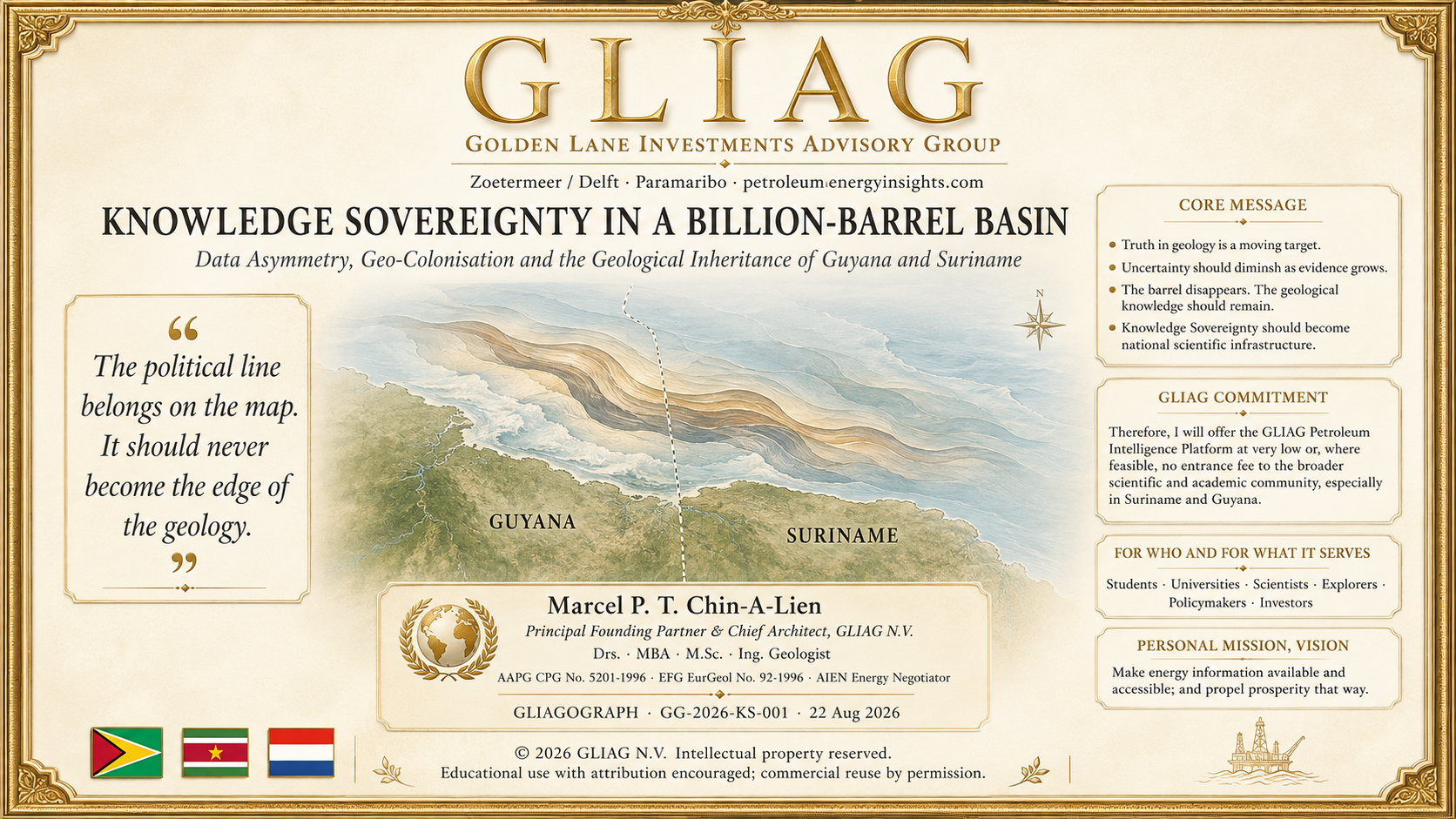
GLIAG · KNOWLEDGE SOVEREIGNTY IN A BILLION-BARREL BASINGLIAG-GSB-2026-0822-001
GLIAG
GOLDEN LANE INVESTMENTS ADVISORY GROUP N.V.
Zoetermeer / Delft · Paramaribo · petroleumenergyinsights.com
GLIAG SCIENTIFIC & POLICY ESSAY · GLIAG-GSB-2026-0822-001 · 22 AUGUST 2026
Knowledge Sovereignty in a Billion-Barrel Basin
IMAGE 2026, data asymmetry, geo-colonisation and the geological inheritance of Guyana and Suriname
Drs. M.P.T. Chin-A-Lien, MBA, M.Sc., Ing. Geologist
Principal Founding Partner, Managing Partner & Chief Architect, Golden Lane Investments Advisory Group N.V.
Certified Professional Geologist Nr. 5201-1996 (AAPG) · Chartered European Geologist Nr. 92-1996 (EFG) · Energy Negotiator, June 2021 (AIEN)
The political line belongs on the map.
It should never become the edge of the geology.
A basin can be measured in two ways. One measure is what it yields: barrels, cubic feet, dollars of investment recovered, years of production ahead. The other is what it teaches, and how much of that teaching survives in a form that anyone outside the operating consortium can read. By the first measure the Guyana–Suriname Basin is now among the most consequential petroleum provinces of the twenty-first century. By the second, it is close to invisible.
Guyana produces more than 900,000 barrels of oil per day from Stabroek, a block estimated to contain at least 11 billion barrels of oil equivalent, and the ExxonMobil-led consortium has now recovered roughly US$55 billion of the capital invested since 2014. Offshore Suriname is moving toward first deepwater oil from the US$10.5 billion GranMorgu project in 2028; PETRONAS reports eight discoveries in Block 52 representing more than one billion barrels of oil equivalent; TotalEnergies intends to return to Block 58 with a four-well exploration campaign. Every one of those facts describes a province in the middle of an intense learning cycle. Wells are being drilled, fluids sampled, pressures logged, models revised, dry holes explained. The subsurface is being read at industrial scale.
Very little of that reading reaches the open scientific record. This essay offers a small, deliberately narrow measurement of the gap, and then argues that the gap is not an inconvenience for academics. It is a question of sovereignty — a third kind, alongside the two that Guyana and Suriname have already learned to defend.
I. A basin that has outgrown its bibliography
IMAGE 2026 in Houston — the joint SEG, AAPG and SEPM flagship meeting — reported more than 1,100 technical presentations across 165 oral and 115 poster sessions, with over 7,800 attendees from 83 countries. It is the closest thing the applied geosciences have to a global annual census of what is being learned about the Earth’s sedimentary basins and by whom.
The conference recognised the Guyana–Suriname Basin as a distinct technical theme; it scheduled a dedicated special session under the name of both countries. But when one counts only those presentations in which Guyana, Suriname or the Guyana–Suriname/Guiana Basin was the principal study area, the total is approximately ten. Against a denominator of more than 1,100, that is below approximately 0.91% of the programme.
A province that has absorbed tens of billions of dollars of exploration and development capital, and that is currently rewriting the atlas of Atlantic-margin deepwater plays, accounted for roughly one presentation in a hundred at the discipline’s largest annual gathering. That is the disproportion this essay is about.
II. The audit: what Houston actually heard
A count of this kind is only useful if its rules are stated in advance and can be repeated by someone else. Mine are as follows. The source is the official IMAGE 2026 technical programme. A paper is counted only where Guyana, Suriname, or the Guyana–Suriname/Guiana Basin is the principal study area. South Atlantic and conjugate-margin papers that invoke the basin merely as an analogue are excluded. The denominator is the conference’s own published figure of more than 1,100 presentations, which makes 0.91% an upper bound rather than a falsely precise number. The audit counts institutional lead authorship, not the nationality of individuals — a distinction I return to below, because it carries most of the argument.
| Lead institution | No. in defined GSB set | Share of GSB set | Representative subject matter |
| Staatsolie (Suriname) | 5 | 50% | Open-Door keynote; Aptian petroleum system; Aptian–Albian carbonates; Demerara Plateau heat flow; nearshore–onshore system |
| ExxonMobil | 2 | 20% | Guyana deepwater reservoir heterogeneity; non-DHI prospect characterisation |
| TotalEnergies | 1 | 10% | Block 58 / GSB ocean-bottom-node field-development imaging |
| SLB (with PETRONAS) | 1 | 10% | Deepwater Suriname thin-bed reservoir full-waveform inversion |
| S&P Global | 1 | 10% | Guyana–Suriname super-basin synthesis |
| Total, defined GSB set | ≈10 | 100% | Out of more than 1,100 presentations: below approximately 0.91% of the IMAGE 2026 programme |
Of those ten, only three were led by major international operators — two by ExxonMobil, one by TotalEnergies. A fourth involved PETRONAS as a co-author institution but was led by SLB. Staatsolie, the national oil company of a country that has not yet produced a single deepwater barrel, led half of the entire identified set.
III. What the operators brought — and what they did not
This finding requires careful wording, because the careless version of it is false. It would be wrong to say the majors contributed nothing. ExxonMobil presented two Guyana case studies. TotalEnergies presented a Suriname–Guyana Basin ocean-bottom-node study. PETRONAS participated in the SLB-led deepwater Suriname full-waveform inversion paper. These are real technical contributions, made by competent people, and they advance the discipline.
The issue is scale, measured against the information base those companies hold. ExxonMobil and its partners have drilled and developed Stabroek through multiple producing projects and several hundred subsurface decisions. TotalEnergies is constructing a US$10.5 billion development from Block 58 discoveries. PETRONAS has made eight discoveries in Block 52. The entire major-operator-led contribution identified in this audit is three papers out of more than 1,100 — below approximately 0.27% of the conference. Adding the SLB/PETRONAS paper brings direct major-operator participation to four.
Nor do those papers constitute a public synthesis of the basin. They address important but bounded problems: reservoir heterogeneity, quantitative characterisation of prospects without direct hydrocarbon indicators, the value of ocean-bottom nodes, high-resolution imaging of thin beds. What remains scarce in the public domain is the integrated, operator-level anatomy of the petroleum system — source families and their biomarker signatures, oil-to-source correlation, pressure architecture, charge timing, migration geometry, fluid families, reservoir connectivity, and what years of actual production have confirmed or refuted about the pre-drill models.
That synthesis exists. It exists in Houston, in Kuala Lumpur, in Paris, in La Défense server rooms and in the working memory of teams that will eventually be reassigned to other basins. It does not exist in a form that a lecturer at the University of Guyana can put in front of a class, or that an independent Surinamese geologist can challenge on the evidence.
IV. Suriname: small in absolute terms, large in proportion
Suriname’s showing at IMAGE is simultaneously modest and impressive, and both readings are true at once. In absolute terms, five Staatsolie-led papers within a programme of more than 1,100 presentations is roughly 0.45% — a small global footprint by any measure. Counting the TotalEnergies and SLB/PETRONAS studies, approximately seven of the ten clearly basin-specific contributions were Suriname-focused or Suriname-led.
Measured against the size of the sector behind it, however, Staatsolie’s performance is striking. The company led half of the defined set, and it did so on basin-level scientific questions rather than corporate showcases: the Aptian petroleum system, Aptian–Albian carbonate reservoir potential, heat flow across the Demerara Plateau, the nearshore–onshore petroleum system, and exploration access through the Open-Door Offering. These are the questions a national institution asks when it intends to understand its own subsurface rather than merely license it.
This does not mean Suriname has solved the problem. A great deal of high-value subsurface information remains commercially licensed, and the public GeoAtlas is by necessity a synthesis rather than a release of the underlying proprietary data. But the direction of travel matters more than the current position. A national company is converting part of its internal geological learning into public scientific memory. That is precisely the behaviour that Knowledge Sovereignty requires, and it deserves to be named as such.
V. Guyana: papers about the country, none led from within it
The Guyana result is the more troubling one, and for that reason it must be stated with the greatest precision. IMAGE 2026 did contain Guyana papers; ExxonMobil led two of them within the defined set. Any claim that “nothing came from Guyana” is simply wrong if it is taken to mean that no Guyana-related technical content was presented.
What the audit shows is narrower and harder. Among the approximately ten clearly basin-focused contributions, I identify no lead institutional affiliation from the University of Guyana, the Guyana Geology and Mines Commission, or any other clearly identifiable scientific or governmental geoscience institution based on the Guyana mainland. The institutional count is zero out of approximately ten.
This is not a statement about the nationality of individual authors. Nationality cannot responsibly be inferred from surnames or corporate affiliations, and I make no attempt to do so. It is a statement about institutional scientific visibility — about whether the country hosting one of the world’s fastest-growing petroleum industries appeared before the international geoscience community as an author of its own basin science, or only as its subject.
For sovereignty, that distinction matters far more than rhetoric about local content. A mature national petroleum system requires more than nationals employed inside operating companies, valuable as that is. It requires visible, independent national institutions with the standing to access data, publish interpretations, contradict the operator’s model in public, and train the geologists who will still be working the basin in 2060.
VI. The millimetre-perfect line
The fragmentation is visible in something as ordinary as a map. Public maps of Guyana routinely stop, millimetre-perfect, at the Suriname political line. Suriname’s maps perform the mirror image. Administratively this is understandable. Geologically it is an absurdity.
The source rock does not stop at the maritime boundary. The deepwater fan does not recognise diplomatic coordinates. A thermal maturity contour cannot read a production-sharing contract. Migration pathways do not change direction because one fiscal regime becomes another. Licence boundaries are human constructs imposed upon a single continuous system that was assembled over roughly one hundred million years by processes indifferent to treaties.
The political line belongs on the map.
It should never become the edge of the geology.
A serious basin map shows the border clearly — for sovereignty, licensing, fiscal and regulatory purposes — and then allows every geological layer to continue through it wherever the evidence requires continuity. The correct architecture is easy to state and rarely practised: one geological basin, two sovereign jurisdictions, one continuous scientific map.
VII. The knowledge chain, and where it turns
The cartographic habit is a symptom of a larger structure. A country owns its subsurface; the information derived from that subsurface can nonetheless travel in an entirely different direction:
national subsurface → data acquisition → proprietary processing → operator interpretation → commercial aggregation → subscription product → national researcher
Every step in that chain may be entirely legitimate. International capital and expertise are indispensable to deepwater exploration; no one drills in 2,000 metres of water on goodwill. Service companies create genuine technological value. Operators deserve a period of competitive protection on data they paid to acquire. Commercial intelligence firms add real integration and analysis, and are entitled to charge for it.
The problem arises only when a temporary asymmetry hardens into permanent intellectual dependency — when the country owns the molecules but the most convenient integrated understanding of its own petroleum province resides elsewhere and must be bought back, in instalments, from a vendor. I use the term geo-colonisation for that risk. I do not mean colonialism in its historical legal sense, and I am not accusing any company of it. I mean a knowledge structure in which resource sovereignty has been achieved and knowledge sovereignty has not.
VIII. Some uncertainty belongs to the Earth; some is manufactured
This distinction becomes sharpest in the way the industry talks about uncertainty. Some uncertainty exists because a well has not yet been drilled. Some exists because seismic resolution is finite and always will be. Some exists because several geological histories fit the same observations equally well, and no amount of processing will separate them. These are honest uncertainties, imposed by nature and by the limits of inference, and a geologist learns to live inside them.
A fourth category is different in kind. The observation has already been made. The sample has already been analysed. The well has already been drilled, logged, tested and abandoned. Yet the scientist attempting to understand the basin cannot reach the result. That is not uncertainty imposed by the Earth. It is uncertainty manufactured by institutional and commercial arrangement.
Scientific humility requires accepting what nature has not yet permitted us to know. It does not require accepting, indefinitely, what institutions already know and have chosen not to release.
IX. Confidentiality is legitimate — but it should have a geological half-life
None of this is an argument against the international oil companies, and none of it is a demand for the immediate release of live commercial intelligence. New seismic volumes, active reservoir models, current prospect inventories and development-optimisation data carry real competitive value, and a regime that ignored this would simply deter the investment on which both countries depend.
But commercial sensitivity decays. Wells age. Acreage is relinquished. Plays become established and then routine. Final investment decisions are taken and cannot be un-taken. New data supersede old data, and the model that was a competitive advantage in 2018 becomes, by 2030, a paragraph in a textbook. At some point the public-interest balance changes, and the burden of proof should change with it.
Commercial secrecy should have a geological half-life.
The regulatory question should therefore invert over time. It should move from “why should this data be released?” to “what continuing competitive justification requires this mature geological information to remain unavailable?” Suriname and Guyana both have the instruments to set that half-life in contract and in law. What has been missing is the doctrine that says they should.
X. Knowledge Take: the missing component of government take
Petroleum economics is fluent in the measurement of government take. Royalty, corporate income tax, profit oil splits, signature and production bonuses, state participation, cost-recovery ceilings, ring-fencing — every one of these is modelled to a decimal place, argued over in negotiation, and audited afterwards. I propose that petroleum states should measure one further component, and hold it to the same standard.
Call it Knowledge Take. Every major development should leave behind a defined set of national assets: core and cuttings physically stored in-country, wireline and LWD suites, fluid samples and their analyses, pressure histories, processed and reprocessed seismic archives, validated interpretations, trained national specialists, funded research capacity, and datasets accessible to universities under terms that a student can actually satisfy. A state that receives billions in petroleum revenue but fails to retain the technical learning generated while its resource was being depleted has not captured the full intergenerational value of the development. It has monetised the barrel and forfeited the understanding.
The asymmetry is fundamental and worth stating plainly. Petroleum is exhaustible; knowledge is cumulative. The barrel is burned once. The dataset can be reinterpreted for a century, with technologies that have not yet been invented, by geologists who have not yet been born.
XI. From criticism to commitment
Criticism on its own is cheap, and an essay that only diagnoses is an essay that has done half the work. If I argue that geological knowledge should become more accessible, I am obliged to contribute to that accessibility rather than merely to recommend it.
For that reason I intend to offer the GLIAG Petroleum Intelligence Platform to the wider scientific, academic and educational community — particularly in Suriname and Guyana — at very low cost and, wherever it is feasible, with no entrance fee at all. Where grants or commercial licensing can support maintenance, my preference is unambiguous: students, universities and scientific users in both countries should reach it without a financial barrier.
The aim is not to displace commercial data vendors, governments, Staatsolie, the GGMC, the operators or the universities. Each of those does something the others cannot. The aim is to bridge the gaps between them — to hold licences, wells, discoveries, petroleum-system evidence, dry-well learning, source–charge–phase interpretation, infrastructure and cited public evidence in one continuously updated regional environment, with provenance attached to every claim. Commercial users can help finance that system through licensing. In such an architecture, commercial intelligence pays for scientific accessibility rather than competing with it.
XII. A practical proposal: an Open GSB Reference Atlas
One regional objective is achievable now, without new legislation and without waiting for any operator’s consent: a continuously maintained, freely accessible Open Guyana–Suriname Basin Reference Atlas. At minimum it should carry current and historical licences; operators and partners; exploration and appraisal wells; discoveries and dry holes; producing fields; floating production units and major infrastructure; bathymetry; the principal tectonostratigraphic domains; publicly supported source-rock and charge fairways; and a direct link to the provenance of every element shown.
The political boundary should remain clearly drawn on every sheet. The geology should not stop there.
Such an atlas would not replace high-value commercial seismic or proprietary interpretation, and it should not attempt to. It would supply the factual public skeleton on which university research, independent analysis and genuine national scientific capacity can be built — the thing that currently has to be reassembled, at cost, by every researcher who approaches the basin from outside a consortium.
XIII. Three sovereignties
The IMAGE 2026 figures are not an indictment of a conference. IMAGE can only publish what is submitted to it and accepted by its committees, and a count of ten papers does not capture every talk, poster, panel or corridor conversation touching the basin. The value of the audit is diagnostic, not accusatory, and it should be read that way.
The diagnosis is nonetheless hard to dismiss. One of the most active exploration and development provinces on Earth accounted for less than approximately one percent of more than 1,100 presentations under a narrow basin-specific definition. Only three were led by major international operators. Staatsolie, from a country still approaching its first deepwater barrel, led half the identified set. And no University of Guyana, GGMC or clearly identifiable Guyana-mainland scientific institution led a paper in that defined sample.
These observations do not prove deliberate secrecy, and I do not allege it. What they demonstrate is a substantial and measurable gap between the scale at which subsurface knowledge is being generated in this basin and the scale at which that knowledge is being converted into open regional scientific synthesis. A gap of that size does not close on its own, and it does not close by exhortation. It closes through contract terms, data-release schedules, funded institutions and people who publish.
Which is why petroleum sovereignty, properly understood, has three components rather than two:
RESOURCE SOVEREIGNTY
DATA SOVEREIGNTY
KNOWLEDGE SOVEREIGNTY
The first protects the resource. The second secures custody of the information generated in extracting it. The third ensures that the country can understand what it holds, preserve it, challenge the interpretations placed upon it, and build on them long after the last cargo has sailed.
The barrel disappears.
The geological knowledge should remain.
Zoetermeer / Delft · Paramaribo, 22 August 2026
Selected Evidence and Sources
IMAGE 2026 Technical Program — More than 1,100 presentations across 165 oral and 115 poster sessions; official titles, speakers and affiliations used for the GSB audit. Source
IMAGE 2026 About — Conference scale: 7,800+ attendees, 1,100+ presentations, 200+ exhibitors, 83 countries. Source
Reuters, 31 July 2026 — Guyana production above 900,000 bpd; Stabroek at least 11 billion boe; approximately US$55 billion of investment recouped. Source
Reuters, 23 June 2026 — PETRONAS Block 52: eight discoveries, more than 1 billion boe; Suriname offshore development context. Source
Reuters, 24 June 2026 — TotalEnergies plans four new Block 58 exploration wells; GranMorgu US$10.5 billion, first oil targeted 2028. Source
About the Author and GLIAG
Drs. M.P.T. Chin-A-Lien, MBA, M.Sc., Ing. Geologist is Principal Founding Partner, Managing Partner and Chief Architect of Golden Lane Investments Advisory Group N.V. (GLIAG N.V.), with offices in Zoetermeer / Delft, Netherlands and Paramaribo, Suriname. He is a Certified Professional Geologist (AAPG, Nr. 5201-1996), a Chartered European Geologist (EFG, Nr. 92-1996) and an AIEN-certified Energy Negotiator (June 2021), with nearly five decades of international upstream experience across Venezuela, the former USSR, the North Sea and the Guyana–Suriname Basin. He is the originator of the “Golden Lane” concept for the Guyana–Suriname Basin petroleum fairway.
Golden Lane Investments Advisory Group N.V. · Zoetermeer / Delft · Paramaribo · petroleumenergyinsights.com
Disclaimer and Legal Notice
No advice. This essay is published for informational, scientific and policy-discussion purposes only. It does not constitute investment, financial, legal, tax, technical or commercial advice, and it must not be relied upon as the basis for any decision. Readers should obtain independent professional advice appropriate to their circumstances.
No offer or solicitation. Nothing in this document constitutes an offer to sell, or a solicitation of an offer to buy, any security, interest, licence, concession or participation, nor an invitation to enter into any transaction.
Independence of analysis. The views expressed are those of the author and of GLIAG N.V. alone. They do not represent the positions of Staatsolie Maatschappij Suriname N.V., the Guyana Geology and Mines Commission, the University of Guyana, ExxonMobil, TotalEnergies, PETRONAS, SLB, S&P Global, SEG, AAPG, SEPM, the IMAGE organising committee, or any government or regulatory authority. No confidential, proprietary or non-public data of any operator, service company or national institution has been used in the preparation of this essay.
Sources and methodology. All quantitative statements derive from publicly available sources cited above, principally the official IMAGE 2026 technical programme and published news reporting. The presentation audit reflects a deliberately narrow, reproducible counting rule and is presented as an upper-bound approximation, not an exhaustive census. Programme content, affiliations and reported figures may be revised by their originators after publication.
Forward-looking statements. Statements regarding future exploration campaigns, development timelines, first oil, production volumes, resource estimates and platform initiatives are forward-looking and subject to geological, technical, commercial, regulatory and political risks. Actual outcomes may differ materially. No assurance is given that any proposal set out in this essay will be implemented.
Copyright and Intellectual Property
© 2026 Golden Lane Investments Advisory Group N.V. (GLIAG N.V.). All rights reserved. This essay, its structure, analysis, terminology and design are the intellectual property of GLIAG N.V. and may not be reproduced, distributed, republished or adapted, in whole or in part, without prior written permission. Short quotation with full attribution to the author and GLIAG N.V. is permitted.
Sovereign Molecule™, Sovereign Conversion Capacity™, Caribbean Gas Arc™, the Sovereign Cash Waterfall doctrine, “Golden Lane” as applied to the Guyana–Suriname Basin petroleum fairway, and the concepts Knowledge Sovereignty, Knowledge Take and geo-colonisation as developed herein are proprietary analytical frameworks of GLIAG N.V.
Text and Data Mining reservation. GLIAG N.V. expressly reserves all rights in this work for the purposes of text and data mining, machine learning and artificial-intelligence training, pursuant to Article 4(3) of Directive (EU) 2019/790 on Copyright in the Digital Single Market. No part of this document may be used to train, fine-tune, evaluate or otherwise develop any artificial-intelligence or machine-learning system without the prior express written consent of GLIAG N.V.
Converting bare headlines into deep strategic, added value
GLIAG · Where Information Becomes Intelligence
— —