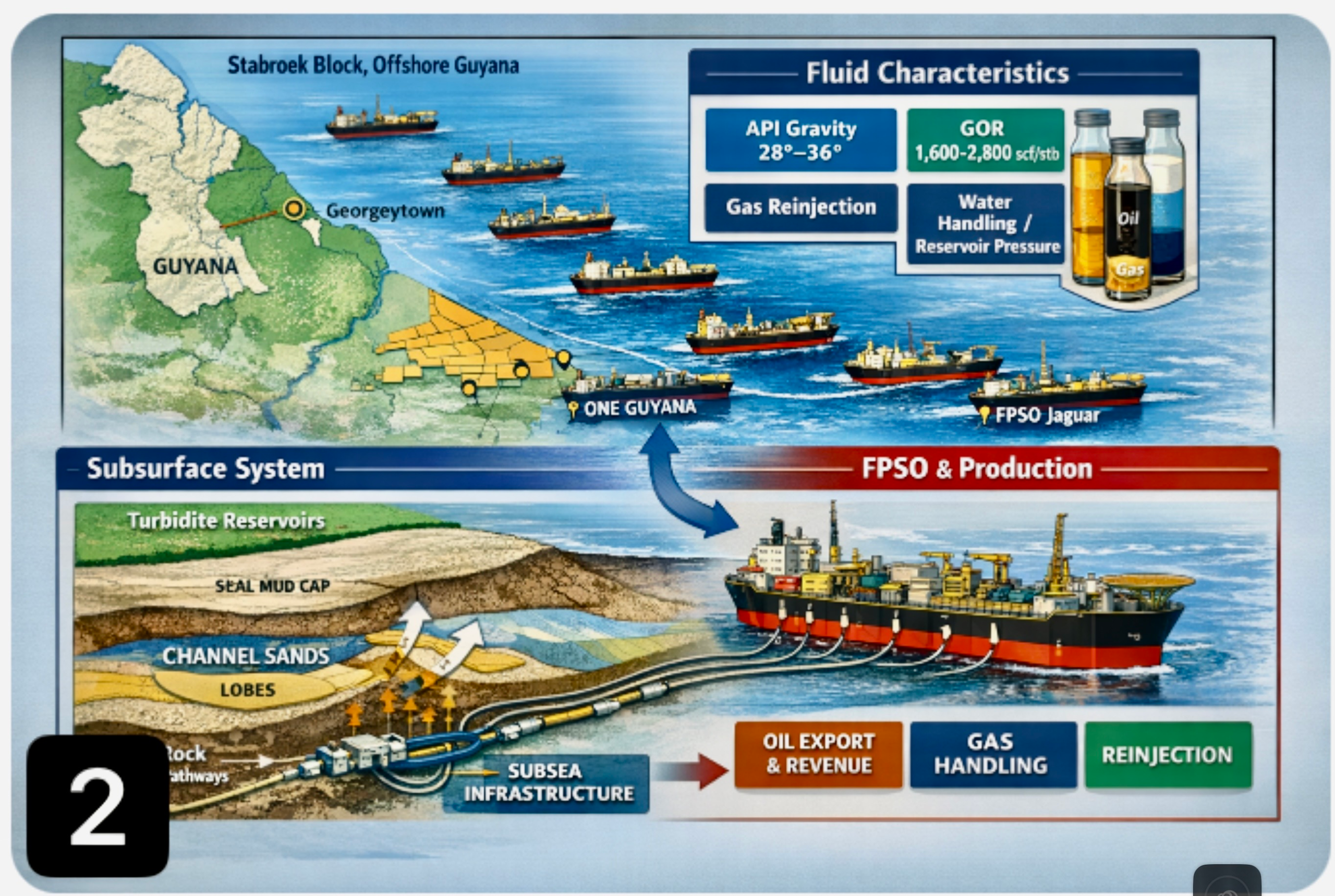
An integrated subsurface–facilities–economics synthesis of the Stabroek Block development model
Written by Marcel Chin-A-Lien, Petroleum & Energy Advisor, 27 January 2026
Abstract
Since first oil in December 2019, offshore Guyana has emerged as one of the most consequential petroleum developments of the last two decades.
At the core of this transformation lies the “Golden Lane” of the Stabroek Block: a laterally extensive, repeatable deep-water turbidite petroleum system that has enabled rapid, modular development through a growing fleet of Floating Production, Storage and Offloading vessels (FPSOs).
My article presents a high-level yet technically rigorous synthesis connecting basin geology, reservoir architecture, fluid behavior (PVT and gas–oil ratio), FPSO design philosophy, production performance, and national revenue generation.
Seven FPSO hubs — producing, sanctioned, or approved — are examined as surface expressions of a single subsurface fairway, demonstrating how geological repeatability translates directly into capital efficiency, operational reliability, and fiscal outcomes.
1. Geological Context: The Golden Lane Petroleum System
1.1 Basin setting
The Guyana–Suriname Basin is a classic Atlantic passive-margin system, characterized offshore by thick Cretaceous to Paleogene deep-water successions deposited along the continental slope and basin floor.
The Golden Lane?
The beautiful name, petroleum belt and its corresponding petroleum system, that I myself envisioned, proposed and also coined in 2010, already 4 years before the first Liza-1 discovery, corresponds to a fairway of stacked turbidite channel–lobe complexes deposited by long-runout gravity flows sourced from regional hinterland systems.The petroleum system is defined by:
- Reservoir: Multi-story turbidite sandstones with strong net-to-gross and lateral continuity
- Seal: Regionally extensive marine mudstones and slope drapes
- Charge: Highly effective source kitchens and long-distance migration pathways
The Liza discovery established this play as a stratigraphic giant, and subsequent discoveries confirmed the repeatability of the depositional motifs across the block.


2. Reservoir Architecture and Development Implications
Golden Lane reservoirs are dominated by amalgamated channel fills transitioning into lobe complexes. This architecture provides high well deliverability, large drainage areas, and effective pressure support under water and gas injection.
From a facilities perspective, reservoir quality manifests as stable production plateaus, predictable water-cut evolution, and the ability to standardize subsea layouts and FPSO designs while scaling capacity.
3. Fluids, GOR and PVT Behavior: The Critical Subsurface–Facilities Link
3.1 Crude quality
Marketed Guyana crude grades exhibit systematic variation along the Golden Lane:
- Liza: ~32° API
- Unity Gold: ~33–34° API
- Payara Gold: ~28° API
- Golden Arrowhead (Yellowtail): ~36.5° API
Sulfur content is low to moderate, supporting strong global demand and favorable pricing.
3.2 Associated gas and GOR
Public EPA project summaries for Yellowtail provide paired oil and gas rate ranges:
- Oil: ~220–250 thousand barrels per day
- Gas: ~400–620 million standard cubic feet per day
This implies a producing GOR of approximately 1,600–2,800 scf/bbl.
Such GOR levels directly drive FPSO topsides design, particularly gas compression, reinjection capacity, fuel gas availability, and operational uptime.


4. FPSO Hubs and Spatial Organization
Seven FPSOs represent successive development hubs along the Golden Lane:
- Liza Destiny
- Liza Unity
- Prosperity (Payara)
- ONE GUYANA (Yellowtail)
- Errea Wittu (Uaru)
- Jaguar (Whiptail)
- Hammerhead FPSO
Together they form a coherent production system rather than isolated projects.
5. Production Growth and National Revenue
Guyana’s production trajectory closely mirrors FPSO commissioning:
- First oil: December 2019
- 2021: ~42.7 million barrels
- 2024: ~225 million barrels
- 2025: ~261 million barrels
- Installed capacity (post-Yellowtail): >900,000 bbl/d
The causal chain is unambiguous:
Reservoir quality → well productivity → FPSO uptime → export volumes → government revenue.
6. Conclusions
The Golden Lane is not merely a collection of discoveries; it is a development model grounded in geology. Its success demonstrates how sedimentology, reservoir connectivity, and fluid behavior can be translated efficiently into large-scale offshore production and durable national revenue.
References
- ExxonMobil (2015–2025). Guyana Project News Releases and Project Summaries.
- Environmental Protection Agency of Guyana (2017–2024). Liza, Payara, Yellowtail, and Uaru Development Project Summaries.
- U.S. Energy Information Administration (2023). Guyana Country Analysis Brief.
- GeoscienceWorld / AAPG (2019). “Liza Field, Guyana: The Finding of a Stratigraphic Giant.”
- Reuters (2024–2025). Guyana oil production and revenue reporting.
- Guyana Ministry of Finance (2021–2025). Natural Resource Fund Reports.
Author
Marcel Chin-A-Lien
Petroleum & Energy Advisor
I am an internationally experienced petroleum geologist and energy advisor with more than four decades of global experience across exploration, deep-water field development, portfolio strategy, and energy geopolitics.
He has advised international oil companies, national oil companies, governments, financial institutions, and investors across the Americas, West Africa, the Middle East, and Europe, with particular expertise in the Guyana–Suriname Basin.
He is the founder of PetroleumEnergyInsights.com, where he publishes independent, technically grounded analysis at the intersection of geology, energy economics, and geopolitics.