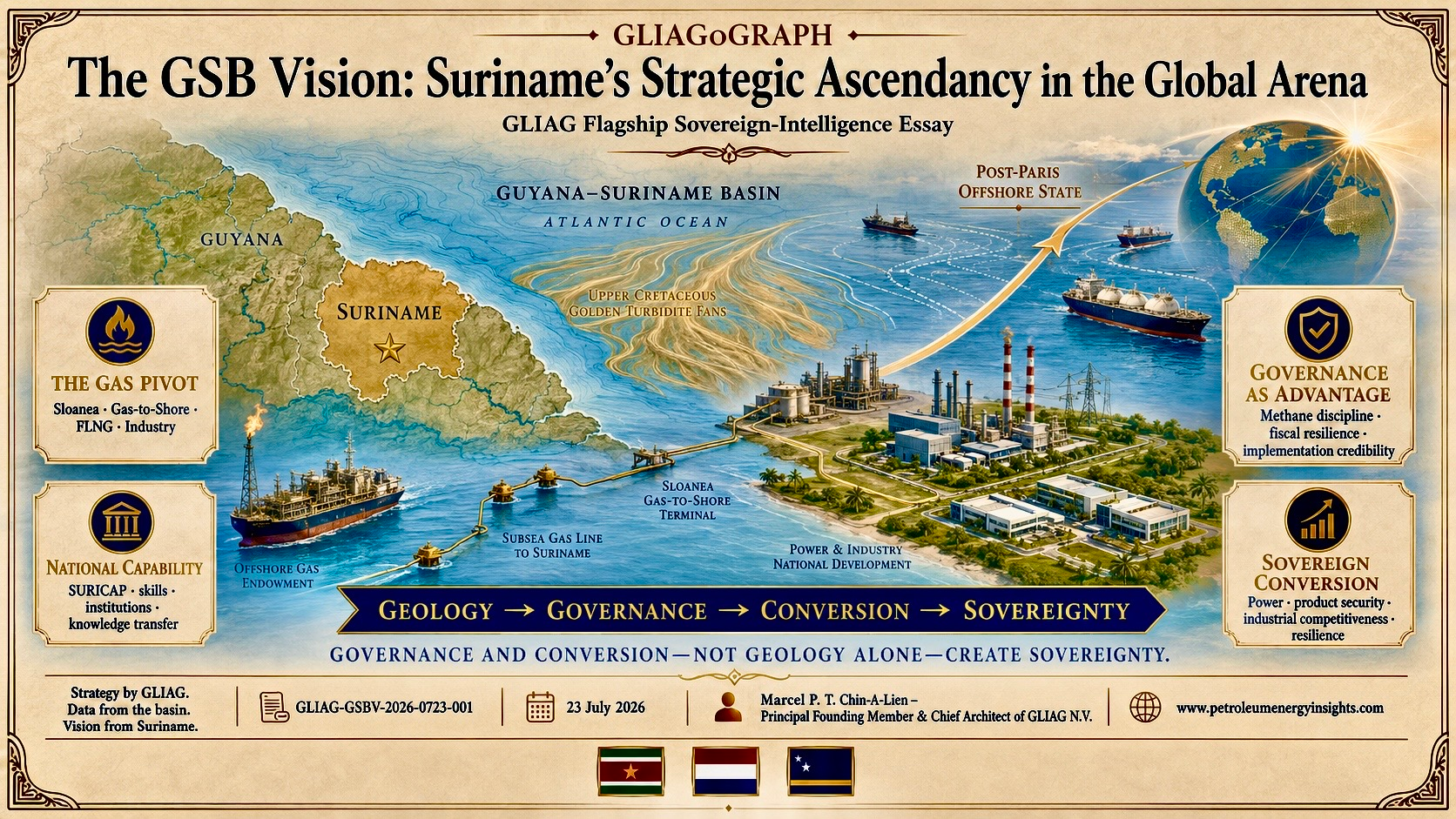
The GSB Vision: Suriname’s Strategic Ascendancy in the Global Arena
GLIAG Flagship Sovereign-Intelligence Essay
Written by Marcel P. T. Chin-A-Lien – Petroleum & Energy Advisor – Principal Founding Partner & Chief Architect of GLIAG N.V. – Golden Lane Investments Advisory Group – 23 July 2026 – Monaco
The Basin Context
The Guyana-Suriname Basin is not merely another petroleum province. It is a post-Paris offshore system—developing during the convergence of climate governance, transition finance, sovereign-risk repricing, and institutional transformation . Unlike twentieth-century basins that matured within a hydrocarbon-centric geopolitical order, the GSB is emerging under intensifying climate-governance architecture, methane scrutiny, and ESG-finance systems . Suriname is therefore not entering a conventional petroleum era; it is emerging as a post-Paris offshore state.
The known oil reserves in the basin total some 30 billion barrels equivalent, with gas reserves exceeding 30 trillion cubic feet—amounting to 10 percent of the world’s conventional oil . This geological endowment, concentrated in the Upper Cretaceous turbidite fans of the so-called “Golden Lane,” positions Suriname at the center of the world’s newest petro-power corridor .
The Strategic Vision
Suriname’s leadership has articulated a vision that transcends extraction. President Jennifer Geerlings-Simons declared at the Suriname Energy, Oil and Gas Summit: “Every aspect of Suriname’s natural wealth must develop into broad national prosperity. What emerges from our soil and our deep waters today must be visibly and tangibly reflected in the daily lives of our people tomorrow” .
This is not rhetoric—it is doctrine. The nation is aligning its offshore momentum with the core GLIAG principle of conversion: transforming geological fortune into generational prosperity. Minister Patrick Brunings has explicitly framed oil and gas as a catalyst, not a destination, positioning the sector to accelerate diversification while mitigating Dutch disease risks .
The Global Positioning
Suriname is strategically positioning itself on multiple global fronts:
- The Gas Pivot
Suriname is moving decisively toward becoming a regional gas hub. Staatsolie is actively pressing Exxon and TotalEnergies to combine cross-border gas developments with Guyana to achieve scale economics . The emerging gas-condensate architecture—with Sloanea commerciality, Fusaea discovery, and the broader southeastern gas corridor—supports the interpretation that the GSB contains substantially larger gas volumes than currently recognized .
Minister Brunings stated: “If we find a lot of gas, we can establish various industries, such as the bauxite industry and the petrochemical industry. The whole world is now looking for reliable gas suppliers, and we believe we can play that role very well” .
- Governance Quality as Competitive Advantage
The future competitiveness of offshore systems increasingly depends not on geology alone, but on governance quality, emissions discipline, institutional coherence, and implementation credibility . Suriname’s relatively early-stage development trajectory—its institutions remain shapeable, its infrastructure pathways not yet locked in—offers a strategic timing advantage .
This “governance plasticity” enables Suriname to integrate lower-flaring standards, methane-governance systems, resilience-linked fiscal architecture, and climate-compatible project framing earlier than legacy producers historically did . The country is laying down the institutional markers that will define its global credibility in the climate-governance era.
- Institutional Readiness and Capacity Building
The strategic vision is being operationalized. The signing of a Memorandum of Understanding between TotalEnergies, Staatsolie, and the Government of Suriname launched SURICAP—the Suriname Capacity Program—designed to strengthen vocational education, modernize training facilities, and align curricula with international industry standards . Forty companies and nine educational institutions have already joined this initiative .
This reflects a fundamental GLIAG insight: long-cycle offshore success depends on sovereign synchronization—the ability to maintain alignment between offshore expansion, infrastructure modernization, fiscal governance, institutional scaling, and energy-system transformation simultaneously .
- The Infrastructure-State Interface
Gas-to-Shore must be evaluated not merely as a hydrocarbon monetization project, but as a sovereign energy-system transformation platform . For Suriname, imported fuel dependence, electricity affordability, and long-cycle energy resilience remain strategic national-development considerations. The strategic value of offshore gas depends not merely on export potential, but on its ability to stabilize electricity systems, reduce imported fuel exposure, and strengthen industrial competitiveness .
The Global Arena
Suriname’s emergence as a petro-power occurs against a backdrop of intensifying competition for reliable energy supplies. The post-Ukraine war energy landscape has fundamentally reshaped global natural gas markets, with European and Asian buyers seeking secure, diversified sources . Suriname’s dual oil and gas-condensate system, located in a geopolitically stable region with proximity to Atlantic markets, represents a valuable proposition.
Yet the nation is not simply replicating Guyana’s trajectory. The GSB is evolving into a dual oil and gas-condensate super-basin, with the eastern and southeastern sectors displaying retrograde gas systems, condensate-rich discoveries, and deep overpressure compartments . This fluid-phase transition means Suriname’s strategic pathway diverges from the oil-centric model of its neighbor—toward FLNG, Gas-to-Shore, and industrialization .
The GLIAG Doctrine
The basin’s most durable geological doctrine applies equally to strategy: petroleum systems, not licence blocks, are the true architecture. And for sovereign development, governance systems—not geology alone—determine which nations translate offshore wealth into durable resilience .
Suriname is navigating a narrow strategic window. Offshore revenues may still possess the capacity to finance adaptation, modernize infrastructure, and strengthen sovereign resilience before transition constraints tighten structurally . The period between initial offshore acceleration and full climate-governance intensity represents a limited historical resilience window.
The challenge is not simply whether hydrocarbons can be extracted, but whether offshore expansion can be translated into resilient sovereign-development systems before governance, financing, and transition pressures intensify globally .
Strategy by GLIAG. Data from the basin. Vision from Suriname.
References:
· GLIAG, “Transforming Offshore Energy: Governance in the Guyana-Suriname Basin”
· Industrial Info Resources, “Suriname Eyes Bigger Role in Global Oil & Gas Industry,” July 2026
· AAPG Explorer, “The Rise of the Guyana Super Basin,” October 2025
· Oil & Gas News, “Suriname presses Exxon, Total to combine gas developments,” June 2026
· GLIAG, “The Emerging Gas-Condensate System of the Guyana-Suriname Basin,” June 2026
· Kaieteur News, “Petronas eyes final investment decision in Suriname,” June 2026
· Routledge, “Oil and Climate Change in the Guyana-Suriname Basin,” 2024
· Key News Suriname, TotalEnergies SURICAP MoU, June 2026
· GLIAG, “Exploring the Complex Petroleum Dynamics,” June 2026