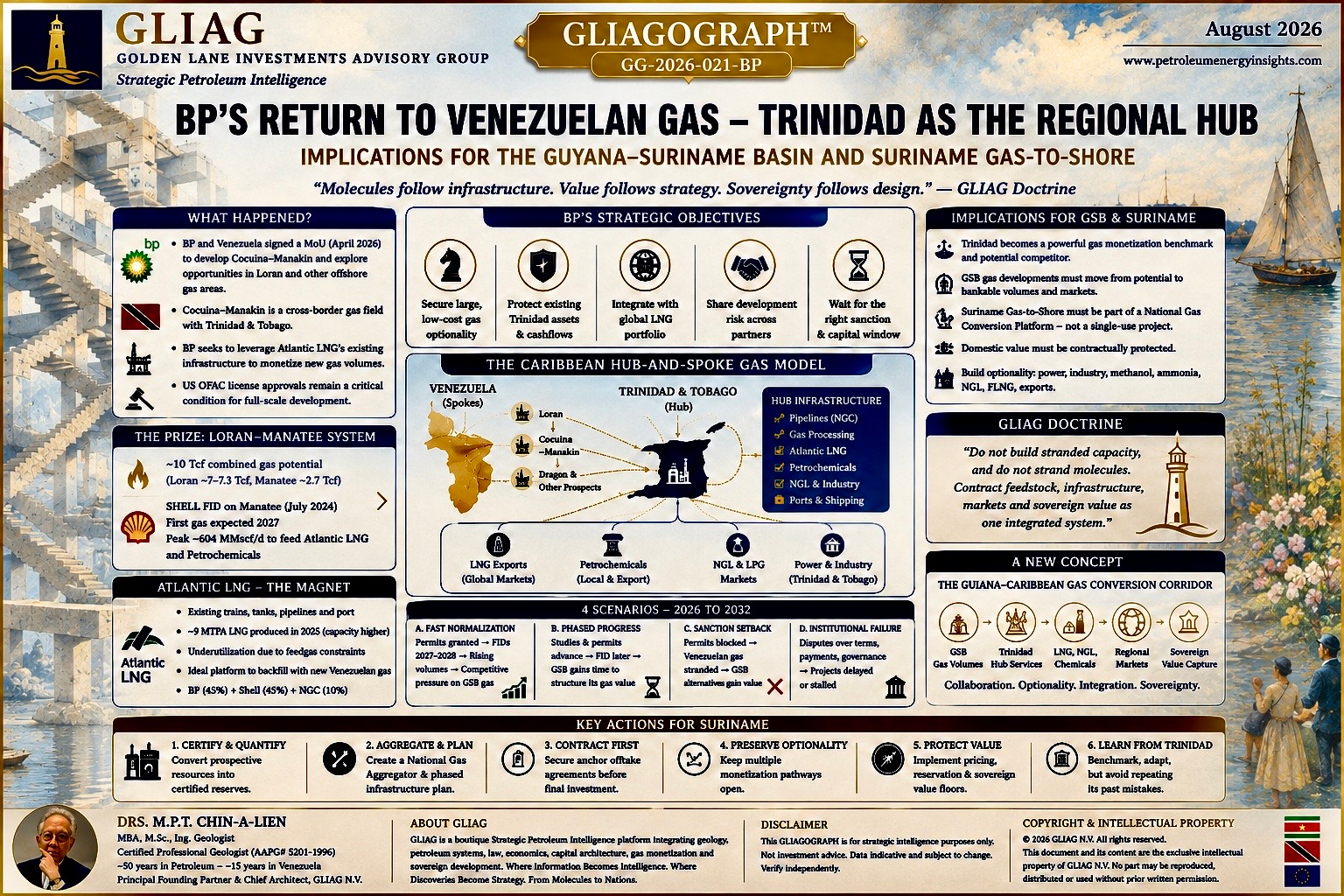
BP Reconnects Venezuelan Gas to the Caribbean Value Chain
Loran–Manatee, Cocuina–Manakin and Atlantic LNG — What the Emerging Hub-and-Spoke Model Means for the Guyana–Suriname Basin and Suriname Gas-to-Shore
reporting.
| Document reference | GLIAG_ESSAY_2026_15_BP-VENEZUELA-GAS |
| Classification | Public Strategic Position Essay |
| Author | Drs. M.P.T. Chin-A-Lien, MBA, M.Sc., Ing. Geologist |
| Professional standing | AAPG Certified Professional Geologist No. 5201-1996 | EurGeol No. 92-1996 |
| Date | 5 August 2026 |
Executive Thesis
| GLIAG CENTRAL JUDGEMENTBP is not merely returning to Venezuelan gas. It is attempting to reconnect stranded or delayed offshore molecules to an already-built Trinidadian processing, petrochemical and LNG value chain. The strategic prize is not acreage alone; it is the restoration of throughput, utilization and portfolio value across an integrated regional system. |
The April 2026 memorandum between BP and Venezuela should be understood as an option-creation instrument. It advances Cocuina–Manakin and opens a route into Loran, but it does not yet constitute a final investment decision. The geological resource is material; the decisive variables are sanctions authorization, cross-border commercial architecture, payment security, capital allocation and the ability to deliver gas into Trinidad’s existing infrastructure.
For Suriname and the wider Guyana–Suriname Basin (GSB), the development is strategically important even if no Surinamese molecule ever flows physically to Trinidad. It establishes a powerful regional benchmark: gas should be monetised through the lowest-risk combination of certified feedstock, existing or modular infrastructure, creditworthy demand and sovereign value capture—not through infrastructure ambition in isolation.
1. The Verified Transaction Signal
On 29 April 2026, BP and Venezuela signed a memorandum of understanding covering development of the cross-border Cocuina–Manakin offshore gas field and the exploration of joint opportunities in the Venezuelan Loran area. Cocuina–Manakin extends across the Venezuela–Trinidad maritime boundary; BP operates the Trinidadian side as Block 5(b). Reporting indicates that more than 1 Tcf could ultimately be directed to Trinidad for LNG production and export, subject to the necessary authorisations and commercial agreements.
Direct source: Reuters — BP signs agreement with Venezuela to develop offshore gas fields
This is not a conventional greenfield story. Trinidad already possesses a mature gas-processing, petrochemical, marine and LNG system. Its core commercial problem has increasingly been insufficient feedgas rather than absence of infrastructure. BP’s transaction therefore has two simultaneous purposes: create upstream resource access and defend the value of existing midstream and downstream assets.
2. Loran–Manatee: One Accumulation, Two Sovereignties, Different Timetables
Loran–Manatee is a cross-border accumulation divided between Venezuelan and Trinidadian waters. Commonly cited figures place approximately 7 Tcf on the Loran side and 2.7 Tcf on the Manatee side. The split creates a classic boundary-field challenge: geology is continuous, but law, fiscal systems, sanctions exposure, project timing and political risk are not.
Shell took final investment decision on the Trinidadian Manatee development in July 2024. Shell states that production is expected to start in 2027 and reach approximately 604 MMscf/d at peak. Manatee demonstrates the value of separating a developable national segment from a more complicated cross-border whole where commercial alignment cannot be achieved quickly.
Primary corporate source: Shell — Manatee final investment decision
| STRATEGIC INFERENCEThe Manatee precedent shows that “integrated geology” does not automatically require “integrated timing.” A host state can preserve the long-term value of unitisation while still designing phased or delinked development routes that prevent the entire accumulation from remaining stranded. |
3. Atlantic LNG Is the Economic Gravity Centre
Atlantic LNG’s nominal capacity is approximately 15 million tonnes per annum. The facility, together with Trinidad’s pipelines, gas processing, Point Lisas petrochemicals, port infrastructure, workforce and trading connections, forms a sunk-capital platform whose value rises sharply when incremental gas is introduced.
Primary source: Atlantic LNG — corporate site and facility overview
A greenfield LNG chain must normally fund liquefaction trains, storage, jetties, utilities, marine systems, marketing and a large dedicated upstream supply. By contrast, Venezuelan gas routed into Trinidad may carry a lower incremental infrastructure burden. That difference creates infrastructure arbitrage: a molecule can command higher netback because it is connected to facilities that already exist and need feedgas.
This does not make the project simple. Existing capacity has technical constraints, contractual ownership, train-specific economics, gas-quality requirements and competing domestic uses. Nevertheless, the existence of a mature conversion system changes the threshold volume, capital intensity and time-to-market calculation.
4. BP’s Integrated Commercial Logic
4.1 Secure low-cost strategic options
An MoU permits BP to secure access, data, negotiating position and partner alignment before committing full development capital. In a sanctions-sensitive jurisdiction, this has material option value. BP can progress subsurface work, development concepts, pipeline routing, fiscal negotiations and licensing while retaining the ability to defer FID.
4.2 Restore utilization of existing assets
Incremental gas can protect the economic value of Atlantic LNG and Trinidad’s petrochemical base. The relevant calculation is therefore not simply project IRR at Cocuina or Loran. BP can assess the combined uplift in upstream margin, LNG throughput, trading optionality and avoided underutilisation across its broader portfolio.
4.3 Convert molecules through a global LNG portfolio
A portfolio LNG company can optimise destination, shipping, contract tenor and market timing. The commercial value of a gas molecule is consequently determined not only at the wellhead but by its position within a global network of liquefaction, vessels, contracts and customers.
4.4 Stage capital behind political and commercial gates
Capital discipline does not contradict strategic interest. BP can be strongly interested while postponing the largest commitment until sanctions authorisations, payment mechanics, project governance and cost certainty are sufficiently robust. A 2027 decision horizon would therefore be consistent with disciplined option maturation rather than lack of conviction.
5. The Real Bottleneck Is Above Ground
The principal risks are no longer discovery risk. They are the institutional conditions that determine whether discovered gas can become bankable gas:
• OFAC and other sanctions permissions, including the durability and scope of licences;
• PDVSA counterparty, credit and payment risk;
• currency convertibility, permitted settlement routes and profit repatriation;
• cross-border field governance, data sharing and development coordination;
• fiscal stability, taxation, royalties and change-in-law protection;
• pipeline ownership, capacity access, tariffs and gas-quality specifications;
• gas sales agreements, take-or-pay commitments and creditworthy offtakers;
• operator control, procurement integrity, audit rights and dispute resolution.
| GLIAG PRINCIPLEA resource becomes a project only when geology, law, infrastructure, finance, market and governance function simultaneously. Subsurface abundance cannot compensate indefinitely for weak commercial architecture. |
6. A Caribbean Hub-and-Spoke Gas Model Is Emerging
Trinidad is evolving from a gas province dependent exclusively on its domestic upstream base into a regional gas-conversion hub. The potential spokes include Manatee, Loran, Cocuina–Manakin, Dragon and future Trinidad deepwater discoveries. The hub consists of the pipeline grid, processing assets, Atlantic LNG, Point Lisas, ports, trading capability and specialist services.
The model resembles a refinery or petrochemical hub that processes feedstock from multiple origins. It can increase regional resource recovery by allowing fields that are individually too small, too delayed or too infrastructure-constrained to enter a common conversion system.
The new competitive unit is therefore not merely the field. It is the integrated value chain: resource + transportation + processing + conversion + market + sovereign framework.
7. Strategic Influence on the Guyana–Suriname Basin
7.1 Trinidad becomes both benchmark and competitor
GSB gas projects will increasingly be compared with Venezuelan–Trinidad backfill opportunities. Existing Trinidad infrastructure may offer lower incremental capex and shorter time-to-market than some greenfield schemes. This can redirect IOC capital, LNG offtake attention, EPC capacity and specialised personnel.
7.2 Gas discoveries must mature faster into commercial propositions
The GSB cannot rely on generic statements about large gas potential. Investors and governments need field-specific evidence: certified recoverable volumes, deliverability, composition, condensate yield, impurities, plateau duration, decline profile, development cost and binding market pathways.
7.3 Existing-infrastructure optionality must be tested—not assumed
Physical pipeline export from Suriname to Trinidad is not an obvious base case. Distance, water depth, compression, seabed hazards and minimum economic volume may make it inferior to FLNG, domestic conversion or a Suriname-based hub. Trinidad’s greatest immediate relevance is therefore its commercial architecture, not necessarily its geography.
7.4 The region is competing for timing, not only resources
The project that establishes bankable feedstock and firm offtake first can capture contractors, finance and market space. Delayed gas is not neutral: it may lose its preferred market window or be forced into a lower-value pathway.
8. Implications for Suriname Gas-to-Shore
Suriname should resist reducing Gas-to-Shore to a pipeline-to-power project. It should be structured as an expandable National Gas Conversion Platform capable of serving multiple demand centres and adding new feedstock over time.
• power generation and grid reliability;
• refinery fuel, hydrogen and process heat;
• LPG and natural-gas liquids recovery;
• methanol, ammonia and fertiliser;
• alumina, bauxite, cement and mining applications;
• marine fuels, small-scale LNG and regional island supply;
• data centres and other high-load industrial users;
• FLNG or export options where domestic conversion cannot absorb all volumes.
The infrastructure architecture should be modular and expandable. A trunkline, landing point, processing hub and industrial corridor should be capable of accepting additional fields and operators without unnecessary duplication, subject to technical compatibility and transparent capacity allocation.
9. What Suriname Must Avoid
| Failure mode | Why it destroys value | Required safeguard |
| Oversized infrastructure based on prospective resources | Uncontracted resources cannot service debt or guarantee utilisation | Capacity gates tied to certified reserves and firm offtake |
| Single-purpose Gas-to-Shore design | Locks the country into one demand pathway and weakens resilience | Multi-user conversion platform with modular expansion |
| Domestic reservation without bankable pricing | Creates supply obligations without recoverable economics | Transparent price formula, payment security and creditworthy buyers |
| State absorption of all risks | Converts commercial uncertainty into sovereign liabilities | Allocate construction, feedstock, market and currency risks to capable parties |
| Export-first policy without a sovereign floor | Maximises short-term cash but may forfeit industrial transformation | Contractual domestic-value floor and periodic netback review |
| Duplicated operator infrastructure | Raises unit costs and creates stranded parallel capacity | Open-access/tolling framework where technically and commercially appropriate |
10. Recommended Suriname Action Architecture
10.1 Establish a Gas Aggregator or Single Commercial Interface
A national aggregator can bundle volumes, coordinate transport, aggregate demand, structure pricing and negotiate long-term contracts. Its mandate must be transparent and commercially disciplined; it should not become an opaque monopoly or a vehicle for unfunded political commitments.
10.2 Introduce binding development gates
• Gate 1 — certified reserves, composition and deliverability;
• Gate 2 — selected development concept and classed cost estimate;
• Gate 3 — firm anchor offtake and payment security;
• Gate 4 — environmental and social approvals, land and permits;
• Gate 5 — finance, risk allocation and final investment decision.
10.3 Preserve monetisation optionality
Power, industrial conversion, NGL recovery, FLNG, ammonia, methanol and regional export should be evaluated through a common netback and national-value framework. No pathway should be selected merely because it is politically visible or technologically fashionable.
10.4 Build a sovereign-value floor
The state should define minimum domestic benefits before approving export-led development: secure energy, local industrial feedstock, fiscal revenue, participation, skills, infrastructure access and environmental safeguards. Export remains essential, but it should finance and reinforce domestic conversion rather than displace it automatically.
10.5 Benchmark Atlantic LNG systematically
Suriname should study the ownership restructuring, feedgas contracts, tolling logic, train utilisation, gas pricing, NGC role, petrochemical allocation and consequences of Trinidad’s feedgas shortage. The objective is not to copy Trinidad, but to learn how mature infrastructure can become vulnerable when upstream replacement is not secured early enough.
11. Out-of-the-Box GLIAG Concept: The Guiana–Caribbean Gas Conversion Corridor
GLIAG proposes a long-range Guiana–Caribbean Gas Conversion Corridor—not necessarily as one physical pipeline, but as an integrated commercial and industrial ecosystem connecting the growth resources of Guyana and Suriname with Trinidad’s mature LNG, petrochemical, trading, maintenance and service capabilities.
Possible components include regional LNG cargo swaps, small-scale LNG distribution, shared specialist training, maintenance bases, shipping optimisation, emergency supply arrangements, common technical standards, project-finance cooperation and downstream product trade. Producing states must retain sovereign domestic-value floors; cooperation should not become a mechanism for exporting all value to the established hub.
| THE CORRIDOR TESTRegional integration is valuable only when it lowers unit cost, accelerates monetisation or widens markets without hollowing out domestic industrial development in the producing state. |
12. Scenario Outlook, 2026–2032
| Scenario | Trigger | Regional outcome | GSB/Suriname implication |
| Accelerated integration | Durable licences, bankable contracts, Shell/BP sanction decisions | Venezuelan gas progressively backfills Trinidad LNG and petrochemicals | Higher competition for capital and LNG markets; urgency for Suriname commercial definition |
| Phased progression | Technical work advances but large FIDs wait until 2027+ | Manatee leads; Cocuina/Loran follow in stages | More preparation time, but no justification for institutional delay |
| Sanctions reversal | Licences restricted or revoked | Venezuelan gas remains stranded; Trinidad seeks alternatives | GSB gas becomes relatively more attractive, especially flexible FLNG/domestic options |
| Commercial/governance failure | Payment, fiscal, unitisation or control disputes | Resource remains technically known but unbankable | Confirms that bankability architecture is as important as reserves |
13. GLIAG Strategic Predictions
• Trinidad will increasingly position itself as a regional processor of non-Trinidadian gas rather than only a domestic upstream producer.
• BP and Shell will treat cross-border Venezuelan gas primarily as portfolio and infrastructure optimisation opportunities, not isolated field developments.
• MoUs and licences will proliferate faster than FIDs; sanctions durability and payment security will determine which announcements become projects.
• GSB governments will be forced to compare greenfield LNG against FLNG, domestic conversion and third-party tolling using transparent netback analysis.
• Gas aggregators, shared infrastructure and open-access principles will become central policy questions in both Guyana and Suriname.
• The most valuable GSB gas projects will be those that can combine domestic sovereign value with export scalability rather than choosing one at the expense of the other.
• The regional contest will shift from “who has gas?” to “who can contract, finance and convert gas first?”
14. Final GLIAG Position
| BINDING GLIAG DOCTRINEDo not build stranded capacity, and do not strand molecules. Contract feedstock, infrastructure, markets and sovereign value as one integrated system. |
BP’s Venezuelan engagement is best understood as an attempt to reconnect stranded molecules to an already-built Caribbean value chain. For Venezuela, it offers a route toward offshore gas exports. For Trinidad, it offers feedstock renewal. For BP, it offers upstream access, asset-utilisation recovery and LNG portfolio optionality.
For Suriname, the strategic lesson is unambiguous: design Gas-to-Shore backward from durable markets and forward from certified feedstock—not from infrastructure ambition alone. The country should build an expandable conversion architecture, preserve multiple monetisation paths, establish a sovereign-value floor and refuse to sanction major capacity before feedstock and offtake are contractually secured.
The future Caribbean gas winner will not necessarily be the country with the largest discovered resource. It will be the jurisdiction that most effectively integrates molecules, infrastructure, law, capital, markets and national development.
Sources and Directly Clickable References
1. Reuters — BP signs agreement with Venezuela to develop offshore gas fields — MoU for Cocuina–Manakin development and Loran opportunities.
2. Reuters — BP interested in cross-border opportunities with Venezuela — Industrial logic of connecting cross-border resources to underutilised Atlantic LNG and Point Lisas assets.
3. Reuters — BP and Shell seeking U.S. licences for shared gas fields — Sanctions licensing and cross-border project status.
4. Reuters — Venezuela grants BP and NGC Cocuina–Manakin licence — Twenty-year Venezuelan development licence and project structure.
5. Shell — Manatee final investment decision — First gas target, peak rate and strategic LNG role.
6. Atlantic LNG — Corporate website — Facility overview and nominal LNG capacity.
7. Reuters — Venezuela advances agreements with Shell including Loran — Further evidence of the emerging Venezuela–Trinidad gas corridor.
8. GLIAG — Petroleum & Energy Insights — GLIAG strategic petroleum intelligence and related Suriname/Guyana analysis.
Disclaimer
This publication is a strategic intelligence and scenario-analysis product prepared for general professional discussion. It is not investment advice, legal advice, tax advice, a reserves certification, a competent-person report, a bankable feasibility study, a market forecast or a recommendation to enter any transaction. Resource and project figures are drawn from the cited public sources and may change. Sanctions, licences, political arrangements and commercial negotiations are particularly time-sensitive. Any investment or policy decision requires independent technical, legal, fiscal, environmental, sanctions, market and financial due diligence.
Copyright, Intellectual Property and Proprietary Rights
© 2026 GLIAG N.V. — Golden Lane Investments Advisory Group. All rights reserved. The analytical structure, interpretations, strategic doctrines, scenario architecture, terminology, tables, recommendations and original synthesis contained in this publication constitute proprietary intellectual property of GLIAG N.V. and Drs. M.P.T. Chin-A-Lien. No part may be reproduced, republished, translated, adapted, incorporated into a commercial presentation, advisory product, policy paper, investment memorandum, artificial-intelligence training corpus or third-party publication without prior written permission and full attribution. Fair quotation for scholarly or journalistic purposes must identify the author, GLIAG, the document title, document reference, date and the website www.petroleumenergyinsights.com. External facts and corporate materials remain the property of their respective rights holders and are cited through directly clickable references.
About the Author and GLIAG
Drs. M.P.T. Chin-A-Lien, MBA, M.Sc., Ing. Geologist, is Principal Founding Partner and Chief Architect of GLIAG N.V., with approximately five decades of petroleum-sector experience, including extensive work relating to Venezuela, Suriname, petroleum systems, exploration strategy, contractual frameworks and sovereign resource conversion. He is an AAPG Certified Professional Geologist (No. 5201-1996) and EurGeol (No. 92-1996).
GLIAG is a boutique Strategic Petroleum Intelligence platform integrating geology, petroleum systems, exploration, contracts, law, economics, infrastructure, gas monetisation, industrial policy and sovereign development.
Where Information Becomes Intelligence. | Where Discoveries Become Strategy. | From Molecules to Nations.
www.petroleumenergyinsights.com
GLIAG_ESSAY_2026_15 • Petroleum & Energy Insights • August 2026 • www.petroleumenergyinsights.com