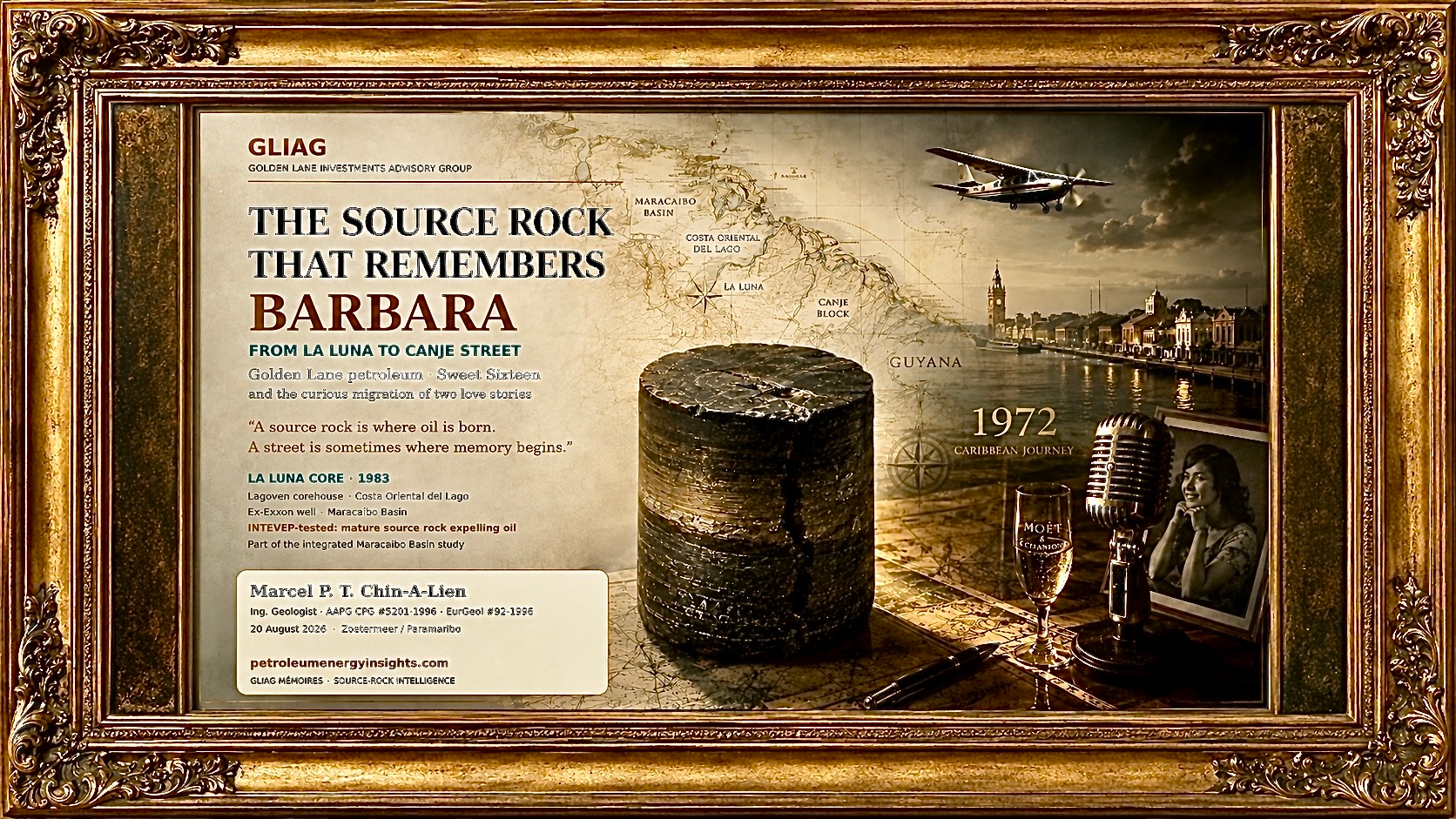
GLIAG MÉMOIRES · LA LUNA · CANJE · GOLDEN LANE
Forty Years on One Desk
A 1983 La Luna core, the Canje system, and the discipline of physical evidence
The industry speaks easily of source rocks. Very few people have met one in the field, broken it, smelled it, studied it — and then kept one on their desk for more than forty years. This essay argues the Guyana–Suriname Basin from that object outward: from a mature La Luna core rescued in 1983 to the Canje charge system beneath the Golden Lane.
Drs. M. P. T. Chin-A-Lien, MBA, M.Sc., Ing. Geologist
Principal Founding Partner, Managing Partner & Chief Architect, GLIAG N.V.
AAPG Certified Petroleum Geologist Nr. 5201-1996 · EFG European Geologist (ChEGeol) Nr. 92-1996
AIEN Certified Energy Negotiator, June 2021
Golden Lane Investments Advisory Group (GLIAG N.V.) · Zoetermeer / Delft, Netherlands · Paramaribo, Suriname
petroleumenergyinsights.com
Document reference: GG-2026-033-LLCB · 20 August 2026
GLIAG Mémoires · Source-Rock Intelligence
Companion memoir chapter: The Street With the River’s Name (GLIAG-MEM-2026-TER-001 · TER-001-CANJE)
The industry speaks easily of source rocks. Very few people have met one in the field, broken it, smelled it, studied it — and then lived with one on their desk for more than forty years.
§ 1The rock on my desk
On my study desk stands a short cylinder of dark rock. It is not handsome in the conventional sense. It does not sparkle. It has none of the vanity of quartz, none of the theatrical colour of copper minerals, and none of the polished manners of marble. It is cracked, compact, grey-black and solemn. A visitor might mistake it for an unusually disciplined piece of charcoal.
But it is La Luna.
I rescued it in 1983 from a group of cores set aside to be discarded near the Lagoven corehouse on the Costa Oriental del Lago, Zulia. It came from a Lagoven well of inherited ex-Exxon lineage in the Maracaibo Basin. The exact well identifier still needs to be reunited with the specimen from surviving notes or labels; geological memory should never impersonate a chain-of-custody form.
But the rock was not identified by sentiment alone. I removed a chip and examined it in the laboratory at INTEVEP. It was La Luna: mature source rock, already in the act of expelling its oil. The specimen entered the sample work and the geological thinking that fed our integrated Maracaibo Basin study. What had been placed on a discard pile was, in reality, a small working model of the basin’s petroleum engine.
Its geological identity is therefore unmistakable to me. I have known La Luna since 1979: in outcrop, in hand specimen, in core, under analysis, and in the oils it generated. It is an object with an almost indecent reversal of value — discarded by a corehouse, then preserved for four decades as evidence of how oil is born.
I have visited it. I have touched it. I have broken it. I have smelled it.
Freshly fractured La Luna can release the characteristic odour of bitumen. The official Venezuelan stratigraphic lexicon describes its dark, laminated, organic-rich limestones and calcareous shales, its black chert and characteristic concretions — and notes that a fresh fracture may carry a strong petroleum smell. This is geology’s least expensive geochemical instrument: the human nose. It is not quantitative, it is not calibrated, and no respectable laboratory should issue a chromatogram signed “nostril.” But it is unforgettable.
The core therefore sits on my desk not merely as a sample. It is a small archive of an ancient sea: a physical record of plankton, oxygen depletion, burial, heat, pressure, molecular transformation and expulsion.
It is the birth of oil, held in one hand. A reservoir is where petroleum comes to live; a source rock is where it is conceived, transformed and expelled. We celebrate discoveries at the reservoir, much as society photographs the graduate and forgets the mother. The dark rock on my desk quietly corrects that discourtesy.
§ 2Quebrada La Luna, 1979
My relationship with this rock began not in a simulation but in the field, at Quebrada La Luna in the Serranía de Perijá, Zulia, in 1979. The type locality lies west of Villa del Rosario, near the old Hacienda La Luna. There the name first published by A. H. Garner in 1926 becomes real: thin-bedded and laminated dark limestone, calcareous shale, black chert, concretions, and the smell of petroleum when a fresh surface is opened.
There is a difference between knowing this from a paper and standing inside it. In the field, thickness becomes distance walked. Bedding becomes the angle at which one balances. Fracture density becomes a cut hand. Organic richness becomes smell. Weathering becomes colour beneath the hammer. A “source interval” ceases to be a coloured polygon and acquires weight.
The surrounding landscape also carries oil seeps — menes — which turn the petroleum system into a surface confession. The El Totumo area, north-northwest of Villa del Rosario, has documented active seeps near the road to Hacienda El Totumo and at Rancho Jota R. Research on the eastern flank of Perijá describes crude emerging through fractures and becoming more active in the wet season. Such seeps are impressive, but they must be interpreted carefully. A seep proves a working charge system and a leakage pathway; it does not, by itself, map the size or commerciality of the subsurface accumulation. Nature supplies the sample and keeps the reserve report to herself.
The field also attaches itself to literature. Henri Charrière — Papillon — later recounted his Venezuelan years in Banco. Independent reviews corroborate that he worked for a time as a cook on a geological expedition. My recollection connects that episode with exploration crews in this broad Venezuelan geological world, close in spirit and geography to the country’s source-rock outcrops. The specific La Luna connection, and the remembered page, remain a memoir lead until checked against the exact edition. Papillon travelled through prisons, rivers and reinvention; La Luna travelled through burial, maturity and migration. Both stories concern escape under pressure, though only one can be modelled with vitrinite reflectance.
§ 3What La Luna taught us
La Luna is among the great petroleum source rocks of northern South America. In our integrated Maracaibo Basin study — Suhas Talukdar, Oswaldo Gallango and Marcel Chin-A-Lien, published in Organic Geochemistry in 1986 — we identified its argillaceous limestones and calcareous shales as the basin’s principal source rock. The study reported organic carbon of roughly 1.5–9.6 wt%, with reconstructed original TOC of about 2.5–10.8 wt%, predominantly oil-prone marine Type II organic matter, and high original hydrogen indices.
The paper’s deeper lesson was methodological. A source rock is not adequately described by TOC alone. A rich but immature rock is a promise without a date. A mature rock without effective expulsion is a kitchen with a locked door. An excellent source without a migration pathway may have generated a fortune and delivered it nowhere useful. Petroleum systems require the conjunction of richness, quality, maturity, transformation, pressure, expulsion, carrier architecture, timing and trap preservation.
Our reconstruction identified two principal generation episodes: an Eocene phase in the north-eastern part of the basin, and a younger Miocene-to-Recent phase in the central, western and southern kitchens. The work proposed that hydrocarbon generation created pore-fluid overpressure and abundant microfractures, facilitating efficient primary migration. Mass-balance calculations suggested oil-expulsion efficiencies on the order of 30–50%, potentially as a hydrocarbon-rich single phase.
That insight still matters for the Guyana–Suriname Basin. A black shale does not release oil merely because a basin modeller colours it green. Generation changes volume and pressure. Mineral fabric and mechanical properties control fracture initiation. Overpressure affects both expulsion and drillability. The source rock is simultaneously a chemical reactor and a geomechanical body.
Our Maracaibo work also showed that oils can mix. Charge generated from different kitchens and at different times may converge in the same accumulation. A produced fluid is therefore often a historical composite rather than the product of one simple kitchen-to-trap arrow. For the GSB, where deeper gas and condensate charge may interact with shallower or earlier oil charge, this is not a footnote. It is a warning against single-phase storytelling.
§ 4Querecual across the country
When my professional life carried me eastward, the same Cretaceous ocean spoke in another stratigraphic dialect: the Querecual Formation of the Guayuta Group.
Querecual is the principal source rock of the Eastern Venezuela Basin. At its type section along the Río Querecual, southeast of Bergantín, it consists of hard, dark, thin-bedded, laminated carbonaceous limestones and calcareous shales, with concretions and chert. Modern work on Chimana Grande Island documents more than 450 metres of organic-rich carbonates and laminated mudrocks deposited under dysaerobic to anoxic bathyal conditions, probably enhanced by high surface productivity and upwelling. Its age range is broader than a simple one-to-one La Luna label, extending in studied sections from the upper Albian into the Santonian.
This distinction matters. La Luna and Querecual are regional equivalents in the sense that they belong to the same broad mid- to Late Cretaceous northern South American organic-rich marine system. They are not identical packages deposited everywhere at the same depth, thickness, age, lithology or organic facies. Equivalent is a correlation hypothesis, not a photocopier.
I remember outcrops in the Puerto La Cruz region, near the world in which Meneven established its eastern headquarters. The corporate move itself is documented: in August 1981 the Venezuelan government announced that Meneven would relocate from Caracas to the Puerto La Cruz–Barcelona region. My remembered setting — the headquarters on a hill overlooking the bay, looking westward, with the dark Cretaceous rocks accessible in the surrounding landscape — belongs to the lived geography of that period. The exact building, hill and outcrop should be identified from photographs or contemporary maps before publication as a cartographic fact. For the memoir, the view remains valid as memory: sea, office, hill and source rock occupying the same horizon.
And here is the practical consequence, which I state as plainly as I know how. The Canje cannot be visited. There is no known mapped surface outcrop of it in Guyana; every gramme of it that any human being has ever handled came up a drill pipe or off the seabed on a research ship. But its brothers and sisters can be seen, touched and smelled — in Venezuela. In the west, at Quebrada La Luna in the Serranía de Perijá, the same drowned ocean lies open to daylight in thin dark plates that can be climbed over, broken with a hammer and held to the face. In the east, along the Río Querecual and on the islands off Puerto La Cruz, hundreds of metres of the same black laminated carbonaceous limestone do the same thing in another stratigraphic dialect. La Luna and Querecual are near-twins: the same anoxic event, the same bottom water without oxygen, the same rain of marine organic matter through a sea that had stopped breathing.
What separates these three from one another is not geology. It is cartography — and cartography is a nineteenth-century habit the Cretaceous was under no obligation to anticipate. In the Cenomanian there was no Venezuela, no Trinidad, no Guyana and no Suriname; no Maroni, no Corentyne, no boundary to dispute and no ministry in which to dispute it. There was one warm, poisoned and magnificent sea — the western reach of the Tethyan realm, spilling into a proto-Caribbean and an Atlantic still in the act of opening — and it laid its dead across the whole of that margin, from Zulia to Demerara Rise, in one continuous act, without consulting a border. The lines were drawn ninety-four million years afterwards. The rock has never acknowledged them.
The operational recommendation follows directly. Any geologist working the Canje charge system who has never handled its equivalents in outcrop should go and do so. A source rock understood only as a coloured layer in a basin model is not understood. Go to the ravine. Touch the sister; smell the brother. The interval beneath the Golden Lane will never permit it, but it is the same family — and the family is not a metaphor but a stratigraphic fact with an outcrop one can bleed on.
Querecual later charged enormous petroleum systems, including the long-distance migration story of the Orinoco Oil Belt. The lesson is again that a world-class source does not dictate one fluid outcome. Migration distance, uplift, cooling, reservoir depth, biodegradation and alteration can turn a marine oil-prone source into accumulations ranging from light oil to extra-heavy crude. The mother may be the same; the children grow up in different neighbourhoods.
§ 5From Venezuela to Canje
In the Guyana–Suriname Basin we speak constantly about Canje, the ACT source interval and OAE 2. This is justified. It is also sometimes too easy.
Ocean Drilling Program Leg 207 recovered tens of metres of organic-rich laminated black shales at five sites on Demerara Rise. The succession records organic-rich deposition from the Cenomanian into the early Campanian, with the most extreme conditions around the Cenomanian–Turonian boundary and OAE 2. Some facies contain very high TOC — locally up to about 30 wt% in recovered intervals — although such exceptional values must never be substituted mechanically for effective basin-wide averages. The drilling results demonstrated that the equatorial Atlantic margin preserved an extraordinary mid-Cretaceous source-rock system.
Published regional studies explicitly correlate these Demerara Rise black shales with the Canje Formation of Guyana and with La Luna farther west. Staatsolie-related literature identifies the Cenomanian–Turonian Canje as a proven world-class source rock, equivalent to La Luna and to Trinidad’s Naparima Hill Formation. AAPG work further describes a broader Albian–Cenomanian–Turonian system, reminding us that the petroleum engine should not be compressed into a single event horizon.
OAE 2, near 94 million years ago, is therefore central — but it is not a magic incantation. It explains a global interval of exceptional organic-carbon burial associated with oceanographic and biogeochemical disruption. It does not guarantee identical kerogen, thickness, maturity, kinetics, mineralogy or expulsion behaviour across every part of the basin. Nor does it explain all potentially effective source intervals. Leg 207 also encountered older Albian organic-rich sediments, and industry interpretations keep Late Aptian and possible Jurassic source hypotheses alive.
This is why I prefer to speak of a source-rock family, or system, rather than a single mother layer drawn with one thickness and one kinetic curve. The Canje name is useful; the ACT concept is often more predictive. In the deepest axes, different members of that family may reach oil, condensate or gas maturity at different times. Their charges may mix. Their pressure histories may differ. Their carrier beds may focus fluids into one fairway and starve another only kilometres away.
§ 6Before Canje: Barbara T.P., Shakira and the Waterfort light
Before Canje became a formation in my professional life, it was a direction in my emotional geography.
The story began on Curaçao, where my own worlds — Caribbean, Dutch, Venezuelan and later Guyanese — were already learning to overlap. I still have the photographs I made of Barbara T.P. there. She was a Guyanese beauty with Chinese ancestry, fine-featured and luminous, and she reminded me of Shakira Baksh.
History needs one correction here: Shakira did not become Miss World. She won Miss Guyana in 1967 and placed third — second runner-up — at Miss World that year. She later married Michael Caine in 1973. Barbara had something of Shakira’s poise, though Barbara’s face carried a stronger Chinese inflection while Shakira’s beauty reflected her Indo-Guyanese heritage.
I remember seeing Shakira with school friends during a fashion presentation by Guyanese women around the swimming-pool area of the Hotel Curaçao InterContinental in Willemstad. I went with my intimate school friends Renée and Edwardo — Wòtie — from our Welgelegen world around Monseigneur Kieckensweg. The presentation was given by a company of designers and mannequins from the Guianas. Its date is not yet established, and the chronology now constrains it: Shakira Baksh placed at Miss World in November 1967 and moved permanently to England in 1968, and I was still a schoolboy on Curaçao until January 1969 — which places the evening in 1968 or late 1967, not during my 1972 holiday, as I long remembered it. The setting is correspondingly earlier: the hotel opened at Waterfort in 1957, but its fourteen-storey tower was not completed until 1970, so what I saw that night was the low original hotel and its pool against the ramparts. The programme and exact date still require the Amigoe or Beurs- en Nieuwsberichten of that period. In the early 1970s it was modern Curaçao announcing itself in concrete, glass, evening clothes and reflected pool light, set against old fort walls and the salt air of Sint Anna Bay.
That evening now feels like a preface written before I knew the book. Shakira was already part of Guyana’s international imagination; Barbara would become part of mine. One represented a public ideal of beauty. The other, without title or sash, became the person for whom I would cross countries, rivers and the long coastal plain.
§ 7The migration route, 1972
In about June 1972 I was twenty-two and Barbara T.P. was sixteen — the age immortalised in Sam Cooke’s Only Sixteen. I will borrow only one short phrase from the refrain: “I was too young to know.” Cooke’s boy was sixteen; I had no such numerical defence. At twenty-two I was six years older and perhaps not one year wiser. That is the private irony that returns whenever I play the record: she was Sweet Sixteen, while I was old enough to cross an ocean and still too foolish to understand what such devotion asked of two people at different stages of life.
At the time I was a student in Leiden. Not a destitute one: I held a study grant of four hundred Dutch guilders a month, and my brother Raymund — already an accountant at home, specialised in detecting fraud within government at the Ministry of Finance — sent money north every month, unasked, for years. The shortage was of a more particular kind: enough to live in Holland, and not one guilder convertible into two thousand kilometres. I had returned to Curaçao for roughly three months of holiday — about May, June and July 1972 — but Barbara was across the water in Guyana. Passion may supply the destination; it does not buy an airline ticket, a ferry crossing or a seat in a shared taxi.
That practical miracle came from my Aunt Agnes in Paramaribo. She gave me the money for the journey. In petroleum-system language, she provided the missing charge; in ordinary language, she believed enough in a young man’s love story to finance it. Without her, the migration pathway from Curaçao and Leiden to Canje Street might have remained a beautiful but undrilled prospect.
In Paramaribo I stayed with my Uncle Rudi and Aunt Agnes — both now, sadly, gone — in their house in Benipark, off the 1ste Rijweg — not a wooden house but a small modern villa, low, white and concrete, standing exactly in the curve of the Rio de Janeirostraat, on what was then the edge of the city, where the asphalt gave out and the ground ran north through pasture and scrub to the coastal mangroves beyond Weg naar Zee and Noord. Their son Henkie, my nephew, was then a sweet little boy of perhaps three or four. Today he is an adviser at Staatsolie: another quiet migration through time, from a child in the family house to a professional within Suriname’s petroleum story. In 1972, however, he belonged to the domestic geology of memory: morning sounds, family voices, and the small unquestioned presence of a child while his aunt helped send an impecunious Leiden student toward Guyana and Barbara.
Aunt Agnes was not merely generous; she was a formidable small entrepreneur. We called her successful business simply the bollenwinkel. It stood at the foot of the Steenbakkerijstraat, where that street comes down to the Waterkant, on the corner facing the CHM building at numbers 9–13 — a junction where three streets and the river arrive within a few square metres, minutes from the Centrale Markt and within sight of the buses at the Heiligenweg. The surviving geography allows the scene to be placed with care. CHM — the Curaçaosche Handel Maatschappij — occupied Steenbakkerijstraat 9–13; the permanent Centrale Markt, completed in 1969, stood on the Waterkant opposite the Jodenbreestraat; and the crowded bus interchange gathered around the Heiligenweg. The shop therefore belonged to that compact downtown triangle of Steenbakkerijstraat, market and buses. The corner is now fixed. The house number, and the name that the intersecting street carried in 1972, still need a contemporary directory, photograph or family document. I will not manufacture coordinates where memory has supplied a better truth: it was opposite CHM, on the corner, where the customers already were.
Her location was commercial intelligence before anyone used that phrase. Market vendors, early shoppers, bus passengers, drivers and workers passed in a continuous human current. Aunt Agnes sold products from Fernandes Bakkerij, part of a Surinamese food enterprise whose roots reach back to Isaak Fernandes’s business in 1910. To catch the first current of customers she had to open at about five in the morning. Long before daylight had fully settled over the Waterkant, she was already at work, receiving and arranging bread and pastries while Paramaribo’s buses and market began to breathe.
And there were the Berliner bollen. I have eaten them later in Berlin, where one might reasonably expect the city to defend its own geological type locality. It failed. None tasted as good as Aunt Agnes’s Fernandes bollen in Paramaribo: soft, rich, sweet, still carrying the freshness of an hour when most people were asleep. Perhaps memory adds a little sugar. But memory is not entirely responsible. Location, freshness and a woman who opened her doors at five every morning are also valid ingredients.
Only after remembering that labour does the money she gave me acquire its full meaning. It was earned before dawn, one loaf, one pastry and one Berliner bol at a time, at perhaps the most strategically placed corner in the city. Aunt Agnes converted bread into distance — and, for a few luminous days, distance into love.
Memory requires the difference in age to be stated plainly. What I recall was tender and embedded in a family world: sisters, aunts, uncles, shared visits and photographs — not a modern mythology imposed backwards. Barbara was connected to my family through Aunt Dolly, the Guyanese wife of my Uncle Hendrik, my mother’s eldest brother. Hendrik lived and worked with Shell on Curaçao, as did several of my uncles. The Caribbean was not a set of separate islands and mainland territories in those years. It was a family archipelago held together by Shell employment, letters, visits, aircraft, river crossings and the addresses of aunts.
From Paramaribo — Pbo, in the shorthand of memory — I went to Zorg en Hoop, the small city airfield between the quarters of Zorg en Hoop and Flora. Its aviation history reaches back to 1952, and within a few years small aircraft were already linking Paramaribo with Nickerie and the interior. I boarded one of those compact machines for Nickerie. Below lay the immense green geometry of coastal Suriname: polders and rice fields, drainage canals reflecting the sky, dark mangrove margins, and the Atlantic always present beyond the low land.
At Nickerie, air travel surrendered to the river. I crossed the Corentyne by ferry as it was done then; the modern Canawaima service and present terminals belong to a later chapter, so I do not force their names onto the 1972 crossing. The river was not merely a border. It was a broad brown threshold, carrying sediment, weather and history between two countries whose petroleum futures had not yet announced themselves.
On the Guyanese side came the shared taxi: four passengers and the coast road. The car followed the narrow inhabited strip through villages, cane country, rice land, drainage trenches, timber houses raised against water, and sudden views of the Atlantic defence. Berbice, Demerara, bridges, ferries, markets, bicycles, schoolchildren, rain. It was a journey through an active delta before anyone called it an energy corridor. Today the same coast is read through offshore blocks, FPSO schedules, local-content debates, shore bases, gas-to-energy plans and sovereign-revenue forecasts. In 1972 I read it by distance to Barbara.
Eventually Georgetown appeared: wooden houses with fretwork and jalousies, broad drainage canals, sea-wall light, churches, bicycles, rain trees, and streets carrying the names of rivers and plantations. The Botanical Gardens had already occupied the old Plantation Vlissengen landscape since the nineteenth century; its palms, ponds and manatees belonged to the city long before petroleum wealth. Nearby, in the quiet residential geography around Lamaha Gardens, lay Bonasika Street and Canje Street. Bonasika was where family and affection met. Canje was close enough to walk.
§ 8Canje Street, where the source rock did not crop out
There is a geological joke hidden in this love story. As far as the accessible published record shows, there is no known formally mapped surface outcrop of the marine Canje Formation in Guyana. The Canje source rock that matters to the offshore petroleum system is known principally from wells, seismic interpretation and its offshore equivalents on Demerara Rise. That is the careful formulation: no known mapped outcrop — not a theatrical claim that no fragment could ever reach daylight.
And yet I had already visited Canje long before I learned to speak about it as a source rock.
Modern mapping confirms that Canje Street and Bonasika Street exist today in the same Georgetown neighbourhood, a short walk apart and near the broader landscape of the Botanical Gardens. Whether the municipal record preserves precisely the same names and alignments for June 1972 remains an archival question. The journey and the addresses belong to my memory; the contemporary geography can be independently located.
In Georgetown I stayed in the home of Barbara T.P. and her mother. Barbara’s father had already died. With a hospitality that now seems almost ceremonial, they gave me the principal bedroom while mother and daughter shared another room. Barbara was still attending school, in the final years of secondary education: sixteen in the official chronology, Sweet Sixteen in mine. The arrangement also quietly defined the boundaries of that visit. I was welcomed into the household, but I was not outside its family order. Even romance had stratigraphy.
Years later, the photographs I had taken of Barbara hung against the door of my room in Huize Maupertuus in Leiden. I lived there from January 1969 until 1 July 1977, simultaneously with my cousin — also named Marcel, also born on 7 March, but one year older — who would later become a general practitioner on Curaçao. Two Marcels under one roof, one birthday between them, and enough confusion to test any registrar. Since last year my former room has, as I understand it, become part of a combined communal space for Maupertuus students. When I visited again last Sunday to collect impressions for these Mémoires, I did not encounter the room as it had been. I encountered a migrated reservoir: walls reassigned, private space made communal, Barbara’s photographs long removed but still perfectly exposed in memory.
The Canje of 1972 did not smell of bitumen. It smelled of rain on warm earth, garden leaves, wooden houses and the impossible confidence of being young. There were no Rock-Eval results, no maturity maps and no licence round. There was, however, a remarkably effective migration pathway between Bonasika Street and Canje Street.
I did not take a geological hammer to the pavement. Georgetown’s municipal authorities would have objected, and Barbara might reasonably have concluded that the suitor from Curaçao had confused courtship with fieldwork. Thus my first encounter with the name Canje was not a black shale in hand specimen but a street sign, a family address and a heartbeat.
She was my Sweet Sixteen queen, though I was twenty-two and insufficiently wise. I took photographs because even then some part of me understood that moments migrate out of reach. Barbara now lives in Canada, happily married and the mother of three sons. That is not a tragic ending. It is life’s proper preservation mechanism: affection transformed, not destroyed.
Only decades later did Canje become, in my professional vocabulary, the probable mother of the Golden Lane oils: an Upper Cretaceous source-rock system buried offshore, invisible at the surface yet legible in fluids, pressure, maturity and charge. Geology has a mischievous sense of timing. It first gave me Canje as romance, then as petroleum system.
§ 9A mine, a village and the red earth below the green
During that visit I also travelled with Barbara, her sister Janice and a friend of theirs — an engineer — to a bauxite-mining settlement, where we stayed overnight. The exact village must still be recovered from photographs, letters or family recollection. “Near Georgetown” is how memory first places it, but Guyana’s principal bauxite landscape lay inland around Mackenzie–Wismar–Christianburg, later Linden, with further mining settlements at Ituni and Kwakwani. In the early 1970s bauxite was not a peripheral industry: Guyana was among the world’s major producers, and the government nationalised the Demerara Bauxite Company in 1971.
The journey therefore crossed another petroleum-system metaphor. Along the coast, young sediments and water concealed depth; inland, white sands and reddish bauxite capped older terrain. We slept in a company or mining village where engineering organised daily life — houses, roads, power, workshops, shifts. I remember Barbara and Janice within that industrial landscape, geology no longer an abstract subject but the reason a settlement existed.
Which village was it? A memoir must sometimes leave a labelled blank rather than fill it with confidence. Linden is the strongest regional candidate; Ituni or Kwakwani remain possible if the trip continued farther. The engineer’s name, the mine and the route are archival triggers for the extended Mémoires. What matters now is the juxtaposition: before I professionally pursued source rocks, ore deposits were already carrying me through Guyana in the company of love.
§ 10The flight of Barbara T.P. and Barbara Tai Sing
When the Georgetown visit ended, I boarded the return aircraft with a broken heart. The route in memory was Georgetown to Paramaribo. Beside me sat another woman named Barbara.
Not metaphorically. Literally.
She introduced herself as Barbara Tai Sing. I remember her as being about thirty, poised and already very much a professional performer. American listings alternate between Barbara Tai Sing and Barbara Tai-Sing, but they remove any doubt that the woman beside me belonged to a real theatrical career. In 1969 she appeared at least five times on The Merv Griffin Show — on 20 March, 27 May, 19 June, 3 July and 1 September. A contemporary television listing places her on Girl Talk on 26 June. The Tonight Show Starring Johnny Carson records her as a singer on 3 December and as a singer-dancer on 16 December; she also received a 1969 credit on The Jackie Gleason Show. In 1971 she played “The Girl” in the Off-Broadway production Pinkville, in a company that included Michael Douglas, Raul Julia, Art Evans, Lane Smith, James Tolkan and Dimo Condos. She was not a mysterious singer invented by an unreliable romantic memory. She was a working American television and stage artist who happened, with splendid narrative timing, to occupy the seat next to mine.
She told me she was travelling to Paramaribo to perform. I associate those days with Torarica, the Chinese Club, Oase Club and Park Hotel, although the exact programme, order and venues I personally attended still require documentary reconstruction. She invited me to her shows. In Paramaribo I accompanied her, still carrying one Barbara in my sadness while discovering the vivacity of another. It was less a replacement than a geological unconformity: a brief new surface laid across an older emotion that had not stopped subsiding.
After about three days I was again at Uncle Rudi and Aunt Agnes’s house in Benipark, on Rio de Janeirostraat — the same generous household from which Aunt Agnes had financed my outward journey. At approximately seven one morning someone called through the house: “Marcel, telefoon voor jou.” Somewhere nearby, little Henkie was still only three or four. Half asleep, I picked up and answered with confident intimacy. I asked how her performance had gone the previous evening and apologised for having left before the end.
There was a pause.
Then the voice replied: “It is me — Barbara T.P.. From Georgetown.”
No basin model could have predicted the contact.
Barbara T.P. had come to Paramaribo with Janice to visit me and mutual family. In one telephone line, heartbreak, coincidence and comedy became perfectly correlated. I had left Georgetown grieving; the aircraft seated Barbara Tai Sing beside me; and now Barbara T.P. had crossed back into the story before the singer’s applause had faded. Petroleum geologists call this multi-pulse charge. Memoirists call it trouble. At twenty-two, I probably called it breakfast.
§ 11Barbara Tai Sing again: Miami to Snowbird, 1978
Barbara Tai Sing did not disappear completely. In August 1978, travelling with my colleague Enrique from Santiago de Chile, I visited her in Miami at the restaurant run by her parents. We were en route to Snowbird, Utah, and stayed in Salt Lake City for a major mineral-deposit meeting. The historical programme offers a strong match: the Fifth Quadrennial IAGOD Symposium was held at Snowbird in 1978, with the Commission on Manganese meeting there on 17 August. This is probably the conference in my memory, but the identification should be checked against my papers, badges or itinerary before being declared final.
From Utah the journey continued to San Francisco to visit Enrique’s mother, and later to Los Angeles and Las Vegas. Those cities belong to the more extensive Mémoires in statu nascendi. Here they form an epilogue: a woman met by chance on a Georgetown–Paramaribo aircraft reappearing six years later in Miami, just before geology carried me into the mountains. Serendipity has its own migration pathways. Some remain open longer than expected.
§ 12The Golden Lane question
The Golden Lane did not become prolific merely because a source rock existed. Source presence was necessary; charge efficiency was decisive.
The better question is not, “Is Canje present?” It is:
- Which source interval is mature beneath this prospect?
- When did it enter the oil or gas window?
- How much was transformed before trap formation?
- Was expulsion pressure sufficient, and through what fracture or carrier architecture?
- Did faults transmit, baffle or leak?
- Was migration vertical, lateral, fill-and-spill, or a mixture?
- Did later gas charge displace or remix earlier oil?
- What did uplift, cooling and biodegradation do to phase and quality?
- What pressure state will the drill bit encounter?
For GranMorgu, the practical source-rock question concerns the volume, timing and efficiency of oil charge into Upper Cretaceous turbidite reservoirs, followed by preservation and development scale. For Sloanea and the deeper Block 52 axis, the question shifts toward maturity, gas/condensate phase, charge column, seal capacity and monetisation. One petroleum province can contain different commercial provinces, because thermal history and migration architecture partition the outcome.
The La Luna core on my desk provides a useful discipline. It reminds me that a model cell has mineral fabric. A kinetic curve belongs to actual organic matter. An overpressure contour represents stress in a real rock. A migration arrow must cross something. If we cannot describe the source rock physically, chemically, mechanically and temporally, we do not yet understand the charge system. We have merely decorated the map.
§ 13A little humour, because the Cretaceous waited long enough
Petroleum geology occasionally behaves as if adding “OAE 2” to a slide solves the source-rock problem. It is the geological equivalent of adding terroir to a wine label: suggestive, often important, but not a substitute for tasting the bottle — or for checking whether it contains wine.
Likewise, one should be cautious with the famous field test of smelling a fresh fracture. If the sample smells strongly of petroleum, record the observation. If the geologist smells strongly of petroleum, review the sampling procedure.
Humour is not disrespect. It is a defence against abstraction. The rocks are older than our terminology and largely indifferent to our PowerPoint confidence.
§ 14What the source rock remembers
The specimen on my desk has outlived corporate names, reorganisations, offices and fashions in basin modelling. Exxon’s Venezuelan lineage became Lagoven within the nationalised industry. Meneven moved east. PDVSA consolidated its affiliates. Workstations replaced coloured pencils; maturity maps grew from hand calculations into multidimensional simulations. Yet the dark cylinder remains what it was: an Upper Cretaceous rock containing the material history of an ocean.
It also contains part of my own history. Curaçao and Barbara’s photographs; the InterContinental pool light; Leiden, the study grant and Raymund’s unasked monthly support; three months of Caribbean holiday in 1972; Uncle Rudi and Aunt Agnes’s house on Rio de Janeirostraat in Benipark; little Henkie, long before Staatsolie; the bollenwinkel opposite CHM; the Centrale Markt and the waiting buses; Fernandes bread and Berliner bollen before sunrise; and, above all, Aunt Agnes’s gift, earned in mornings that began at five, which transformed a distant love into an actual journey. Then Zorg en Hoop and the little aircraft to Nickerie; the Corentyne crossing; four passengers in a coastal taxi; Bonasika Street and Canje Street; the bauxite village; Janice; the two Barbaras on one improbable return journey; Quebrada La Luna in 1979; the Perijá field; the menes near El Totumo; the laboratories and the integrated work that led to our 1986 paper; the view over the bay in eastern Venezuela; and now the Golden Lane.
La Luna and Canje are not the same rock, and Barbara was not a petroleum analogy. The integrity of the story depends on preserving those distinctions. Yet geology offers a language for time that memoir needs. Source, burial, transformation, expulsion, migration, entrapment, leakage, remigration and preservation: these are not merely technical terms. They are also ways in which human experience survives.
The Canje source rock never needed to crop out on Canje Street. Its oil migrated offshore into reservoirs that would one day change Guyana. Barbara did not remain in my life as the young woman in my photographs; she migrated into another country, another family and a fulfilled life with three sons. The affection remained — not as a claim, but as a preserved signal.
Perhaps that is why I call it the birth of oil. Birth joins chemistry to time, and matter to memory. Before the oil field, before the well, before the seismic amplitude, before the licence round and the cash-flow model, there was organic matter settling through an ancient sea. There was preservation in oxygen-poor water. There was burial. There was heat. There was pressure. There was fracture. There was migration.
And then, nearly one hundred million years later, there was a geologist lifting a dark core to his nose.
The rock said nothing.
It did not need to.
GLIAG Source-Rock Doctrine derived from this essay
- Do not treat “Canje present” as “charge risk solved.” Map richness, type, maturity, kinetics, transformation ratio, expulsion timing and pressure separately.
- Model a source-rock family. Keep Cenomanian–Turonian/OAE 2, older Albian, Late Aptian and Jurassic hypotheses distinct until evidence justifies aggregation.
- Couple geochemistry and geomechanics. Generation-induced overpressure, microfracturing and source-rock mechanical properties affect expulsion and well risk.
- Expect mixed and multi-pulse charge. Test whether present fluids record multiple kitchens, maturities or generation episodes.
- Separate source equivalence from identity. La Luna, Querecual, Naparima Hill and Canje are regional relatives, not interchangeable property decks.
- Make phase prediction first-order. The transition from oil to condensate and gas across deeper axes is a source–thermal-history outcome, not merely a reservoir-depth observation.
- Calibrate models to rocks and fluids. Core, cuttings, Rock-Eval, biomarkers, isotopes, kinetics, pressure data and produced-fluid geochemistry must discipline seismic narratives.
- Preserve negative evidence. Dry or non-commercial wells should update charge, migration, phase and seal probabilities element by element.
Proposed GLIAG Intelligence Platform layers
- ACT/Canje Source Quality & Thickness Atlas
- Source Maturity–Transformation–Phase Atlas
- Generation Overpressure & Expulsion Mechanics layer
- Multi-Pulse Charge and Oil-Family Correlation database
- Kitchen–Carrier–Fault–Trap Connectivity graph
- OAE 2 versus older-source uncertainty layer
- Physical Core & Outcrop Reference Gallery, beginning with the 1983 La Luna core
Verification and provenance note
Independently verified: the La Luna type locality, lithology, bituminous odour and regional stratigraphic character; the 1986 Talukdar–Gallango–Chin-A-Lien paper and its generation/migration conclusions; Querecual’s type-section character and broad age range; the Demerara Rise Leg 207 black shales, their OAE 2 record and the published Canje–La Luna correlation; documented oil seeps in the El Totumo/La Luna area; the 1981 announcement of Meneven’s headquarters relocation; biographical corroboration that Henri Charrière worked as a cook on a geological expedition in Venezuela; the absence of any accessible published evidence for a formally mapped surface outcrop of the marine Canje Formation in Guyana; the present-day existence of Canje Street and Bonasika Street in Georgetown; the 1957 opening and 1970 tower completion of the Hotel Curaçao InterContinental at Waterfort; Shakira Baksh’s Miss Guyana 1967 title and second-runner-up placing at Miss World 1967; the 1952 origins of Zorg en Hoop and its Nickerie services; the Botanical Gardens on the former Plantation Vlissengen; the 1971 nationalisation of DEMBA; Barbara Tai Sing’s documented 1969–1971 television and Off-Broadway career; and the Fifth Quadrennial IAGOD Symposium at Snowbird in 1978.
Personal memoir evidence requiring archival completion:the core’s Lagoven/ex-Exxon well number and full chain of custody; the exact Meneven headquarters building, hill and nearest Querecual outcrop; the precise edition and page of Banco; the June 1972 Georgetown visit and the details of the T.P. household; the Huize Maupertuus residence and the photographs on the door; the Benipark address, Aunt Agnes’s financing and Henkie’s age; the bollenwinkel’s exact 1972 corner and house number; the Curaçao fashion presentation; the 1972 flight operators, ferry landings and taxi route; the bauxite settlement and the engineer; and Barbara Tai Sing’s Suriname engagements and the 1978 Miami visit. These items rest on the author’s photographs, testimony and family evidence, and are identified as memoir evidence rather than converted into false documentary certainty.
Selected sources
- Talukdar, S., Gallango, O. & Chin-A-Lien, M. (1986), “Generation and migration of hydrocarbons in the Maracaibo Basin, Venezuela: an integrated basin study,” Organic Geochemistry, 10(1–3), 261–279.
- Universidad Central de Venezuela, Léxico Estratigráfico de Venezuela: Formación La Luna.
- U.S. Geological Survey, integrated foraminiferal biostratigraphy and chemostratigraphy of the Querecual Formation.
- Ocean Drilling Program Leg 207: black-shale synthesis and conclusions; Scientific Prospectus, Demerara Rise.
- Erbacher et al. (2005), stable organic carbon isotope stratigraphy across OAE 2, Demerara Rise.
- AAPG Explorer, “The Rise of the Guyana Super Basin.”
- Griffith, C. P., AAPG Search and Discovery, “Phenomenon of the Albian–Cenomanian–Turonian Source Rock in the Suriname Part of the Guiana Basin.”
- Wong & van Loon, “Staatsolie’s VISION 2030: the contributions of petroleum geology to Surinamese society.”
- Academia de Ciencias Físicas, Matemáticas y Naturales de Venezuela, “Oil Seeps from the Eastern Flank of Sierra de Perijá, Zulia State, Venezuela.”
- UPI Archives, 27 August 1981, Meneven and Pequiven headquarters relocation announcement.
- Kirkus Reviews, review of Henri Charrière’s Banco.
- GeoView Guyana: Canje Street and Bonasika Street, Georgetown.
- Historical records of the Hotel Curaçao InterContinental at Waterfort; Zorg en Hoop Airport history; CHM Suriname at Steenbakkerijstraat 9–13; Centrale Markt (1969) on the Waterkant; Heiligenweg bus district; Fernandes Group history from 1910; Guyana Botanical Gardens and Plantation Vlissengen; Guyana’s 1971 bauxite nationalisation.
- Barbara Tai Sing / Tai-Sing: The Merv Griffin Show (1969), Girl Talk (26 June 1969), The Tonight Show Starring Johnny Carson (3 and 16 December 1969), The Jackie Gleason Show (1969), Pinkville Off-Broadway cast (1971).
- Proceedings of the Fifth Quadrennial IAGOD Symposium, Snowbird, 1978.
- Sam Cooke, Only Sixteen (1959). The essay invokes the title and cultural motif; lyrics are not reproduced.
Soso Lobi
Con todo mi amor
Ku tur mi amor i apresio
DISCLAIMER AND LEGAL NOTICE
This essay is published by Golden Lane Investments Advisory Group N.V. (GLIAG N.V.) for informational and analytical purposes only. It combines published science with clearly identified personal recollection. It does not constitute a reserves statement, a competent person’s report, an investment recommendation, a solicitation, legal or fiscal advice, or a substitute for licensed subsurface data. Statements regarding basins, blocks, discoveries, operators, states and institutions reflect the author’s professional interpretation of publicly available information at the date of publication. Forward-looking statements are inherently uncertain. GLIAG N.V. accepts no liability for any loss arising from reliance on this material. Personal recollections are presented as memoir evidence and are expressly identified as such where archival corroboration remains outstanding.
COPYRIGHT AND INTELLECTUAL PROPERTY
Copyright © 2026 Drs. M. P. T. Chin-A-Lien / Golden Lane Investments Advisory Group N.V. (GLIAG N.V.). All rights reserved. The proprietary frameworks, terminology and analytical constructs referenced herein — including Caribbean Gas Arc™, Sovereign Molecule™ and Sovereign Conversion Capacity™ — are the intellectual property of GLIAG N.V. No part of this publication may be reproduced, distributed, stored, translated or transmitted in any form or by any means without the prior written permission of the author and GLIAG N.V., except for brief quotations with full attribution.
Reservation of rights — text and data mining / AI & ML training. The rightsholders expressly reserve all rights of reproduction and text and data mining pursuant to Article 4(3) of Directive (EU) 2019/790 on copyright and related rights in the Digital Single Market, and corresponding national implementing provisions. This work may not be used, in whole or in part, for the training, fine-tuning, evaluation or development of artificial-intelligence or machine-learning systems, nor for any commercial text and data mining, without a prior written licence from GLIAG N.V.
Converting bare headlines into deep strategic, added valueGLIAG · Where Information Becomes Intelligence