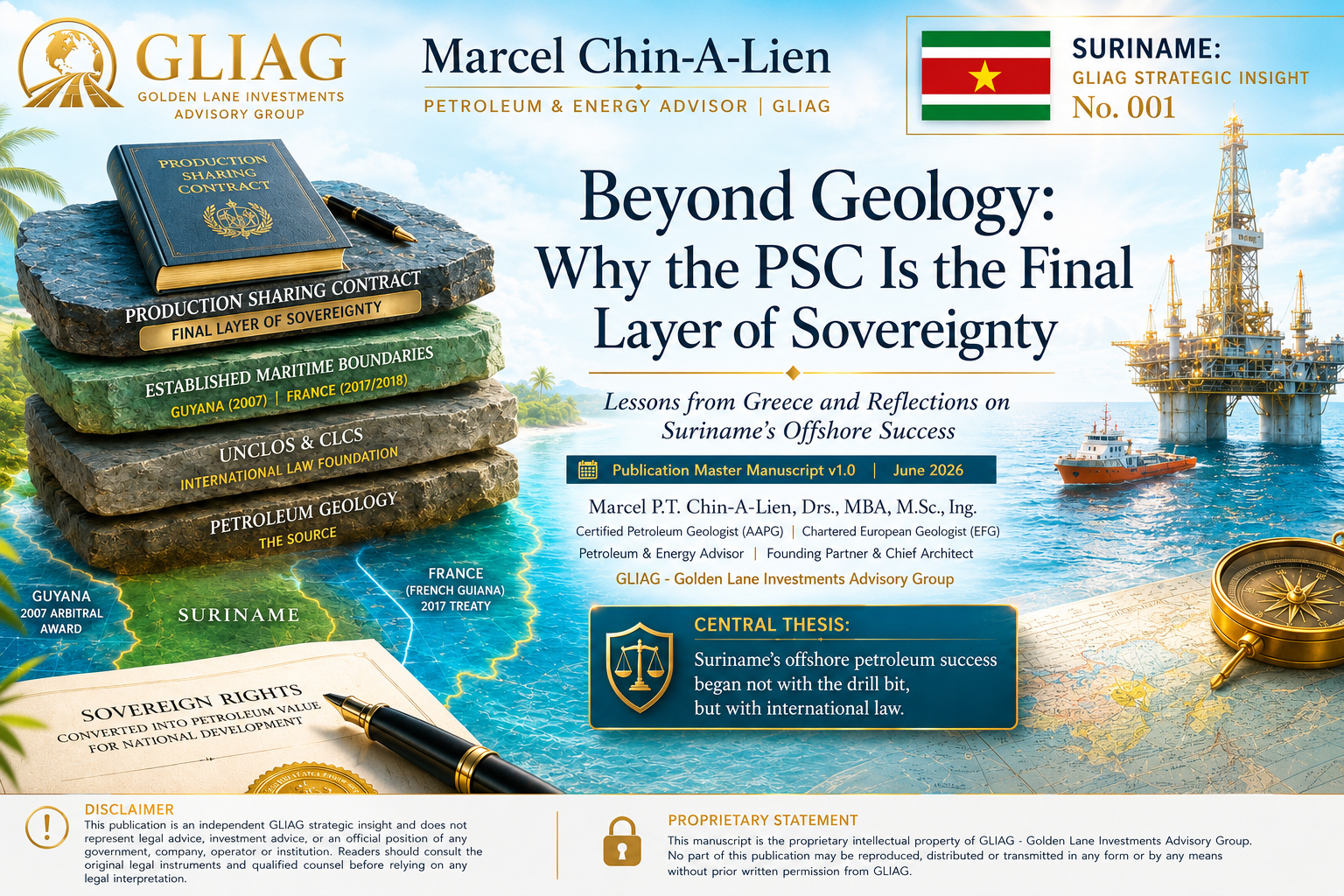
Beyond Geology: Why the PSC Is the Final Layer of Sovereignty
Lessons from Greece and Reflections on Suriname’s Offshore Success
Publication Master Manuscript v1.0 | June 2026
Marcel P. T. Chin-A-Lien, Drs., MBA, M.Sc., Ing.
Certified Petroleum Geologist (AAPG) | Chartered European Geologist (EFG)
Petroleum & Energy Advisor | Founding Partner & Chief Architect
GLIAG – Golden Lane Investments Advisory Group
| Central Thesis: Suriname’s offshore petroleum success began not with the drill bit, but with international law. |
Executive Insight
Greece has raised a new question for offshore petroleum governance: can a petroleum contract help manage the consequences of future geopolitical uncertainty? That question is important. But it also reveals why Suriname is different. Suriname did not use its Production Sharing Contract to solve sovereignty. It secured the legal foundations of its offshore jurisdiction first, and the PSC became the final contractual layer built upon that foundation.
This is the central GLIAG insight: legal certainty is part of the petroleum system. Geology may generate hydrocarbons; international law, maritime boundaries and stable institutions make those hydrocarbons investable.
Greece as the Trigger, Not the Story
Recent discussion around Greek offshore contracting points to a broader trend: States may increasingly use petroleum contracts not only to allocate geological, technical and commercial risk, but also to reduce certain forms of geopolitical uncertainty. If future maritime delimitation or sovereign decisions affect offshore acreage, contractual compensation mechanisms may become part of the investor-protection architecture.
That is an important development. But Greece is not the subject of this paper. Greece is the trigger. The real strategic question is whether a PSC should ever have to carry unresolved sovereignty risk in the first place. Suriname provides a different answer.
Suriname Chose Legal Certainty First
Suriname presents a fundamentally different situation from jurisdictions where offshore acreage remains exposed to unresolved maritime claims. Before the country’s major offshore discoveries, its maritime jurisdiction had already been grounded in internationally recognised legal instruments.
The maritime boundary with Guyana was determined by the 2007 Annex VII UNCLOS Arbitral Award. The maritime boundary with France, concerning French Guiana, was established by bilateral treaty, signed in 2017 and entering into force in 2018. In addition, the United Nations Commission on the Limits of the Continental Shelf issued recommendations concerning Suriname’s continental shelf beyond 200 nautical miles.
Strictly speaking, this is not an ‘extended EEZ’. Under UNCLOS, the exclusive economic zone extends up to 200 nautical miles. The legal instrument beyond 200 nautical miles concerns the continental shelf, where coastal States may exercise sovereign rights over seabed and subsoil resources in accordance with UNCLOS Article 76.
The result is a high degree of offshore legal certainty. Investors entering Suriname’s offshore petroleum sector operate within a jurisdiction whose maritime boundaries and continental shelf framework are founded on international legal instruments rather than on unresolved delimitation claims.
The PSC as the Final Layer of Sovereignty
Suriname’s PSC therefore has a different function. It does not need to resolve sovereignty. It converts already established sovereign rights into petroleum operations, investment obligations, cost recovery, profit sharing, fiscal balance, environmental responsibility and long-term national development.
This is the original GLIAG proposition introduced by this paper: the Production Sharing Contract is the final layer of sovereignty. It should not be the first instrument trying to compensate for unresolved jurisdictional uncertainty.
Figure 1. The Architecture of Offshore Investment Certainty
| Production Sharing Contract |
| Established Maritime Boundaries |
| UNCLOS & CLCS |
| Petroleum Geology |
Suriname’s offshore investment architecture was constructed from the seabed upward: geology first, sovereignty second, investment third.
Why It Matters
Legal certainty is economic infrastructure. It reduces sovereign risk, strengthens investor confidence and helps lower the political risk premium attached to long-cycle offshore projects. It also allows the PSC to do what it is designed to do: allocate petroleum risk, not unresolved sovereignty.
Suriname’s model is therefore not merely a legal achievement. It is a petroleum achievement. The country’s internationally recognised maritime boundaries, continental shelf framework and modern PSC together form an investment architecture. This is why Suriname offers more than geological prospectivity. It offers legal certainty.
GLIAG Strategic Insights
Legal certainty is part of the petroleum system. A petroleum system describes source, reservoir, seal, trap and timing. A petroleum province also requires a legal system that makes capital deployment possible.
International law is investment infrastructure. UNCLOS, maritime delimitation and CLCS recommendations may look legal, but they reduce sovereign risk and create investment confidence.
Suriname solved sovereignty before petroleum contracts. The PSC operates within an already established offshore legal framework rather than managing unresolved maritime claims.
The PSC is the final layer of sovereignty. It converts established sovereign rights into exploration, development, fiscal balance and national value creation.
Petroleum provinces are built by institutions. Geology discovers petroleum; institutions convert petroleum into durable national development.
Conclusion
Greece reminds us that petroleum contracts are evolving. Suriname reminds us that the strongest petroleum contract is the one that does not have to resolve questions of sovereignty.
Petroleum is discovered by geology. Petroleum provinces are built by institutions. Suriname’s offshore success did not begin with the drill bit; it began with legal certainty. The petroleum discoveries that followed confirmed the value of that foundation.
Marcel P.T. Chin-A-Lien, Drs., MBA, M.Sc., Ing.
Certified Petroleum Geologist (AAPG) | Chartered European Geologist (EFG)
Petroleum & Energy Advisor | Founding Partner & Chief Architect
GLIAG – Golden Lane Investments Advisory Group
Annex – Trusted References and Hyperlinks
The following references are selected for publication use. Primary official sources are listed first. The report relies on them for the legal foundation of the argument.
A. International Law and Maritime Boundaries
• United Nations Convention on the Law of the Sea (UNCLOS), official PDF – Relevant especially to EEZ limits, continental shelf definition and maritime delimitation.
• Permanent Court of Arbitration – Guyana v. Suriname case page – Official PCA case page for the arbitration concerning the Guyana-Suriname maritime boundary.
• UN Reports of International Arbitral Awards – Guyana v. Suriname Award of 17 September 2007 – Official UN RIAA text of the 2007 award.
• Agreement on Maritime Delimitation between France and Suriname, signed 8 November 2017, entered into force 1 December 2018 – Official treaty text published via UN DOALOS.
• UN DOALOS Suriname State File – Official UN Law of the Sea page collecting Suriname maritime legislation, treaties and deposits.
• UN CLCS Suriname submission page – Official CLCS page for Suriname’s continental shelf submission.
• UN CLCS Recommendations concerning Suriname’s continental shelf beyond 200 nautical miles – Official recommendations document. This concerns the continental shelf beyond 200 nautical miles, not an extended EEZ.
B. Suriname Petroleum Framework
• Staatsolie Model Production Sharing Contract – Official model PSC published by Staatsolie.
C. International Petroleum and Investment Law References
• Association of International Energy Negotiators (AIEN) – Model Contracts – AIEN states that its model contracts are widely accepted and used in the international energy industry.
• ICSID Convention overview – Official ICSID overview of the Convention for investor-State dispute settlement.
• ICSID Convention PDF – Official ICSID Convention text.
• UNCTAD – State Contracts publication page – UNCTAD publication on State contracts in international investment agreements.
• UNCTAD – State Contracts PDF – Official PDF of the UNCTAD State Contracts paper.
Author Note and Disclaimer
The author had the privilege of contributing to the development of Suriname’s modern Production Sharing Contract framework during advisory work for Staatsolie. This publication is an independent GLIAG strategic insight and does not represent legal advice, investment advice, or an official position of any government, company, operator or institution. Readers should consult the original legal instruments and qualified counsel before relying on any legal interpretation.