Author: Marcel Chin-A-Lien – 20th February 2026
Founder and Affiliation: “ Golden Lane Investments Advisory Group “
Abstract
Sloanea (Block 52, offshore Suriname) has been declared commercially viable and is positioned to become a producing offshore gas development.
Public disclosures confirm hydrocarbon-bearing Campanian sandstone packages and successful appraisal.
However, very limited reservoir and reserves information has been released into the public domain.
In the absence of detailed subsurface data, this study applies a disciplined analog-based methodology to construct a scientifically grounded, conceptual production–depletion profile.
Two well-documented deepwater turbidite gas fields — Mensa (Gulf of Mexico) and Laggan–Tormore (West of Shetland) — are used as behavioral proxies.
The objective is not to forecast Sloanea deterministically, but to establish and prognose at this stage a physics-consistent, most probable production envelope suitable for subsequent fiscal–economic scenario modeling.
1. Commercial Signal — Limited Reservoir Transparency
Public communications indicate:
- Commercial gas discovery in Campanian sandstone packages
- Successful appraisal and comprehensive testing
- Subsea gas development concept
- Standalone offshore gas trajectory
What remains undisclosed publicly includes:
- Porosity and permeability values
- Pressure regime (normal vs geopressured)
- Fluid composition (dry gas vs condensate-rich gas)
- Net pay thickness and net-to-gross
- Connected reservoir volume
- Well test deliverability metrics
- Compartmentalization and segmentation
Without these parameters, deterministic production forecasting is not defensible.
However, reservoir depletion physics follows universal principles.
Therefore, an analog-based envelope approach is scientifically legitimate.
2. Proxy Selection Framework
Valid analog fields must match first-order controls:
- Deepwater depositional system class (turbidite architecture)
- Subsea gas development type
- TCF-scale magnitude
- Depletion-drive behavior
- Published technical documentation
3. Selected Analog Reservoirs
Mensa — Gulf of Mexico
A documented deepwater turbidite sheet/lobe gas reservoir with published reservoir architecture and depletion behavior. It represents an end-member of relatively well-connected deepwater turbidite gas production.
Laggan–Tormore — West of Shetland
Documented Paleocene deepwater turbidite channel–lobe gas(-condensate) fields developed via subsea infrastructure. Represents an end-member where reservoir architecture and facility constraints influence plateau and decline.
4. High-Level Geological Comparison
| Parameter | Sloanea | Mensa | Laggan–Tormore |
|---|---|---|---|
| Depositional Setting | Atlantic passive margin (GSB) | Passive margin deepwater | North Atlantic passive margin |
| Reservoir Age | Campanian (Cretaceous) | Miocene | Paleocene |
| Reservoir Type | Sandstone packages (public detail limited) | Turbidite sheet/lobe | Turbidite channel–lobe |
| Fluid | Gas (publicly indicated) | Dry gas | Gas–condensate |
Age differences introduce diagenetic uncertainty, yet depletion-drive gas behavior remains primarily governed by connected volume, permeability distribution, and development constraints.

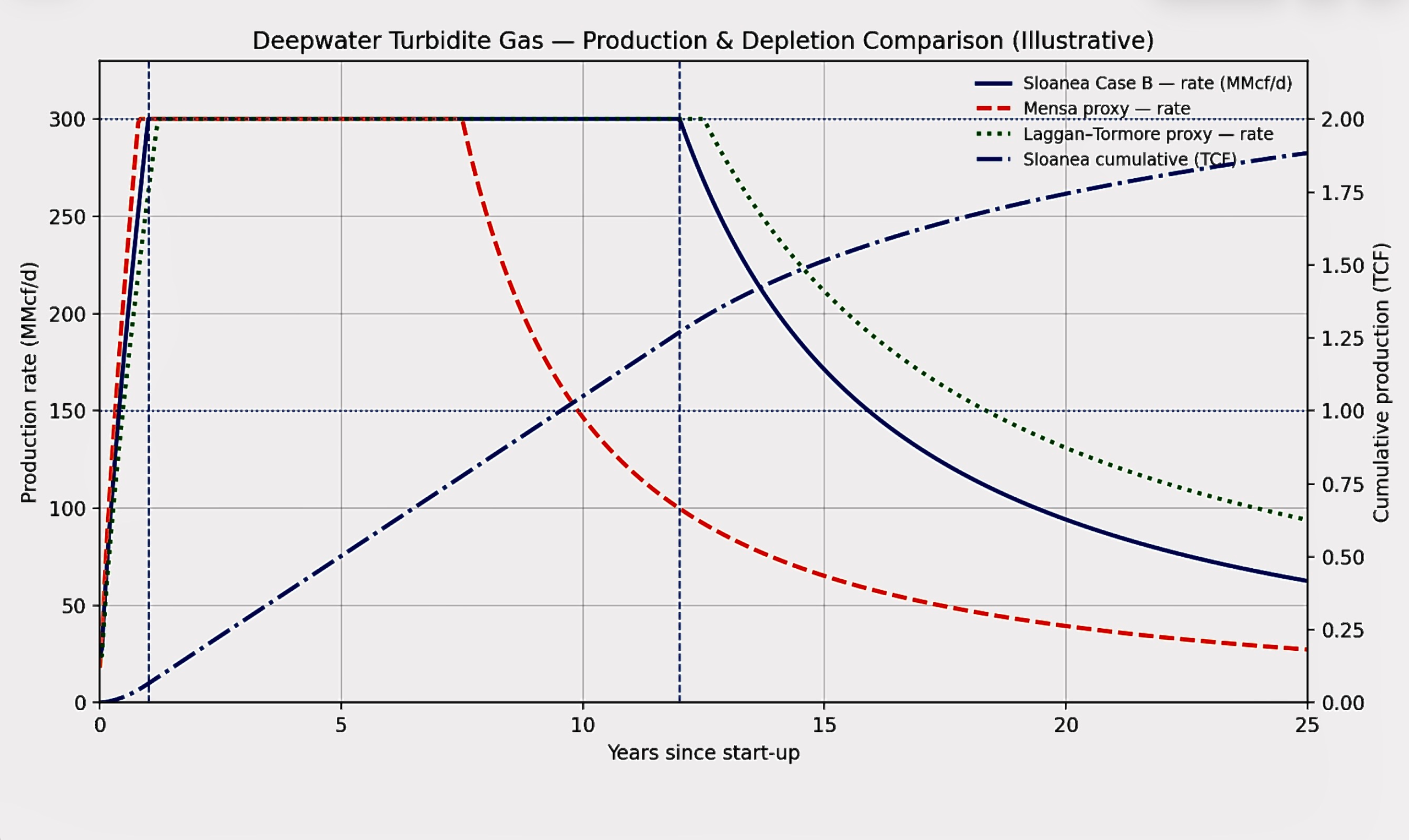
5. Conceptual Production–Depletion Envelope
A normalized production profile was constructed using the analog fields as bounding cases:
- Ramp-up phase
- Plateau phase
- Hyperbolic-style decline
- Long-tail production
The base-case Sloanea profile is positioned between Mensa-like and Laggan–Tormore-like behavior.
Curves represent analog-derived envelopes and are not based on published Sloanea well-test data.

6. Cumulative Recovery Implications (1–2 TCF Scenario)
Under a TCF-scale assumption:
- 1 TCF may be reached within the first half of project life under moderate connectivity
- 2 TCF requires sustained plateau and favorable reservoir continuity
- Decline steepness materially impacts fiscal timing and NPV
7. Risk Assessment
Critical uncertainties that may materially alter depletion behavior:
- Pressure regime (normal vs geopressured)
- Reservoir compartmentalization
- Condensate yield and near-well phase behavior
- Facilities-driven plateau constraints
- Structural vs stratigraphic trap complexity
Therefore, the curves should be interpreted strictly as physically plausible envelopes pending reservoir data disclosure.
8. Relevance for Fiscal–Economic Modeling
Fiscal modeling is highly sensitive to:
- Plateau rate and duration
- Timing of decline onset
- Cumulative recovery timing
- Facility utilization efficiency
The analog-based production–depletion envelope provides the technical foundation necessary for structured economic scenario analysis in the next phase of research.
Conclusion
Sloanea is indicated to move toward production. However, reservoir transparency remains limited. In such conditions, disciplined analog selection offers a scientifically grounded pathway to estimate production behavior.
Mensa and Laggan–Tormore provide validated deepwater turbidite gas references. By bracketing Sloanea between these systems, we establish a credible depletion framework suitable for further fiscal-economic evaluation.
All curves presented are conceptual analog-based envelopes and do not represent published Sloanea reservoir parameters.
About the Author
Marcel Chin-A-Lien
Global Petroleum & Energy Advisor
Founder – Golden Lane Investments Advisory Group
Marcel Chin-A-Lien brings 48 years of international experience across exploration geology, reservoir evaluation, upstream commercial structuring, and fiscal regime design. His career spans giant field discovery, frontier basin entry, offshore bid rounds, Production Sharing Contract (PSC) design, upstream M&A, and government–IOC negotiation advisory across Europe, Asia, Africa, and the Americas.
He has contributed to multi-billion-dollar upstream developments, including early international ventures in the former USSR and long-term producing assets in mature basins such as the Dutch North Sea. His work consistently integrates subsurface rigor with commercial discipline—bridging geology, reservoir engineering, and fiscal-economic modeling.
Holding four postgraduate petroleum degrees in geology, engineering, international business, and management, Marcel combines technical reservoir insight with contract strategy and valuation expertise. This integrated perspective underpins the analog-based production–depletion framework presented in this article and supports subsequent fiscal-economic scenario modeling.
Professional Credentials
- Drs – Petroleum Geology
- Engineering Geologist – Petroleum Geology
- Executive MBA – International Business, Petroleum & M&A
- MSc – International Management (Petroleum)
- Certified Petroleum Geologist #5201 – AAPG
- Chartered European Geologist #92 – EFG
- Energy Negotiator – Association of International Energy Negotiators (AIEN)
Advisory focus areas include exploration strategy, giant field discovery evaluation, PSC fiscal structuring, upstream asset valuation, integrated technical–commercial due diligence, and government negotiation support.
Contact:
LinkedIn: (Insert Profile URL)
Email: marcelchinalien@gmail.com