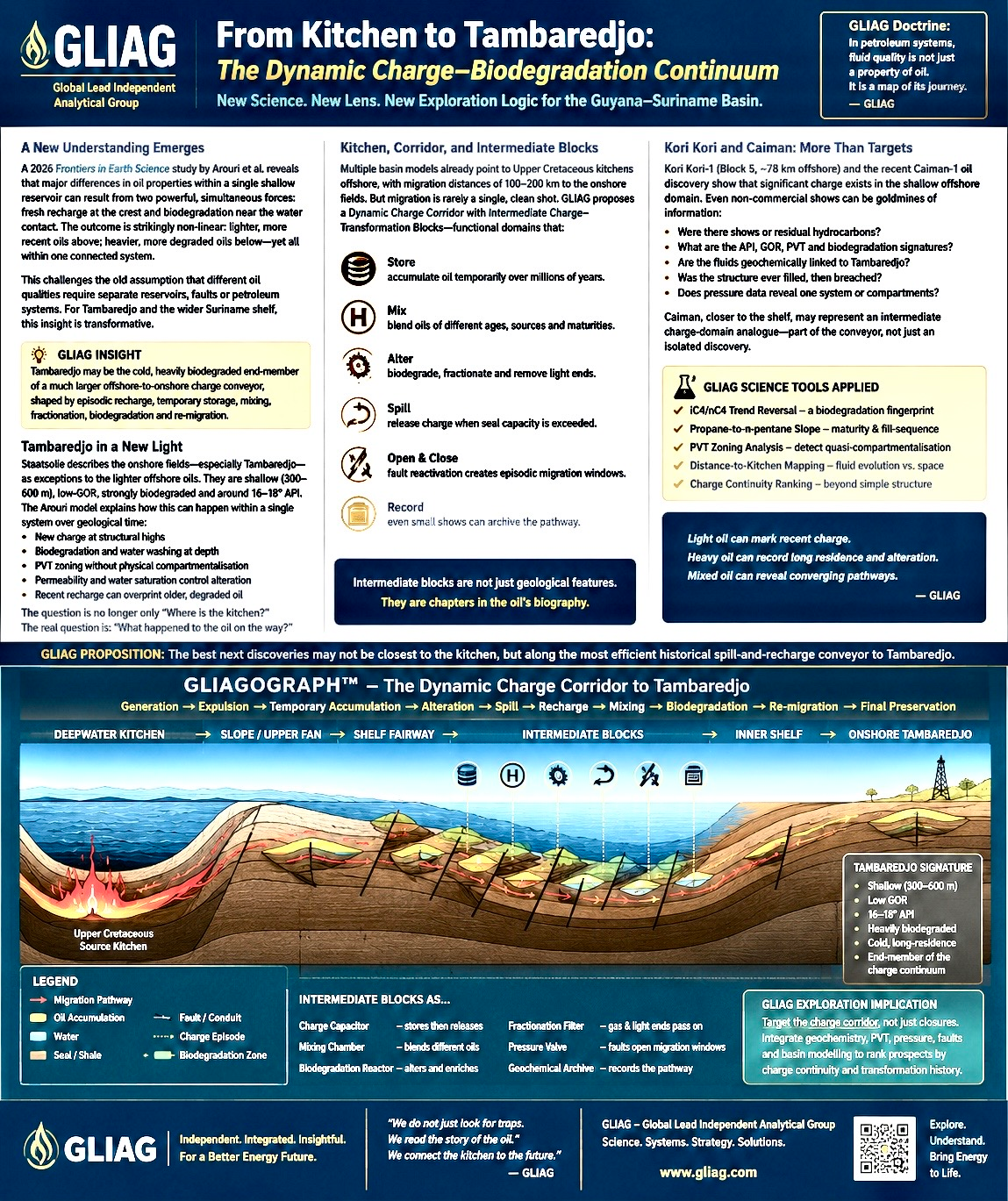
A flagship GLIAG website essay in the style of your Strategic Petroleum Intelligence Platform, integrating the Frontiers paper while clearly distinguishing evidence from GLIAG’s independent hypotheses.
GLIAG Strategic Petroleum Intelligence Platform
From Kitchen to Tambaredjo
Rethinking Petroleum Migration in the Guyana–Suriname Basin
The Dynamic Charge–Biodegradation Continuum
GLIAG Strategic Petroleum Intelligence Essay
Publication No.: GLIAG-SPI-2026-0723
23 July 2026
Marcel P. T. Chin-A-Lien
Principal Founding Member & Chief Architect of GLIAG N.V. – 23 July 2026
Executive Summary
Petroleum systems are commonly portrayed as elegant and orderly. Organic matter matures within a source rock, hydrocarbons are expelled, migrate along carrier beds, accumulate beneath competent seals, and remain preserved until discovered by drilling.
Nature, however, is rarely so simple.
A recent publication by Arouri et al. (2026) in Frontiers in Earth Science challenges one of the petroleum industry’s most persistent assumptions: that variations in reservoir-fluid properties necessarily indicate different reservoirs, separate petroleum systems, or structural compartmentalization. Their study demonstrates that a single connected accumulation may evolve into multiple fluid domains through the combined effects of continued hydrocarbon recharge, biodegradation, water washing, gravity segregation and incomplete mixing.
Although their work was conducted in a Middle Eastern carbonate reservoir, its conceptual implications extend far beyond that case study.
For the Guyana–Suriname Basin, it offers an entirely new way of thinking about the relationship between the deep offshore Golden Lane, the continental shelf, and Suriname’s historic onshore Tambaredjo oil fields.
This essay proposes that Tambaredjo should not simply be viewed as an isolated heavy-oil field. Instead, it may represent the preserved landward end-member of a dynamic petroleum conveyor extending from offshore source kitchens through a succession of intermediate charge domains toward the coastal basin.
This proposition is not yet established fact.
It is a hypothesis worthy of systematic testing.
Beyond Static Petroleum Systems
Traditional petroleum-system models describe migration as a largely one-way process:
Generation → Expulsion → Migration → Accumulation → Preservation
That sequence remains fundamentally correct.
Yet it often creates the impression that migration occurs once, after which fluids remain essentially unchanged.
Increasingly, modern geochemistry suggests otherwise.
Hydrocarbons continue evolving after emplacement.
Reservoirs may receive repeated recharge events.
Microbial alteration changes oil composition.
Water washing selectively removes soluble compounds.
Later charge pulses may mix with earlier degraded oils.
Faults may alternately seal and leak over geological time.
Consequently, fluid properties become records not merely of origin, but of geological history.
Oil is not simply stored.
Oil evolves.
The Dynamic Charge–Biodegradation Continuum
The Frontiers study demonstrates that apparently separate fluid populations can arise inside one hydraulically connected reservoir.
Freshly charged lighter oils preferentially occupy structurally higher positions.
Older oils, residing longer near active aquifers, become progressively biodegraded.
The resulting variations in viscosity, API gravity, gas–oil ratio and composition may therefore reflect dynamic geological evolution rather than structural isolation.
For petroleum exploration, this distinction is profound.
Fluid variation is not necessarily evidence of compartmentalization.
It may instead represent the geological memory of the petroleum system.
Looking Again at Tambaredjo
For decades Tambaredjo has been recognised as one of the world’s largest shallow heavy-oil accumulations.
Its oils are characteristically:
- shallowly buried;
- relatively cold;
- strongly biodegraded;
- low in dissolved gas;
- approximately 16–18° API.
Conventional interpretation attributes these characteristics largely to long-distance migration followed by biodegradation.
The Dynamic Charge–Biodegradation Continuum suggests a richer interpretation.
Tambaredjo may preserve the final evolutionary stage of hydrocarbons that experienced multiple episodes of migration, temporary storage, biodegradation, mixing and renewed movement before arriving within Paleocene reservoirs.
Its heavy oil is therefore not merely degraded oil.
It may be the geological biography of an entire petroleum system.
A Missing Chapter Between the Kitchen and the Field
One question naturally follows.
If hydrocarbons travelled from offshore Upper Cretaceous source kitchens toward the present coastline, where are the intermediate accumulations?
GLIAG proposes that these may exist—or may once have existed—as what we term:
Intermediate Charge-Transformation Blocks
These domains need not have been commercially significant.
Their geological importance lies elsewhere.
They may have functioned as:
- temporary hydrocarbon storage systems;
- spill points;
- pressure regulators;
- biodegradation reactors;
- mixing chambers;
- remigration staging areas;
- geochemical archives.
Instead of viewing migration as a single uninterrupted journey, petroleum may have advanced across the basin through successive episodes of filling, spilling, leakage, recharge and re-accumulation.
This resembles a relay race rather than a direct sprint.
Kori Kori and Caiman Revisited
Within this framework, recent shallow-offshore exploration acquires entirely new significance.
The importance of wells such as Kori Kori or discoveries such as Caiman should not be measured solely by commercial success.
Their true value may lie in answering different questions.
Did hydrocarbons once pass through these structures?
Were fluids biodegraded?
Do geochemical fingerprints resemble Tambaredjo?
Did these structures temporarily retain charge before leakage?
Do they preserve evidence of earlier migration episodes?
Even non-commercial hydrocarbon shows may become critical calibration points within a basin-wide migration model.
Dry holes may still contain extraordinary geological information.
A Socratic Perspective
GLIAG deliberately approaches this hypothesis through continuous questioning rather than confirmation.
Does the Golden Lane directly charge Tambaredjo?
Perhaps.
Does existing evidence prove such continuity?
Not yet.
Could multiple offshore kitchens contribute?
Possibly.
Could intermediate accumulations have transformed fluid properties before final migration?
Quite possibly.
Could different oils within Tambaredjo reflect dynamic recharge rather than separate petroleum systems?
That question deserves renewed investigation.
Scientific progress rarely begins with certainty.
It begins with better questions.
Implications for Future Exploration
If this dynamic migration model proves valid, exploration philosophy changes fundamentally.
Prospects should not be ranked solely according to structural closure.
They should also be evaluated according to their position within regional charge pathways.
Future exploration may benefit from integrating:
- basin modelling;
- pressure connectivity;
- volatile hydrocarbon geochemistry;
- biomarker analysis;
- fault-seal evolution;
- biodegradation indicators;
- fluid inclusion studies;
- migration-path reconstruction.
Exploration success may depend as much upon understanding petroleum history as petroleum geometry.
The GLIAG Proposition
GLIAG therefore advances the following independent working hypothesis:
Tambaredjo may represent the preserved landward end-member of a dynamic offshore-to-onshore petroleum conveyor in which hydrocarbons experienced repeated cycles of migration, temporary accumulation, biodegradation, mixing and remigration through intermediate charge domains extending from the deep offshore Guyana–Suriname Basin toward coastal Suriname.
This proposition remains a scientific hypothesis.
Its value lies not in replacing existing petroleum-system models, but in expanding them.
Should future geochemical correlations, basin modelling, pressure analysis and exploration drilling support this concept, the implications extend well beyond Tambaredjo.
The Guyana–Suriname Basin would increasingly be interpreted not as a collection of isolated discoveries, but as an evolving petroleum continuum whose history is recorded within the fluids themselves.
Oil would cease to be viewed merely as a commodity.
It would become evidence.
It would become memory.
And perhaps, as every geologist eventually learns, the Earth remembers far more than we first imagine.
About GLIAG
GLIAG N.V. – Golden Lane Investments Advisory Group is an independent Strategic Petroleum Intelligence Platform integrating petroleum geology, basin evolution, geochemistry, exploration strategy, fiscal architecture, energy economics and sovereign development.
GLIAG Philosophy
“Where Information Becomes Intelligence.”
“Where Discoveries Become Strategy.”
“From Molecules to Nations.”
Copyright © 2026 GLIAG N.V. All Rights Reserved.
This publication represents an independent scientific interpretation prepared by GLIAG. It distinguishes published evidence from forward-looking hypotheses intended to stimulate discussion and guide future research. All interpretations should be tested against geochemical, geological and engineering data before being adopted as exploration or investment decisions.
Related GLIAG Essays
Readers interested in the Dynamic Charge–Biodegradation Continuum are encouraged to explore the following companion essays, which collectively develop GLIAG’s integrated interpretation of the Guyana–Suriname Basin.
Petroleum Systems & Golden Lane
• The Untold Story of Suriname’s Golden Lane
Evolution of the Golden Lane concept and its implications for the Guyana–Suriname Basin.
• The Golden Lane Corridor: Suriname’s Oil Future Unfolds
The emerging petroleum fairway linking recent discoveries into a coherent regional system.
• Exploring the Legendary Petroleum Province of El Dorado
Historical evolution of the Guyana–Suriname petroleum province.
Block 52 and the Second Petroleum Engine
• Block 52: Suriname’s Strategic Dual-Track Gas and Oil Development
How oil and gas discoveries together redefine the southeastern basin.
• The Second Engine
Why southeastern Suriname may represent the basin’s next phase of petroleum growth.
• Gran Morgu: Beyond the Headlines of Oil Reserves
Understanding reserves, uncertainty and long-term value creation.
• GranMorgu and Beyond: What Four New Names Indicate
Interpreting new discoveries as part of a growing petroleum system.
Petroleum Systems, Geochemistry and Basin Evolution
• The Connection Between Fish and Oil: Insights from the Guyana–Suriname Basin
A multidisciplinary perspective on basin evolution and environmental history.
• Maximizing Yellowtail Reservoir Value Through Stewardship
Reservoir management viewed through geological and fiscal stewardship.
Suriname’s Energy Transformation
• Suriname’s Energy Transformation: From Gas to Shore to National Wealth
Connecting offshore gas to industrialisation and sovereign development.
• Transforming Suriname’s Petroleum into Productive Power
Converting petroleum resources into sustainable national prosperity.
• Building Suriname’s Future: The Case for a Modular Refinery
A strategic roadmap for downstream value creation.
• Understanding Petroleum Law’s Role in Suriname’s Development
The legal architecture underpinning successful petroleum development.
• SURINAME and THE CONVERSION
From resource discovery to economic transformation.
GLIAG Series Banner
Part of the GLIAG Strategic Petroleum Intelligence Series
From Molecules to Nations
Integrating petroleum geology, petroleum systems, geochemistry, exploration, reservoir engineering, petroleum law, fiscal architecture, gas monetization and sovereign development into one continuously expanding knowledge platform.
This creates a coherent “GLIAG Library” where every new publication links readers to earlier work, reinforcing my platform as an interconnected body of strategic intelligence rather than isolated articles.