Pioneering Subsurface Exploration in the Maracaibo Basin
Witten by Marcel Chin-A-Lien – Petroleum and Energy Insights Advisor – 3th August, 2025.
A stroll down Geo-Memory Lane.
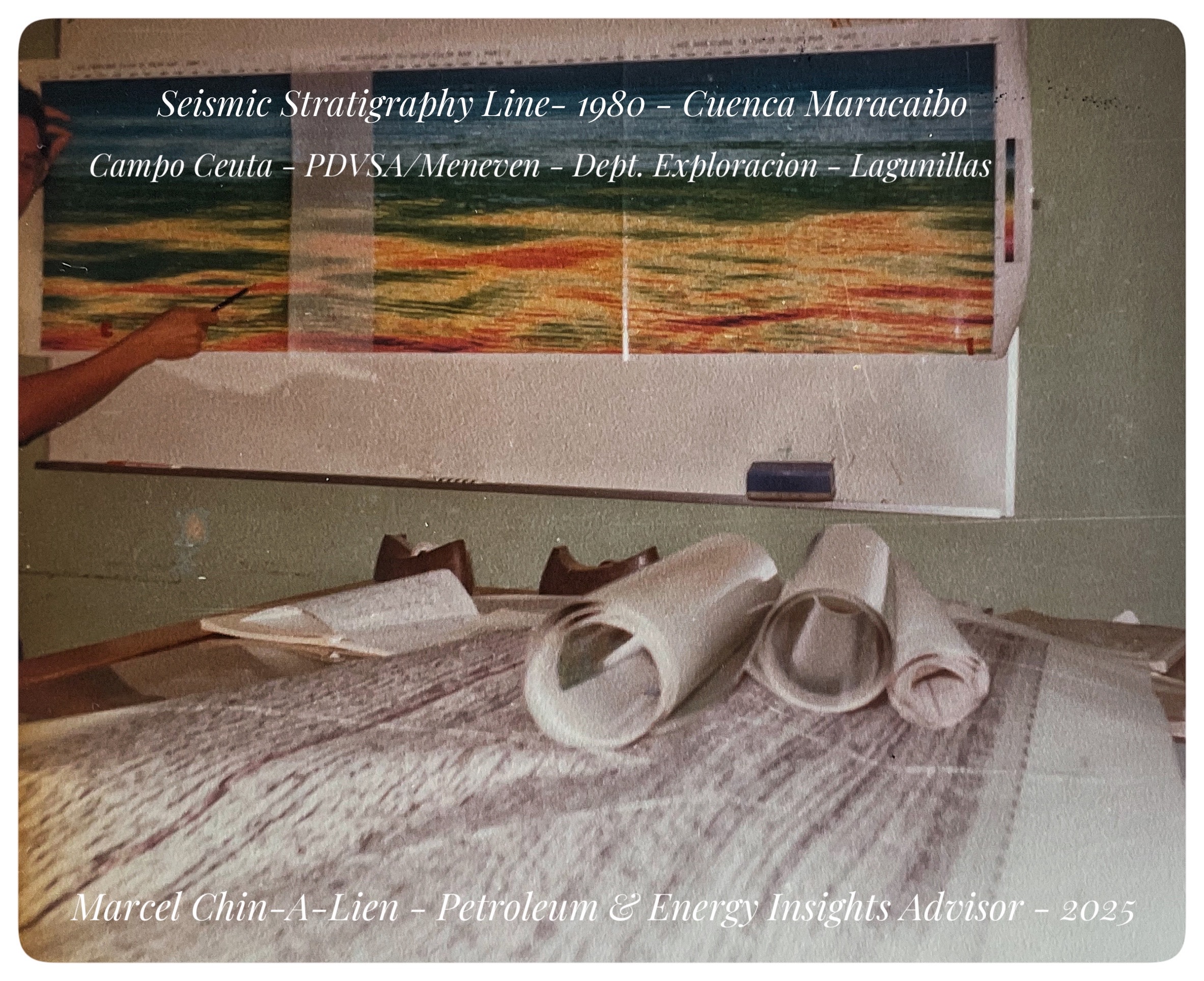
The year 1980 marked a watershed moment in Venezuelan petroleum exploration, as geologists and geophysicists at Petróleos de Venezuela’s Meneven division stood at the threshold of a revolutionary approach to understanding the subsurface.
In the humid corridors of the Departamento de Exploración in Lagunillas, Estado Zulia, a small team of dedicated professionals was about to make geological history using the nascent science of seismic stratigraphy, a discipline that would soon unlock one of Venezuela’s most spectacular oil discoveries.
The Birth of a Revolution
Seismic stratigraphy had emerged as a transformative concept following the groundbreaking work of Peter Vail and his colleagues at Exxon Production Research Company in the early 1970s.
The discipline gained widespread recognition after the publication of the seminal American Association of Petroleum Geologists (AAPG) Memoir 26 in 1977, titled “Seismic Stratigraphy—Applications to Hydrocarbon Exploration.”
This 516-page tome, edited by Charles E. Payton, became the bible of us all as a new generation of explorationists who dared to see beyond conventional sedimentary and stratigraphic focussed geology.
The revolutionary concept was elegantly simple yet profoundly complex: seismic reflections could be interpreted not merely as structural features, but as chronostratigraphic surfaces representing ancient depositional environments.
Vail’s sequence stratigraphy provided a framework for understanding how sea-level changes controlled sediment deposition, creating predictable patterns of reservoir and seal rocks across sedimentary basins.
The Maracaibo Basin: A Geological Theater
The Cuenca de Maracaibo, with its prolific Eocene Misoa Formation, presented an ideal natural laboratory for applying these revolutionary concepts. This foreland basin, formed during the Andean orogeny, contained a complex succession of fluvial, deltaic, and shallow marine deposits that had been the backbone of Venezuelan oil production since the early 20th century.
Yet despite decades of successful drilling, vast areas remained unexplored, many of their secrets still locked in the layers of the Misoa Formation sediments, in the already mature basin.
The Technology of Discovery: 1980
In an era before digital workstations and sophisticated software, the art of seismic interpretation was truly that—an art. The tools of the trade were refreshingly analog: rolls of paper seismic sections unfurled across interpretation tables, colored pencils worn smooth from countless hours of line picking, and the indispensable Texas Instruments scientific calculator—a marvel of 1970s technology that could perform complex trigonometric functions and statistical calculations essential for time-depth conversions and petrophysical analysis.
The seismic data itself arrived as photographic prints, each line a continuous strip of variable-area or wiggle-trace displays showing the Earth’s response to acoustic energy. Interpreters would spend hours tracing reflectors with colored pencils—red for strong events, blue for weaker ones, green for possible faults. Correlation panels were hand-drawn, and structural contour maps emerged from painstaking point-by-point calculations using slide rules and calculators.
Well log analysis was equally hands-on. Petrophysicists would manually digitize curves from paper logs, calculate porosity and saturation values point by point, and construct cross-plots on graph paper. The Texas Instruments calculator became the computational workhorse, its red LED display a familiar glow in darkened offices as geologists performed Archie equation calculations and statistical analyses that today’s computers execute in milliseconds.
Campo Ceuta: Where Theory Met Reality
Against this backdrop of technological simplicity and interpretive complexity, the team at Meneven embarked on their ambitious project in Campo Ceuta. The seismic line that would become historically significant represented one of the earliest applications of sequence stratigraphic principles in Venezuela. Using Vail’s concepts of systems tracts and sequence boundaries, the interpreters began to see the Eocene Misoa Formation not as a simple layer cake of rocks, but as a complex three-dimensional tapestry of depositional environments.
The breakthrough came through the careful identification of sequence boundaries—unconformities that represented significant changes in depositional conditions.
By mapping these surfaces and the intervening systems tracts, the team could predict where the prolific fluvio-deltaic sandstones of the giant Eocene Misoa delta had accumulated in favorable structural and stratigraphic positions, creating the reservoir-quality sandstones that would later prove to contain the Ceuta Field’s impressive reserves.
The Discovery That Changed Everything
The validation of these seismic stratigraphic interpretations came in 1981 with the discovery of the east flank of the giant Ceuta Field.
With over three billion barrels of light, high-gravity premium crude oil in place within the Eocene Misoa Formation, this discovery represented not only a triumph of new thinking over conventional wisdom but also a transformative economic windfall for Venezuela.
The field’s exceptional reserves of premium-grade oil commanded top prices in international markets, generating billions of dollars in revenue that would fuel national development for decades to come.
The success proved that seismic stratigraphy could unlock previously hidden reserves in mature basins, fundamentally changing how explorationists viewed “played-out” areas while delivering extraordinary economic returns that justified continued investment in advanced exploration technologies.
The discovery was particularly significant because it demonstrated the power of sequence stratigraphic concepts in a complex foreland basin setting while delivering unprecedented economic value to the nation.
The reservoir sandstones, recognized as fluvio-deltaic deposits of the giant Eocene Misoa delta, represented the product of a massive sedimentary system that had built seaward during periods of high sediment supply.
Understanding the depositional architecture of this delta complex through sequence stratigraphic analysis allowed the team to predict reservoir distribution and quality with unprecedented accuracy.
This understanding opened new exploration plays throughout the Maracaibo Basin and established Venezuela as a pioneer in the practical application of seismic stratigraphy.
The east flank discovery alone, with its massive reserves of high-gravity crude, represented one of the most economically significant petroleum discoveries in Venezuelan history, transforming the nation’s energy portfolio and providing substantial financial resources for social and economic development.
A Legacy Written in Colored Pencil
Looking back from our current era of 3D seismic, artificial intelligence, and machine learning, quantum computing, the simplicity of 1980s exploration technology seems almost quaint.
Yet there was something profound about the intimate relationship between interpreter and data that those analog tools fostered.
Every reflection was traced by hand, every correlation considered and reconsidered, every interpretation the product of careful observation and geological intuition honed through direct engagement with the data.
The seismic line from Campo Ceuta stands as a monument to this era, a testament to the power of human insight combined with revolutionary scientific concepts and simple but reliable tools.
It represents a moment when petroleum geology was transformed from an empirical art to a predictive science, when the subsurface became readable in new ways, and when a small team in Lagunillas, Estado Zulia, helped write a new chapter in the history of oil exploration.
In the grand narrative of petroleum exploration, 1980 in Campo Ceuta represents more than just the successful application of new technology.
It marks the moment when seismic stratigraphy came of age, when theoretical concepts proved their worth in the unforgiving arena of commercial exploration, and when the future of oil discovery was forever changed by the marriage of sequence stratigraphy and seismic interpretation.
A Tribute to Visionary Leadership
This essay stands as a tribute to the small but exceptional Exploration Department in Lagunillas, Estado Zulia, operating under PDVSA’s Meneven division.
The success of the Campo Ceuta project was made possible by the brilliant and creative leadership of a young geologist but already with rank of superintendent, Diego Funes, whose vision and commitment to innovation created an environment where revolutionary ideas could flourish.
Under his guidance, this modest and young team transformed theoretical concepts into commercial reality, proving that institutional support for scientific innovation, combined with exceptional leadership, could unlock the Earth’s hidden treasures.
The colored pencils may have faded, and the Texas Instruments calculators may have been relegated to museums, but the principles discovered and applied in that historic year continue to guide petroleum exploration around the world.
In every modern workstation displaying sophisticated seismic interpretations, the ghost of those hand-drawn interpretations from Campo Ceuta lives on, a reminder that great discoveries often begin with simple tools, revolutionary ideas, and visionary leadership that dares to embrace the unknown.

About the Author — Marcel Chin-A-Lien
Global Petroleum and Energy Advisor
48 Years of Transformative Expertise | Exploration, Oil & Gas Giant Fields Finder – Business Development, M&A, PSC Design, Contract Strategy
Marcel Chin-A-Lien brings nearly five decades of unmatched global expertise at the highest levels of the energy sector—where technical mastery meets business acumen to unlock extraordinary value.
His career has delivered multi-billion-dollar giant field discoveries, spearheaded the iconic first capitalist upstream ventures in the USSR, shaped successful offshore bid rounds, and secured enduring cash flow streams from exploration and production activities across mature and frontier basins such as the Dutch North Sea.
A rare fusion of technical, commercial, and managerial insight, Marcel holds four postgraduate petroleum degrees spanning geology, engineering, international business, and management—uniquely positioning him to bridge the worlds of exploration strategy, M&A, PSC design, and contract negotiation.
Fluent in many languages and culturally attuned to diverse business environments, he has navigated complex geographies from Europe to Asia, Africa, and the Americas—driving innovation, de-risking investments, and aligning stakeholder interests from national oil companies to supermajors.
Whether advising on frontier basin entry, government negotiations, fiscal regime optimization, or asset valuation, Marcel’s critical insights integrate Exploration & Production of Petroleum with Business Development, Commercial ans Strategy Realism—generating sustainable growth in volatile energy markets.
Credentials and Distinctions
- Drs – Petroleum Geology
- Engineering Geologist – Petroleum Geology
- Executive MBA – International Business, Petroleum, M&A
- MSc – International Management, Petroleum
- Energy Negotiator – Association of International Energy Negotiators (AIEN)
- Certified Petroleum Geologist #5201 – AAPG (Gold Standard)
- Chartered European Geologist #92 – EFG (Gold Standard)
- Cambridge Award – “2000 Outstanding Scientists of the 20th Century”, UK
- Paris Awards – “Innovative New Business Projects”, GDF-Suez (2x Gold Awards, 2003)
Strategic Expertise
- Exploration and Production of Petroleum, Strategy & Giant Field Discovery
- Upstream M&A and Asset Valuation
- Production Sharing Contract (PSC) Design & Fiscal Optimization
- Government and IOC Negotiation Advisory
- Bid Round Structuring and Evaluation
- Integrated Technical-Commercial Due Diligence
For trusted advisory services at the nexus of technical excellence, commercial clarity, and geopolitical understanding, connect directly:
Public Profile: LinkedIn
Email: marcelchinalien@gmail.comRegards, Marcel Chin-A-Lien