THE EARTH REMEMBERS · MEMOIRS, PART: COLOMBIA
MEMOIRS · THE EARTH REMEMBERS
THE EARTH REMEMBERS
La tierra recuerda
PEREIRA · LA VIRGINIA · COLOMBIA
A poem-essay of love, grief, despecho and memory

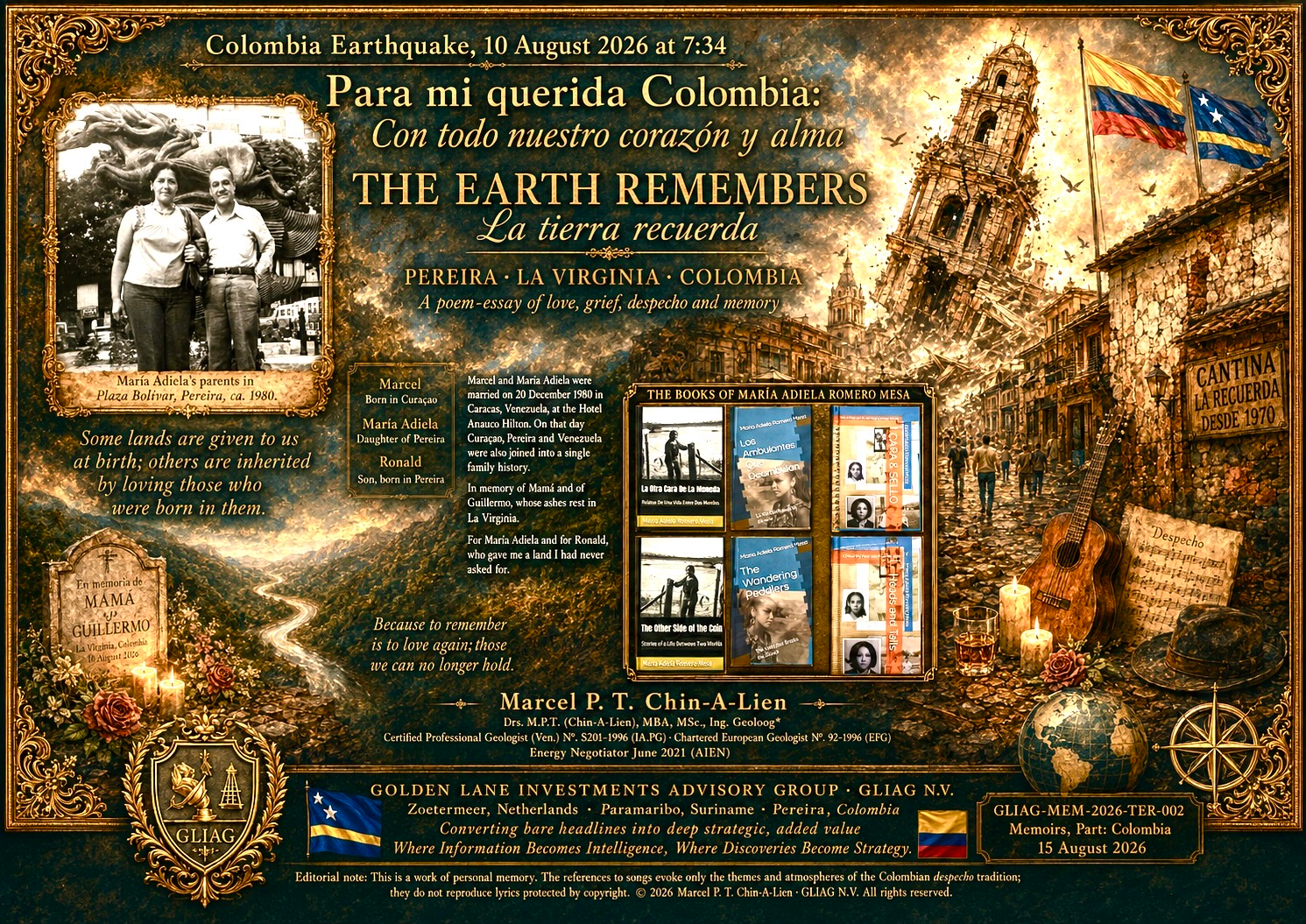
María Adiela’s parents, Plaza Bolívar, Pereira, ca. 1980. An ordinary afternoon that time turned into a relic.
Marcel P. T. Chin-A-Lien
Drs. M.P.T. Chin-A-Lien, MBA, M.Sc., Ing. Geologist
Certified Professional Geologist Nr. 5201-1996 (AAPG) · Chartered European Geologist Nr. 92-1996 (EFG)
Energy Negotiator June 2021 (AIEN)
GLIAG-MEM-2026-TER-001 · Memoirs, Part: Colombia · 15 August 2026
«Some lands are given to us at birth; others are inherited by loving those who were born in them.»
| MarcelBorn in Curaçao | María AdielaDaughter of Pereira | RonaldSon, born in Pereira |
Marcel and María Adiela were married on 20 December 1980 in Caracas, Venezuela, at the Hotel Anauco Hilton. On that day Curaçao, Pereira and Venezuela were also joined into a single family history.
In memory of Mamá and of Guillermo, whose ashes rest in La Virginia.
For María Adiela and for Ronald, who gave me a land I had never asked for.
I
The first tremor was not the one in the ground
There are days when the earth trembles beneath the houses.
And there are others when it trembles inside a man.
That day, when we learned that Pereira and La Virginia had been shaken again, it was not the ground we felt move first.
It was memory.
María Adiela’s childhood trembled. The place where Ronald was born trembled. The road between La Virginia and Pereira trembled — travelled so many times, since those years when we were still young and believed, as all young people believe, that the people we loved would last forever.
The Sundays trembled.
The market square trembled.
Plaza Bolívar trembled.
The old music trembled.
A photograph kept for forty years trembled.
The church trembled.
And when the tower of that church in La Virginia came down, there also came down, for a few seconds, a part of the sky where we had learned to keep our dead.
II
The question one asks the dead
Mamá’s ashes are there. Guillermo’s are there.
Reason says the dead no longer feel fear. The heart understands nothing of reason.
The first question that came was absurd, and for that very reason it was true:
Are you all right?
Mamá… Guillermo… did you feel the church shake?
What a useless question. And yet, what a human question. Because a man can accept death with his head; the heart takes far longer. Sometimes it takes a whole life.
The tower had fallen. But they had not.
Long before that stone came down, Mamá and Guillermo had already moved to a place earthquakes cannot reach: to María’s memory, to Ronald’s blood, to our conversations, to the photographs, to the books, to us.
Because the truly beloved dead end up living in places that stone cannot touch.
And still it hurt. It hurt the way an old song hurts when you hear the first note and already know whom you are about to remember. The way an empty chair hurts. The way a voice that no longer answers hurts. The way it hurts to walk into a house and know exactly where someone sat who is no longer there.
III
Suture
María was born there. I was born in Curaçao. Two geographies that never imagined they would end up joined.
We married on 20 December 1980, in Caracas, at the Hotel Anauco Hilton. That day, without knowing it, our maps married too.
In geology there is a name for the place where two fragments of crust, born apart, thousands of kilometres from one another, are stitched together forever. It is called a suture. It is not a delicate seam: it is the scar left by a collision. And yet, once it exists, there is no longer any way to say where one continent ends and the other begins.
Our suture has a date.
Curaçao entered Pereira.
Pereira entered me.
Venezuela was the witness.
I was not born in Pereira. But the woman I love was born there. Our son was born there. And with the years I learned that a land, too, can be inherited through love.
You receive a country in the eyes of the person you love. In their memories. In the way they pronounce certain names. In the sadness a song brings them. In the silences that appear when someone mentions a street.
And one day you discover that you carry that land in your chest as well.
IV
Sunday
The Pereira of our memory is not exactly the Pereira that exists today. No city survives intact the people who loved it.
Ours belongs to the eighties and the early nineties. To a time when Sunday seemed to last longer.
La Virginia woke early and the market square breathed: fruit, meat, coffee, wet earth, people, voices, radios, vendors. The greeting called out from half a block away.
— How is your mother?
— When did you get back?
— Sit down a while.
— Have something before you go.
Those phrases were small. Now they seem enormous, because they were the everyday form of affection.
Sundays kept a different time. Nobody hurried so much. You could sit, talk, wait, run into someone, lose half a morning in conversation and never feel you were losing anything at all. Today we understand that the time we thought we were losing was precisely life.
You live inside paradise thinking it is routine.
Only when you lose it do you understand where you had been. There were Sundays when everyone was there. Today that seems an impossible wealth. You could still walk into a house and find Mamá. Guillermo could still appear in a doorway. A voice could still say: «See you on Sunday.» And Sunday came.
Nobody told us that one of them would be the last.
Nobody hangs a sign above the last lunch. Nobody announces: «Listen closely to this voice, because it is the last time.» Nobody says: «Hold him a little tighter, because tomorrow you will not be able to.»
Life has that cruel way of passing off its definitive moments disguised as ordinary days.
V
The road
Then came time. First it took the eighties. Then the nineties. And then it began to take people. One by one. Without hurry. Like a thief who knows the house well.
And we kept going back. 2000. 2010. 2020. 2025. Every return held something of joy and something of a funeral, because to return is also to verify what is no longer there.
— There used to be a…
— Do you remember…?
— That place closed.
— He died. She did too.
— This used to be…
What a sad phrase: «this used to be…». A whole life fits into four words.
And there was the road between La Virginia and Pereira. So many times. So many years. At first we travelled young, with more future than past. Then we travelled with children. Then with memories. Then with absences.
And at some point the car began to carry the dead as well. Not in an urn: in a bend, in a house, in a tree, in a conversation. You looked out of the window and suddenly someone came back — a voice, a face, an afternoon, a Sunday — and you went on driving, but inside you had travelled back forty years.
VI
The photograph
Then Pereira would appear. The streets. The shops. The movement. And Plaza Bolívar: the Bolívar Desnudo, the cathedral, the pigeons, the façades, the people.
And there is a photograph.
Plaza Bolívar, Pereira, ca. 1980 — María Adiela’s parents. The photograph stays while we grow old in front of it.
María Adiela’s parents, together, in front of the Bolívar Desnudo, around 1980. They are looking at the camera.
They are alive.
And now we understand that this was a great deal. Perhaps nothing extraordinary happened that day. Perhaps they walked. Perhaps they ate something. Perhaps they spoke of small things. Perhaps they went back to La Virginia before nightfall.
They did not know they were posing for the future.
They did not know that one day their bodies would be ashes. They did not know that those ashes would rest in the church at La Virginia. They did not know that a tower would fall. They did not know their daughter would write books. They did not know that decades later we would look at that photograph and want to step through it and tell them: «Don’t go yet.»
That is the terrible thing about old photographs: the people in them do not know what we already know. They do not know who will die first. They do not know which house will disappear. They do not know which farewell will be the last. They do not know how much they will be missed.
And you would like to warn them from the future:
Don’t hurry.
Look at each other properly.
Hold each other.
This day matters.
But the photograph does not answer. And they are still there. Motionless. Alive forever in 1980. While we grow old in front of them.
Perhaps that is why the dead hurt so much: because once they are gone you begin to remember even what used to irritate you. A habit. An argument. A repeated phrase. A door closed too hard. A way of calling your name. And you would give anything to hear again the very thing that once annoyed you.
Even the flaws of those we love were a form of company.
VII
Cantina
And then the cantinas appear. Those of La Virginia. Those of Pereira. Places where people sometimes went to drink, but also to suffer.
A table. A bottle. An ashtray. A jukebox. A guitar. A tired light.
And that music: Caballero Gaucho, Óscar Agudelo, Garzón y Collazos — and later other voices of despecho, able to open wounds you believed closed. Songs of mothers. Of death. Of abandonment. Of earth. Of the grave. Of farewell. Songs in which a man was not ashamed to say that living hurt him.
There were songs you did not listen to: you suffered them.
They came in through the ear and ended in the chest. A voice would begin to sing and someone would lower his head. Another would order an aguardiente. Another would stop talking. Another would stare at some random point on the table, because there, suddenly, the face of someone dead had appeared.
And another would say: «Play it again.» That meant many things. It meant: I don’t want to go home alone yet. It meant: let me remember a little longer. It meant: let me suffer until I am tired of suffering.
Barman, tonight put on one of those. One that hurts from the first chord. One for Mamá. Another for Guillermo. One for the La Virginia of the eighties. One for the people who are no longer here.
Perhaps that is why despecho found in Colombia so deep a homeland. Because despecho is not only losing a woman or a man.
Despecho is losing a house.
Despecho is losing an era.
Despecho is losing a mother, losing a father.
Despecho is going back to the town and discovering that the person you were looking for died years ago.
Despecho is hearing a song and being twenty years old again.
Despecho is looking at a photograph and wanting to step inside it.
Despecho is returning.
And despecho is also being unable to return.
A note on one word. Despecho has been left in Spanish throughout. English has no equivalent. It is not quite heartbreak, not quite spite, not quite grief — it is the whole Colombian tradition of songs sung by people who have lost something and refuse to pretend otherwise.
VIII

Against the second death
María understood something of this, and she wrote.
La otra cara de la moneda — Relatos de una vida entre dos mundos
The Other Side of the Coin — Stories of a Life Between Two Worlds
Los ambulantes que deambulan — La voz que rompe el silencio
The Wanderers Who Wander — The Voice That Breaks the Silence
Heads and Tails — I Show My Face and I Set My Seal Upon It
The books of María Adiela Romero Mesa: memory, migration, dignity, and a written voice against oblivion.
She wrote against the second death.
Because a person dies once when they stop breathing. And they can die a second time when nobody says their name any more. María refused to allow that second death.
She wrote the family. She wrote the pain. She wrote the resistance. She wrote the roads. She wrote what would otherwise have been lost.
They are not only books. They are houses. Houses the dead can still enter. Where Mamá can sit down again. Where Guillermo can come through a door. Where a street exists once more. Where a voice says something again. Where a family can return, for a few pages, to a time that no longer exists.
IX
Stratigraphy
Perhaps that is why my own Memoirs carry that name: The Earth Remembers. La tierra recuerda.
A geologist knows it. The earth never entirely forgets. It keeps layers. Fractures. Unconformities. Ancient seas. Vanished rivers. Pressures. Scars.
Beneath those lands of the Cauca runs the Romeral fault system. The cordillera that today gives coffee was once beneath the sea. The valley through which the river runs was first a wound. None of it can be seen from the road, and yet all of it is there, written, waiting.
Everything leaves a trace. We do too.
We are stratigraphy as well. Beneath the man of today lies the man of 2025. Further down, the man of 2000. Further down, the man of 1990. And deeper still, but intact, the man of 1980 goes on walking: the one who married María Adiela on a 20th of December, in Caracas, at the Hotel Anauco Hilton.
That man did not know all that was coming. He did not know how many roads he would travel. Nor how many countries. Nor how many farewells. Nor how many dead. Nor how much memory would come to hurt.
There is a term I learned very young and only truly understood with the years. When the record of a span of time is missing between two layers — because it was eroded away, because nobody deposited it, because the sea withdrew — that surface is called an unconformity. It is the technical name for a missing time.
Grief is an unconformity.
Above, the life that continues. Below, the life that was. And between the two, a very thin line where everything is missing.
The earth remembers. And so does the body. Sometimes a song is enough. A smell. A photograph. A piece of news. And then forty years disappear. We go back. And for a few seconds the dead come back too.
For three minutes, if the song is the right one, nobody has died.
Mamá is alive. Guillermo is alive. The square is full. The road still seems eternal. María is young. Ronald is a boy. And I still do not know how much I am going to miss all of it.
And then the song ends. As all things end. And the silence stays.
X
Tomorrow
If I could ask for anything, I would not ask for youth. I would ask for a Sunday. Just one. A Sunday in the La Virginia of those years.
To go early. To walk across the square. To meet those who are gone. To sit down. To eat. To talk. Not to look at the clock. Not to hurry. And this time to know that the day is a treasure: to look properly at the faces, to listen to the voices, to keep the gestures. And before leaving, to hold them. A little tighter. A little longer. The way you hold someone when you already know.
Because now I know something I did not know then:
Paradise nearly always looks like an ordinary day while we are still inside it.
Death is perhaps not the saddest thing. Sadder still is to love someone all your life and to believe, always, that tomorrow there will be time to tell them so.
Tomorrow I’ll call. Tomorrow I’ll go. Tomorrow I’ll come back.
Tomorrow I’ll hold him. Tomorrow I’ll say «I love you».
Tomorrow. What a dangerous word. What an arrogant word. As though time belonged to us.
So, if anyone is reading these words and still has a mother: call her. If you have a father: listen to him. If there is someone you love: say it.
Do not wait for a song to have to say it for you.
Do not wait for a photograph. Do not wait for an urn.
Do not wait for a fallen tower.
XI
A handful of earth
If one day it falls to me to die far away, I want no great words. I want no marble. I want no speeches. I would like only a little earth from the places where I loved.
Earth from Curaçao.
Earth from Venezuela.
Earth from Suriname.
And, for María and Ronald, a handful of earth from Pereira.
Let them throw it over me. Slowly. Not to say where I died, but to remember where those I love were born.
Because in the end you take no titles with you. No houses. No diplomas. None of what you worked for so hard.
Perhaps you take names.
María. Ronald. Mamá. Guillermo. And all the others.
XII
The last one
One day we will go back. To La Virginia. To Pereira. We will go to the church, even if the tower is another one, even if the place has changed. We will look for the spot where the ashes of Mamá and Guillermo rest.
Perhaps María will touch a wall. Perhaps she will close her eyes. And for a few seconds she will be a girl again. Perhaps she will hear her name spoken by someone who is no longer there.
Sometimes memory is the only form of resurrection left to us.
Then we will go to Plaza Bolívar. We will take the photograph from 1980 with us. We will look for the exact spot. And there two times will stand looking at each other: they and we; 1980 and the present. The dead looking, without knowing it, towards those who would one day remember them. The living trying to find something of them in the air.
And perhaps then María will weep. And perhaps I will too. And perhaps Ronald will stay silent, because there are tears that need no explanation.
Mamá. Guillermo. The tower fell. But we still know your names.
Barman: now, yes. The last one.
One for La Virginia. One for Pereira. One for those Sundays. One for the market square. One for the cantinas. One for the old songs. One for the road. One for the church. One for the tower. One for Mamá. One for Guillermo. One for María. One for Ronald. One for Curaçao, where I was born. One for Caracas, where we married on that 20th of December 1980.
And one last one for us. Those of us still living. Those of us carrying more and more dead inside our chest.
Because staying hurts too. Sometimes the survivor holds his own funeral inside himself. He does not say so. But each year he carries more names. More absences. More dates. More places he can no longer return to as he once did.
That, too, is growing old: to have more and more beloved dead, and fewer and fewer people with whom to remember them.
And when the song begins, do not speak to me. Let me listen. Perhaps La Virginia will come back. Perhaps Pereira will come back. Perhaps 1985 will come back. Perhaps Mamá will come through a door. Perhaps Guillermo will smile. Perhaps María will be that young woman again. Perhaps Ronald will be a boy again. Perhaps I will be again the man who did not yet know all he was going to lose.
And for as long as the song lasts, nobody will have died.
Then it will end. The glass will remain. The table will remain. The empty chair will remain. That strange sadness songs leave behind when they finish will remain.
And someone will ask: «Shall we go?» And we will say yes. But it will not be entirely true. Because there are places one never leaves.
·
Coda
The tower can fall. The church can crack. The square can change. The cantina can close. The road can take another line. The houses can disappear. Bodies can turn to ashes.
But as long as somebody says «I remember…», something remains.
Pereira, how it hurts to love you.
La Virginia, how it hurts to remember you.
But we would not trade that pain for forgetting. Because pain is also the shadow love leaves behind as it passes. And only what once made us deeply happy can hurt us deeply.
Perhaps this is the last truth: you do not weep only for what you lost. You weep for what you had. For what you loved. For what you believed eternal. For those Sundays that seemed ordinary. For the voices you did not think to record. For the people you did not hold enough. For the times you said «tomorrow». For all that happiness that was taking place while we thought we were simply living.
Mamá. Guillermo. Rest easy. The tower fell. The stone broke. But you did not. Long ago you stopped living only in a church. Now you live here: in María, in Ronald, in us, in the books, in the photograph, on a road, in a song, in this remembrance.
And if one day our own memory begins to fail as well, let somebody open the books. Let them look at that photograph from 1980. Let them read these pages. Let them put on the old music. Let them pour an aguardiente. And let them say their names.
Afterwards, let them stay silent. Because there are moments when silence says everything that hurts better than we can.
And when the day comes for us to leave as well, let them not say only that we died. Let them say:
they lived. they loved. they travelled. they remembered.
they mourned their dead.
and they were happy many times without knowing it.
THE EARTH REMEMBERS · LA TIERRA RECUERDA
The earth remembers the fractures. It remembers the houses. It remembers the dead. It remembers our footsteps. And so does the heart.
And so, as long as somebody can still pronounce their names; as long as a song can bring them back; as long as a photograph can make us weep; as long as María can say «these were my parents»; as long as Ronald can say «I was born there»; and as long as I can say «there the woman I love was born» —
nobody will have gone completely.
And perhaps then we will understand why memory hurts so much:
Because to remember is to love again those we can no longer hold.
«A photograph preserves an instant. Writing preserves a voice. Love preserves what not even death manages to take away.»
Marcel P. T. Chin-A-Lien
Drs. M.P.T. Chin-A-Lien, MBA, M.Sc., Ing. Geologist
Certified Professional Geologist Nr. 5201-1996 (AAPG) · Chartered European Geologist Nr. 92-1996 (EFG)
Energy Negotiator June 2021 (AIEN)
15 August 2026 · Pereira · La Virginia · Curaçao · Caracas
From the Memoirs THE EARTH REMEMBERS · GLIAG-MEM-2026-TER-001
Soso Lobi.
GOLDEN LANE INVESTMENTS ADVISORY GROUP · GLIAG N.V.
Zoetermeer / Delft · Paramaribo · www.petroleumenergyinsights.com
Converting bare headlines into deep strategic, added value
GLIAG · Where Information Becomes Intelligence. Where Discoveries Become Strategy.
Editorial note. This is a work of personal memory. The references to songs evoke only the themes and atmospheres of the Colombian despecho tradition; they do not reproduce lyrics protected by copyright. The photographs belong to the family archive and are reproduced with consent. This English text is the author’s own edition of the Spanish original, La tierra recuerda; certain words — despecho, cantina, aguardiente, Bolívar Desnudo — have been kept in Spanish, having no equivalent in English.
© 2026 Marcel P. T. Chin-A-Lien · GLIAG N.V. All rights reserved. No part of this text may be reproduced, distributed or adapted without the written authorisation of the author. Express reservation of rights is made pursuant to Article 4(3) of Directive (EU) 2019/790: the use of this work for text and data mining, or for the training of artificial intelligence or machine learning systems, is excluded.
— —