GLIAG N.V. | STRATEGIC PETROLEUM INTELLIGENCE
| GLIAGGOLDEN LANE INVESTMENTS ADVISORY GROUP N.V. |
ORINDUIK’S SECOND LIFE
Why the Eco–Navitas PSA is not a licence extension, but a strategic reconstruction of a discovered petroleum province
A GLIAG Branded Strategic Essay
Marcel P. T. Chin-A-Lien
Principal Founding Member & Chief Architect of GLIAG N.V.
Guyana–Suriname Golden Lane Strategic Petroleum Intelligence
25 July 2026
🇸🇷 🇳🇱 🇨🇼
| EXECUTIVE THESISThe proposed Eco–Navitas agreement over Orinduik should be understood as a sovereign and commercial reset. It reconnects two proven but technically difficult heavy-oil discoveries with an untested Cretaceous exploration inventory, under a modernised Guyanese legal framework and a new operator whose recent Sea Lion final investment decision materially changes the credibility of the project. Yet a signed PSA would preserve optionality—not establish commerciality. The decisive issue is whether the new contract converts geological inheritance into a disciplined, financeable sequence of appraisal, exploration, development concept selection and eventual sanction. |
1. A licence did not simply expire; an investment proposition had to be rebuilt
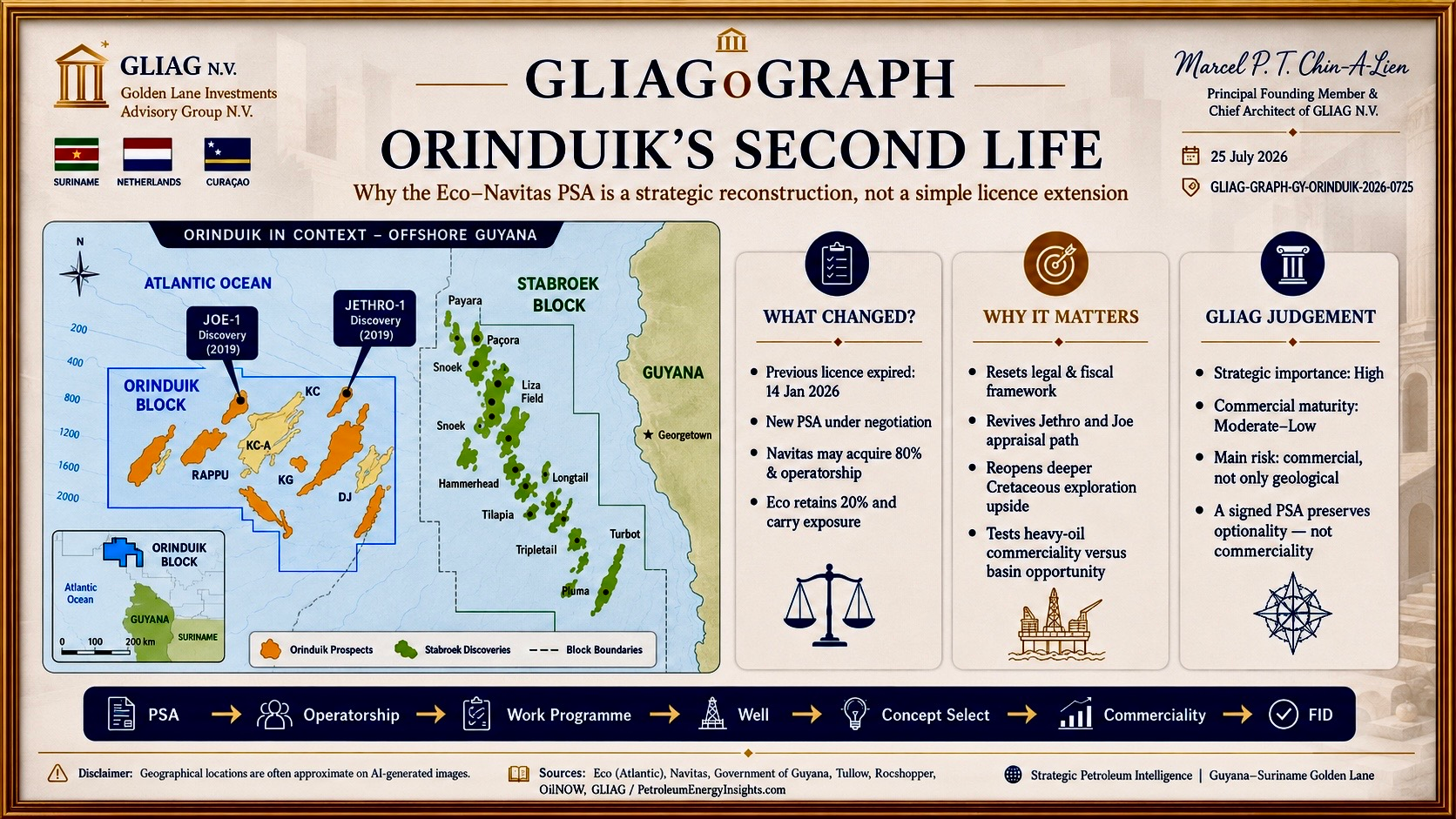
The Orinduik story has entered a second institutional life. Eco (Atlantic) Oil & Gas reported in June 2026 that it and Navitas Petroleum had applied for a new appraisal and exploration licence over the Orinduik area, including the Jethro and Joe discoveries, and were in advanced PSA negotiations expected to conclude in the third quarter of 2026. The former licence had reached the end of its second renewal term on 14 January 2026.
This is not a semantic distinction. A routine extension normally continues an existing legal and commercial framework. A new PSA creates the opportunity—and the necessity—to redefine acreage, fiscal treatment, work obligations, appraisal timing, operator qualifications, relinquishment, environmental liabilities, cost recovery, local content and financial security.
Orinduik is therefore being reconstructed simultaneously in four dimensions: as a legal right, as a partnership, as a subsurface portfolio and as a future capital project. Any analysis that reduces the development to ‘Eco retained the block’ misses the central transformation.
2. The petroleum system contains two very different businesses
Orinduik is not one homogeneous opportunity. Its discovered Tertiary heavy oil and its deeper Cretaceous exploration potential represent different risk classes, different value chains and potentially different investor constituencies.
Jethro-1, announced in August 2019, encountered 55 metres of net oil pay in Lower Tertiary sandstone. Joe-1, announced the following month, encountered oil-bearing Upper Tertiary sandstone. Subsequent laboratory work established that both discoveries contained mobile heavy crude with elevated sulphur. The discoveries proved charge, migration and reservoir effectiveness, but they did not establish a bankable development. [11][12][13]
Heavy oil imposes penalties through lower realised pricing, more demanding processing, larger fluid-handling requirements, possible heating or blending needs, higher power intensity and uncertain well productivity. The relevant commercial question is not merely whether the crude moves, but whether it can be produced, processed, stored and marketed at sufficient margin after royalty, tax, cost recovery and financing.
By contrast, the deeper Cretaceous inventory offers the possibility of lighter, higher-value oil in the broader play family that transformed Stabroek. But it remains exploration, not appraisal. The block’s strategic tension is therefore clear: pursue lower geological risk with lower-quality discovered oil, or accept higher geological risk in search of a materially better barrel.
3. Why Navitas matters
The December 2025 framework gave Navitas an option to acquire 80% and become operator, while Eco would retain 20%. Eco disclosed a US$2.5 million exercise payment and a carry of Eco’s 20% share of a gross work programme of up to US$55 million—equivalent to a maximum net carry of US$11 million for Eco—excluding mobilisation costs. These terms are significant because they transfer the principal technical and capital burden to a company with a recent record of taking a long-stranded offshore discovery to FID. [2] [2][14]
Navitas reached final investment decision on Sea Lion in December 2025. The sanctioned first phase targets approximately 170 million barrels and peak production near 50,000 barrels per day, with first oil planned for 2028. Sea Lion is not an exact analogue for Orinduik, but it demonstrates that Navitas is willing to structure financing, contracting and phased development around a remote, capital-intensive offshore resource. [3][4]
That operator credibility alters Orinduik’s probability tree. Eco alone could preserve and promote an opportunity; Navitas can potentially organise the chain from subsurface work through development concept, financing and execution. Nevertheless, the US$11 million carry should not be mistaken for a fully funded deepwater well. It is entry capital and risk-sharing consideration, not proof of drilling readiness.
4. Hammerhead is an analogue, not a shortcut
The adjacent Hammerhead accumulation on Stabroek has renewed market interest in heavier Tertiary oil. It provides evidence that heavier crude can be accommodated within Guyana’s offshore development system. But Hammerhead’s strategic setting is fundamentally different.[5][6]
ExxonMobil’s Stabroek consortium benefits from a dense portfolio of discoveries, established logistics, multiple FPSOs, repeatable subsea architecture, contractor scale, operating data and export systems. A marginal barrel can be evaluated inside an industrial ecosystem. Orinduik, by contrast, must still prove whether it can sustain a standalone development, secure infrastructure collaboration or fit a smaller phased concept.
The correct inference is therefore limited but important: Hammerhead reduces conceptual prejudice against heavier Guyanese offshore oil. It does not eliminate the need for Orinduik-specific PVT, viscosity, productivity, connectivity, recovery-factor and crude-marketing evidence.
5. The new PSA is Guyana’s chance to convert inherited geology into disciplined execution
Guyana now negotiates from a much stronger position than it held when the original Orinduik agreement was awarded. The Petroleum Activities Act 2023 modernised the sector’s statutory architecture, while the government’s model PSA process introduced materially tougher fiscal and administrative expectations for future acreage. [7][8][9]
A robust Orinduik PSA should avoid two opposite errors. The first would be to grandfather a marginal heavy-oil project into overly generous terms without firm commitments. The second would be to impose a fiscal and work programme calibrated only to large light-oil Stabroek developments, making technically difficult discoveries permanently unfinanceable.
The sovereign objective should be dynamic value maximisation: secure a credible work programme, prevent indefinite acreage warehousing, preserve auditability and environmental protection, and retain sufficient economic flexibility for heavy-oil appraisal to proceed. The state’s interest lies not in the nominal strictness of the contract, but in the probability-adjusted value of timely, well-governed investment.
6. Acreage geometry and resource reconciliation are critical
The reported new Orinduik area is approximately 1,354 square kilometres, smaller than historical descriptions of the licence. That difference may reflect relinquishment, boundary redesign or concentration around discoveries and priority prospects. [1][10]
This creates a disclosure obligation. Historical prospective-resource figures cannot automatically be carried into the new licence. The market and government require a prospect-by-prospect reconciliation showing which Tertiary discoveries, extensions, leads and Cretaceous prospects remain inside the proposed polygon.
Without such reconciliation, large legacy resource numbers risk becoming promotional artefacts rather than decision-grade estimates. A new PSA should therefore be accompanied by a new acreage map, revised prospect inventory, updated risking and a clear separation between discovered resources and prospective resources.
7. The optimal first well should maximise information, not headlines
The first post-PSA well will determine the commercial direction of the block. A pure Jethro appraisal well could reduce uncertainty around fluid properties, reservoir continuity and productivity. A Cretaceous exploration well could create transformational upside but might add little to the development case for the existing discoveries if unsuccessful.
The best decision should be based on expected value of information. A carefully placed well may be designed to calibrate the Tertiary petroleum system while also improving seismic depth conversion, pressure understanding and regional charge models relevant to deeper targets.
GLIAG’s preferred sequence is: full data-room reconstruction; modern seismic reprocessing; integrated PVT and geochemical review; static and dynamic modelling of Jethro and Joe; updated Cretaceous prospect risking; concept screening for standalone, tie-back and phased development; and only then final well selection.
8. The bankability test
A discovery becomes an asset only when uncertainty is translated into a financeable risk allocation. Orinduik’s bankability will depend on the interaction among reservoir quality, crude quality, development scale, fiscal terms, FPSO concept, contractor appetite, debt capacity and realised price discount.
Navitas must demonstrate more than geological enthusiasm. It must show that the operator can fund appraisal, absorb cost escalation, manage environmental obligations and carry the project through concept select. Guyana must demonstrate that approvals, fiscal administration and data governance are predictable enough to support long-duration capital.
The decisive metric is not the signing ceremony. It is whether the PSA creates a sequence in which each dollar of committed expenditure materially reduces the next category of uncertainty.
9. Strategic implications for the Guyana–Suriname Golden Lane
Orinduik sits in a part of the basin where commercial outcomes are likely to become more differentiated. The era in which every offshore discovery was interpreted through the lens of giant, light-oil Stabroek success is ending. The next phase will be defined by fluid quality, development architecture, infrastructure access, fiscal calibration and operator-specific execution capability.
For Suriname, the case is instructive. As its own offshore portfolio advances beyond discovery, future policy will need to distinguish between giant, infrastructure-anchoring projects and technically stranded or lower-quality accumulations. Contract discipline should remain firm, but differentiated resources may require differentiated commercial pathways.
Orinduik may therefore become an early test of a wider basin principle: mature petroleum provinces are not created only by discovering the best barrels. They are created by building institutions and operating models capable of converting second-tier barrels into competitive projects without sacrificing sovereign value.
10. GLIAG judgement
GLIAG assigns high strategic importance to the new PSA negotiations, but only moderate near-term commercial maturity. A Q3 2026 agreement would be a material de-risking event because it restores legal certainty, enables Navitas to exercise its option and defines the work programme. It would not, however, prove reserves, finance a well or establish a development.
The strongest interpretation is that Orinduik is being reconstituted as an investable option with two paths: a discovered-heavy-oil appraisal path and a high-impact Cretaceous exploration path. The project’s value will depend on how intelligently those paths are sequenced.
GLIAG’s central conclusion is therefore precise: the new PSA is not the end of Orinduik’s uncertainty. It is the instrument through which uncertainty can finally be organised.
“A signed PSA preserves the opportunity. Only disciplined appraisal, commercial calibration and executable financing can create the asset.”
The Orinduik value-creation gates
| Gate | What must be proven | Primary failure mode | Decision consequence |
| 1. PSA and title | Legal continuity, acreage, fiscal and work terms | Ambiguous rights or unfinanceable obligations | No option exercise or investment |
| 2. Operatorship | Navitas approval, capability and financial security | Partner structure remains conditional | Programme cannot mobilise |
| 3. Subsurface calibration | PVT, connectivity, productivity and prospect ranking | Discovery volumes remain technically stranded | Reappraise or redirect |
| 4. Concept select | Standalone, shared infrastructure or phased development | Capex and crude penalties overwhelm value | Defer, farm down or abandon |
| 5. Financing | Equity, debt, contractor and offtake alignment | Funding gap or unacceptable sovereign risk | No sanction |
| 6. FID | Integrated technical, fiscal and commercial case | Residual uncertainty exceeds returns | Develop or relinquish |
Research method and evidentiary discipline
This essay distinguishes between: (i) primary corporate disclosures; (ii) Guyanese statutes, model agreements and licences; (iii) independent reporting; (iv) technical interpretation; and (v) GLIAG inference. Company forecasts—especially completion of the PSA in Q3 2026—are treated as targets, not accomplished facts. Prospective resources are not discoveries or reserves. Commercial analogues such as Hammerhead and Sea Lion are used to frame questions, not to imply equivalence.
Documented source notes — trusted references
1. Eco (Atlantic) Oil & Gas Ltd. — 2026 Operational and Business Update, 18 June 2026
Primary company disclosure. Confirms application for a new appraisal and exploration licence over the Orinduik area, advanced PSA negotiations with Guyana’s Ministry of Natural Resources, expected Q3 2026 completion, and preservation of rights relating to Jethro and Joe while the appraisal submission is considered. Open source
2. Eco (Atlantic) Oil & Gas Ltd. — Strategic Partnership with Navitas Petroleum, 3 December 2025
Primary transaction disclosure. Sets out Navitas’ option to acquire 80% and operatorship, the US$2.5 million option exercise payment, and a gross Orinduik work programme of up to US$55 million. Because Eco retains 20%, the disclosed maximum economic carry to Eco is US$11 million, before excluded mobilisation costs. Open source
3. Navitas Petroleum — Sea Lion Project
Primary operator project page. Confirms Navitas’ 65% operated interest, FID status, 216 MMboe net 2P reserves, 603 MMboe net 2C resources and expected first oil in 2028. Used only to assess operator-development credibility, not as a direct geological analogue. Open source
4. Rockhopper Exploration — Final Investment Decision on Sea Lion, 10 December 2025
Primary partner disclosure. Documents Phase 1 sanction, approximately 170 million barrels targeted, peak output near 50,000 barrels per day and first oil planned for 2028. Open source
5. Guyana EITI — Hammerhead Petroleum Production Licence
Official transparency portal entry confirming execution of the Hammerhead production licence on 22 September 2025 and providing access to the licence itself. Open source
6. Reuters — Exxon greenlights US$6.8 billion Hammerhead investment, 22 September 2025
Independent reporting. Records a planned FPSO capacity of approximately 150,000 barrels per day and anticipated start-up in 2029. Supports the argument that heavier Tertiary oil is moving into Guyana’s sanctioned development portfolio. Open source
7. Government of Guyana — Petroleum Activities Act No. 17 of 2023
Primary legislation portal. Establishes the modern statutory framework governing petroleum exploration, production, storage, transportation, oversight and licensing. Open source
8. Government of Guyana — Model Production Sharing Agreement, Deepwater Areas
Primary contractual reference. Provides the government’s modern deepwater framework for fiscal terms, work obligations, cost recovery, accounting, relinquishment, decommissioning and contractor responsibilities. The actual Orinduik PSA may differ and must be reviewed when published. Open source
9. Government of Guyana — Release of Draft Model Petroleum Agreements, 14 March 2023
Official policy statement. Explains that the new model agreements were designed around international practice while seeking to maximise national benefits without disincentivising investment. Open source
10. Government of Guyana — Petroleum Management Documents and Publications
Official document repository containing the historic Orinduik Petroleum Agreement, model PSAs, petroleum licences, production permits, audit reports and legislation. This is the principal documentary source for contract comparison. Open source
11. Tullow Oil — Jethro-1 Oil Discovery, 12 August 2019
Primary discovery announcement. Reports approximately 55 metres of net oil pay in Lower Tertiary sandstone and establishes the original geological basis for the Jethro discovery. Open source
12. Tullow Oil — November 2019 Trading Update
Primary operator-era update covering the Jethro and Joe results and the subsequent recognition that the discovered crude was heavier than initially expected. Open source
13. Hannam & Partners — Eco Atlantic technical note on heavy oil, 20 November 2019
Third-party equity research hosted by Eco. Estimates Jethro crude at roughly 13–15° API and 3.5–4% sulphur, and compares development implications with other heavy-oil systems. These are analyst estimates, not certified current field specifications. Open source
14. Eco (Atlantic) Oil & Gas — audited results and Orinduik work-programme clarification, June 2026
Primary investor-document portal. The 2026 disclosures clarify that the transaction references a gross US$55 million Orinduik programme; Eco’s 20% retained interest converts this to a maximum US$11 million net carry to Eco, subject to exclusions. Open source
15. OilNOW — Eco and Navitas target Q3 completion of new Orinduik PSA, 25 July 2026
Specialist regional reporting and immediate trigger for this essay. Useful for chronology and local context, but the primary Eco, government and licence documents remain controlling. Open source
Related essays by Marcel P. T. Chin-A-Lien / GLIAG
The Golden Lane — Guyana–Suriname Basin
Sets out the basin-scale Golden Lane thesis: hydrocarbons are organised by source, migration, reservoir fairways and stratigraphic trapping rather than distributed randomly. It provides the geological frame for distinguishing Orinduik’s Tertiary discoveries from the deeper Cretaceous fairway. Read essay
Decoding the Golden Lane: Seismic Breakthroughs in Guyana
Explains the role of amplitude-preserving seismic reprocessing, AVO, elastic inversion and stratigraphic interpretation in unlocking Guyana’s deepwater turbidite discoveries. Relevant to the recommendation that Orinduik should be reprocessed and rerisked before selecting its next well. Read essay
Strengthening Suriname’s Licensing Architecture: A Case Study on Cybele Block S7
Develops the GLIAG doctrine that acreage awards must be supported by verifiable capital architecture, bank guarantees, conditions precedent and enforceable work commitments. It provides a contractual comparison for Guyana’s treatment of Navitas’ operatorship and financing obligations. Read essay
Strategic Insights for Suriname: Free Lessons from Guyana’s Cost Recovery Audit
Examines cost eligibility, pre-contract expenditure, auditability and PSA compliance. It supports the essay’s emphasis on modern cost-recovery controls, transparent accounting and state capacity under any new Orinduik agreement. Read essay
Liza Crude: Guyana’s High-Value Light Oil Explained
Contrasts the refinery value of lighter, lower-residuum Liza crude with heavier grades. The article helps explain why Orinduik’s heavy, high-sulphur oil cannot be valued or developed using a simple Stabroek light-oil analogy. Read essay
The Golden Lane: A Visionary’s Canvas of Guyana’s and Suriname’s Oil Future
Documents the author’s early basin-scale Golden Lane concept and its translation into geological art before the Liza discovery. It provides intellectual and historical context for GLIAG’s continuing source-to-sink and petroleum-systems interpretation. Read essay
Key evidence still required before a final investment view
• The executed new Orinduik PSA, licence polygon and full minimum work programme.
• Government approval of Navitas as operator and evidence that all conditions precedent have been satisfied.
• Updated competent-person resource estimates separating Jethro and Joe discovered resources from Cretaceous prospective resources.
• Current PVT, viscosity, sulphur, metals, TAN, flow-assurance and well-productivity data.
• A documented development-concept screen comparing standalone FPSO, shared infrastructure, tie-back and phased alternatives.
• Funding plan for the first well, including mobilisation, contingencies, guarantees and Eco carry mechanics.
Disclaimer
This essay is independent strategic analysis prepared for information and professional discussion. It is not investment advice, legal advice, a reserves certification, a competent-person report or a substitute for primary technical, fiscal and contractual due diligence. Statements attributed to Eco, Navitas, Tullow, Rockhopper and the Government of Guyana are derived from the cited sources. GLIAG interpretations, scenario judgements and probability assessments are analytical opinions. Company targets and timelines are forward-looking and may change. No conclusion on commerciality should be reached before the executed PSA, licence geometry, updated resource report, fluid data, well programme and financing structure are available.
About GLIAG N.V.
Golden Lane Investments Advisory Group N.V. is a boutique strategic petroleum intelligence and advisory platform integrating petroleum geology, petroleum systems, commercial structuring, fiscal design, project bankability, gas monetisation and sovereign industrial strategy across the Guyana–Suriname Basin and wider Atlantic Margin.
Marcel P. T. Chin-A-Lien – Principal Founding Member & Chief Architect of GLIAG N.V.
Envisioned & Coined “Guyana–Suriname Golden Lane – GSGL” in 2008.
GLIAG-ESSAY-GY-ORINDUIK-2026-0725 | 25 July 2026 | © GLIAG N.V.