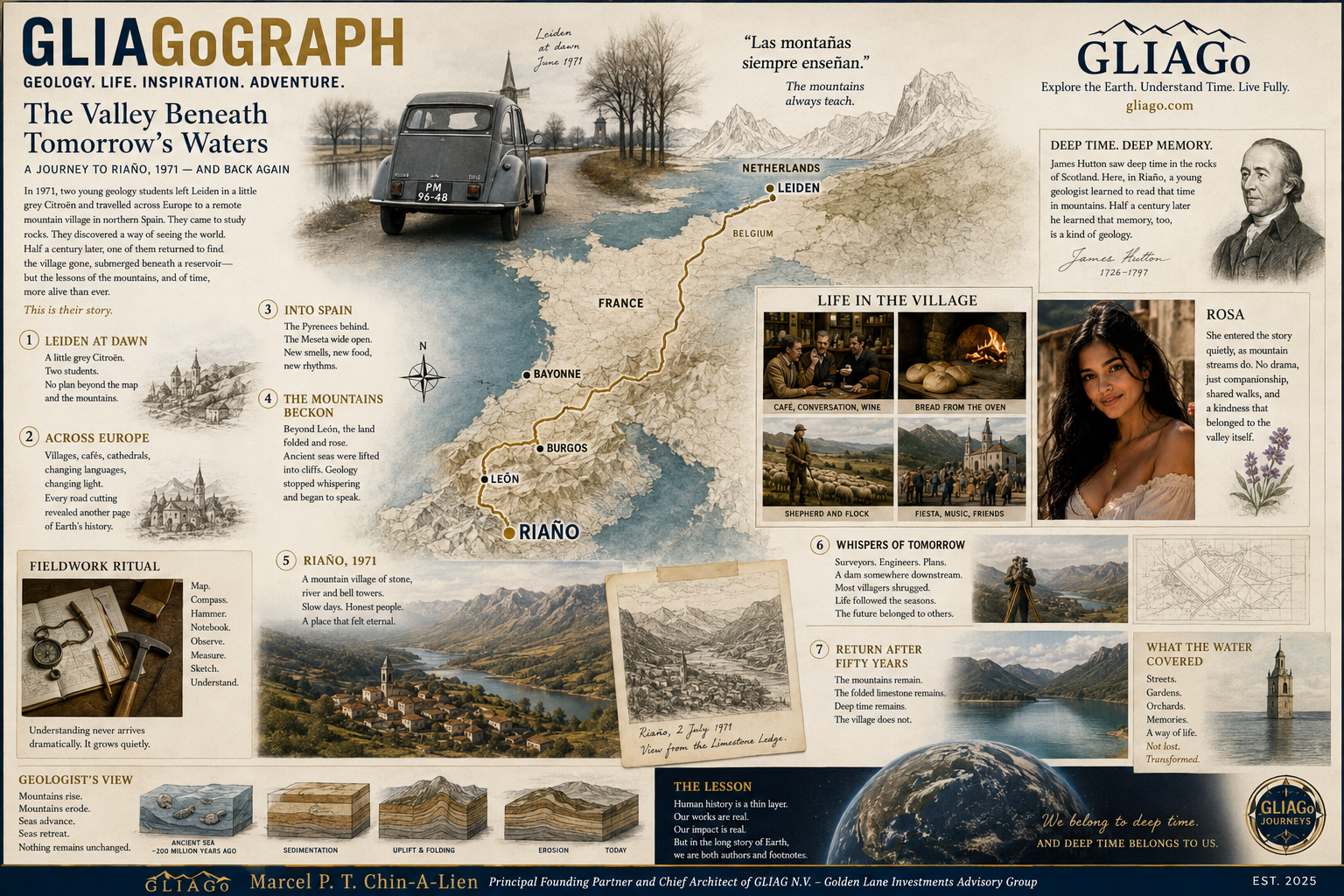
A REFLECTION, by Marcel P.T. Chin-A-Lien – Petroleum & Energy Advisor – Principal Founding Partner of GLIAG N.V. _ Golden Lane Investments Advisory Group
The Valley Beneath
Tomorrow’s Waters
On Deep Time, Memory, and the Ethics of Progress
There is a peculiar arrogance in the way human beings measure time. We speak of “long ago” when we mean a generation, of “ancient” when we mean a few centuries, of “forever” when we mean, at most, a human lifespan stretched to its limit. Geology corrects this arrogance without cruelty. It simply shows us the ledger — the folded limestone, the marine fossil lifted three thousand metres into alpine air, the river that has patiently exploited the same structural weakness for a hundred thousand centuries — and lets us draw our own, humbler conclusions.
This is the inheritance carried by every geologist who has ever knelt at an outcrop with a hammer and a notebook: the understanding that we are not witnesses to history so much as brief, privileged readers of an autobiography whose first chapters were written before there was anyone to read them, and whose final chapters will be written long after we have gone.
It is this inheritance that gives a small Spanish valley — a village called Riaño, visited once by a young student in a modest Citroën and revisited half a century later above the still water of a reservoir — its unexpected weight as a subject worthy of serious reflection.
I. The Grammar of Rock
A road cutting is not scenery. To the trained eye it is a sentence, and the geologist’s task is translation: bedding plane as noun, fault as verb, unconformity as the italics that signal something has been left unsaid — an interval of time simply missing from the record, eroded away or never deposited at all. James Hutton understood this in the eighteenth century when he stood on the Scottish coast and realized, with something like vertigo, that the Earth possessed no visible beginning and no foreseeable end. His insight was not merely scientific. It was a reordering of human self-importance. We are not the measure of geological time; we are a rounding error within it.
To travel through such a landscape — as two students once did, crossing Belgium unnoticed, France slowly, and Spain with mounting attention as the Meseta gave way to the folded marine limestones of the Cantabrian mountains — is to travel not across countries but across epochs. Every outcrop is a page. Every fold in the strata is evidence of forces that make a human career, a human romance, a human village, seem impossibly brief and impossibly precious at once.
II. The Village That Knew Nothing of Its Ending
Riaño did not announce itself as historic. That, in retrospect, is precisely what made it so. It was ordinary in the way that most of what matters is ordinary: children with a football, a fountain, an old man removing his cap for a neighbour, a blacksmith’s hammer keeping time against stone streets worn smooth by centuries of unremarkable footsteps. The village occupied, without knowing or needing to know it, the only sensible geological terrace above the river — proof that human settlement, long before it called itself engineering, was already a form of applied geology. People had always built where the rock told them to build.
Into this ordinariness came, briefly, a young geologist’s notebook: strike and dip, lithology, fossils, the patient accumulation of observation that geology demands and that eventually — never dramatically, always quietly — resolves into understanding. And into the notebook’s margins, unbidden, came something else: a woman who entered the evenings the way mountain streams enter a valley, without announcing herself, and who belonged to Riaño as naturally as its bells and its river light.
Somewhere in the same conversations, almost as an aside, came word of surveyors. Engineers. A future reservoir. The villagers shrugged. Such matters belonged to offices far away. The valley felt eternal — which is, of course, precisely the illusion that geology exists to dissolve.
✦ ✦ ✦
III. Two Questions Upon the Same Rock
There is a truth here worth stating plainly, because it is easy to sentimentalize and easier still to moralize, and both temptations should be resisted. The geologist and the engineer often stand on the very same outcrop and ask entirely different questions. One reconstructs the past. The other designs the future. Both are legitimate. Both are, in their own register, acts of respect toward the material beneath their boots.
The reservoir that eventually rose over Riaño was not an act of violence committed against innocence. It was the fulfillment of engineering’s proper purpose — electricity, water security, prosperity extended to a great many people who would never know the village’s name. This is a truth that deserves to be held without apology.
And yet another truth endures beside it with equal dignity: every great work of civilization asks something in return. Sometimes what it asks for is a village.
To notice this cost — to name it, to mourn it appropriately, without either sentimentality or false guilt — is not sentimentality itself. It is simply honesty of the kind geology teaches by habit: nothing in nature, and nothing built by human hands upon nature, remains unchanged. Mountains rise and mountains erode. Seas advance and retreat. Plankton becomes petroleum; coral reefs become limestone; entire landscapes vanish and leave, in their place, indelible traces within the rock for someone else, centuries later, to read.
IV. What the Water Preserves
Return, after fifty years, to stand above such a reservoir, and something unexpected happens. The mountains are unchanged. The folded limestone is unchanged. Deep time, indifferent as ever, continues exactly as before. What has changed is smaller and, in its way, more affecting: a village, a church bell, a fountain’s particular laughter, a woman’s manner of entering a room.
But even this loss is not absolute. Memory, it turns out, obeys geological rather than human logic. It does not fade in the tidy, chronological way we imagine when we say time heals. It sediments. It waits, compressed and dormant, until some unrelated stimulus — the scent of rain on freshly broken rock, encountered decades later above a drill core recovered thousands of metres beneath an entirely different ocean — releases it whole, undiminished, as vivid as the original afternoon. Memory travels through the senses, not through calendars.
V. The Lesson That Does Not Age
A Spanish geologist, met once and only briefly on a mountain path near Riaño, left behind a single sentence before continuing on his own traverse:
“Las montañas siempre enseñan.”
The mountains always teach.
It is a modest claim, and that is exactly its strength. The mountains do not moralize. They do not offer consolation. They simply persist, folded and patient, offering their evidence to whoever troubles to kneel down and read it.
What they teach, in the end, is not resignation but proportion. A career built on interpreting seismic lines and exploration wells across continents and offshore basins still begins, every time, exactly as it began on that first traverse above Riaño: by learning to observe before attempting to explain. A reservoir still floods a valley and still lights a thousand distant homes. A village can still vanish beneath calm water and still remain, entire, in a single mind that once sketched it from a hillside at midday, not knowing the sketch would outlive the place.
The valley disappeared beneath the water.
The journey never did.
Soso Lobi