GLIAG STRATEGIC PETROLEUM INTELLIGENCE™
The Well That Was Never Drilled
What Cairn Energy’s Block 61 tells us about the changing economics of offshore Suriname
Drs. M.P.T. Chin-A-Lien, MBA, M.Sc., Ing. Geologist – 11 July 2026
Certified Professional Geologist (AAPG No. 5201-1996) • Chartered European Geologist (EFG No. 92-1996) • Energy Negotiator (AIEN, 2021)
Founding Partner & Chief Architect, GLIAG
GLIAG-INTEL-2026-HIST-001
In petroleum exploration, history is often written by discoveries. Yet some of the industry’s most valuable lessons come from wells that were never drilled.
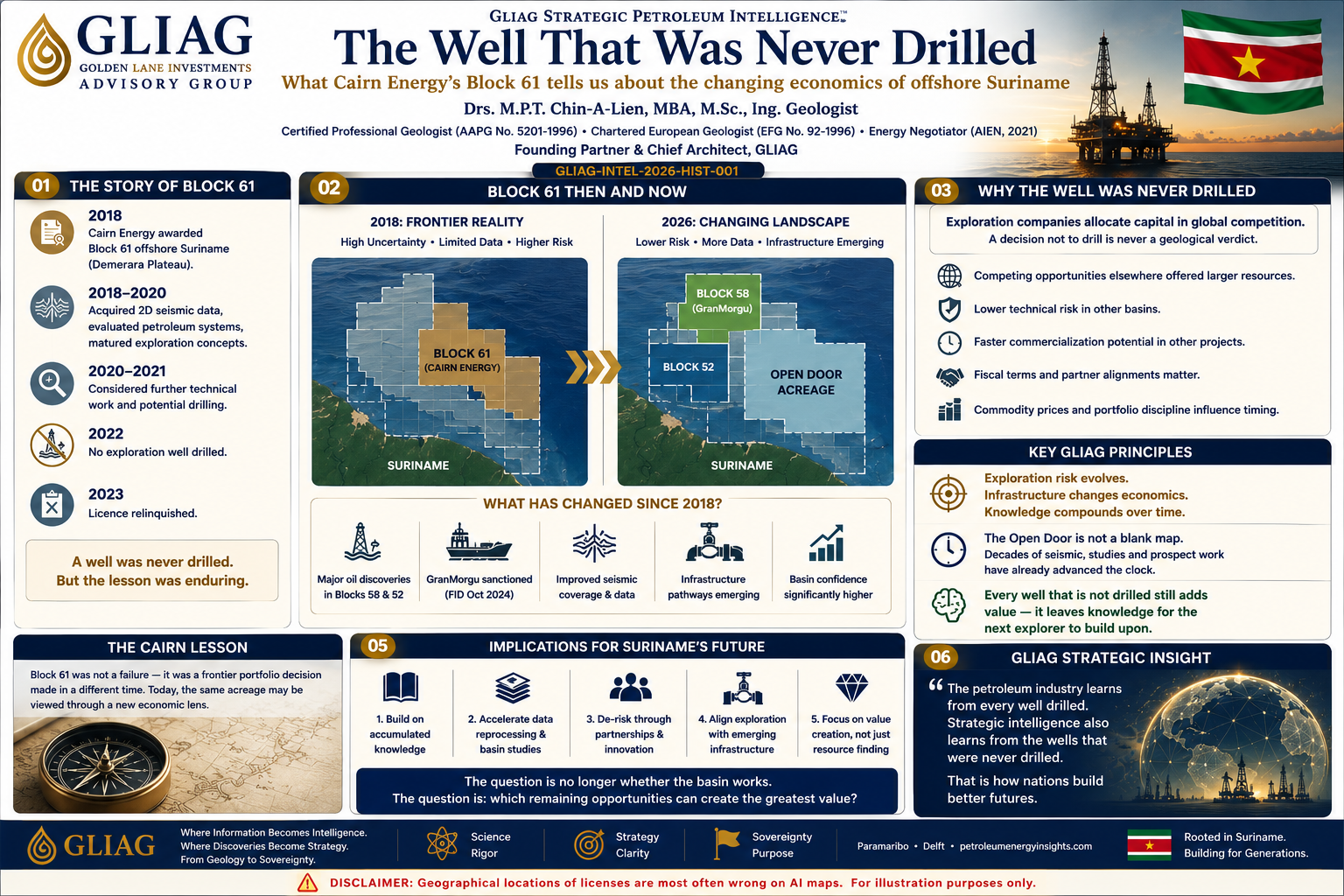
One such example is Cairn Energy’s offshore Suriname venture in Block 61. Awarded in 2018, the licence covered a large portion of the Demerara Plateau, an area that today forms part of Suriname’s reorganized Open Door acreage. Cairn acquired regional two-dimensional seismic data, evaluated the petroleum systems, matured exploration concepts and considered further work. However, the company never progressed to drilling an exploration well.
Eventually the licence was relinquished.
Viewed superficially, this might be interpreted as evidence that the area lacked prospectivity. Such a conclusion would be misleading.
Exploration Decisions Are Capital Decisions
Exploration companies do not allocate capital solely on geological merit. Every drilling decision represents a competition within a global investment portfolio.
A frontier basin may contain technically attractive prospects yet still lose capital to opportunities offering larger resource potential, lower technical risk, faster commercialization, stronger fiscal terms or greater strategic importance elsewhere in the world.
Consequently, an exit from a basin should never automatically be interpreted as a geological verdict.
Instead, it reflects a broader portfolio optimization process in which geology, corporate strategy, financial discipline, commodity prices and competing investment opportunities interact.
Time Changes Exploration Value
Perhaps the most important lesson from Block 61 is that exploration value is not static.
When Cairn entered Suriname, the basin remained largely frontier. Since then, the commercial landscape has changed fundamentally.
Major oil discoveries in Block 58, continued success in Block 52, the sanctioning of the GranMorgu development and growing confidence in the Guyana–Suriname Basin have transformed regional economics. Infrastructure planning, future production systems and improved geological understanding have collectively reduced uncertainty across the province.
Consequently, acreage that appeared relatively high-risk in 2018 may be evaluated very differently today.
This is a fundamental GLIAG principle:
Exploration risk evolves. Infrastructure changes economics. Knowledge compounds over time.
The New Open Door Is Not a Blank Map
An important implication follows.
The current Open Door acreage should not be regarded as unexplored territory.
Much of it has already benefited from seismic acquisition, geological interpretation, basin modelling and prospect screening undertaken by previous operators.
Today’s applicants therefore inherit not only acreage, but decades of accumulated geological knowledge generated by Staatsolie and successive international operators.
The exploration clock has not been reset.
It has advanced.
A GLIAG Perspective
The Cairn story should therefore be remembered not as a failed exploration chapter, but as an example of disciplined frontier portfolio management.
Its greatest contribution may not be a discovery.
Rather, it provided another layer of geological understanding that subsequent explorers can build upon.
As Suriname enters its next exploration phase through the Open Door programme, the strategic question is no longer whether the basin works.
That question has already been answered.
The more important question has become:
Which remaining opportunities can create the greatest value in an increasingly infrastructure-supported petroleum province?
That is the question future explorers—and Suriname itself—must now answer.
GLIAG Strategic Insight
The petroleum industry learns from every well drilled. Strategic intelligence also learns from the wells that were never drilled.