Suriname Offshore — Guyana–Suriname Basin
Marcel Chin-A-Lien
Petroleum & Energy Advisor
February 2026
www.petroleumenergyinsights.com
Scan to open:
petroleumenergyinsights.com
Executive Summary
The Coniacian–Santonian interval (Late Cretaceous; ~89–83 Ma) represents a decisive architectural phase in the evolution of the Guyana–Suriname passive margin.
While the Cenomanian–Turonian interval established the principal marine source rocks during Oceanic Anoxic Event 2 (OAE2), the Coniacian–Santonian stage developed deepwater reservoir and carrier-bed systems that later enabled large-scale hydrocarbon accumulations.
- Coniacian–Santonian deposition constructed sand-prone turbidite fairways across the slope and basin floor.
- Burial during this interval likely initiated early oil-window maturation in deeper depocenters.
- Structural hinge zones and slope-parallel corridors focused sediment routing and later hydrocarbon migration.
- The Golden Lane fairway concept is stratigraphically and structurally preconditioned during this phase.
- The interval is a reservoir-seeding and carrier-bed establishment stage, not the peak source deposition phase.
Abstract
This report reconstructs the Coniacian–Santonian petroleum-system configuration offshore Suriname by integrating margin architecture, slope instability processes, and maturity evolution.
The Coniacian–Santonian interval is interpreted as the principal reservoir- and carrier-bed development phase, while hydrocarbon charge is linked to burial-driven maturation of underlying Cenomanian–Turonian marine source rocks deposited during OAE2.
The framework provides implications for Golden Lane-style fairways and outer-shelf maturity differentiation across the basin.
1. Introduction
The Guyana–Suriname Basin has emerged as one of the world’s most significant new hydrocarbon provinces.
Despite this, Coniacian–Santonian stratigraphy is often treated as background context rather than an explicit reservoir and carrier system development phase.
My paper positions the Coniacian–Santonian as a foundational interval that bridges source development (Cenomanian–Turonian) and later charge realization during continued burial.
The objective is to provide a defensible conceptual framework focused on: (i) margin morphology, (ii) sediment routing, (iii) structural controls, (iv) burial/maturity evolution, and (v) implications for Golden Lane-style accumulations.
2. Regional tectonostratigraphic setting
By Coniacian–Santonian time, the margin was dominated by passive thermal subsidence.
Differential subsidence expanded deep-basin accommodation, while the Demerara Plateau persisted as a structural and bathymetric high influencing sediment dispersal.
Within this context, sediment loading, overpressure development, and gravitational processes provide a sufficient mechanism for slope failure and mass transport, without invoking major tectonic reactivation.
3. Shelf–slope–basin architecture
3.1 Shelf-margin system
The Coniacian–Santonian shelf margin is best interpreted as a mixed siliciclastic–carbonate ramp with episodic deltaic progradation.
During supply-enhanced phases and/or relative sea-level fall, sediment bypass across the shelf break fed deepwater turbidite systems.
3.2 Slope processes and mass transport
Mass Transport Complexes (MTCs) reflect slope instability driven by rapid loading, overpressure, and gravitational collapse focused near the slope break (hinge line).
MTCs increase heterogeneity, can disrupt seal continuity, and may locally modify migration pathways by creating complex permeability architectures.
3.3 Basin-floor fairways and fan complexes
Sand-prone turbidite fairways developed as channel–levee systems feeding basin-floor fan complexes.
These corridors likely followed subtle structural lineaments, avoided bathymetric highs such as the Demerara Plateau, and persisted as sediment routing axes. Such fairways are interpreted as key reservoir bodies and later carrier-bed conduits.
4. Source rock and maturity evolution
The principal hydrocarbon source interval is interpreted as Cenomanian–Turonian marine organic-rich shales associated with OAE2. Coniacian–Santonian time is therefore not a primary source deposition phase; it is the interval during which reservoir and carrier-bed systems are constructed while burial-driven maturity increases in deeper depocenters.
In this framework, early oil-window maturation initiates basinward as burial progresses, while shelfal areas remain relatively immature. Charge efficiency is expected to increase during continued Campanian–Maastrichtian burial.
5. Structural controls and Golden Lane implications
Subtle slope-parallel structural ridges, differential compaction over basement topography, and hinge-line geometry likely influenced both sediment routing and the spatial persistence of fairways.
The Golden Lane concept can be interpreted as a focused carrier-bed corridor enhanced by structure and stratigraphic trapping along preferred sediment axes.
The Coniacian–Santonian interval is therefore interpreted primarily as a reservoir-seeding and carrier-bed establishment phase, rather than the peak generation phase.
This distinction is essential for assessing maturity gradients and fluid phase variability (oil vs condensate/gas) along the shelf–basin transect.
6. Discussion
From a petroleum-system perspective, Coniacian–Santonian stratigraphy should be framed as:
- Reservoir-seeding phase — deepwater sands accumulate in organized fairways and fan complexes.
- Carrier-bed establishment phase — laterally connected conduits develop along focused sediment axes.
- Pre-charge maturation phase — burial increases maturity in deeper depocenters and primes migration pathways.
Exploration strategies that include outer-shelf gas-prone targets should incorporate maturity gradients and recognize that fluid phase can vary systematically even where reservoir architecture remains broadly similar.
7. Conclusions
- Coniacian–Santonian deposition establishes primary deepwater sand fairways offshore Suriname.
- Cenomanian–Turonian marine shales remain the dominant source interval in the system.
- Burial during this stage likely initiates early oil-window maturation in deeper depocenters.
- Structural hinge zones and slope-parallel corridors precondition Golden Lane-style fairways.
- The interval is architecturally critical to petroleum-system evolution across the Guyana–Suriname Basin.
Uncertainties & data gaps
- Limited publicly available well control for Coniacian–Santonian reservoir calibration offshore Suriname.
- MTC frequency, geometry, and seal impact require seismic-based mapping and stratigraphic calibration.
- Maturity gradients require basin modeling constrained by heat flow, burial history, and calibrated proxies (e.g., VR/TAI).
- Fluid phase predictions (oil vs condensate/gas) should be validated with PVT/DST data where available.
Figure caption
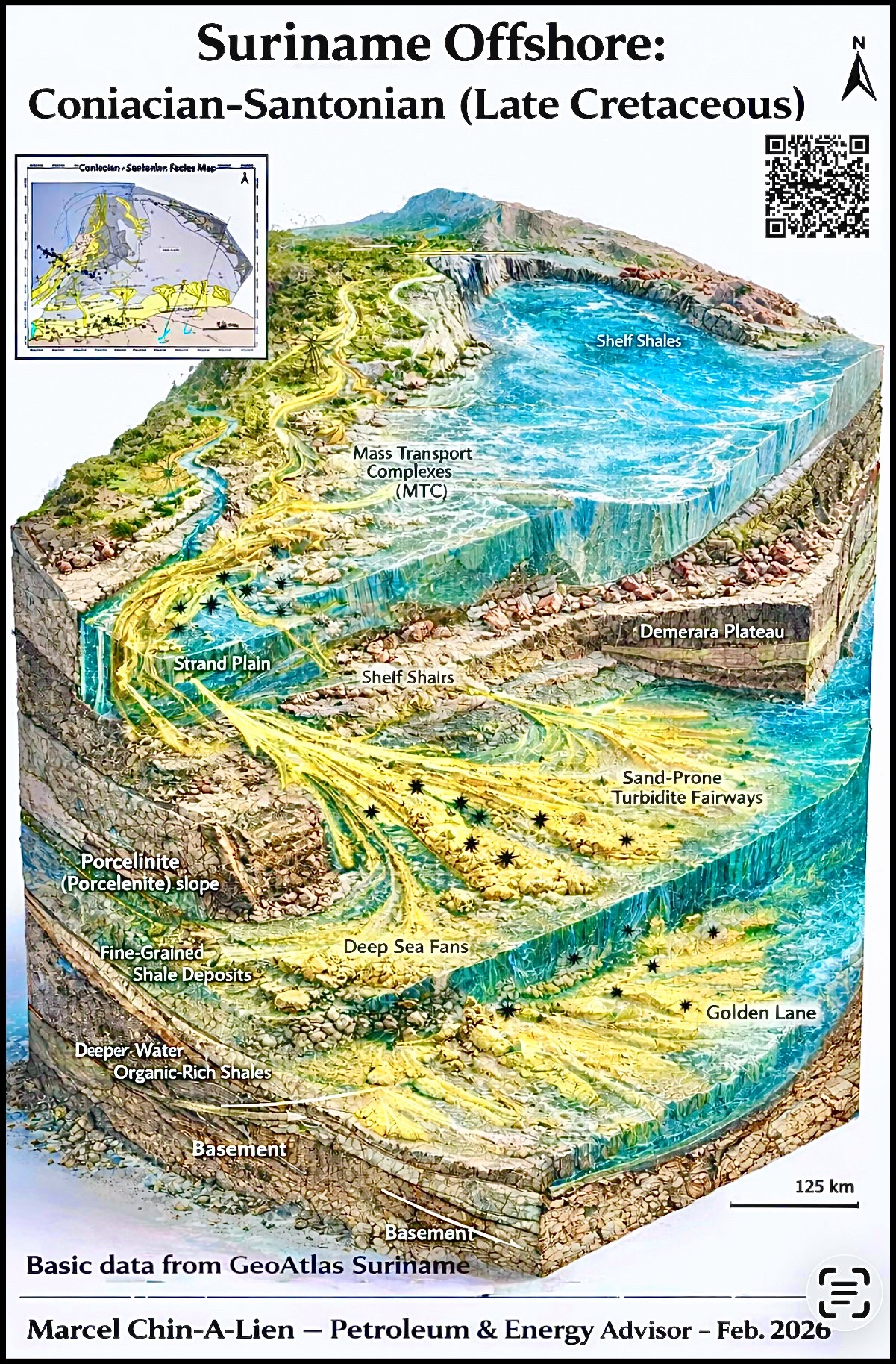
Figure 1. Coniacian–Santonian Petroleum-System Framework, Suriname Offshore.
Three-dimensional conceptual reconstruction of the Late Cretaceous passive-margin architecture of the Guyana–Suriname Basin.
The Coniacian–Santonian interval records continued thermal subsidence and development of sand-prone turbidite fairways sourced from a mixed siliciclastic–carbonate shelf margin.
Mass transport complexes and slope-channel systems focus sediment delivery into basin-floor fan complexes.
The principal hydrocarbon source interval comprises Cenomanian–Turonian marine organic-rich shales deposited during OAE2. During Coniacian–Santonian burial, early oil-window maturation initiates in deeper depocenters, establishing migration pathways into structurally influenced fairways (Golden Lane concept).
Regional sealing is provided by Upper Cretaceous shales.
The Demerara Plateau acts as a bathymetric high influencing sediment routing.
Annex — Wells Penetrating the Coniacian–Santonian Interval (Open-Source Confirmed)
Evidence standard:
The wells below are included where open sources explicitly reference penetration and/or pay in the Santonian (often together with Campanian).
Public sources rarely publish full stratigraphic tops (including explicit “Coniacian”) for each well; therefore, this annex is framed as confirmed Santonian penetrations within the broader Coniacian–Santonian Upper Cretaceous petroleum-system framework.
Annex A — Suriname (Block 58 / “Golden Lane” play context)
| Area | Block | Well | Interval stated in open sources | Evidence (open sources) |
|---|---|---|---|---|
| Suriname Offshore | Block 58 | Maka Central-1 | Upper Cretaceous (Campanian & Santonian reservoirs stated) | TotalEnergies: Press release. Staatsolie: Play synopsis (PDF). |
| Suriname Offshore | Block 58 | Sapakara West-1 | Play described in Santonian–Campanian context | Staatsolie: Discovery sequence. Staatsolie: Play synopsis (PDF). |
| Suriname Offshore | Block 58 | Kwaskwasi-1 | Play described in Santonian–Campanian context | Staatsolie: Discovery sequence. Staatsolie: Play synopsis (PDF). |
| Suriname Offshore | Block 58 | Keskesi East-1 | Santonian reservoirs explicitly referenced (Staatsolie NL) | Staatsolie: EN / NL. TotalEnergies: Press release. |
Additional note (Block 58):
S&P Global reports that Apache’s Suriname wells penetrated the Santonian in all its wells (in the context of the Suriname–Guyana Santonian play extension).
A complete well-by-well Coniacian confirmation requires a stratigraphic tops table. S&P Global (Apr 28, 2021).
Annex B — Guyana (Stabroek Block — Santonian penetrations stated)
| Area | Block | Well | Interval stated in open sources | Evidence (open sources) |
|---|---|---|---|---|
| Guyana Offshore | Stabroek | Uaru-2 | Deeper Santonian reservoirs below Uaru-1 | S&P Global (Apr 28, 2021) |
| Guyana Offshore | Stabroek | Liza Deep | Santonian penetration (listed) | S&P Global (Apr 28, 2021) |
| Guyana Offshore | Stabroek | Tripletail | Santonian penetration (listed) | S&P Global (Apr 28, 2021) |
| Guyana Offshore | Stabroek | Yellowtail | Santonian penetration (listed) | S&P Global (Apr 28, 2021) |
Annex C — Requirements to complete a strict Coniacian–Santonian well inventory
To expand this annex from “Santonian-confirmed” to “Coniacian–Santonian confirmed” on a strict well-by-well basis, a stratigraphic tops table (or official well reports with formation tops) is required for each well.
Open press releases typically report “Upper Cretaceous” and/or “Santonian/Campanian” without full tops.
About the Author — Marcel Chin-A-Lien
Global Petroleum and Energy Advisor
48 Years of Transformative Expertise | Exploration, Giant Field Discovery, Business Development, M&A, PSC Design, Contract Strategy
Marcel Chin-A-Lien brings nearly five decades of global expertise at the highest levels of the energy sector—where technical mastery meets commercial realism to unlock extraordinary value. His career has delivered multi-billion-dollar giant-field discoveries, spearheaded pioneering first capitalist upstream ventures in the USSR, shaped successful offshore bid rounds, and secured enduring cash flow streams from exploration and production across mature and frontier basins (including the Dutch North Sea).
A rare added-value, all-in-one fusion of technical, commercial, and managerial insight, Marcel holds four postgraduate petroleum degrees spanning geology, engineering, international business, and management—uniquely positioning him to bridge exploration strategy, upstream M&A, PSC design, and contract negotiation.
Fluent in multiple languages and culturally attuned to diverse business environments, he has navigated complex geographies across Europe, Asia, Africa, and the Americas—driving innovation, de-risking investments, and aligning stakeholder interests from national oil companies to supermajors.
Whether advising on frontier basin entry, government negotiations, fiscal regime optimisation, or asset valuation, Marcel’s critical insights integrate Exploration & Production with Business Development and Commercial Discipline—supporting sustainable growth in volatile energy markets.
Credentials and Distinctions
- Drs — Petroleum Geology
- Engineering Geologist — Petroleum Geology
- Executive MBA — International Business, Petroleum, M&A
- MSc — International Management, Petroleum
- Energy Negotiator — Association of International Energy Negotiators (AIEN)
- Certified Petroleum Geologist #5201 — AAPG (Gold Standard)
- Chartered European Geologist #92 — EFG (Gold Standard)
- Cambridge Award — “2000 Outstanding Scientists of the 20th Century”, UK
- Paris Awards — “Innovative New Business Projects”, GDF-Suez (2× Gold Awards, 2003)
Strategic Expertise
- Exploration Strategy & Giant Field Discovery
- Upstream M&A and Asset Valuation
- Production Sharing Contract (PSC) Design & Fiscal Optimisation
- Government and IOC Negotiation Advisory
- Bid Round Structuring and Evaluation
- Integrated Technical–Commercial Due Diligence
Connect
Website: www.petroleumenergyinsights.com
Public Profile: LinkedIn
Email: marcelchinalien@gmail.com
Marcel Chin-A-Lien
Petroleum & Energy Advisor
February 2026
www.petroleumenergyinsights.com