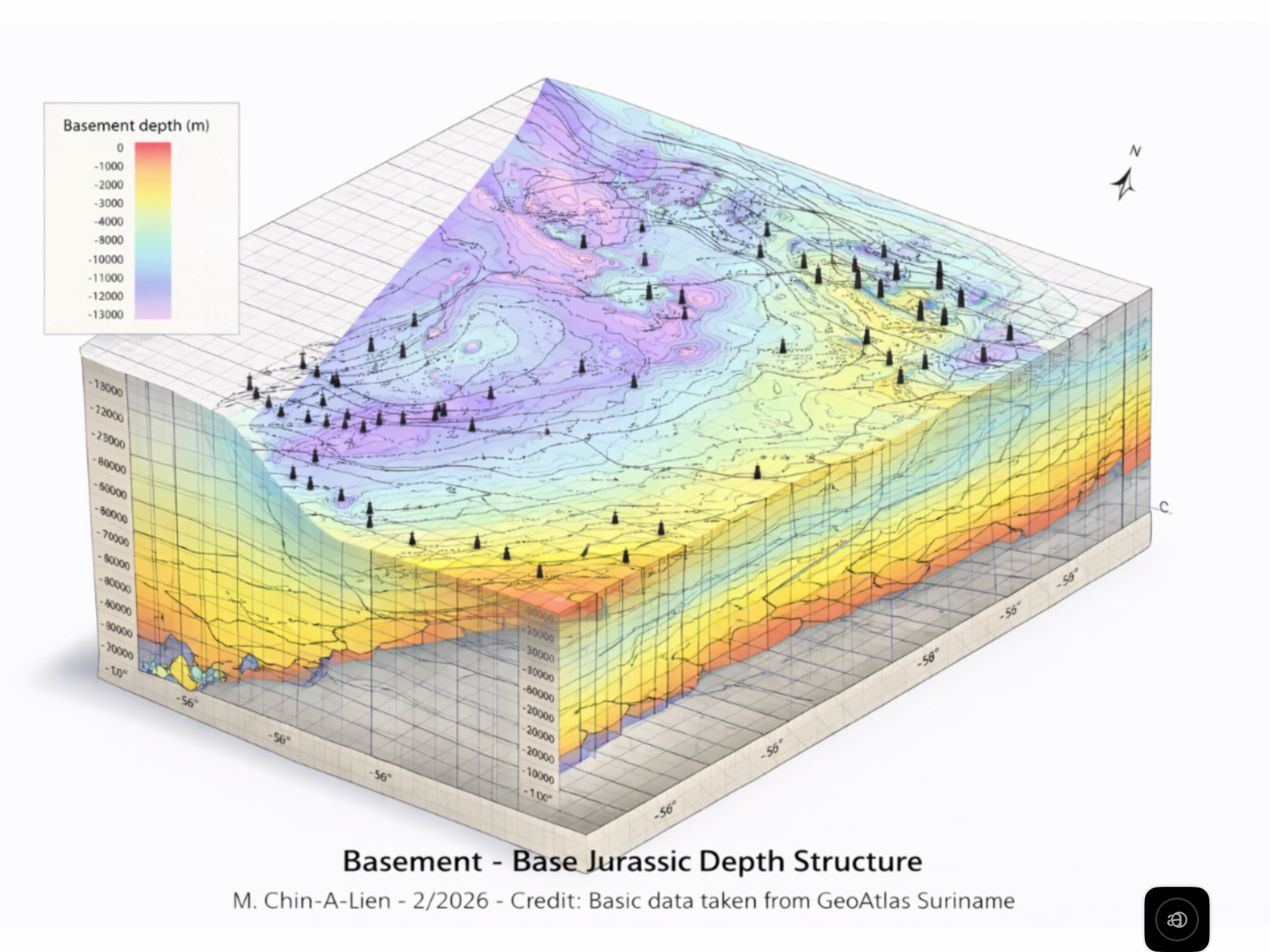
Suriname Offshore — Basement–Base Jurassic Depth Structure
The Tectonic Foundation of the Petroleum System
Primary Geological Reference: GeoAtlas of Suriname, Staatsolie Maatschappij Suriname N.V.
Abstract
This study presents my own structural interpretation of the Basement–Base Jurassic depth surface offshore Suriname, constructed using the GeoAtlas of Suriname (Staatsolie) as the primary geological reference.
The map reveals the tectonic architecture that governed sediment accommodation, source rock maturation, migration pathways and trap inheritance in the Guyana–Suriname Basin.
Basement geometry represents the foundational event in the regional petroleum system.
All subsequent stratigraphy, maturation history and hydrocarbon entrapment are structurally inherited from this tectonic framework.
1. Rift Architecture and Basin Genesis
The Basement surface reflects Jurassic rifting associated with the opening of the Central Atlantic.
The depth structure shows:
- Crustal thinning toward the oceanward direction
- Fault-bounded structural blocks
- NW–SE trending ridges
- Segmented depocenters
- Transform-related lineaments
These features define early accommodation space and controlled the thickness of Cretaceous and Tertiary sediment packages.
2. Hydrocarbon Kitchen Development
Deep basement troughs correspond to areas of maximum burial. Greater burial implies:
- Higher thermal maturity
- Earlier oil generation
- Potential gas-prone deeper domains
Thus, the Basement map doubles as a first-order proxy for hydrocarbon kitchen delineation.
Migration likely occurred from deep troughs toward structural highs and hinge zones.
3. Structural Inheritance into the Golden Lane
The Golden Lane corridor appears spatially aligned with long-lived structural elements.
Basement highs may have:
- Influenced Maastrichtian slope gradients
- Directed turbidite fairways
- Created subtle inversion traps
- Controlled sediment routing systems
This suggests that Golden Lane is not purely stratigraphic — it may represent a tectonically inherited petroleum fairway.
4. Overpressure and Seal Integrity
Deep depocenters indicated by the Basement map likely correlate with:
- Rapid Tertiary loading
- Disequilibrium compaction
- Overpressured shale intervals
These conditions influence drilling risk, trap preservation and hydrocarbon phase behavior.
Understanding basement depth is therefore critical for predicting pressure regimes.
5. Exploration & Development Implications
- Map basement lows against discovered fields to refine kitchen modelling.
- Assess maturity gradients across structural corridors.
- Identify underexplored structural closures inherited from rift geometry.
- Evaluate fluid phase risk along deeper margins.
- Integrate with Top Maastrichtian and Top Paleocene surfaces for full petroleum system reconstruction.
Conclusion
The Basement–Base Jurassic depth structure represents Event Zero of the Suriname offshore petroleum system.
It governs burial, maturation, migration, structural inheritance and overpressure development.
Golden Lane and adjacent plays must be understood within this tectonic framework.
Future structural and stratigraphic analysis (Top Maastrichtian and Top Paleocene) will further illuminate trap evolution, charge timing and preservation risk.
Author: Marcel Chin-A-Lien
Petroleum & Energy Advisor
Golden Lane Investments Advisory Group