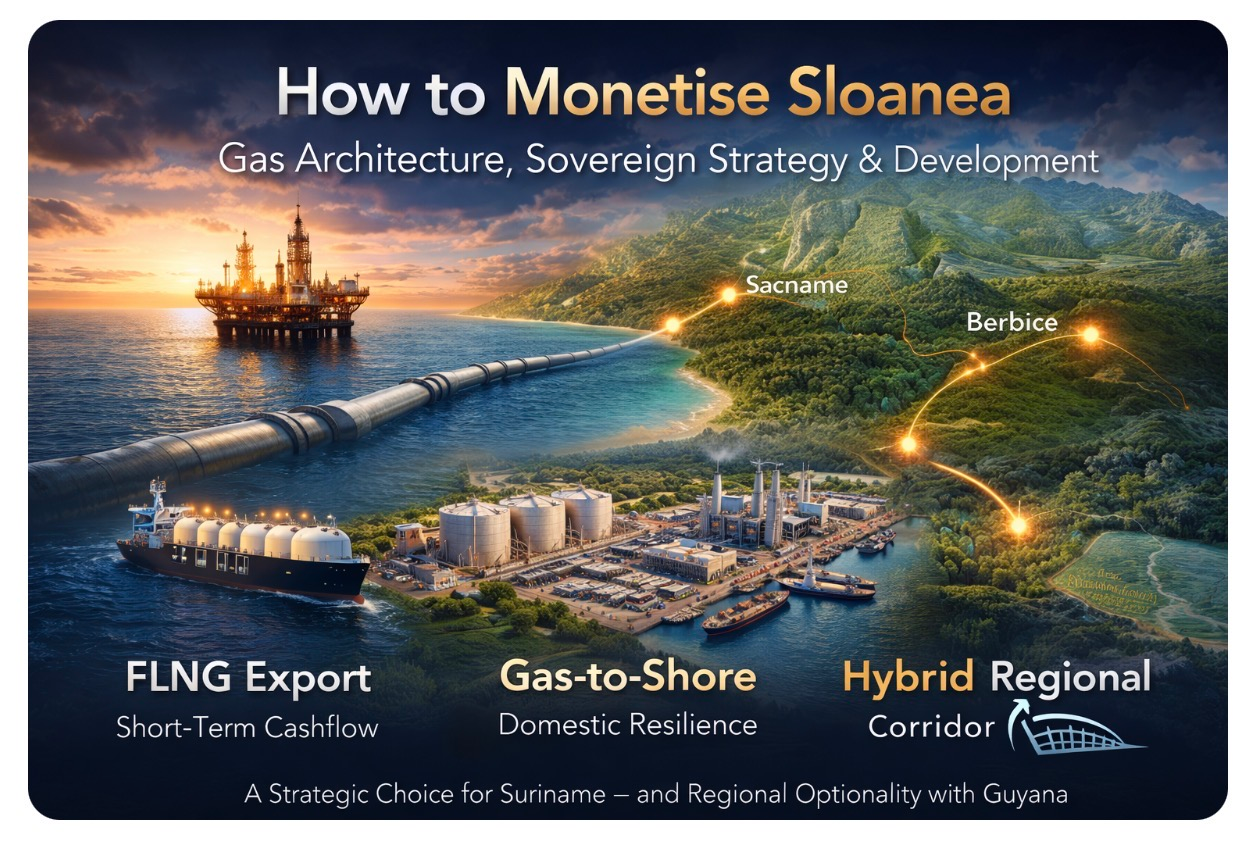
Gas Architecture, Sovereign Strategy & Long-Term Value Creation for Suriname
Executive Overview
Written by Marcel Chin-A-Lien – Petroleum & Energy Advisor – 22 February 2026.
Sloanea is not merely a gas discovery.
It is a strategic inflection point.
The core decision facing Suriname is not whether gas exists.
It is how that gas should be deployed.
Three monetisation pathways emerge:
- Full FLNG Export Model
- Gas-to-Shore (GtS) using 20% Domestic Entitlement
- Hybrid / Regional Gas Architecture (Suriname–Guyana integration)
The question is not technical feasibility alone.
It is institutional design, capital discipline, fiscal resilience, and long-term development architecture and wise energy strategy
Executive Comparative – Sloanea Monetisation Options
| Dimension | FLNG Only | Gas-to-Shore (20%) | Hybrid / Regional Hub |
|---|---|---|---|
| Indicative NPV (US$ million) | ~4,200 | ~2,800 | ~3,500 |
| IRR (project level) | 18–22% | 13–16% | 15–18% |
| Domestic Energy Security | Low | High | Very High |
| Industrial & Regional Development | Limited | Strong (Nickerie anchor) | Transformational (Berbice corridor) |
| Financeability | Very Strong | Conditional (firm supply + PPA) | Complex multi-party |
| Key Fragility | Lower | Utilisation risk | Treaty + governance complexity |
The Strategic Value of Gas-to-Shore
While FLNG maximises short-term capital efficiency, Gas-to-Shore maximises long-term sovereign resilience.
1. Energy Cost Transformation
- Reduction of heavy fuel oil dependency
- Lower and more stable electricity tariffs
- Improved macroeconomic predictability
2. Industrial Anchoring – Nickerie Development
- Agro-processing clusters
- Cold storage logistics
- Light manufacturing and fabrication services
- Local services ecosystem growth
3. Regional Integration – Berbice Corridor
High-level discussions between Suriname and Guyana have already acknowledged the strategic value of cross-border energy integration. A pipeline interconnection increases:
- Security of supply
- Infrastructure utilisation
- Investment attractiveness
- System redundancy
The Critical Questions??
- Is 20% entitlement firm enough to underpin take-or-pay contracts?
- Can domestic demand ramp-up synchronise with offshore plateau?
- Is tariff governance transparent and predictable?
- Does institutional capacity match project complexity?
- Would blended finance lower WACC sufficiently?
If alignment holds, Gas-to-Shore becomes a development engine. If sequencing fails, it becomes a fiscal burden.
Balanced Conclusion
Gas does not create development automatically. Architecture does.
The most prudent sovereign pathway appears sequential:
- Stabilise via export-led cashflow (FLNG)
- Secure firm domestic tranche
- Build Phase 1 Gas-to-Shore conservatively sized
- Scale regionally once contractual and institutional maturity is proven
The objective is not export versus domestic use.
It is disciplined integration.
About the Author
Marcel Chin-A-Lien
Global Petroleum & Energy Advisor
Nearly five decades of international experience integrating exploration, production strategy, fiscal regime design, and commercial structuring across mature and frontier basins.
- Drs – Petroleum Geology
- Engineering Geologist – Petroleum
- Executive MBA – International Business & Petroleum
- MSc – International Management
- Certified Petroleum Geologist (AAPG)
- Chartered European Geologist (EFG)
Strategic focus: Exploration Strategy • PSC Design • Fiscal Optimisation • Sovereign Advisory • M&A • Integrated Technical-Commercial Structuring
Golden Lane Investments Advisory Group
Strategic Energy Advisory | Sovereign Fiscal Modelling | Integrated Gas Architecture
For advisory engagement:
Email: marcelchinalien@gmail.com
LinkedIn: Marcel Chin-A-Lien