The Company That Paid the Tuition
Murphy Oil never made a commercial discovery in Suriname. It de-risked the basin for everyone who did.
GOLDEN LANE INVESTMENTS ADVISORY GROUP
Murphy Oil is often overlooked in the story of the Guyana-Suriname Basin, because it did not find a barrel of commercial oil. That is precisely why it deserves closer attention.
History remembers discoverers. It rarely remembers the companies whose dry wells made discovery possible for someone else. Murphy Oil belongs to the second category, and its eight-year presence in Suriname — two blocks, two exploration wells, one consequential farm-out — is a case study in how frontier value is created long before it is produced.
WHY MURPHY ENTERED
Block 37, 2007
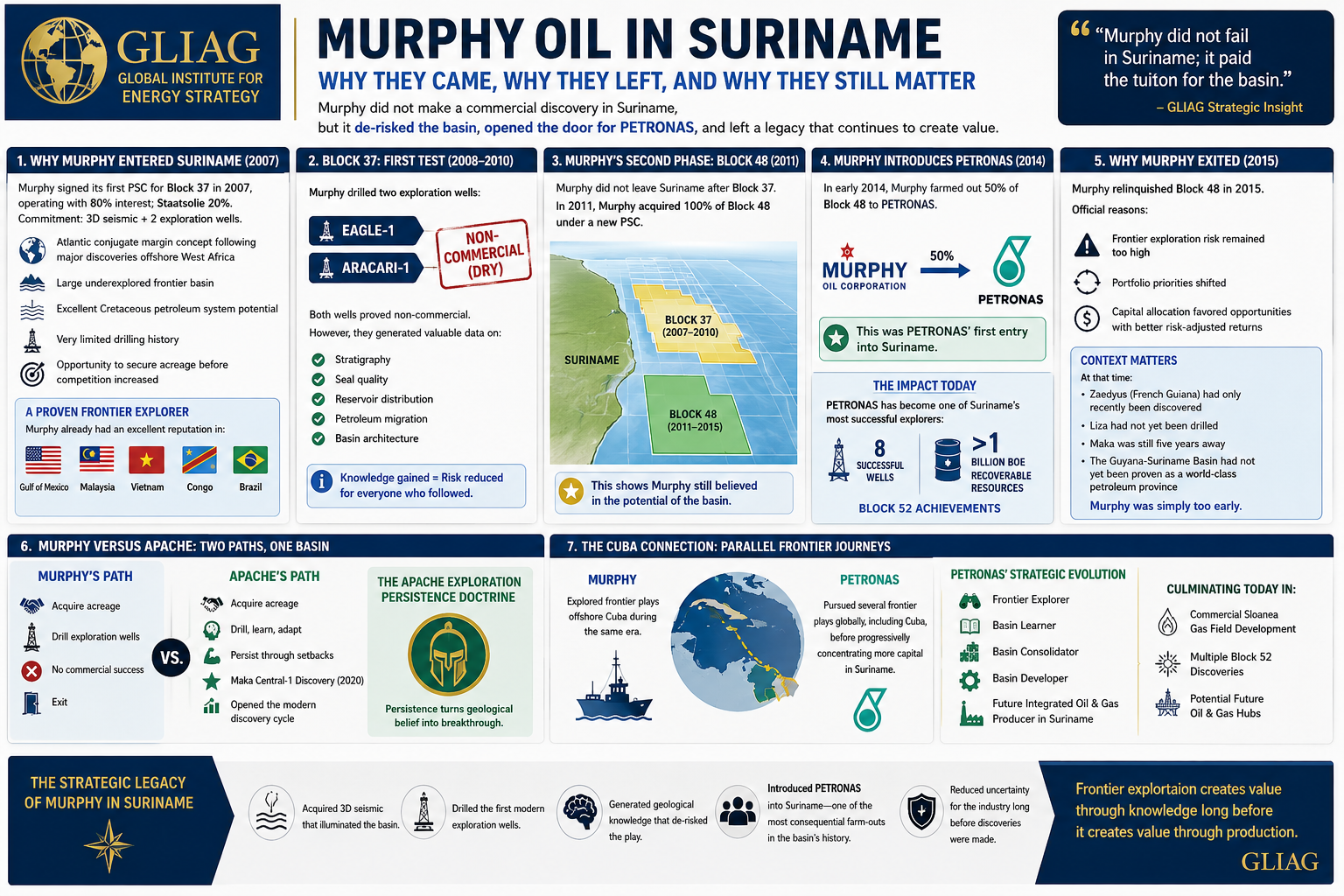
Murphy signed its first Production Sharing Contract for Block 37 in 2007, operating with an 80% interest while Staatsolie retained the remaining 20%. The commitment was straightforward: acquire 3D seismic, drill two exploration wells.
The attraction to Suriname was legible from Murphy’s own playbook. It was an Atlantic conjugate margin concept, following the major discoveries then unfolding offshore West Africa — a large, underexplored frontier basin with strong Cretaceous petroleum system potential and, critically, very limited drilling history. The acreage was still available before competition arrived in force.
Murphy was already a credentialed frontier deepwater explorer, with standing exploration programs in the Gulf of Mexico, Malaysia, Vietnam, Congo, and Brazil. Suriname fit that strategy precisely.
BLOCK 37: TWO WELLS, NO DISCOVERY
Murphy drilled Eagle-1 and Aracari-1. Both proved non-commercial and were considered dry from an exploration standpoint.
The wells were dry. The information was not.
Eagle-1 and Aracari-1 generated data on stratigraphy, seal quality, reservoir distribution, petroleum migration, and basin architecture — exactly the category of information later entrants would use to calibrate their own risk models.
THE SECOND BET: BLOCK 48
Murphy did not leave Suriname after Block 37’s disappointment. In 2011 the company acquired 100% of Block 48 under a new PSC. That decision is easy to skip past, but it is the detail that separates a one-off gamble from a strategic conviction: Murphy still believed in the basin.
THE FARM-OUT THAT MATTERED
How PETRONAS entered Suriname
In early 2014, Murphy farmed out 50% of Block 48 to PETRONAS — the Malaysian national oil company’s first entry into Suriname. Murphy was, in effect, the company that introduced PETRONAS to the basin.
That single transaction became one of the most consequential farm-outs in Suriname’s exploration history. PETRONAS has since become one of the country’s most successful explorers, with eight successful wells and more than 1 billion boe of recoverable resources identified in Block 52.
THE EXIT
2015 — too early, not wrong
Murphy relinquished Block 48 in 2015. The stated reasons were conventional: frontier exploration risk remained too high, portfolio priorities shifted, and capital allocation favored opportunities with better risk-adjusted returns elsewhere in Murphy’s global portfolio.
What matters is what Murphy did not conclude. It did not leave because Suriname lacked a petroleum system. At the time of Murphy’s exit, Zaedyus in French Guiana had only recently been discovered, Liza had not yet been drilled, Maka was still five years away, and the Guyana-Suriname Basin had not yet been proven as a world-class petroleum province. Murphy was not wrong about the geology. It was early.
2007
Block 37 PSC signed. Murphy operates with 80% interest; Staatsolie holds 20%. 3D seismic and two exploration wells committed.
2007–2011
Eagle-1 and Aracari-1 drilled. Both non-commercial. Stratigraphy, seal quality, and migration data generated for the basin.
2011
Block 48 acquired. Murphy takes 100% interest under a new PSC, despite the Block 37 disappointment.
2014
PETRONAS farm-in. Murphy farms out 50% of Block 48 — PETRONAS’ first entry into Suriname.
2015
Murphy relinquishes Block 48. Capital reallocated elsewhere. The basin’s petroleum system remains unproven — for five more years.
MURPHY VERSUS APACHE
The contrast is one of the sharpest in the basin’s history. Murphy followed a traditional exploration sequence: acquire acreage, drill, absorb the result, exit without commercial success. Apache chose a different path — after several disappointments of its own, Apache persisted and drilled Maka Central-1, opening the modern Suriname discovery cycle.
MURPHY’S PATH
- Acquire acreage
- Drill
- No commercial success
- Exit
APACHE’S PATH
- Acquire acreage
- Drill, absorb disappointment
- Persist through further attempts
- Maka Central-1 — discovery cycle opens
This is precisely the contrast that underlies GLIAG’s Apache Exploration Persistence Doctrine: in a frontier basin, the discipline to keep drilling through dry results is itself a strategic asset, distinct from and sometimes more decisive than the initial acreage decision.
THE PETRONAS ARC
Murphy also pursued frontier exploration offshore Cuba during roughly the same era, and PETRONAS followed a similar pattern globally — including its own frontier positions in Cuba — before progressively concentrating capital in Suriname as the geological evidence strengthened.
That trajectory traces PETRONAS’ own strategic evolution: frontier explorer, then basin learner, then basin consolidator, then basin developer, and now an integrated oil-and-gas producer in Suriname. That evolution culminates in the commercial Sloanea gas field development, multiple Block 52 discoveries, and the potential for future oil and gas hubs — an arc that began with a farm-in Murphy structured in 2014.
GLIAG STRATEGIC INSIGHT
Murphy did not fail in Suriname. It paid the tuition for the basin.
Its seismic acquisition, frontier drilling, geological interpretation, and willingness to farm into PETRONAS reduced uncertainty for every company that followed. Murphy was one of the basin’s pathfinders — and its greatest legacy may not be the wells it drilled, but the door it opened for PETRONAS, which went on to become one of Suriname’s most successful offshore explorers.
Frontier exploration creates value in two currencies. One is production, counted in barrels and cash flow. The other is knowledge — de-risked stratigraphy, calibrated seal models, a farm-out relationship that outlives the farmer. Murphy earned almost none of the first currency in Suriname. It earned a considerable amount of the second, and the basin has been spending it ever since.
Soso Lobi.
GLIAG
Golden Lane Investments Advisory Group — Independent Strategic Petroleum Advisory, Guyana–Suriname Basin