The Hidden Transition
Guyana’s petroleum story is no longer about how many barrels it can produce. It is about how many industries a single barrel can create.
GOLDEN LANE INVESTMENTS ADVISORY GROUP
For years, Guyana’s petroleum strategy could be summarized in one sentence: find more barrels, produce more barrels.
That sentence is no longer sufficient.
That was the Exploration and Production Era. It had a clean logic and a clean scoreboard. Today the strategic question has changed, and it has changed quietly enough that the shift is easy to miss from inside the industry itself.
It is no longer: “How many barrels can Guyana produce?”
It is becoming: “How many industries can one barrel create?”
That is not a change in emphasis. It is an entirely different development philosophy, and it carries different metrics, different institutions, and a different definition of success.
A GLIAG INTERPRETATION
Five successive stages
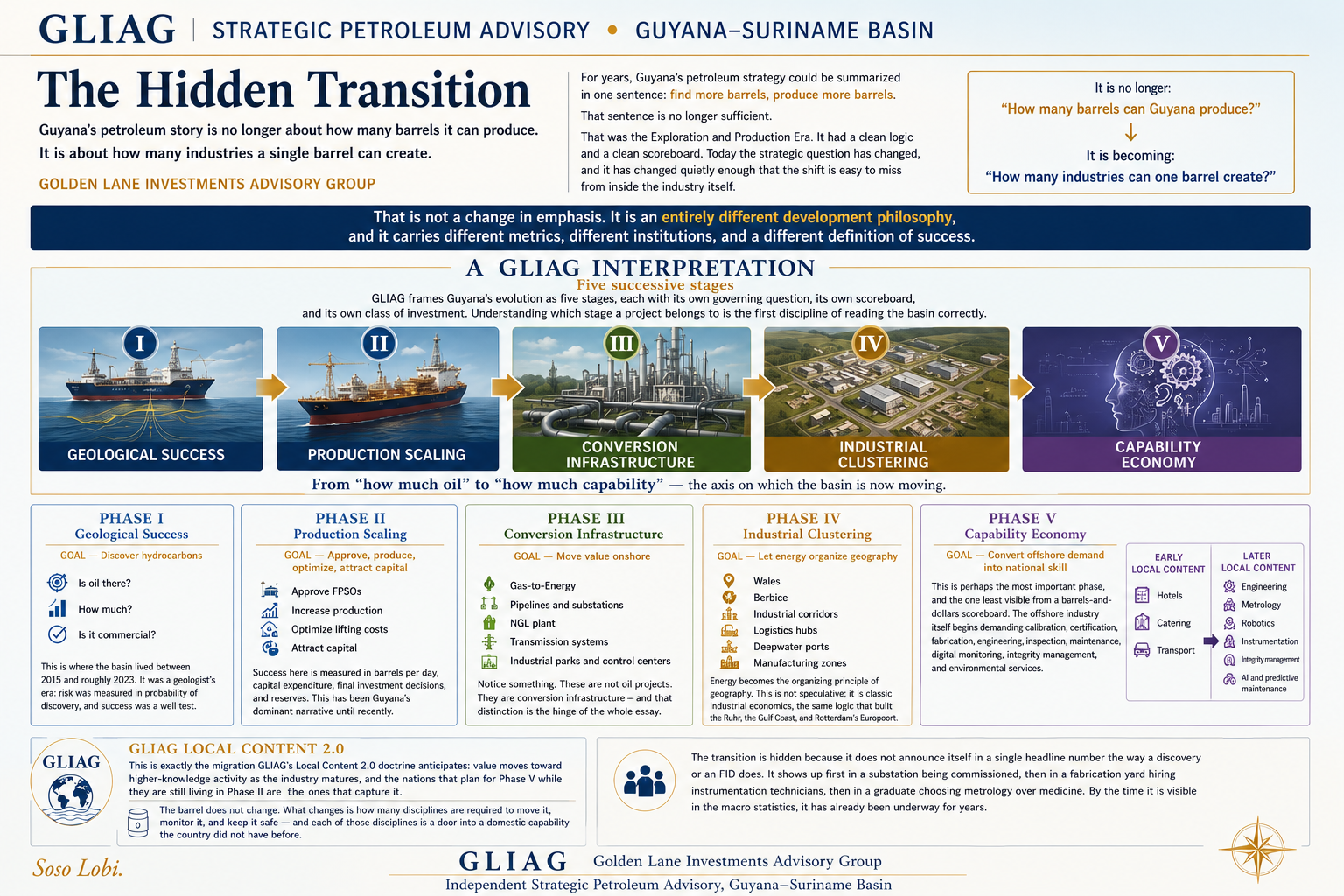
GLIAG frames Guyana’s evolution as five stages, each with its own governing question, its own scoreboard, and its own class of investment. Understanding which stage a project belongs to is the first discipline of reading the basin correctly.
I – GEOLOGICAL SUCCESS
II – PRODUCTION SCALING
III – CONVERSION INFRASTRUCTURE
IV – INDUSTRIAL CLUSTERING
V – CAPABILITY ECONOMY
From “how much oil” to “how much capability” — the axis on which the basin is now moving.
PHASE I – Geological Success
GOAL — Discover hydrocarbons
- Is oil there?
- How much?
- Is it commercial?
This is where the basin lived between 2015 and roughly 2023. It was a geologist’s era: risk was measured in probability of discovery, and success was a well test.
PHASE II – Production Scaling
GOAL — Approve, produce, optimize, attract capital
- Approve FPSOs
- Increase production
- Optimize lifting costs
- Attract capital
Success here is measured in barrels per day, capital expenditure, final investment decisions, and reserves. This has been Guyana’s dominant narrative until recently, and it is the narrative most external observers still assume is the only one running.
PHASE III – Conversion Infrastructure
GOAL — Move value onshore
Now something changes. Instead of investing primarily offshore, investment begins appearing onshore: Gas-to-Energy, pipelines, substations, an NGL plant, transmission systems, industrial parks, control centers.
- Gas-to-Energy
- Pipelines and substations
- NGL plant
- Transmission systems
- Industrial parks and control centers
Notice something. These are not oil projects. They are conversion infrastructure — and that distinction is the hinge of the whole essay.
PHASE IV – Industrial Clustering
GOAL — Let energy organize geography
Once energy arrives cheaply onshore, entirely new industries become possible. Instead of asking “where is the oil?”, the country begins asking “where should industries locate?”
- Wales
- Berbice
- Industrial corridors
- Logistics hubs
- Deepwater ports
- Manufacturing zones
Energy becomes the organizing principle of geography. This is not speculative; it is classic industrial economics, the same logic that built the Ruhr, the Gulf Coast, and Rotterdam’s Europoort.
PHASE V – Capability Economy
GOAL — Convert offshore demand into national skill
This is perhaps the most important phase, and the one least visible from a barrels-and-dollars scoreboard. The offshore industry itself begins demanding calibration, certification, fabrication, engineering, inspection, maintenance, digital monitoring, integrity management, and environmental services.
Notice how the value chain shifts.
EARLY LOCAL CONTENT
- Hotels
- Catering
- Transport
LATER LOCAL CONTENT
- Engineering
- Metrology
- Robotics
- Instrumentation
- Integrity management
- AI and predictive maintenance
GLIAG LOCAL CONTENT 2.0
This is exactly the migration GLIAG’s Local Content 2.0 doctrine anticipates: value moves toward higher-knowledge activity as the industry matures, and the nations that plan for Phase V while they are still living in Phase II are the ones that capture it.
The barrel does not change. What changes is how many disciplines are required to move it, monitor it, and keep it safe — and each of those disciplines is a door into a domestic capability the country did not have before.
The transition is hidden because it does not announce itself in a single headline number the way a discovery or an FID does. It shows up first in a substation being commissioned, then in a fabrication yard hiring instrumentation technicians, then in a graduate choosing metrology over medicine. By the time it is visible in the macro statistics, it has already been underway for years.
Soso Lobi.
GLIAG
Golden Lane Investments Advisory Group — Independent Strategic Petroleum Advisory, Guyana–Suriname Basin