Independent Reservoir-to-Revenue Assessment · GranMorgu, Block 58, Suriname · 27 June 2026
GLIAG TECHNICAL REPORT · DEEPWATER PETROLEUM SYSTEMS · BLOCK 58, OFFSHORE SURINAME
Gran Morgu: From Reservoir Physics
to National Prosperity
An Independent GLIAG Reservoir-to-Revenue Assessment of Suriname’s First World-Class Deepwater Development
Drs. M.P.T. Chin-A-Lien, MBA, M.Sc., Ing. Geologist
PRINCIPAL FOUNDING PARTNER & CHIEF ARCHITECT · GLIAG
Golden Lane Investments Advisory Group
Certified Professional Geologist Nr. 5201-1996 (AAPG) ·
Chartered European Geologist Nr. 92-1996 (EFG) ·
Energy Negotiator June 2021 (AIEN)
27 June 2026 · petroleumenergyinsights.com
Gran Morgu is Suriname’s defining petroleum project: the first large-scale deepwater development that will move the country from an exploration province to a long-term producing nation.
GLIAG CORE DOCTRINE — RESERVOIR ENGINEERING BEFORE REVENUE ENGINEERING
Rather than starting from headline revenue forecasts, the GLIAG model begins with reservoir physics, builds a technically defensible production and depletion profile, and only then derives cash flows under Suriname’s Production Sharing Contract.
Reservoir → Production → Depletion → Revenue → PSC → Staatsolie → Government → National Value
32
SUBSEA WELLS
(16 PROD · 16 INJECTION)
220kb/d
FPSO DESIGN CAPACITY
2028
EXPECTED FIRST OIL
25 yr
VALUE-GENERATION HORIZON
TABLE OF CONTENTS
- 01 – GLIAG Perspective and Purpose
- 02 – Reservoir Characterization
- 03 – Production Engineering
- 04 – Production and Depletion Engineering
- 05 – Petroleum Economics and the PSC
- 06 – Revenue Generation 2028–2053
- 07 – Sensitivity Analysis and Risk Assessment
- 08 – Strategic Conclusions and Implications
- 09 – Independent Conclusions and Recommendations
- 10 – Epilogue — From Gran Morgu to Suriname Horizon 2050 and Beyond
- 11 – Future Work
- Re – References
Chapter 1 — GLIAG Perspective and Purpose
The Gran Morgu development targets the Sapakara and Krabdagu discoveries in Block 58 through a 32-well subsea development — 16 production wells and 16 water-injection wells — connected to a 220,000 b/d Floating Production, Storage and Offloading vessel. Final Investment Decision has been taken; first oil is expected around 2028; and project execution is underway with major subsea and FPSO contracts awarded.
Public discussion has understandably focused on reserves, plateau rates and future revenues. GLIAG’s independent assessment reframes GranMorgu as a 25-year value-generation system, where geology, reservoir engineering, production engineering, petroleum economics and governance must function as one integrated system.
PURPOSE OF THIS REPORT
- Establish a scientifically defensible reservoir and production framework
- Reconstruct a volumetrically consistent production and depletion profile
- Translate the production profile into PSC cash-flow and revenue trajectories
- Evaluate robustness through sensitivity analysis and scenario modelling
- Articulate strategic implications for Suriname’s long-term national development
Chapter 2 — Reservoir Characterization
GranMorgu targets two proven Upper Cretaceous deepwater sandstone reservoirs — Sapakara and Krabdagu — which together form a single integrated development system. The objective is to maximise recovery through coordinated reservoir management rather than independent field depletion.
Both reservoirs contain high-quality light crude oil and have demonstrated commercial flow rates during appraisal and well testing. They are significantly overpressured, providing strong initial reservoir energy and excellent well deliverability, consistent with Upper Cretaceous turbidite systems in the Guyana–Suriname Basin. Pressure maintenance through water injection has therefore been selected as the preferred depletion strategy.
FIVE GOVERNING RESERVOIR PARAMETERS
From a reservoir-engineering perspective, five parameters ultimately govern GranMorgu’s performance: reservoir pressure evolution; well productivity; water-injection efficiency; reservoir sweep efficiency; and decline behaviour after plateau production. These variables determine the production profile, cumulative recovery and, ultimately, the economic value of the development.
GLIAG’s production model therefore begins with reservoir behaviour rather than financial assumptions — reservoir physics constrains production, and production determines revenues.
GLIAG OBSERVATION
The reservoir is the first asset. Protecting its energy is the first responsibility of field development.
Chapter 3 — Production Engineering
Production engineering forms the operational bridge between the reservoir and the production facility. Its objective is not to maximise instantaneous oil rates, but to maximise ultimate recovery, maintain production stability and protect long-term reservoir performance.
For GranMorgu, production engineering integrates the Sapakara and Krabdagu reservoirs into a single production system — 16 production wells, 16 water-injection wells, subsea flowlines, manifolds, risers and the 220,000 b/d FPSO. Each component must operate as one hydraulic system.
In practice, the reservoir — not the FPSO — ultimately determines sustainable production. Production engineering should be viewed as active reservoir management at the surface.
PRODUCTION ENGINEERING OBJECTIVES
- Maximise sustainable oil production and ultimate recovery
- Maintain reservoir pressure through balanced water injection
- Optimise well productivity and drawdown across all 16 producers
- Delay detrimental water breakthrough through sweep management
- Maintain robust flow assurance and subsea system integrity
- Minimise production deferment and unplanned downtime
Chapter 4 — Production and Depletion Engineering
Production forecasting is fundamentally a reservoir-engineering exercise. Before revenues, taxes or government take can be estimated, the production profile must first satisfy the physical laws of reservoir depletion and material balance.
GOVERNING PRINCIPLE
Every production forecast must satisfy volumetric closure. First close the barrels. Then calculate the dollars.
4.1 Engineering Logic of the Production Profile
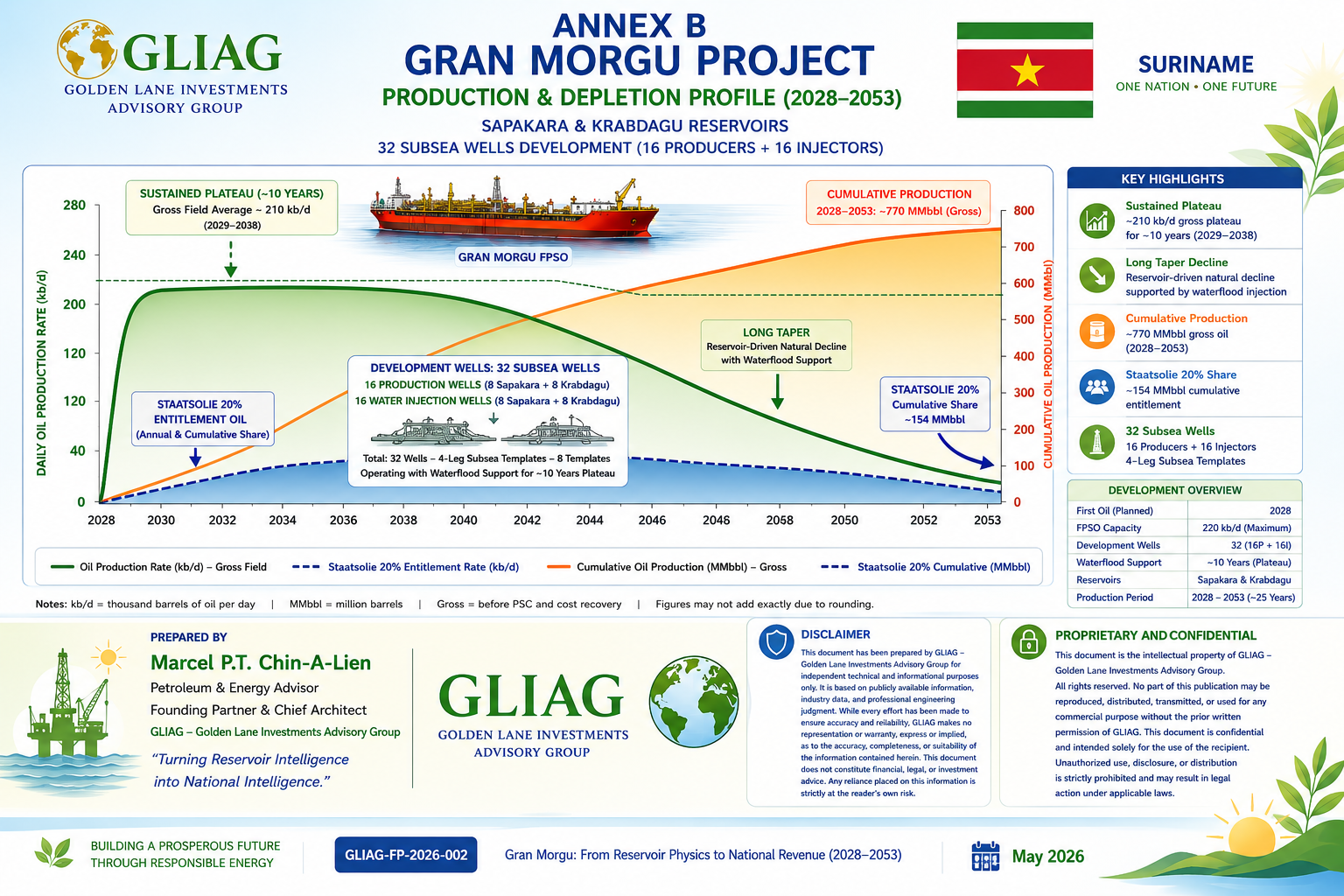
The GLIAG model begins with reservoir behaviour rather than economic assumptions. Annual production rates are reconstructed from a technically consistent sequence of field development: initial ramp-up as wells are drilled, completed and commissioned; managed production plateau supported by continuous water injection and active surveillance; controlled production decline governed by reservoir depletion and water-cut evolution; and late-life optimisation through targeted interventions.
4.2 FPSO Capacity versus Long-Term Field Rates
The 220,000 b/d quoted for GranMorgu represents the maximum processing capacity of the FPSO — not the expected long-term average production rate of the field. Sustainable field production is likely to fluctuate below this design capacity as reservoir management seeks to maximise ultimate recovery rather than maximise short-term volumes, consistent with good reservoir stewardship.
4.3 Volumetric Closure Before Fiscal Modelling
GLIAG ENGINEERING SEQUENCE
Reservoir engineering establishes what can be produced. Production engineering determines how it can be produced. Petroleum economics determines what those barrels are worth. Reversing this sequence weakens every economic forecast that follows.
Only after the annual production curve, cumulative production curve and implied reservoir depletion profile are mathematically reconciled can the model be reliably used as the basis for PSC allocation, government revenues, Staatsolie participation and investor cash-flow analysis.
Chapter 5 — Petroleum Economics and the Production Sharing Contract
Once the production profile has been demonstrated to be reservoir-engineering consistent, petroleum economics can begin. For GranMorgu, value distribution is governed by the Production Sharing Contract. Under a PSC, ownership of the petroleum remains with the Republic of Suriname, while the contractor assumes the exploration, development and production risks.
PSC VALUE CHAIN
STEP 1
Reservoir Production
STEP 2
Gross Revenue
STEP 3
Cost Recovery
STEP 4
Profit Oil Split
STEP 5
Tax & Royalty
STEP 6
Government Take
STEP 7
National Value
GLIAG ECONOMIC PRINCIPLE
Every dollar must be traceable back to a produced barrel. Reservoir uncertainty decreases through drilling. Economic uncertainty decreases through transparency.
Chapter 6 — Revenue Generation During the Production Life (2028–2053)
Revenue generation is not constant throughout the project. It follows the evolution of reservoir depletion, production rates, capital recovery and the PSC mechanisms. The project evolves through three distinct economic phases.
THREE ECONOMIC PHASES — GRANMORGU 2028–2053
- Investment Recovery Phase — high capital recovery, lower government cash flow; development capital allocated to cost recovery under the PSC
- Value Creation Phase — stable production and increasing government participation; the fiscal balance shifts as profit oil grows
- Mature Production Phase — declining production with continued positive cash generation until economic field limit is reached
GranMorgu should not be viewed simply as a high-revenue project. It is a 25-year value-generation system in which geology, engineering, finance and fiscal policy interact continuously. Revenue is not an independent variable — it is the mathematical consequence of reservoir performance, production engineering, petroleum economics, and sound governance.
Chapter 7 — Sensitivity Analysis and Risk Assessment
Every field development is based on uncertainty. No production or revenue model should be evaluated using a single deterministic case; a robust engineering framework requires systematic sensitivity analysis.
RESERVOIR RISK
Ultimate recovery depends on reservoir continuity, pressure support, water-injection efficiency, sweep performance and long-term well productivity. The reservoir remains the largest source of uncertainty throughout field life.
PRODUCTION RISK
Performance may be affected by drilling schedules, well availability, flow assurance, subsea equipment reliability, FPSO uptime and intervention requirements. Even modest production reductions can significantly impact cumulative recovery over 25 years.
ECONOMIC RISK
Project economics remain sensitive to Brent oil price, operating costs, capital expenditure, financing costs and schedule slippage. Lower oil prices primarily reduce annual cash flow and government take.
FISCAL RISK
Annual government revenues depend on production performance, cost-recovery dynamics, oil prices and the timing of fiscal allocations. Changes in any of these elements can alter the effective government-take profile over time.
GLIAG SENSITIVITY CASES
| SCENARIO | PRIMARY VARIABLE | ASSESSMENT FOCUS |
|---|---|---|
| BASE CASE | Reference assumptions | Central engineering and economic outcome |
| Low Oil Price | Brent price reduction | Government take and cash flow resilience |
| High Oil Price | Brent price increase | Upside government revenue and contractor return |
| +1 Year First Oil Delay | Project schedule | Revenue deferral and financing cost impact |
| +2 Year First Oil Delay | Project schedule | Cumulative cash flow and covenant pressure |
| Higher CAPEX | Development cost | Cost recovery timing and investor returns |
| Higher OPEX | Operating cost | Field economics in late-life production |
| Lower Reservoir Recovery | Recovery factor | Downside production and revenue profile |
| Higher Reservoir Recovery | Recovery factor | Upside production and national value potential |
GLIAG PRINCIPLE
Sensitivity analysis should never begin with revenue. It should begin with the reservoir. GranMorgu should not be viewed as one forecast — it should be viewed as a range of technically plausible outcomes.
Chapter 8 — Strategic Conclusions and Implications
GranMorgu is considerably more than Suriname’s first world-class offshore oil development; it represents the country’s transition from an exploration province into a long-term petroleum-producing nation. The project should not be evaluated solely on reserves, peak production or annual revenues, but on its ability to generate sustainable national value over its entire productive life.
GLIAG — THE FIVE-DISCIPLINE VALUE CHAIN
From a national perspective, GranMorgu should be regarded as a 25-year value-generation system, not merely a 25-year oil project. Its success will ultimately be measured by the interaction of five disciplines: petroleum geology; reservoir engineering; production engineering; petroleum economics; and national governance. Weakness in any one of these disciplines diminishes the value created by the other four.
The reservoir determines production.
Production determines cumulative recovery.
Cumulative recovery determines gross revenues.
Gross revenues determine value distribution under the PSC.
Sound governance determines whether petroleum revenues become long-term national prosperity.
Chapter 9 — Independent Conclusions and Recommendations
This independent GLIAG assessment leads to nine principal conclusions.
1
The Reservoir Is the Foundation. Every technical and economic outcome begins with the reservoir. Reservoir characterization, pressure management and depletion behaviour determine the amount of recoverable oil and therefore the long-term value of the project.
2
Engineering Must Lead Economics. Production forecasts should never be driven by financial expectations. Reservoir engineering and production engineering must first establish a technically defensible production profile before any economic evaluation is undertaken.
3
Volumetric Closure Is Essential. The cumulative production profile must reconcile mathematically with the recoverable reserves. A production forecast that does not satisfy material balance cannot be considered engineering-defensible.
4
Production Capacity Is Not Production Reality. The 220,000 b/d FPSO defines maximum processing capacity, not necessarily sustained field production. Long-term reservoir performance should always take precedence over short-term production maximisation.
5
Reservoir Management Creates Value. Water injection, surveillance, reservoir simulation, production optimisation and well management are not operational details — they are the principal mechanisms through which additional national value is created.
6
Financial Models Must Remain Transparent. Every revenue forecast should be fully traceable from annual production through the PSC to government revenues, Staatsolie participation and contractor cash flow.
7
Scenario Analysis Is Superior to Single Forecasts. The future cannot be predicted precisely. It can, however, be prepared for. Scenario-based modelling provides a more realistic basis for strategic planning than any single deterministic forecast.
8
Engineering Excellence Must Continue Beyond First Oil. The announcement of first oil is not the end of the engineering challenge; it is the beginning. Reservoir management during production will largely determine ultimate recovery and lifetime project value.
9
GranMorgu Is a National Development Platform. It should not be viewed solely as an offshore oil project — it is a long-term platform for fiscal stability, institutional strengthening, human capital development, industrial growth and national transformation.
GLIAG RECOMMENDATIONS — INTEGRATED EVALUATION FRAMEWORK
- Annual reservoir-performance reviews and updated dynamic reservoir simulation
- Production-optimisation studies and recovery-factor monitoring
- Annual production–depletion reconciliation against the material-balance model
- Transparent PSC cash-flow reconciliation reported annually
- Integrated reservoir–production–economic modelling throughout field life
- Regular sensitivity analyses for oil price, production performance and project execution
Chapter 10 — Epilogue: From GranMorgu to Suriname Horizon 2050
EVERY PETROLEUM PROVINCE REACHES A DEFINING MOMENT
NORWAY
Ekofisk
BRAZIL
Lula
GUYANA
Liza
SURINAME
Gran Morgu
GranMorgu represents the transition from exploration success to production responsibility. The discovery phase is ending; the execution phase has begun. History demonstrates that natural resources alone do not create prosperous nations. Prosperity is created when geology is combined with engineering excellence, sound institutions, disciplined financial management and long-term national vision.
GranMorgu should not simply be viewed as an oil project. It should be regarded as a national systems project. Its success will ultimately depend upon the integration of petroleum geology, reservoir engineering, production engineering, project execution, fiscal policy, governance, environmental stewardship, local content, education and strategic investment.
The oil itself is finite. The institutions built around it need not be. This may be GranMorgu’s greatest contribution to Suriname: not merely the millions of barrels produced or the billions of dollars generated, but the creation of a new generation of Surinamese engineers, geoscientists, economists, financiers, entrepreneurs and public institutions capable of managing a modern offshore petroleum province.
GLIAG LEGACY STATEMENT
Petroleum geology discovered the opportunity.
Reservoir engineering transforms that opportunity into producible reserves.
Production engineering delivers those reserves safely and efficiently.
Petroleum economics converts production into national income.
Good governance converts income into lasting prosperity.
Oil is a finite resource. Knowledge is a renewable resource. Institutions are the bridge between the two.
Chapter 11 — Future Work: Towards a Fully Integrated Reservoir-to-Revenue Model
This publication has established the engineering framework for understanding the GranMorgu development. The GLIAG objective is straightforward: Every barrel. Every dollar. Every year. Fully reconciled.
WORK PACKAGE 1
Reservoir Engineering
Reconstruct the reservoir model from publicly available information and accepted deepwater analogues, including reservoir architecture, fluid properties, pressure behaviour and depletion mechanisms.
WORK PACKAGE 2
Production Engineering
Develop an annual production model for 2028–2053 in which production rates, cumulative recovery and field depletion satisfy volumetric closure before economic calculations begin.
WORK PACKAGE 3
Petroleum Economics
Reconstruct the PSC into an annual cash-flow model linking gross production, gross revenue, cost recovery, profit oil, Staatsolie participation, contractor cash flow and government revenues.
WORK PACKAGE 4
Risk and Sensitivity
Evaluate the influence of oil price, production performance, capital expenditure, operating costs, project delays and recovery efficiency on long-term project economics.
WORK PACKAGE 5
Strategic Integration
Integrate reservoir engineering, production engineering, petroleum economics and national development into one transparent engineering framework supporting evidence-based decision-making throughout the producing life of GranMorgu.
GLIAG STANDARD — FOUR INDEPENDENT CLOSURE TESTS
TEST 1
Reservoir Closure
Recoverable reserves reconcile with cumulative production
TEST 2
Production Closure
Annual production reconciles with the depletion model
TEST 3
Fiscal Closure
PSC allocations reconcile with annual production and revenue
TEST 4
Financial Closure
Annual revenues reconcile with cumulative project value
SELECTED REFERENCES
Craft, B.C., Hawkins, M.F., & Terry, R.E. 1991. Applied Petroleum Reservoir Engineering, 2nd ed. Prentice Hall, Englewood Cliffs, NJ.
Cosentino, L. 2011. Fundamentals of Applied Reservoir Engineering. Elsevier, Oxford.
Dake, L.P. 1983. Fundamentals of Reservoir Engineering. Elsevier, Amsterdam.
Daniel, P., Keen, M., & McPherson, C. 2010. The Taxation of Petroleum and Minerals.Routledge, London.
Economides, M.J., Hill, A.D., & Ehlig-Economides, C. 1994. Petroleum Production Systems. Prentice Hall, Englewood Cliffs, NJ.
Fanchi, J.R. 2006. Principles of Applied Reservoir Simulation, 2nd ed. Gulf Professional Publishing, Houston.
Johnston, D. 1994. International Petroleum Fiscal Systems and Production Sharing Contracts. PennWell Books, Tulsa.
Smith, J.E. 2014. Risk and Decision Analysis in Oil and Gas Exploration. SPE Monograph Series. Society of Petroleum Engineers, Richardson, TX.
Sunley, E., Baunsgaard, T., & Simard, D. 2003. Revenue from the Oil and Gas Sector: Issues and Country Experience. IMF Working Paper. Washington, DC.
Wood Mackenzie. 2026. GranMorgu (Block 58) – Upstream Oil and Gas Report. Wood Mackenzie Ltd., Edinburgh.
Government of Suriname. 2026. Gran Morgu-project op koers voor eerste olieproductie.GOV.SR, Paramaribo, 14 April 2026.
Staatsolie Maatschappij Suriname N.V. 2024 & 2025. Staatsolie Annual Reports 2023 and 2024. Paramaribo. Available at: staatsolie.com
TotalEnergies. 2024 & 2025. GranMorgu project announcements and FID press release.TotalEnergies SE, Paris.
TechnipFMC. 2024. TechnipFMC Awarded Major iEPCI™ Contract for TotalEnergies’ GranMorgu Development. Press release, 13 November 2024.
Saipem. 2024. Saipem Awarded Subsea Development Contract for GranMorgu Project Offshore Suriname. Press release, 15 November 2024.
OilNOW / Rystad Energy. 2025–2026. Articles on GranMorgu offshore development, FPSO scale and subsea architecture. OilNOW.gy, Georgetown.
ANNEXES (A – E).
ANNEX A
Production Table 2028–2053

Annual production, cumulative volumes and PSC metrics by year.
ANNEX B
Production–Depletion Curve
Graphs of annual production rate and cumulative production over field life.

ANNEX C
PSC Flow Diagram
Schematic showing cost recovery, profit oil allocation and government take.

ANNEX D
Revenue Model
Year-by-year cash-flow breakdown for State, Staatsolie and contractor.

ANNEX E
Sensitivity Cases
Summary tables and charts for price, volume, cost and recovery scenarios across all nine GLIAG sensitivity cases.

DISCLAIMER
This publication has been prepared exclusively for educational, scientific and professional discussion. It does not constitute reserve certification, investment advice, legal advice, engineering advice or commercial valuation of GranMorgu, Block 58, TotalEnergies, Staatsolie Maatschappij Suriname N.V., or any related entity. Interpretations are based on publicly available information and established petroleum-engineering and economic methodology. Readers requiring technical, investment or legal counsel should consult qualified professional advisors. GLIAG has no commercial relationship with any entity referenced in this publication.
GLIAG — GOLDEN LANE INVESTMENTS ADVISORY GROUP
Independent Geoscience · Energy Intelligence · Strategic Advisory
“Turning Reservoir Intelligence into National Intelligence.”
© 2026 GLIAG – Golden Lane Investments Advisory Group. All Rights Reserved.
petroleumenergyinsights.com · Drs. M.P.T. Chin-A-Lien, MBA, M.Sc., Ing. Geologist
Soso Lobi.