Guyana • Golden Lane • Stabroek • FPSOs • Production • Public Finance
Guyana’s Golden Lane Production History (2019–2025): How Output, FPSOs, and Revenues Evolved — and What Comes Next (2026–2030)
Author: Marcel Chin-A-Lien • Affiliation: Petroleum & Energy Advisor • Date: 27 January 2026
Executive summary
Since first oil in December 2019, Guyana’s offshore petroleum sector—often described through the “Golden Lane” fairway narrative (FYI: a most beautiful name for the petroleum fairway that I myself predicted, coined and published in 2010, already 4 years before the discovery Liza-1, the first Golden Lane well), production has progressed from a single FPSO into a multi-FPSO production system with a steep output ramp.
Public reporting indicates full-year crude production of 225.4 million barrels in 2024 and 261.1 million barrels in 2025, alongside growing petroleum inflows to the Natural Resource Fund (NRF).
This article provides an easy-to-read, well-documented chronology of FPSOs and field developments, how production evolved over time, how “produced-to-date” compares to the remaining resource base, and how government petroleum inflows have scaled.
A five-year outlook (2026–2030) is offered using operator guidance, official reporting, and international financial institution (IFI) framing.
Contents
- Scope and definitions
- Chronology: FPSOs and project start-ups
- Production evolution: annual and cumulative
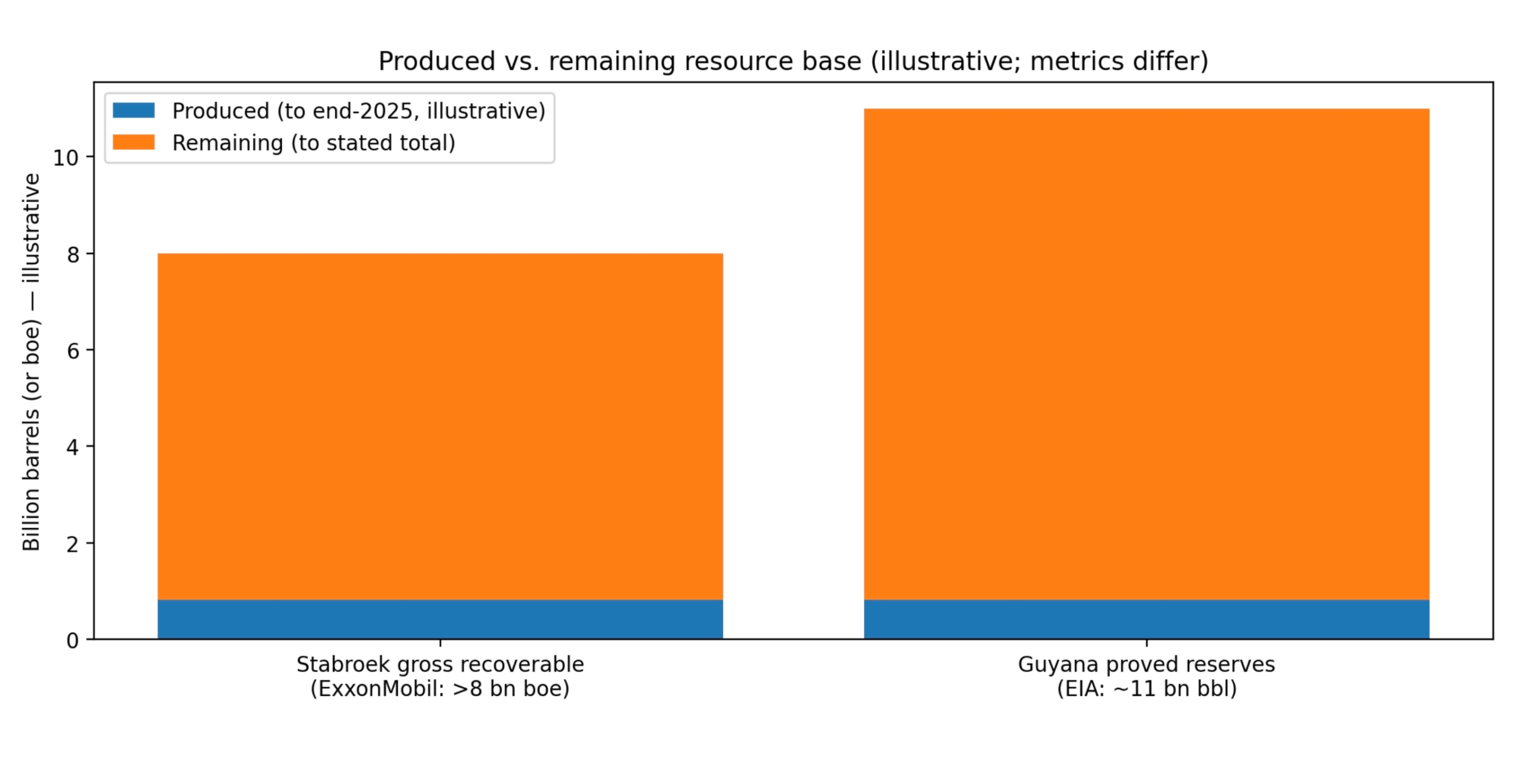
- Produced vs. remaining resource base
- Revenue flow through time: NRF inflows
- Prognosis: 2026–2030
- Selected sources
1) Scope and definitions
The term “Golden Lane” is used widely as an industry shorthand for the exceptionally successful deep-water trend offshore Guyana.
Operationally, the development engine is the Stabroek Block, led by ExxonMobil and partners, where successive FPSO projects have enabled rapid production growth.
A note on resource terminology: “gross recoverable resource” (operator framing) and “proved reserves” (statistical/agency framing) are different categories.
This article uses both only to show scale, and the comparison figure is explicitly labeled as illustrative.
2) Chronology: producing projects, FPSOs, and sanctioning cadence
| Project (FPSO) | Start-up (publicly reported) | Context (high level) |
|---|---|---|
| Liza Phase 1 (Liza Destiny) | Dec 2019 | First oil; established Guyana as a producing province. |
| Liza Phase 2 (Liza Unity) | Feb 2022 | Second hub; enabled sustained national step-up in output. |
| Payara (Prosperity) | Late 2023 | Third hub; underpinned the 2024 production increase. |
| Yellowtail (ONE GUYANA) | Aug 2025 | Fourth hub; late-2025 Stabroek milestone reported at ~900 kbpd. |
| Uaru (planned) | 2026 (guidance) | Next growth step; under construction and repeatedly referenced as 2026 start. |
| Whiptail (planned) | ~2027 (guidance) | Commonly cited around late-2027; subject to execution. |
| Hammerhead (planned) | 2029 (guidance) | Approved; described publicly as a later-phase development. |


3) Production evolution: how output scaled over time


4) Produced-to-date vs. reserves/resources: scale matters


Important: the “gross recoverable resource” figure and “proved reserves” are different categories; the figure is intentionally labeled illustrative and should not be read as a formal reserve reconciliation.
5) Revenue flow through time: NRF inflows


6) Prognosis: 2026–2030
Base-case outlook
- Production: Sustained high output with potential further step-ups as planned projects start and reach stable operations.
- Public finance: NRF inflows likely remain large in absolute terms; year-to-year variation is expected due to oil price and lift scheduling.
- Resource longevity: Even with strong growth, produced volumes remain modest relative to the multi-billion-barrel scale of the endowment.
- Governance and transparency: As volumes and inflows scale, consistent reporting, audit cadence, and institutional capacity become increasingly valuable to long-run outcomes.
Selected sources
- ExxonMobil Guyana: Stabroek overview and releases (resource scale and project milestones).
- Government of Guyana / Ministry of Finance: NRF annual and quarterly reporting.
- Bank of Guyana: NRF audited financial statements.
- IMF country materials for macro framing where annual barrels are not consolidated in one official table.
- U.S. EIA country brief for proved reserves context.
- Reputable press reporting summarizing annual barrels and near-term outlook using official/operator inputs.
© PetroleumEnergyInsights.com

About the Author — Marcel Chin-A-Lien
Global Petroleum and Energy Advisor
49 Years of Transformative Expertise | Exploration, Oil & Gas Giant Fields Finder – Business Development, M&A, PSC Design, Contract Strategy
Marcel Chin-A-Lien brings nearly five decades of unmatched global expertise at the highest levels of the energy sector—where technical mastery meets business acumen to unlock extraordinary value.
His career has delivered multi-billion-dollar giant field discoveries, spearheaded the iconic first capitalist upstream ventures in the USSR, shaped successful offshore bid rounds, and secured enduring cash flow streams from exploration and production activities across mature and frontier basins such as the Dutch North Sea.
A rare fusion of technical, commercial, and managerial insight, Marcel holds four postgraduate petroleum degrees spanning geology, engineering, international business, and management—uniquely positioning him to bridge the worlds of exploration strategy, M&A, PSC design, and contract negotiation.
Fluent in multiple languages and culturally attuned to diverse business environments, he has navigated complex geographies from Europe to Asia, Africa, and the Americas—driving innovation, de-risking investments, and aligning stakeholder interests from national oil companies to supermajors.
Whether advising on frontier basin entry, government negotiations, fiscal regime optimization, or asset valuation, Marcel’s critical insights integrate Exploration & Production with Business Development and Commercial Realism—generating sustainable growth in volatile energy markets.
Credentials and Distinctions
- Drs – Petroleum Geology
- Engineering Geologist – Petroleum Geology
- Executive MBA – International Business, Petroleum, M&A
- MSc – International Management, Petroleum
- Energy Negotiator – Association of International Energy Negotiators (AIEN)
- Certified Petroleum Geologist #5201 – AAPG (Gold Standard)
- Chartered European Geologist #92 – EFG (Gold Standard)
- Cambridge Award – “2000 Outstanding Scientists of the 20th Century”, UK
- Paris Awards – “Innovative New Business Projects”, GDF-Suez (2x Gold Awards, 2003)
Strategic Expertise
- Exploration Strategy & Giant Field Discovery
- Upstream M&A and Asset Valuation
- Production Sharing Contract (PSC) Design & Fiscal Optimization
- Government and IOC Negotiation Advisory
- Bid Round Structuring and Evaluation
- Integrated Technical-Commercial Due Diligence
For trusted advisory services at the nexus of technical excellence, commercial clarity, and geopolitical understanding, connect directly:
Public Profile: LinkedIn
Email: marcelchinalien@gmail.com
Regards, Marcel Chin-A-Lien