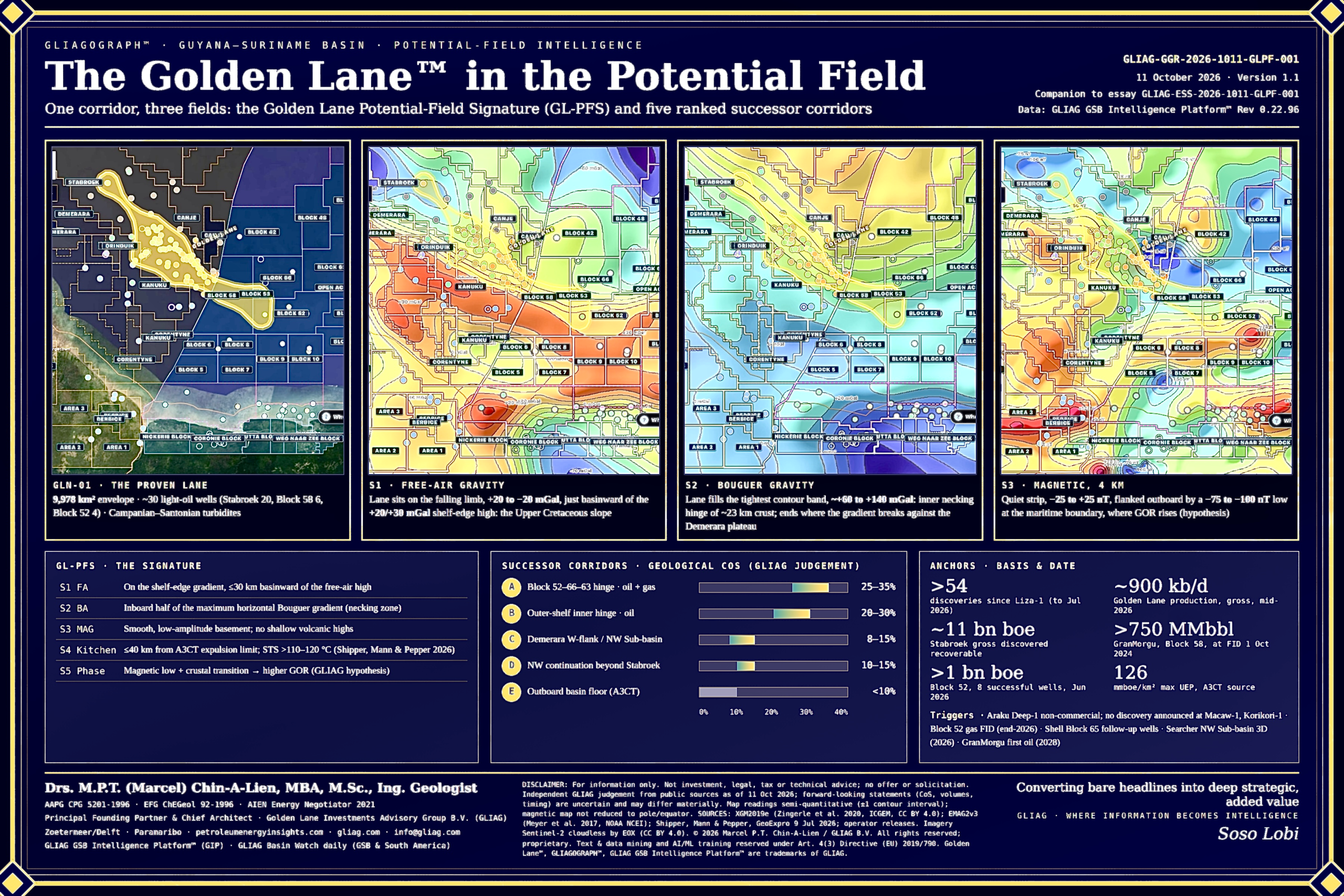
| Characterising and projecting the Guyana–Suriname Basin light-oil fairway from free-air gravity, Bouguer gravity and magnetic anomalies By Drs. M.P.T. (Marcel) Chin-A-Lien, MBA, M.Sc., Ing. Geologist AAPG Certified Petroleum Geologist Nr. 5201-1996 · EFG Chartered European Geologist Nr. 92-1996 · AIEN Energy Negotiator (June 2021) Principal Founding Partner, Managing Partner & Chief Architect, Golden Lane Investments Advisory Group B.V. (GLIAG) |
ID: GLIAG-ESS-2026-1011-GLPF-001 · Version 1.1 · 11 October 2026 · Public Strategic Edition · GLIAGOGRAPH™: GLIAG-GGR-2026-1011-GLPF-001
| The finding. The Golden Lane™ has a measurable potential-field address. On the three regional grids loaded in the GLIAG GSB Intelligence Platform™ (XGM2019e free-air and Bouguer gravity; EMAG2v3 magnetics upward-continued to 4 km), the 9,978 km² Golden Lane envelope (layer GLN-01), which holds about 30 light-oil wells, occupies one and the same corridor in every layer: immediately basinward of a +20 to +30 mGal free-air shelf-edge high, inside the steepest band of the seaward-rising Bouguer gradient, and over a magnetically quiet strip that is flanked outboard by a −75 to −100 nT low. GLIAG names this triple coincidence the Golden Lane Potential-Field Signature (GL-PFS). Read against the 2026 full-lithosphere basin model of Shipper, Mann and Pepper, the GL-PFS marks the inner crustal-necking hinge of a 23 km-thick, non-volcanic, obliquely rifted margin, where Upper Cretaceous slope fans sit within about 40 km of a mature Albian–Turonian kitchen. Where the Bouguer gradient swings north-north-east around the 25–30 km-thick Demerara volcanic plateau, the Golden Lane ends as a contiguous trend and its successor plays begin. Screening the basin for GL-PFS analogues yields five corridors. GLIAG ranks the Block 52–66–63 hinge first (judgement: geological chance of success 25–35%, mixed oil and gas) and the outboard Albian–Turonian basin floor last (below 10%). |
Key findings
1. Location.
In all three potential-field layers the Golden Lane sits on a gradient, never on a high or a low.
Free-air: the upper-to-lower slope band between about +20 and −20 mGal. Bouguer: the tightest contour band, about +60 to +140 mGal (reading, ±20 mGal).
Magnetic: a smooth 0 to +25 nT strip at 4 km, with the strongest outboard low (−75 to −100 nT) centred on the Guyana–Suriname maritime boundary.
2. Meaning.
The gradients trace the inboard half of a crustal-necking zone that a 3D gravity inversion presented at the 2022 EAGE Guyana–Suriname conference resolved as a 167 to 74 km taper with a ~4° top-basement slope.
That hinge concentrated slope accommodation, heat flow and fan delivery in one strip.
3. Termination.
The Golden Lane’s south-eastern lobe (Blocks 53 and 52) ends exactly where the steep NW–SE Bouguer gradient breaks up against the thicker crust of the Demerara plateau.
The basin model of Shipper et al. (July 2026) places the end of the Albian–Turonian (A3CT) oil-expulsion fairway in the same blocks.
4. Phase. The magnetic low at the Golden Lane’s bend coincides with the modelled crustal transition and with the high-GOR window near the maritime boundary (Haimara gas-condensate;
Pluma gas). GLIAG treats this as a testable phase indicator, not a rule.
5. Where next.
Five GL-PFS analogue corridors are ranked in Section 6.
The live trigger is Petronas’s Block 52 gas FID, targeted by end-2026.
Outside the lane, the 2025–26 wells have tightened the screen: Araku Deep-1 (Block 65) found no commercially viable hydrocarbons, and no discovery has been announced at Macaw-1 (Block 64) or Korikori-1 (Block 5).
6. Decision use.
The GL-PFS is a first-pass screen that costs nothing to run and can be rerun after every well.
It ranks acreage before 3D seismic money is committed. It does not replace seismic, AVO or basin modelling.
1. Why potential fields, and why now
The Golden Lane is no longer a hypothesis.
Since Liza-1 in May 2015 it has been established by more than 54 discoveries and production has risen to about 900,000 bbl/d, according to the 9 July 2026 GeoExpro study by Shipper, Mann and Pepper.
ExxonMobil and partners carry the Stabroek gross discovered recoverable resource at about 11 billion oil-equivalent barrels (JPT).
In Suriname, TotalEnergies took FID on GranMorgu on 1 October 2024: Sapakara and Krabdagu, over 750 million barrels recoverable, a 220,000 bbl/d FPSO, about US$10.5 billion, first oil in 2028 (TotalEnergies release).
In June 2026 Petronas reported eight successful wells in Block 52 and more than 1 billion boe discovered (The Edge Malaysia).
The open question is extension, not existence.
Shipper et al. note that recent Suriname wells away from the established trend have failed to find commercial petroleum, and Staatsolie is offering an open-door round over more than 70,000 km² in five offshore sectors (The Edge Malaysia).
Every bidder therefore faces one question: which undrilled kilometres carry the Golden Lane’s geological DNA?
Gravity and magnetic grids answer a narrower question very cheaply.
They do not detect oil.
They map the crustal architecture that controls subsidence, heat flow and sediment routing, and they cover the whole basin with public, citable data. Seismic answers the trap question.
Potential fields answer the corridor question: where does the system architecture that built the Golden Lane repeat?
The author first named this fairway the Golden Lane in 2008, seven years before Liza-1 (see Decoding the Golden Lane and Transformational Potential of Block 52).
This essay gives the name a geophysical definition.
2. Data and method
All observations below come from four layers of the GLIAG GSB Intelligence Platform™ (GIP), Rev 0.22.96 of 9 October 2026, read on screen as stepped colour classes with black contours.
Values are quoted to the nearest contour and carry an uncertainty of about one contour interval.
They are semi-quantitative readings, not grid extractions.
| GIP layer | Dataset and source | Grid and resolution | Contours / range in window | Role in this study |
| GRV-01 Free-air | XGM2019e_2159 (Zingerle et al. 2020; ICGEM, CC BY 4.0) | 301×251, 2′ (~4 km), 62–50°W, 2–12°N | 10 mGal; −175.2 to +152.9 mGal | Shelf break, slope, margin geometry |
| GRV-01 Bouguer | XGM2019e_2159 (ICGEM conventions; density [VERIFY GIP setting]) | 301×251, 2′ (~4 km) | 20 mGal; −175 to +344.3 mGal | Crustal thinning, necking zone, Moho trend |
| MAG-01 Magnetic | EMAG2v3 upward-continued to 4 km (Meyer, Saltus & Chulliat 2017, NOAA NCEI) | 361×301 | 25 nT; −275.4 to +288 nT; not reduced to pole | Basement fabric, volcanic crust, segment boundaries |
| GLN-01 Golden Lane | GLIAG interpretive envelope, Rev 0.22.51 | Polygon, 9,978 km² | ~30 light-oil wells: Stabroek 20, Block 58 6, Block 52 4 | Reference corridor (JUDGEMENT, not an official boundary) |
Table 1. Data used. All grids are displayed with Gaussian smoothing of about 9 km; cursor and profile tools use the unsmoothed grid.
Two properties of XGM2019e matter for interpretation.
Offshore, its short wavelengths come from DTU13 satellite-altimetry gravity at 1′; onshore, wavelengths beyond degree 719 are modelled from topography (Zingerle et al. 2020).
Offshore readings are therefore reliable at the 10–20 km scale; onshore detail is low-confidence and is used here only qualitatively.
EMAG2v3 at 4 km altitude suppresses shallow sources, so the magnetic map speaks about basement and deep crust.
At the basin’s latitude (about 6–9°N) the geomagnetic inclination is low:
Paramaribo sits at 14.7°N geomagnetic and 4.9°N corrected-geomagnetic latitude (ISGI, IGRF-13 epoch 2020.5), which implies a dip of roughly 10–28°, so anomaly shapes are shifted and partly inverted relative to their sources.
Every magnetic statement below is made with that caveat.

Figure 1. GIP base map with the GLN-01 Golden Lane envelope (9,978 km²), licence blocks, wells coloured by fluid, and sanctioned-discovery bubbles. Source: GLIAG GSB Intelligence Platform™ Rev 0.22.96, 9 Oct 2026; Sentinel-2 cloudless by EOX (CC BY 4.0).
3. Locating the Golden Lane on three maps
3.1 Free-air gravity: the slope behind the shelf-edge high
The free-air map is dominated by a NW–SE positive belt of +20 to +30 mGal that runs 20–40 km wide beneath the Orinduik and Kanuku blocks, south-west of the Golden Lane. North-east of it the field falls to −40 to −50 mGal beneath northern Canje and Block 64.
The Golden Lane envelope lies on the falling limb between them: its north-western half straddles the 0 to −20 mGal contours, and its south-eastern lobe in Blocks 53 and 52 sits on a +10 to +20 mGal saddle where the belt bends east.

Figure 2. Free-air gravity anomaly (XGM2019e_2159), contours every 10 mGal, with the GLN-01 envelope. Colour scale −80 to +40 mGal. Source: GIP layer GRV-01.
This is the classic edge-effect couplet of a passive-margin shelf break: a mass excess on the shelf edge and a deficit at the foot of the slope.
The Golden Lane therefore occupies the slope domain immediately basinward of the shelf-edge high.
That matches the drilling record: OilNOW, summarising the Canje partners, notes that most discoveries offshore Guyana have been made in the slope environment, while Canje uniquely also contains basin-floor terrain (OilNOW).
3.2 Bouguer gravity: the steepest step of the necking zone
Once the water layer is replaced by rock density, the Bouguer anomaly rises steadily north-eastward, from about 0 to +40 mGal over the shelf to more than +200 mGal beneath Canje, Block 42 and Block 48.
The Golden Lane envelope coincides with the tightest band of 20 mGal contours on the whole map, at about +60 to +140 mGal.
In Suriname the contours fan out and turn north-north-east between Blocks 66 and 63, while Blocks 52, 15, 14, 9 and 10 stay low, at about +20 to +60 mGal.

Figure 3. Bouguer gravity anomaly (XGM2019e_2159), contours every 20 mGal, with the GLN-01 envelope. Colour scale −80 to +320 mGal. Source: GIP layer GRV-01.
A seaward-rising Bouguer gradient of this size records crustal thinning and a shallowing Moho.
Its steepest band is the necking zone. A 3D gravity inversion of marine satellite gravity, constrained by refraction data and presented at the First EAGE Guyana–Suriname Basin Conference, resolved a tapered necked zone of 167 to 74 km with an average top-basement gradient of about 4°, supporting a rifted-passive origin (EarthDoc proceedings).
The Golden Lane lies on the inner half of that taper. Its south-eastern termination falls where the steep NW–SE gradient breaks up against the low-Bouguer Demerara plateau, whose crust is about 25 km thick at its western margin (Shipper et al. 2026) and about 30 km thick on the plateau itself, with a high-velocity lower crust and thick seaward-dipping reflectors (Museur et al., MARGATS).
3.3 Magnetic anomaly at 4 km: a quiet strip with a loud neighbour
The north-western half of the Golden Lane overlies a smooth corridor of 0 to +25 nT.
Its north-eastern flank drops across closely spaced contours into an elongate low of −75 to −100 nT centred near the Guyana–Suriname maritime boundary, beneath south-eastern Canje, north-western Block 58 and western Block 66. A second broad low of −50 to −100 nT covers Blocks 48, 63 and 64.
The south-eastern lobe sits on −25 to 0 nT next to a +75 to +100 nT high at the Block 52–15 boundary. Onshore and along the coast, the Guiana Shield produces high-amplitude anomalies of up to +125 nT.

Figure 4. Magnetic anomaly, EMAG2v3 upward-continued to 4 km, contours every 25 nT, with the GLN-01 envelope. Colour scale −175 to +125 nT; not reduced to pole. Source: GIP layer MAG-01.
Three readings follow, each labelled by confidence.
First (moderate confidence): the quiet strip says the Golden Lane rests on deep, weakly magnetic basement without shallow volcanic sheets, consistent with a non-volcanic, obliquely rifted segment.
Second (moderate): the +75 to +100 nT high at the Block 52–15 boundary sits on the western edge of the Demerara volcanic margin, where MARGATS imaged seaward-dipping reflector sequences (Museur et al.).
Third (low, a hypothesis): the strong low at the Golden Lane’s bend coincides with the crustal transition that Shipper et al. place across the maritime boundary, and with the high-GOR window there (Pluma gas; Haimara, about 63 m of gas-condensate-bearing sandstone, per OE Digital).
If the low marks thicker, more granitic and more radiogenic crust, it is also a phase indicator. At low inclination, a reduction-to-equator or analytic-signal transform is required before this can be relied on.
3.4 The Golden Lane Potential-Field Signature (GL-PFS)
Combining the three layers with the kitchen limits of Shipper et al. gives a five-part signature.
GLIAG proposes it as a screening template for the whole margin from Venezuela to French Guiana.
| Element | Golden Lane reading (GIP) | Geological meaning | Screening rule |
| S1 Free-air | −20 to +20 mGal on the falling limb, within ~30 km basinward of the +20 to +30 mGal shelf-edge high | Upper Cretaceous slope behind the shelf break | On the shelf-edge gradient, never on the high or the deep low |
| S2 Bouguer | +60 to +140 mGal, tightest 20 mGal contour band | Inner half of the necking zone; ~23 km crust | Inboard half of the maximum horizontal Bouguer gradient |
| S3 Magnetic (4 km) | Smooth −25 to +25 nT; outboard low of −75 to −100 nT | Deep non-volcanic basement; segment boundary outboard | Quiet strip; avoid high-amplitude volcanic highs |
| S4 Kitchen | Within ~40 km of the A3CT expulsion limit; STS above 110–120 °C | Short lateral and vertical charge distance | Inside a modelled oil-expulsion window |
| S5 Phase modifier | Magnetic low + crustal transition = higher GOR (hypothesis) | Radiogenic heat raises thermal stress | Expect gas-condensate where S3 low meets crustal transition |
Table 2. GL-PFS. Readings are semi-quantitative (±1 contour interval). S4 from Shipper, Mann & Pepper (GeoExpro, 9 Jul 2026). S5 is a GLIAG hypothesis.
4. Geological meaning: the hinge where heat, mud and sand meet
The signature is not a coincidence of colours.
Each element maps one of the three conditions that the Golden Lane needed.
The first is a kitchen. Organofacies B marine mudstones in the Aptian–Lower Albian and the Upper Albian–Cenomanian–Turonian (A3CT) intervals reach 15.8 wt% TOC and a hydrogen index of 730 mg HC/g TOC, giving an ultimate expellable potential of up to 126 mmboe/km² (Shipper et al. 2026).
The Canje Formation is the Cenomanian–Turonian equivalent of Trinidad’s Naparima Hill Formation (Staatsolie Vision 2030 paper, Netherlands Journal of Geosciences). The A3CT oil-expulsion window extends across Blocks 52 and 58 but its outboard limit lies only about 40 km north of the Golden Lane.
The second condition is heat in the right amount.
Shipper et al. attribute the along-strike GOR pattern (low GOR at Liza, rising to vapour-phase accumulations near the maritime boundary, falling again at GranMorgu) to burial depth combined with radiogenic heat from more granitic crust.
Their modelled expelled oil peaks at 24 mmbo/km² beneath the present outer shelf near Block 52 and falls to 6–8 mmbo/km² near Liza. The Bouguer and magnetic maps are the only basin-wide, public datasets that image that crustal variation directly.
The third condition is sand on the slope. Santonian–Campanian canyons tied to faults and major rivers fed sand-rich slope and basin-floor fans (Bartok, Oropeza & Campbell, AAPG), and bottom currents may have shaped the updip limit of the Golden Lane reservoirs (GeoExpro).
Deeper Turonian–Santonian reservoirs retain quality at greater burial than the shallower Campanian–Maastrichtian (EAGE 2022).
The free-air shelf-edge gradient (S1) marks where that sand left the shelf.
The necking hinge (S2) is where subsidence created room for it and where the kitchen sat close enough to charge it.
The author’s companion essays develop the structural hinge argument (Insights into Suriname’s Offshore Hydrocarbon Accumulations) and the AVO expression of the same reservoirs (Decoding the Golden Lane).
5. Benchmarks: the proven Golden Lane in numbers
Any new corridor must be judged against the trend that already works. Table 3 collects the anchors, each with unit, basis, date and source.
| Anchor | Value | Basis and date | Source |
| GLN-01 envelope | 9,978 km² | GLIAG interpretive polygon, Rev 0.22.51 | GIP (JUDGEMENT) |
| Light-oil wells inside envelope | ~30 | Stabroek 20, Block 58 6, Block 52 4 | GIP GLN-01 |
| Discoveries since Liza-1 | More than 54 | Count to July 2026 | Shipper et al. |
| Golden Lane production | ~900,000 bbl/d | Gross, mid-2026 | Shipper et al. |
| Stabroek discovered resource | ~11 bn boe | Gross discovered recoverable, operator estimate | JPT |
| GranMorgu (Block 58) | More than 750 MMbbl; 220,000 bbl/d; ~US$10.5 bn | Recoverable reserves at FID, 1 Oct 2024; first oil 2028 | TotalEnergies |
| Block 52 | 8 successful wells; more than 1 bn boe | Operator statement, June 2026 | The Edge |
| Sanctioned discovery volumes | 445 to 925 MMbbl per record | Gross recoverable oil, 100% project, at FID; 8 records, compiled 5 Aug 2026 | GIP |
| Source quality | TOC ≤15.8 wt%; HI ≤730; UEP ≤126 mmboe/km² | Rock-Eval and Staatsolie Atlas 2025 compilation | Shipper et al. |
| Screening yield (GLIAG) | 0.5 to 1.0 MMboe/km² (P50 to P10) | ~11 bn boe ÷ 9,978 km² = 1.1 MMboe/km² upper bound; part of the Stabroek resource lies outside GLN-01 | GLIAG JUDGEMENT |
Table 3. Golden Lane anchors. Volumes are gross and mix reserves and resources as stated by each source; they are not additive.
6. Where next: five GL-PFS analogue corridors
Applying S1–S5 to the GIP window produces five corridors.
Areas are GLIAG map readings (±25%).
The indicative unrisked volume is area × screening yield and is shown only to make the corridors comparable.
Chance of success (CoS) is a GLIAG judgement of geological success for a first well, not a commercial probability.
| Rank | Corridor (blocks) | GL-PFS match | Evidence for | Main risk | Phase | CoS (judgement) | Indicative unrisked volume |
| A | Block 52–66–63 hinge, east and north of the GL lobe | S1 ✓ · S2 partial (gradient fans NNE) · S3 mixed · S4 ✓ (Aptian to Blocks 63/64) | 8 Block 52 successes; Roystonea-2 DST confirmed oil productivity (Jun 2026) | Vertical migration loss; volcanic-margin edge | Oil and gas | 25–35% | ~1,500 km² × 0.2–0.5 = 300–750 MMboe |
| B | Outer-shelf inner hinge: western Block 52, north edges of Blocks 6 and 8, outboard Kanuku–Corentyne | S1 shelf side · S2 low–moderate · S3 noisy · S4 ✓ (shelfal expulsion peak) | Caiman-1 oil in 90 m water, TD 5,065 m (Jun 2026); 24 mmbo/km² expulsion peak | Trap and seal on the shelf; biodegradation updip | Oil | 20–30% | ~2,000 km² × 0.1–0.3 = 200–600 MMboe |
| C | Demerara western flank and NW Sub-basin (Blocks 63, 64, 65, open acreage) | S2 on the NNE limb · S3 low · S4 Aptian only | Aptian oil window 120 km into Blocks 63/64; Searcher MC3D planned 2026 | Reservoir (Araku-1 2017 lacked reservoir-quality rock; Araku Deep-1 non-commercial); charge reach | Oil (Aptian), gas | 8–15% | Not quantified; Araku Deep-1 non-commercial (2026) |
| D | North-west continuation beyond Stabroek | S1 ✓ · S2 ✓ · S3 low (−100 nT) | Gradients continue NW | Declining expulsion volume at NW charge front; above-ground access | Oil | 10–15% geological | Not quantified (access) |
| E | Outboard basin floor: north Canje, Kaieteur, deep Blocks 42/48/64 | S1 deep low · S2 beyond hinge · S4 outside A3CT limit | Aptian deep targets only | Canje 0 for 3 commercial; Kaieteur Tanager-1 non-commercial | Gas-prone or dry | Below 10% (A3CT) | Downgraded |
Table 4. GLIAG ranking of GL-PFS analogue corridors, 11 Oct 2026. Sources in text.
Corridor A, the Block 52–66–63 hinge, ranks first because it is the only corridor with S1 and S4 both satisfied and a live operator campaign.
Petronas reports eight successful wells, including Caiman-1, the Swartzia Aspasia Complex-1 gas find 8 km east of Sloanea-1 and the Roystonea-2 appraisal 7 km north of Roystonea-1 (Ghana Upstream; Brazil Energy Insight).
Sloanea-1 found hydrocarbons in Campanian sandstones at a TD of 4,780 m in 2020 (Petronas).
The Aptian expulsion window reaching Blocks 63 and 64 gives this corridor a second, deeper charge source. Its weakness is phase: three of the eight Block 52 results carry gas.
Corridor B, the outer-shelf inner hinge, is the low-cost option. Shipper et al. place the A3CT expulsion maximum beneath the present outer shelf near Block 52 and argue that this shelfal sweet spot charged about 1 billion barrels in Suriname’s coastal heavy-oil fields by updip migration.
Caiman-1, drilled in 90 m of water, found several oil-bearing Cretaceous sandstone intervals. The potential-field expression is the shelf side of S1 and the low side of S2. The risk moves from charge to trap and seal.
Chevron’s Korikori-1 in shallow-water Block 5 (30–45 m) tested an inboard extension of the Upper Cretaceous play and was drilled in 2025 with no discovery announced (Staatsolie); it lies inboard of Corridor B and marks its landward limit until well data are released.
Corridor C, the Demerara western flank, is the largest prize and the least proven.
Searcher plans multi-client 3D in the NW Sub-basin in 2026 to test a Golden Lane extension in Upper Cretaceous sands (GeoExpro).
Wood Mackenzie assigned about 300 mmboe each to Macaw-1, Korikori-1 and Araku Deep-1 (OilNOW).
The original Araku-1 (2017) was abandoned without significant reservoir-quality rock, and Goliath Voltzberg North-1 showed Aptian-sourced oil without commercial accumulation (see the author’s Macaw-1 essay).
The 2025–26 tests have since reported. Shell’s Araku Deep-1, which targeted deeper horizons in Block 65, did not encounter commercially viable hydrocarbons (Caribbean Energy Week).
Macaw-1 tested a carbonate play west of the Demerara plateau to a planned TD of 5,180 m (Westwood via Offshore);
Staatsolie lists it as drilled in 2025 with no discovery announced (Staatsolie). GLIAG therefore lowers Corridor C from 10–20% to 8–15%.
Shell holds approval for up to four Block 65 wells, so the corridor stays open but is now a deep-reservoir problem, not a charge problem.
Corridor D follows S1 and S2 north-west of Stabroek, but Shipper et al. read the north-western edge of the charge fairway as a decline in expulsion volume from the distal offshore.
Above-ground access adds a separate constraint that this essay does not price.
Corridor E is downgraded on evidence. Bulletwood-1 (2,846 m of water, TD 6,690 m), Jabillo-1 and Sapote-1 (2,549 m of water, TD 6,758 m) in Canje all found non-commercial hydrocarbons (OilNOW), and Tanager-1 in Kaieteur was non-commercial as a standalone development (OilNOW).
All lie on the free-air low and outboard of the S2 hinge.
| GIP FORMAT: ANSWER → BASIS → UNCERTAINTY → WHAT WOULD CHANGE THE VIEWAnswer. The next Golden Lane-type barrels are most likely in Corridor A (Block 52–66–63 hinge), then B (outer shelf). C remains the high-impact option but was weakened by Araku Deep-1.Basis. GL-PFS match (Tables 2 and 4); A3CT and Aptian kitchen limits (Shipper et al., Jul 2026); eight Block 52 successes to Jun 2026; three non-commercial Canje wells; Araku Deep-1 non-commercial; no announced discovery at Macaw-1 or Korikori-1.Uncertainty. Corridor A CoS 25–35%; B 20–30%; C 8–15%; D 10–15%; E below 10%. Readings ±1 contour interval; magnetic interpretation unreduced at low inclination.What would change the view. An oil discovery in Shell’s follow-up Block 65 wells, or released Macaw-1 data showing live oil, lifts C back toward 15–20%. A gas-only outcome on the next Block 52 wells shifts A toward gas commercialisation. An RTE-transformed magnetic map without the boundary low removes S5. |
7. From observation to decision
For operators and farm-in candidates.
The GL-PFS ranks acreage before seismic money is spent.
In Corridors A and B the order of work should be a regional 3D gravity inversion tied to wells, then targeted 3D seismic with AVO screening, then basin-model calibration.
Staatsolie has already received two proposals for Sector 3 Demerara of its open acreage (Ghana Upstream), which places Corridor C acreage in play now.
For governments.
Suriname’s open-door offer covers more than 70,000 km². A tiering of that acreage by GL-PFS strength gives the state a defensible basis for differentiated signature bonuses and work programmes, and supports the National Pre-FID Gate doctrine: rank first, license second, sanction third. For Guyana, the same screen identifies which relinquished or undrilled ground still deserves a second look.
For investors.
Four dated triggers will move valuations on this margin: the Block 52 gas FID, targeted by end-2026 with first gas around 2030 (Brazil Energy Insight); Shell’s follow-up wells in Block 65; Searcher’s 2026 NW Sub-basin 3D;
and GranMorgu first oil in 2028. TotalEnergies’ purchase of a 25% stake in Block 53, next to GranMorgu (Caribbean Energy Week), shows where one major is placing capital: inside the GL-PFS, close to infrastructure.
Each one either confirms or breaks an element of the GL-PFS. GLIAG’s daily Basin Watch newsletters track these triggers, and the screen behind this essay is rerun in the GLIAG GSB Intelligence Platform™ as each well result posts.
8. Uncertainty and limits of the method
• Potential-field interpretation is non-unique. The same anomaly can come from different density or magnetisation distributions; only joint modelling with seismic and refraction constraints removes that ambiguity.
• Readings are taken from smoothed (~9 km) display grids at about 4 km native resolution. They resolve corridors of 10–20 km, not prospects.
• Offshore free-air gravity is altimetry-derived; onshore XGM2019e detail above degree 719 is topography-modelled and should not be used for onshore prospect work.
• The Bouguer density convention used by GIP should be stated and tested [VERIFY]; a 2,670 kg/m³ slab over-corrects deep water on thinned crust.
• EMAG2v3 offshore coverage is uneven, and the map is not reduced to pole or equator. Polarity-dependent statements (S5) are hypotheses.
• GL-PFS is calibrated on one trend. Its transfer to Venezuela or French Guiana assumes a similar margin type, which the Demerara plateau shows is not guaranteed.
Recommended next steps, in order of cost:
(1) reduction-to-equator, analytic-signal and tilt-derivative transforms of MAG-01;
(2) isostatic-residual and horizontal-gradient maps of GRV-01;
(3) a 3D gravity inversion for Moho and top basement, constrained by MARGATS refraction;
(4) coupling of crustal thickness to the basin model’s radiogenic heat term;
(5) 2.5D profiles (GIP tool PRF-01) across each corridor, tied to wells.
9. Related GLIAG research
• Decoding the Golden Lane: Seismic Breakthroughs in Guyana (May 2025): Class III AVO and the 2008 origin of the Golden Lane name.
• Insights into Suriname’s Offshore Hydrocarbon Accumulations: structural hinge zones and slope-parallel corridors as Golden Lane preconditions.
• Transformational Oil & Gas Potential of Petronas’ Block 52 in Suriname’s Golden Lane: Block 52 production profiles.
• AI-Driven Seismic Reprocessing in Suriname: TotalEnergies’ Macaw-1 Insights: the eastern Golden Lane, GVN-1 and Araku-1.
• Evaluating Offshore Hybrid Potential in the GSB: Frack or Not?: the ACT source complex and the Golden Lane union zone.
• Guyana–Suriname Awakening Timeline and Switi Sranan Offshore: From Blank Map to Black Gold: discovery chronology and field map.
• Guyana’s Petroleum Renaissance and Guyana’s Oil Boom 2015–2025: national context.
• GLIAG-ESS-2026-035-GM, When a Vision Became Geology, Contract and Nation (GranMorgu, 22 Aug 2026);
GG-2026-033-GM, Forty Years on One Desk; GLIAG-GSB-2026-0819-001, From 300 Billion Barrels Generated to the Barrels We Can Actually Produce. All at petroleumenergyinsights.com.
10. References
1. Shipper, K., Mann, P. & Pepper, A. (2026). Spatial variation in charge risk along the Guyana–Suriname margin. GeoExpro, 9 July 2026. geoexpro.com
2. Zingerle, P., Pail, R., Gruber, T. & Oikonomidou, X. (2020). The combined global gravity field model XGM2019e. Journal of Geodesy 94:66. doi:10.1007/s00190-020-01398-0; dataset doi:10.5880/ICGEM.2019.007
3. Meyer, B., Saltus, R. & Chulliat, A. (2017). EMAG2v3: Earth Magnetic Anomaly Grid (2-arc-minute resolution). NOAA NCEI. doi:10.7289/V5H70CVX
4. Museur, T., Graindorge, D., Klingelhoefer, F., Roest, W., Basile, C., Loncke, L. et al. Deep structure of the Demerara Plateau: from a volcanic margin to a Transform Marginal Plateau (MARGATS). HAL insu-03685400
5. EAGE (2022). First EAGE Guyana–Suriname Basin Conference, proceedings (3D gravity inversion; reservoir quality with burial). EarthDoc
6. Staatsolie authors (2016). Staatsolie’s Vision 2030: the contributions of petroleum geology to Surinamese society. Netherlands Journal of Geosciences. Cambridge Core PDF
7. Bartok, P., Oropeza, S. & Campbell, C. Tectonic, sedimentation and hydrocarbon habitat of the Great Guyana–Suriname Offshore Basin: the Albian to Coniacian play. AAPG presentation. aapg.org
8. Searcher (2026). Inside every basin you know is another basin you haven’t met: Suriname’s NW Sub-basin. GeoExpro, 17 March 2026. geoexpro.com
9. GeoExpro. Have bottom currents defined the Golden Lane and determined updip prospectivity? geoexpro.com
10. Yang, W. & Escalona, A. (2011). Basin modelling and source rock evaluation in the Guyana Basin. First Break 29(10). doi:10.3997/1365-2397.2011030
11. ISGI. Paramaribo (PAB) observatory: geomagnetic coordinates, IGRF-13 epoch 2020.5. isgi.unistra.fr
12. Caribbean Energy Week (2026). Suriname’s offshore oil momentum builds (Araku Deep-1; TotalEnergies 25% in Block 53). caribbeanenergyweek.com
13. Staatsolie (2025). Staatsolie ends 2025 strong (Macaw-1, Caiman-1, Korikori-1 drilled). staatsolie.com
14. Westwood Global Energy via Offshore Magazine (2025). Macaw-1 carbonate test, planned TD 5,180 m. offshore-mag.com
15. TotalEnergies (1 Oct 2024). Final Investment Decision for the GranMorgu development on Block 58. Business Wire
16. JPT. Stabroek Block bounty off Guyana gets bigger (≥11 bn boe). jpt.spe.org
17. PETRONAS (11 Dec 2020). Hydrocarbon discovery in Block 52 (Sloanea-1). petronas.com
18. The Edge Malaysia (June 2026). Petronas Block 52: eight discoveries, more than 1 bn boe; Staatsolie open-door round over 70,000 km². theedgemalaysia.com
19. Ghana Upstream (7 Jul 2026). Petronas adds oil, gas discoveries in Block 52 (Caiman-1, SAC-1, Roystonea-2). ghanaupstream.com
20. Brazil Energy Insight (31 Aug 2026). The eight wells driving PETRONAS’ Block 52 plans. brazilenergyinsight.com
21. OilNOW. Eco says Canje Block remains highly prospective (Bulletwood-1, Jabillo-1, Sapote-1). oilnow.gy; post-drilling analysis Canje and Kaieteur oilnow.gy
22. OE Digital. ExxonMobil’s third well in Canje disappoints (Sapote-1; Haimara 63 m gas-condensate). oedigital.com
23. Staatsolie (5 May 2025). Macaw-1 first of five offshore exploration wells in 2025. staatsolie.com
24. OilNOW. Suriname’s 2025 exploration wells targeting 900 million boe (Wood Mackenzie). oilnow.gy
ABOUT THE AUTHOR
Drs. M.P.T. (Marcel) Chin-A-Lien, MBA, M.Sc., Ing. Geologist is Principal Founding Partner, Managing Partner and Chief Architect of Golden Lane Investments Advisory Group B.V. (GLIAG). Born in Willemstad, Curaçao, in 1950 and trained at Leiden University, he has nearly five decades of international petroleum experience, including first-entrant and new-venture positions in the former USSR, Hungary and across Africa, Production Sharing Contract negotiation, and co-discovery of the Ceuta giant field in Lake Maracaibo. He co-authored the 1986 Talukdar–Gallango–Chin-A-Lien paper on Maracaibo Basin generation and migration, worked with Staatsolie in Paramaribo in 2008–2010 on Suriname’s PSC and offshore promotion, and originated the term Golden Lane for the Guyana–Suriname fairway in 2008.
AAPG Certified Petroleum Geologist Nr. 5201-1996 · EFG Chartered European Geologist Nr. 92-1996 · AIEN Energy Negotiator (June 2021).
GLIAG
Golden Lane Investments Advisory Group B.V. (GLIAG) · Zoetermeer / Delft, the Netherlands · Paramaribo, Suriname · petroleumenergyinsights.com · www.gliag.com · info@gliag.com · GLIAG GSB Intelligence Platform™ (GIP) · GLIAG Basin Watch (GSB and South America editions)
DISCLAIMER AND LEGAL NOTICE
1. No advice. This essay is published for information and professional discussion only. It is not investment, legal, tax, engineering or financial advice, and must not be relied on as such. Readers should obtain independent professional advice before acting.
2. No offer or solicitation. Nothing in this essay constitutes an offer, invitation or solicitation to buy or sell any security, licence interest, asset or service, or to enter into any transaction, in any jurisdiction.
3. Independence of analysis. The analysis is the independent professional judgement of the author and GLIAG, based on public sources and GLIAG’s own interpretation as of the date shown. GLIAG has no mandate from, and receives no compensation from, any operator, partner or government named. Statements labelled JUDGEMENT, hypothesis or [VERIFY] are explicitly marked as such.
4. Forward-looking statements. Statements about prospectivity, chance of success, volumes, timing, FIDs and production are forward-looking, involve material risks and uncertainties, and may differ materially from outcomes. Third-party figures are quoted as published and have not been independently audited. GLIAG undertakes no obligation to update this essay.
COPYRIGHT, PROPRIETARY RIGHTS AND AI/ML OPT-OUT
© 2026 Marcel P.T. Chin-A-Lien / Golden Lane Investments Advisory Group B.V. (GLIAG). All rights reserved. Essay GLIAG-ESS-2026-1011-GLPF-001, Version 1.1, 11 October 2026. This essay, its tables, the Golden Lane Potential-Field Signature (GL-PFS) and the corridor ranking are proprietary intellectual property of GLIAG. Reproduction, redistribution or adaptation, in whole or in part, requires prior written permission, except brief quotation with full attribution and a link to the original.
Text and data mining reservation. Pursuant to Article 4(3) of Directive (EU) 2019/790 on copyright in the Digital Single Market, and to Article 15o of the Dutch Copyright Act (Auteurswet), the rightsholder expressly reserves all rights to text and data mining of this work, including use for training, fine-tuning or evaluating artificial-intelligence or machine-learning systems. No such use is permitted without a written licence.
Trademarks. Golden Lane™, GLIAGOGRAPH™, GLIAG GSB Intelligence Platform™, Sovereign Molecule™, Sovereign Conversion Capacity™ and Caribbean Gas Arc™ are trademarks of GLIAG. Third-party names, datasets and marks belong to their owners. Map screenshots: GLIAG GSB Intelligence Platform™; base imagery Sentinel-2 cloudless by EOX IT Services GmbH (CC BY 4.0, contains modified Copernicus Sentinel data 2016); gravity XGM2019e_2159 via ICGEM/GFZ (CC BY 4.0); magnetics EMAG2v3, NOAA NCEI.
Converting bare headlines into deep strategic, added value
GLIAG · WHERE INFORMATION BECOMES INTELLIGENCE
Soso Lobi
GLIAG-ESS-2026-1011-GLPF-001 · © 2026 M.P.T. Chin-A-Lien / GLIAG B.V. · Proprietary ·